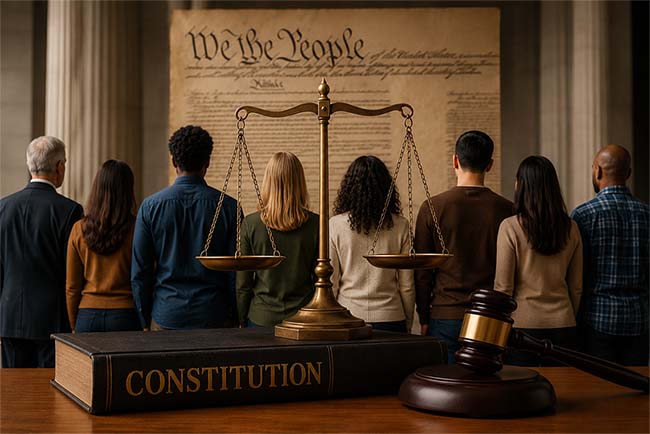
The Constitution should protect every American under the same standard of justice
by the El Reportero staff
The U.S. Supreme Court’s recent decision not to hear U.S. v. Donte J. Carter may appear, at first glance, to be just another procedural action. In reality, the refusal to review the case prompted a powerful dissent from Justices Samuel Alito and Clarence Thomas that raises an important constitutional question: Should the law apply differently depending on a person’s race?
That question deserves careful consideration because the answer affects every American, regardless of political beliefs or ethnic background.
The case involved a police encounter in Washington, D.C., during which officers eventually discovered a stolen handgun after stopping Donte J. Carter. The D.C. Court of Appeals ruled that Carter had been unlawfully seized before police had reasonable suspicion to detain him. In reaching that conclusion, the court reasoned that Carter’s race was relevant because Black Americans, based on historical experiences with law enforcement, may reasonably perceive police encounters differently than members of other racial groups.
The Supreme Court declined to review that ruling. However, Justices Alito and Thomas strongly disagreed with allowing that reasoning to stand without further examination.
Their concern extends beyond one defendant or one criminal case. It centers on a much larger constitutional principle.
America’s legal system has long been built upon the belief that justice should be impartial. Courtrooms display symbols reminding judges, juries, and citizens that justice is blind. The ideal has always been that the law evaluates facts and conduct—not race, ethnicity, religion, wealth, or political affiliation.
That principle has never been perfectly achieved. Our nation’s history contains undeniable examples of discrimination, unequal treatment, and shameful abuses of constitutional rights. Those injustices should neither be ignored nor forgotten.
But acknowledging history does not necessarily require creating different constitutional standards for different racial groups.
Supporters of the D.C. court’s reasoning argue that courts cannot ignore the reality that many Black Americans have experienced difficult relationships with law enforcement. They believe judges should recognize those experiences when determining whether a reasonable person would have felt free to leave during a police encounter.
Yet recognizing history is different from allowing race itself to alter constitutional protections.
The Constitution promises equal protection of the laws to every citizen. That promise loses much of its meaning if identical police conduct is judged by different legal standards depending on the race of the individual involved.
The danger identified by Justices Alito and Thomas is that once courts begin creating race-based constitutional rules, there is no obvious stopping point.
If one rule applies to Black Americans, should another apply to Hispanic Americans?
Should there be different standards for Asian Americans, Native Americans, Middle Eastern Americans, Pacific Islanders, or individuals of mixed heritage?
Would police officers be expected to determine a person’s racial identity before deciding whether ordinary constitutional standards apply?
Such a system would create uncertainty not only for law enforcement officers but also for judges, prosecutors, defense attorneys, and citizens themselves.
Perhaps most importantly, it risks moving the nation away from treating individuals as individuals.
Every person is unique. Two people of the same race may have very different life experiences and attitudes toward law enforcement. Assuming that all members of a racial group think or react alike replaces individual judgment with broad generalizations.
Ironically, America’s civil rights movement fought for decades to eliminate exactly those kinds of assumptions.
The objective was not to create separate legal standards for different races but to ensure equal treatment under one Constitution.
The phrase “equal justice under law,” engraved on the front of the Supreme Court building, reflects that aspiration. It does not promise different justice depending upon race or ethnicity. It promises that every citizen stands equally before the law.
This does not mean courts should ignore genuine discrimination or tolerate unconstitutional police conduct. When officers violate constitutional rights, they should be held accountable regardless of the race of the victim. Likewise, every person accused of a crime deserves the full protection of the Constitution.
Those protections belong equally to everyone.
A legal system that begins dividing constitutional protections according to race, even with good intentions, risks creating new forms of unequal treatment while attempting to correct old ones.
The goal should never be preferential treatment for one group or diminished protection for another. The goal should be equal justice for all Americans.
Our country is strongest when constitutional rights are universal rather than conditional.
The law should neither favor nor disadvantage anyone because of race. It should judge citizens according to their actions, protect their constitutional rights equally, and hold government officials to the same legal standards in every case.
America’s diversity is one of its strengths. Our legal system should protect every citizen equally—not by creating different constitutional rules for different groups.
Equal justice under law remains one of the nation’s highest ideals. It is an ideal worth preserving, not only for today’s generation, but for every American who will depend upon the Constitution in the years ahead.
– Sources: Supreme Court filings in U.S. v. Donte J. Carter; dissent by Justices Samuel Alito and Clarence Thomas; public court records.