by Marvin Ramírez
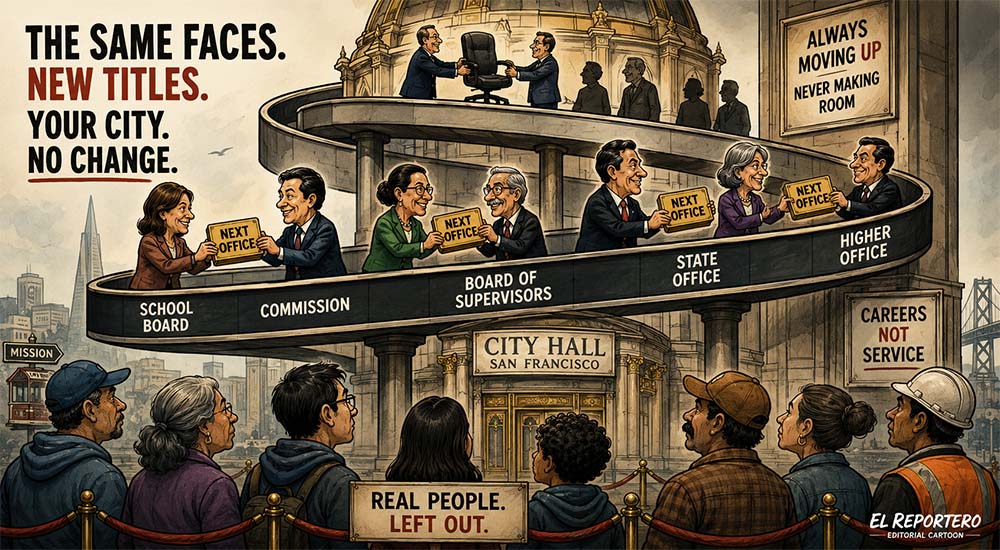
San Francisco was once governed largely by citizens who temporarily stepped into public office, served their communities, and eventually returned to private life. Today, many residents increasingly feel they are watching something very different: the emergence of a permanent political class that circulates power within the same interconnected circles year after year.
The names may change, but often the faces remain familiar. One official leaves a position for higher office, and another from the same political network rises to replace them. Staffers become commissioners. Commissioners become supervisors. Supervisors move into state offices or other influential positions, while allies and protégés inherit the vacancies left behind. The process repeats itself so frequently that many voters have begun questioning whether San Francisco’s government still functions as a system of citizen representation or whether it has evolved into a self-sustaining political ecosystem.
This concern is not limited to one ideology or one faction. Political machines have existed throughout American history in both liberal and conservative cities alike. The issue is not whether politicians are progressive or moderate, but whether public office slowly becomes detached from ordinary life and transformed into a professional governing career.
San Francisco’s Board of Supervisors itself reflects part of this transformation. Decades ago, the position was generally viewed closer to part-time public service. Supervisors maintained stronger connections to private-sector employment and everyday life outside City Hall. Over time, however, the role evolved into a fully professionalized, full-time political career with significantly higher salaries, larger staffs, and expanded political influence.
Supporters argue that complex modern government requires full-time leadership and experienced officials. There is truth to that argument. Running a major city requires knowledge, organization, and long-term planning. Institutional experience can help maintain continuity in policy and administration.
But there is also a growing public concern that professionalized politics creates unintended consequences. When governing becomes a long-term career path, incentives begin to change. Public office risks becoming less about temporary civic duty and more about maintaining political influence, building alliances, protecting networks, and securing future advancement within government itself.
For ordinary residents, this can create a sense of distance from the people elected to represent them. A working-class resident, small-business owner, teacher, mechanic, immigrant parent, or independent community advocate may look at City Hall and feel that entering public office without insider connections has become increasingly difficult. Campaigns are expensive. Endorsement systems are powerful. Political consultants, nonprofit organizations, donor networks, and institutional alliances often shape who becomes “viable” long before voters cast ballots.
The result is a growing perception that political succession is increasingly managed from within the same circles of influence.
That perception alone is dangerous for democracy.
Public trust depends not only on elections, but on the belief that government remains genuinely open to new voices and independent leadership. When residents begin to feel that offices are passed from one insider to another, confidence in democratic institutions slowly erodes.
Recent debates surrounding proposed term-limit measures and veteran political figures have once again exposed this broader frustration. While disagreements over specific politicians may dominate headlines, the deeper issue extends beyond any individual officeholder. Many voters are questioning whether San Francisco’s political culture has become too insulated, too interconnected, and too resistant to renewal.
This does not mean experience has no value. Cities benefit from knowledgeable leadership. But democratic systems also require healthy turnover, fresh perspectives, and leaders whose lives remain rooted in experiences outside government institutions.
Public office was never intended to become an exclusive professional ladder climbed by the same interconnected networks for decades. The purpose of local government is not to create a permanent governing class. It is to administer services, protect public safety, maintain infrastructure, and responsibly manage taxpayer resources on behalf of residents.
Government functions best when elected officials remain closely connected to the realities faced by ordinary people who live outside political circles.
San Francisco still possesses extraordinary civic energy, creativity, and public engagement. But preserving that democratic spirit requires more than elections alone. It requires openness. It requires political humility. And it requires recognizing that no city benefits when power becomes concentrated within a small and recurring governing establishment.
The city does not belong to political insiders. It belongs to its residents.
Democracy renews itself when leadership remains accessible to citizens from all walks of life — not only to those already standing inside the halls of power.
-With references to recent public reporting on San Francisco term-limit proposals.