An experience with sixth-grade students demonstrates how scientific observation can foster respect for biodiversity and help us reflect on our own prejudices

by Sebastián Alberto Chiapella
Natural Sciences teacher at the Schönthal Institute in Buenos Aires, Argentina
What do many children do when they find a spider, an ant or another small creature in their home? The response is often immediate: kill it. This is not necessarily an act of cruelty. Rather, unfamiliar creatures can provoke fear and be perceived as a threat.
This reaction became the starting point for “Knowing Leads to Respect,” a Natural Sciences workshop conducted with sixth-grade students at the Schönthal Institute in Buenos Aires, Argentina. The experience was designed to teach biology through the direct observation of small arthropods, while also conveying a broader lesson: before rejecting or judging something unfamiliar, we should try to understand it.
Fear before knowledge
Before entering the laboratory, I asked the students what they normally did when they found a “bug” in their homes. Many answered that they killed it because it frightened them or because they assumed it might sting or bite them.
That led to the question that would guide the entire activity: Do we really know these animals? Do we understand how they live, what they eat or whether they truly pose a danger?
The students’ silence revealed that much of their fear did not come from direct experience, but from ideas they had previously acquired. Arthropods therefore offered a familiar example of how people can form opinions before possessing sufficient knowledge.
During the following days, the students searched for small arthropods in gardens and green spaces. Before beginning, they received instructions on how to avoid harming the creatures and how to prepare ventilated containers with appropriate material inside. The activity was supervised and did not include handling potentially dangerous species. Students who were uncomfortable touching the specimens could participate by preparing the containers or assisting their classmates.
The purpose was not to force them to overcome their fears, but to allow each student to participate according to his or her comfort level.
Observing to discover
On the day of the workshop, the students arrived at the laboratory carrying the organisms they had collected. The specimens were carefully placed together in a terrarium so the observation could begin.
Using magnifying glasses and small brushes, the students gently moved the soil aside. Questions soon emerged: Why does this animal have antennae? Why does that one have eight legs? Do they all belong to the same group?
Without realizing it, the students had stopped asking whether the creatures should be killed. Now they wanted to know what they were and how they lived. Fear was beginning to give way to curiosity.
The activity continued with the laboratory’s entomological display boxes. There, students compared the organisms they had collected with preserved and identified specimens. What had initially been described simply as a “bug” began to acquire a name and a place within biological classification.
The students counted legs, looked for antennae and learned to distinguish among insects, arachnids and crustaceans. They compared a spider with a scorpion and discovered that the pill bug belongs to the crustacean group, despite living on land.
Biology was no longer merely a list of concepts. It had become a living experience. The students were no longer observing simply because their teacher instructed them to do so; they were observing because they wanted to discover more.
A world revealed through the microscope
The next step was to examine the arthropods with a digital microscope connected to a laboratory television. The enlarged images allowed students to observe legs, eyes, antennae and mouthparts in remarkable detail, further increasing their interest.
By recognizing the differences among the organisms, the students learned that finding an arthropod inside a home does not necessarily mean encountering a danger. Some species require caution, but many others perform important ecological functions and pose no threat to people.
The questions continued: Where do they live? Why do some emerge at night? Why do they hide when exposed to light?
Each answer produced another observation and reinforced the workshop’s central idea: understanding is more valuable than reacting solely out of fear.
The experience also allowed us to examine a common perception. We often think these animals are invading our spaces. However, cities, houses and gardens were built on environments where many species already lived. In numerous cases, arthropods are simply trying to survive and adapt to changes caused by human activity.
From arthropods to people
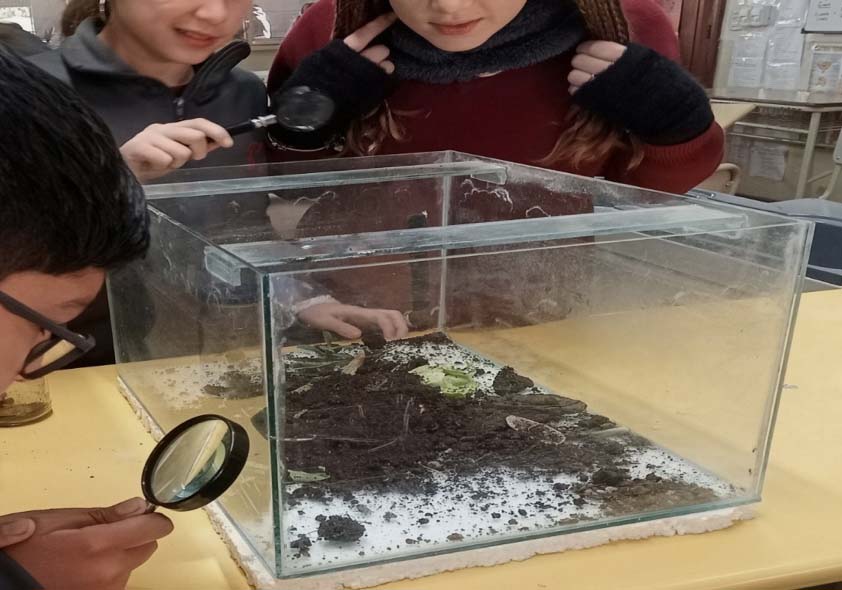
At the end of the activity, the specimens were carefully returned to the laboratory terrarium, where they could continue living in an appropriate environment. After observing and learning about them, treating them respectfully came naturally to the students.
We then returned to the opening question. The true purpose had not been limited to learning about arthropods. It was also to understand how knowledge can change the way we relate to other forms of life.
From that conclusion, we expanded the discussion to human relationships. We can also reject, criticize or exclude a person without first giving that individual an opportunity to show who he or she is. Some judgments are based on what we truly know, while others originate in our own ideas, fears or prejudices.
This comparison is not intended to equate people with animals. Rather, it highlights a shared principle: approaching, observing, listening and learning can help us overcome reactions rooted in unfamiliarity.
The students returned to their classrooms with new knowledge of the natural sciences, but also with a lesson that extended beyond the laboratory. They began that morning by observing small arthropods and finished by reflecting on respect, empathy and the importance of understanding before judging.
Science education does more than communicate information. When built upon observation, questions and direct experience, it can also help form more curious, thoughtful and respectful people.
References
Allport, G. W. (1954). The Nature of Prejudice. Addison-Wesley.
Musengimana, J., Kampire, E., and Ntawiha, P. (2022). “Effect of Inquiry-Based Learning on Students’ Attitude Toward Biology.” Journal of Baltic Science Education, 21(5), 848–861.
Shahriari-Namadi, M., Sharzad, K., Rezaee, R., and Vazirianzadeh, B. (2018). “Entomophobia and Arachnophobia Among School-Age Children: A Psychological Approach.” Shiraz E-Medical Journal, 19(7).
Soga, M., Gaston, K. J., Yamaura, Y., Kurisu, K., and Hanaki, K. (2016). “Both Direct and Vicarious Experiences of Nature Affect Children’s Willingness to Conserve Biodiversity.” International Journal of Environmental Research and Public Health, 13(6).