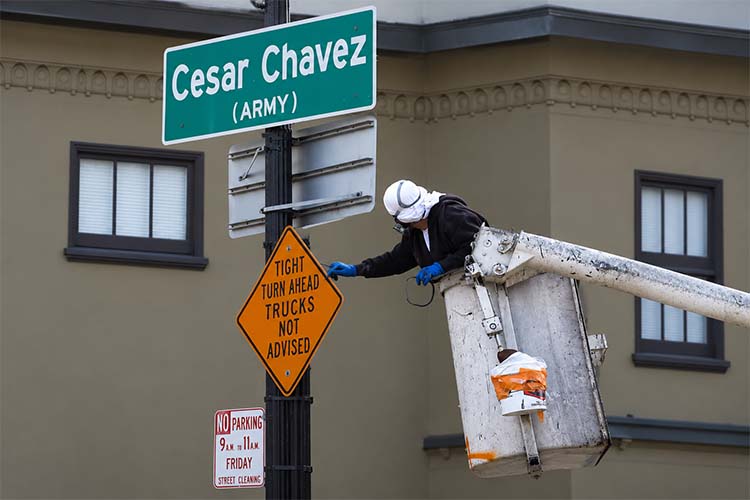
Hispanic business leaders propose an alternative as San Francisco advances a new street name, with a November hearing offering another opportunity for public input
by El Reportero staff
San Francisco’s effort to rename César Chávez Street is entering a critical stage, raising questions about community representation, historical recognition and whether alternative proposals can still influence a process that has already produced a preferred name.
On October 20, Supervisor Jackie Fielder introduced legislation proposing that the major thoroughfare be renamed Las Campesinas Street, honoring women whose contributions helped sustain California’s farmworker movement.
The proposal followed a months-long review by a 27-member working group established under Mayor Daniel Lurie and co-led by Assessor-Recorder Joaquín Torres and former Supervisor Susan Leal.
According to published reports, the group considered several alternatives and received more than 680 public responses before recommending Las Campesinas.
However, the recommendation has not ended the debate.
Carlos Solórzano-Cuadra, representing the Hispanic Chambers of Commerce of San Francisco and the Latin American & Caribbean Business Chamber of Commerce, submitted a letter proposing Avenida de las Américas as an alternative.
The proposal emphasizes the Mission District’s multicultural identity and the contributions of Latin American communities to San Francisco’s economic and cultural development.
Supporters of Las Campesinas argue that the name recognizes women farmworkers whose contributions have historically received less attention than those of prominent male labor leaders.
Others have questioned whether the selection process adequately reflects the preferences of residents and businesses directly affected by the change.
The controversy originated in March, when a New York Times investigation reported allegations that Chávez sexually abused women and girls decades earlier.
Dolores Huerta, who co-founded the United Farm Workers with Chávez, subsequently stated that she had experienced sexual coercion and assault involving him during the 1960s. Huerta also disclosed that two encounters with Chávez resulted in pregnancies and that both children were born and subsequently raised by other families. She also had a long-term relationship with Chávez’s younger brother, Richard Chávez, with whom she had four children.
Chávez died in 1993, approximately 33 years before the allegations became public in 2026, leaving him unable to respond. The disclosures prompted institutions and government officials to reconsider public honors associated with his name.
The timing of the revelations and the institutional response have also brought questions about historical accountability and public commemoration into the discussion. However, no verified evidence establishes that the allegations were disclosed as part of a coordinated political effort to influence the street-renaming process.
Meanwhile, the practical implications extend beyond historical symbolism.
Changing the name of a major San Francisco street would affect businesses, property owners and residents who may need to update addresses, records, signage and customer information.
The city’s legislative record identifies the proposed change as File 261159, currently pending before the Board of Supervisors’ Land Use and Transportation Committee.
In correspondence responding to the Chamber’s proposal, Fielder’s office identified a November 9 public hearing as another opportunity for community participation.
Although Las Campesinas remains the recommended name, additional municipal reviews and approvals are required before a final change can take effect.
The unresolved question is whether new proposals, including Avenida de las Américas, can receive substantive consideration during the remaining proceedings.
For the Mission District, the decision involves more than replacing street signs. It concerns how San Francisco recognizes its history, weighs competing community perspectives and ensures that public participation remains meaningful before a final decision is reached.
– Sources: San Francisco Board of Supervisors, File 261159; San Francisco Chronicle; KQED; The San Francisco Standard; ABC News; correspondence from Supervisor Jackie Fielder’s office and the Hispanic Chambers of Commerce of San Francisco.