by Yue Stella Yu, Kristen Hwang and Jeanne Kuang
CalMatters
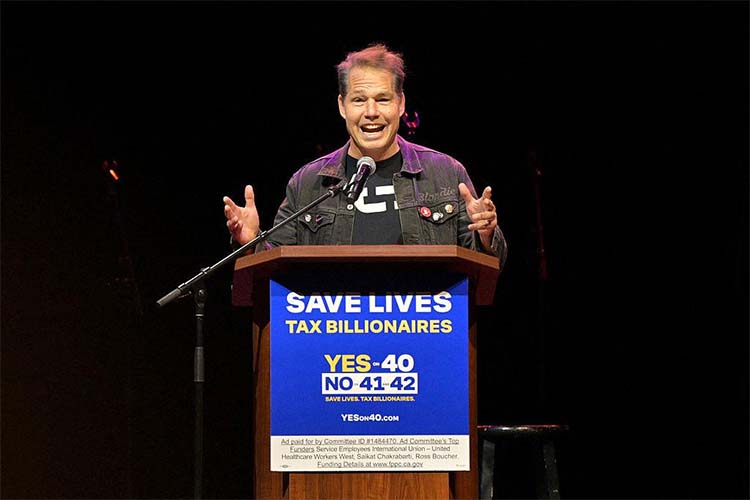
California billionaires not only defeated a proposal to impose the nation’s first tax on the assets of the wealthiest residents; they also won new protections that could make future attempts considerably more difficult.
Proposition 42, which prohibits new taxes on personal property such as business holdings, intellectual property and financial assets, was leading with 54 percent of the vote when nearly 60 percent of anticipated ballots had been counted. It was one of two measures backed by technology billionaires to counter Proposition 40, the proposed wealth tax.
California’s nonpartisan Legislative Analyst’s Office warned that Prop. 42 could limit lawmakers’ ability to raise revenue and reduce future state income, although the size of any loss remains uncertain. The restriction also complicates efforts by Democrats who support higher taxes on wealthy residents but disagreed with the design of Prop. 40.
Supporters of Prop. 42, including California Professional Firefighters and the Peace Officers Research Association of California, promoted the initiative as protection for pensions and retirement accounts. Billionaires provided roughly $159 million for the campaign, which also secured Gov. Gavin Newsom’s endorsement.
“These Californians backed the strongest protections available to protect their hard-earned life savings from double taxation,” said Nathan Click, spokesperson for the Yes on 42 campaign.
Opponents, led primarily by the Service Employees International Union-United Healthcare Workers West, called that argument misleading. They maintained that Prop. 40 would not have targeted ordinary retirement savings, except Roth IRA accounts containing more than $10 million.
Despite their defeat, wealth-tax advocates promised to continue the fight and bring the issue to the national stage.
“We’re going to call out these economic royalists. We’re going to tax them the way they need to be taxed, and we’re going to invest in Medicare for all and free childcare,” said Rep. Ro Khanna, a Santa Clara Democrat who supported the proposal.
Prop. 42 blocks new wealth taxes enacted through state law or constitutional amendments, but the restriction is not permanent. California voters could reverse it by approving another ballot measure.
“That’s not set in stone,” said Lorena Gonzalez, president of the California Labor Federation. “We have the ability to change things.”
Democrats hold supermajorities in both chambers of the Legislature, but efforts to tax assets have repeatedly stalled in committees since 2020. The new measure creates an additional obstacle for lawmakers seeking such a tax.
California faces mounting fiscal pressures following four consecutive years of budget deficits despite revenue growth. Shortfalls have contributed to healthcare cuts, suspended payments to schools and tax increases.
Federal reductions to Medicaid could increase pressure on Gov.-elect Xavier Becerra as patient advocates and health workers urge the state to replace lost federal funding. Becerra has said he is open to new taxes but opposed the billionaire-tax proposal.
Some Democratic lawmakers favor closing corporate tax loopholes and finding alternative revenue sources. Republicans counter that excessive state spending is the underlying problem.
State Sen. John Laird, a Santa Cruz Democrat and chair of the Senate Budget Committee, said he had not expected Prop. 42, designed to offset the billionaire tax, to pass on its own. He anticipates no immediate budget effect but wants lawmakers to examine possible unintended consequences.
Click argued that the measure leaves other options available, including taxes on business sales, corporate income, healthcare providers and insurance companies.
“Existing funding for schools, public safety, roads, healthcare, etc. is untouched by this measure,” he said.
But Kayla Kitson, senior policy analyst at the California Budget and Policy Center, warned about another provision: the prohibition on retroactive new taxes except during budget emergencies.
Governments sometimes backdate new taxes to the beginning of a tax year to discourage avoidance and raise money quickly. Kitson said the restriction could cost California several months of potential revenue during future fiscal difficulties.
The outcome leaves supporters of higher taxes on large fortunes facing a different political challenge: persuading voters to undo protections they have just approved at the ballot box.
Editor’s note: This article has been edited and shortened to fit available space.