by Marvin Ramírez
When Bill Maher, a man who openly says he is not a Christian, uses his national television platform to call attention to the killing of Christians in Nigeria, perhaps it is time for the rest of the world to listen.
Maher recently spoke about the enormous violence suffered by Christian communities in Nigeria and asked a question that deserves an answer: Where are the protests?
His point should trouble anyone who believes that human rights are universal. We have watched demonstrations erupt around the world over wars, racial injustice, police violence and political causes. Young people fill streets and university campuses when they believe innocent people are suffering. Yet the prolonged slaughter, kidnapping and displacement of Christians in Nigeria rarely produces anything approaching that level of international outrage.
Why?
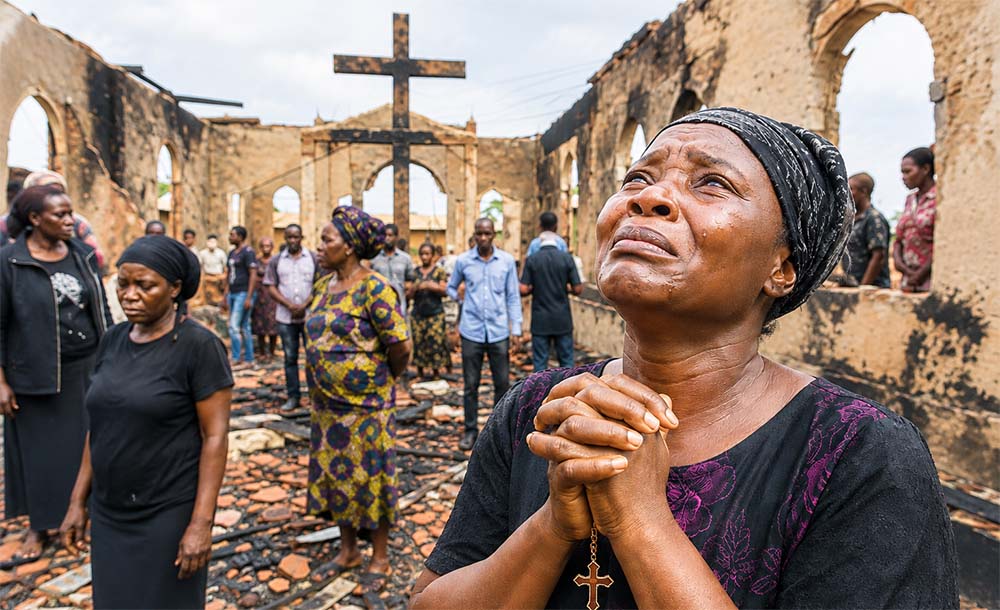
Nigeria is one of Africa’s most important nations, with more than 200 million people and a population divided largely between Christians and Muslims. For years, the country has faced horrific violence from Boko Haram, the Islamic State West Africa Province and other armed extremists. Churches have been attacked. Worshippers have been murdered. Priests and pastors have been kidnapped. Villages have been destroyed and families driven from their homes.
The U.S. Commission on International Religious Freedom has repeatedly described Nigeria’s religious-freedom conditions as extremely serious. Human-rights organizations have also documented killings, kidnappings and attacks involving extremist organizations, armed groups and conflicts between farming and herding communities.
We should be careful with numbers circulating on social media. Some posts claim that more than 100,000 Christians have been killed and thousands of churches destroyed. Those exact figures are disputed and difficult to independently verify.
But arguing about a number must never become an excuse for ignoring the dead.
One murdered person because of his faith is one too many.
There is another distinction that must be made. This is not an indictment of every Muslim. Millions of Muslims reject terrorism, and Muslims themselves have been murdered by Boko Haram and other Islamist extremists. Nigerian Muslim leaders have joined Christian leaders in condemning religious violence.
That distinction, however, cannot require silence about the ideology invoked by extremists who murder in the name of religion.
When Boko Haram attacks Christians, burns churches or terrorizes communities while claiming religious justification, we should have the courage to identify the fanaticism behind those crimes. Calling religious extremism by its name is not hatred. Hatred is murdering a neighbor because he worships differently.
Christians are not perfect, and Christianity’s history, like the history of other great religions and civilizations, contains violence and injustice. But Christians living peacefully in Nigerian villages today are not responsible for wars fought centuries ago. A mother praying inside a church does not deserve to die because someone considers her faith unacceptable.
Neither does a Muslim praying in a mosque.
That should be the principle uniting all decent people.
Religious freedom cannot mean defending only religions we like. If Muslims are persecuted for being Muslims, Christians should defend them. If Jews are attacked for being Jews, Christians and Muslims should defend them. And when Christians are hunted, kidnapped or murdered because they are Christians, secular people and followers of other religions should defend them too.
That is why Maher’s intervention matters. Here is a prominent secular commentator effectively asking why people who constantly speak about oppression have so little to say about persecuted Christians.
It is a fair question.
The answer cannot be selective compassion. Human rights lose their meaning when outrage depends upon the identity of the victim or the politics of the perpetrator.
Nigeria needs security, accountability and cooperation between peaceful Christians and Muslims. Its government must protect vulnerable communities and prosecute killers regardless of their religion, ethnicity or political connections. International institutions must also stop treating persecution of Christians as an uncomfortable subject.
Peace will never come from pretending fanaticism does not exist.
The world should condemn every ideology that teaches human beings to hate, persecute or kill their neighbors over faith. Christians, Muslims, Jews, atheists and everyone else should be able to agree on that.
And if Bill Maher, who is not a Christian, can speak for Nigeria’s persecuted Christians, the rest of us have no excuse for remaining silent.