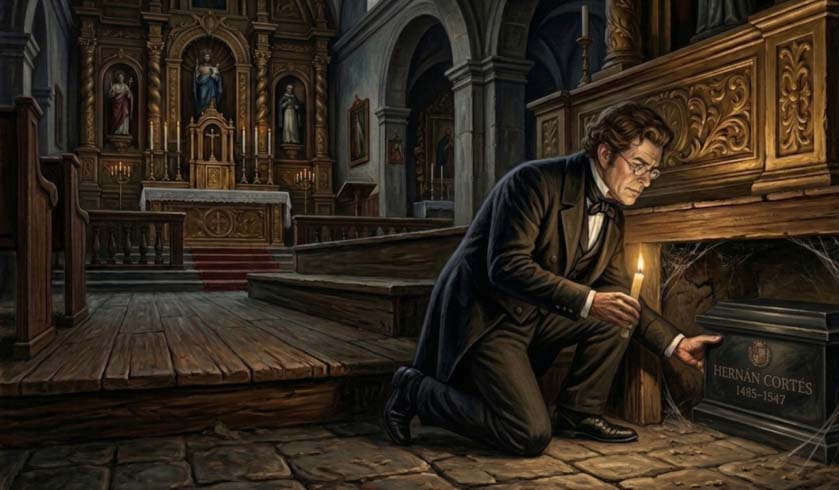
Did you know that conservative politician Lucas Alamán hid the remains of Hernán Cortés so they would not be destroyed by a popular uprising during September 15, 1823?
by México Desconocido
Hernán Cortés, the conqueror of Mexico-Tenochtitlan, is a controversial figure. During his lifetime, as a hidalgo, he provoked the disdain of several of his contemporaries, including his own monarch, Emperor Charles V. One could say that he was never truly able to fully enjoy the recognition he believed he deserved for his military campaigns. After his death, his remains underwent several itinerant burials between Spain and New Spain over the course of many decades. Thus, shortly after the consummation of Mexico’s independence, conservative historian Lucas Alamán hid the remains of Hernán Cortés so they would not be destroyed by popular anger.
A Death in Dishonor
The Extremaduran Hernán Cortés was in Spain around the year 1540. In Iberian lands, he was trying to resolve the legal disputes against him, the famous residency trials, opened in 1526 by order of Emperor Charles V himself. Although all of his military enterprises had been carried out in the name of the Crown and the emperor, the scandals surrounding him were enormous. Therefore, the monarch wanted Cortés’ administration as governor of New Spain to be judicially reviewed.
The Marquis of the Valley of Oaxaca had lost the favor of the imperial court, which always considered him untrustworthy for being a hidalgo, that is, a member of the lower nobility. In 1541, during the disastrous Algiers campaign in which he participated, he was even ignored by Emperor Charles. Without prestige, dishonored and financially ruined, the conqueror of Mexico-Tenochtitlan died on December 2, 1547. His death occurred in the palace of Alonso Rodríguez, a friend of his, in Castilleja de la Cuesta, Seville. Immediately afterward, his body was placed in the Monastery of San Isidoro del Campo, in the crypt of the family of the Duke of Medina Sidonia.
A Conqueror in Constant Relocation
However, during his lifetime Hernán Cortés had designated different destinations for his burial. First, he wished to be buried in the church of the Hospital de Jesús Nazareno in Mexico City; afterward, he wanted his remains to rest in the town of Coyoacán. Finally, shortly before his death, he instructed that he be buried wherever he happened to die. It appears that his final wish was to be buried in a convent in Coyoacán, but that never happened. All of this explains why his body traveled from one place to another.
Cortés’ remains were moved to a nearby altar only a few years after his burial, in 1550. However, in 1566, his family had them transferred to New Spain and deposited in what is now the Cathedral of Texcoco. Later, following the death of Pedro Cortés, the conqueror’s last descendant, in 1629 the remains were moved to the church of the Great Convent of San Francisco in Mexico City. There they rested until 1794, when they were transferred to the main altar of the church of the Hospital de Jesús Nazareno, the site that Cortés himself founded in 1524 and where he first met the huey-tlatoani Moctezuma Xocoyotzin in 1519.
Lucas Alamán Hid Hernán Cortés’ Remains
Nevertheless, the remains of the former Marquis of the Valley of Oaxaca would not find rest. In 1810, Mexico’s War of Independence began. By 1821, the struggle had finally concluded and the historical process had been completed, freeing the young nation from Spanish rule. Amid the turbulence of that era, a historian began to stand out: Lucas Alamán. Besides being a great scholar, he was also a prominent conservative politician. Born in Guanajuato in 1792, he witnessed the storming of the Alhóndiga de Granaditas in 1810, a reason why he always opposed the ideas of Miguel Hidalgo.
By 1823, Alamán was the administrator of the Mexican assets of Hernán Cortés’ heirs, who lived in Italy. At that time, the atmosphere throughout the country, particularly in Mexico City, was hostile toward the former Spanish authority and its symbols. This was reason enough for Cortés’ heirs to take the conqueror’s monument to Palermo. This sculpture served as the tomb in the church of the Hospital de Jesús.
During several disturbances that took place in the nation’s capital, it was believed that the conqueror’s bones rested in the aforementioned Italian city. However, in reality they remained in Mexico City. In fact, they never left the church of the Hospital de Jesús. Secretly, Lucas Alamán hid the remains of Hernán Cortés with the help of the chapel’s priest. He carried this out on the night of September 15, 1823, just as the Independence celebrations were turning into genuine popular uprisings. The historian hid the funerary urn beneath the platform of the main altar of that religious site.
The Zeal of a Conservative Historian
Thanks to the actions of Lucas Alamán, Hernán Cortés’ remains managed to escape popular fury. They remained hidden for 13 long years. Once tensions began to subside, the conservative historian arranged for them to be placed in a niche in the church in 1836. Because he served as minister in several republican governments, he managed to secretly protect the funerary urn. Likewise, he kept the Spanish embassy informed of the exact location where it was kept.
However, with Alamán’s death in 1853, the trail of Cortés’ remains was lost. It would not be until 1946 that they were located again, thanks to the efforts of a group of Mexican scholars.