by the El Reportero staff
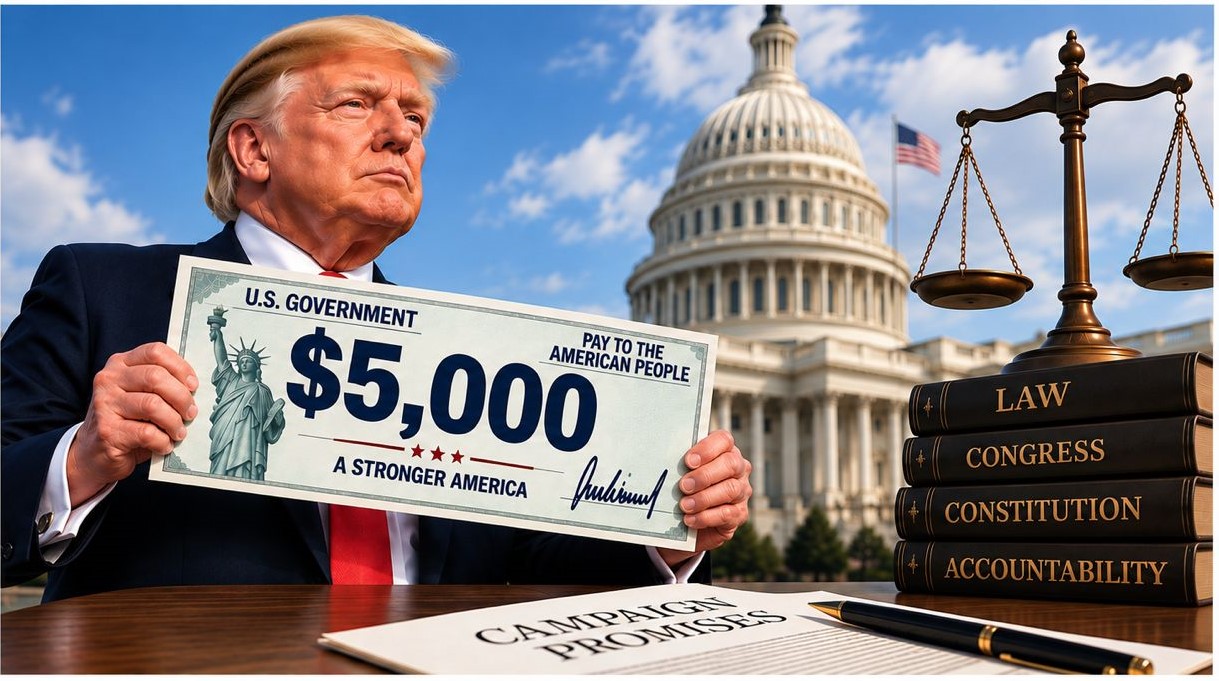
President Donald Trump has put a striking proposition before American voters: If Republicans retain control of both chambers of Congress in the November midterm elections, American adults could receive a $5,000 “dividend.”
The proposal immediately raises two separate questions. Can the government actually finance payments of that magnitude? And if Republicans win Congress, is Trump legally obligated to deliver the money?
The second question has a relatively straightforward answer: generally, no. A campaign promise is normally not an enforceable contract between a politician and individual voters.
Contracts require legal elements such as offer, acceptance and consideration, as well as an intention to create a binding obligation. Political promises — whether involving taxes, Social Security, health care or government payments — generally do not create personal contracts with voters.
Therefore, someone who votes Republican after hearing Trump’s $5,000 proposal ordinarily could not sue Trump personally for $5,000 if the payments never materialize.
But that doesn’t mean the proposal should be dismissed.
Trump announced the dividend at the GOP’s midterm convention and tied it to Republicans maintaining control of the House and Senate. The proposal would reportedly distribute approximately $1.2 trillion among roughly 270 million American adults.
The administration also argues that the money would not necessarily come from taxpayers or additional deficit spending.
Commerce Secretary Howard Lutnick has said the government could generate the money Trump wants to distribute. Among the potential sources he cited is the proposed Trump Platinum Card, an immigration initiative under which applicants would pay substantial fees and contributions to the U.S. government.
Lutnick has said more than 100,000 people are interested in the program and argued that it could generate hundreds of billions of dollars. He also pointed to gains associated with the federal government’s investment in Intel as another potential source of revenue.
White House National Economic Council Director Kevin Hassett has separately suggested that funding for the dividend could emerge through a congressional reconciliation package.
Those arguments are important because they provide the administration’s explanation of how Trump believes the promise could be fulfilled. Whether those projected revenues would actually produce enough money to finance approximately $1.2 trillion in payments is another question.
And skepticism is not confined to Democrats.
Florida Gov. Ron DeSantis, a Republican, has criticized the proposal because of the nation’s growing debt. DeSantis warned against borrowing another trillion-plus dollars and injecting it into the economy, arguing that doing so could generate additional inflation.
The disagreement illustrates why the financing question and the legal question should not be confused.
Even if the administration identifies sufficient revenue, a president does not possess unlimited authority to take federal money and distribute it to Americans. Congress controls federal appropriations, meaning lawmakers would play an essential role in authorizing a program of this magnitude.
There is another question because Trump explicitly connected the payments to Republican victory: Is that buying votes?
Federal law prohibits paying or offering payment to an individual in exchange for voting. “Vote for me and I will personally give you $100” would present a dramatically different legal situation.
A general campaign proposal for a government benefit, however, has traditionally been treated differently. Democrats and Republicans routinely campaign on tax cuts, credits, subsidies and government programs that could financially benefit voters.
The Supreme Court addressed an important aspect of this distinction in Brown v. Hartlage in 1982, emphasizing constitutional protection for political campaign speech. Promising a government policy that financially benefits voters is not automatically equivalent to purchasing individual votes.
Trump is also hardly the first president to promise something he cannot accomplish without Congress. Presidents routinely campaign on legislation that ultimately requires lawmakers’ approval.
That is why journalism should apply the same standard regardless of who occupies the White House.
The press should neither dismiss Trump’s $5,000 proposal simply because it comes from Trump nor tell Americans that $5,000 checks are guaranteed. The administration’s financing argument deserves to be reported, and so do the legal, congressional and economic obstacles.
Ultimately, voters can judge the promise themselves.
A campaign promise may not be an enforceable contract. But politicians of every party should expect their words to be remembered and compared with what they eventually deliver.
That isn’t partisan politics.
It is accountability.