by the El Reportero staff
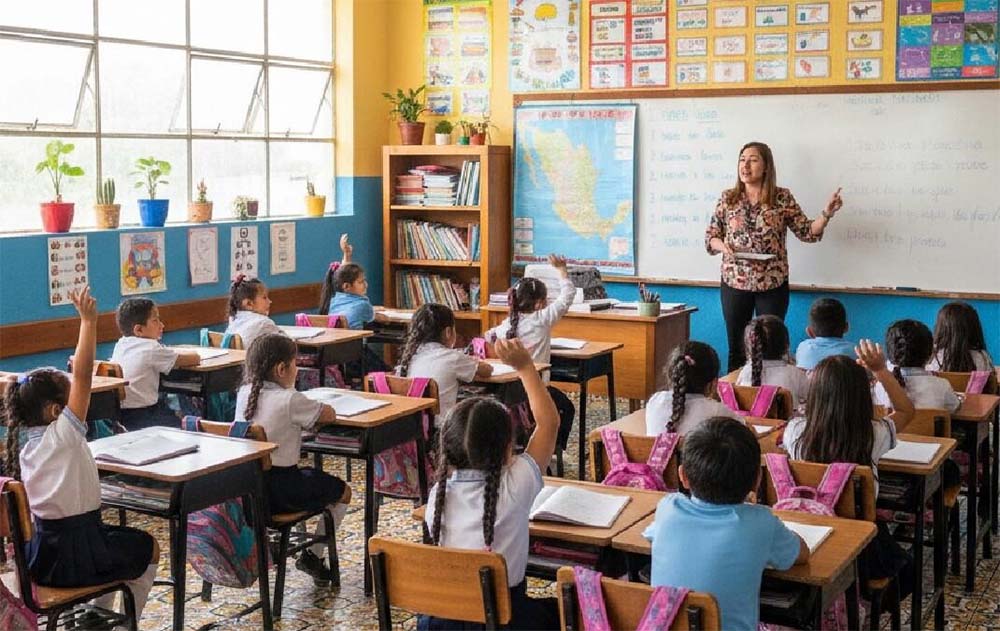
Mexico is preparing to restrict cellphone and tablet use in primary and secondary schools nationwide beginning in late October, joining California in a growing effort to reduce digital distractions in classrooms and encourage students to focus more on learning and face-to-face interaction.
Mexican Education Minister Mario Delgado announced Sept. 21 that federal and state education authorities had reached an agreement to restrict the devices. The measure, pending final approval by President Claudia Sheinbaum, is expected to take effect 30 days after it is formally issued, placing implementation around the end of October.
The announcement follows a survey of more than half a million Mexican teachers in which 81 percent supported guidelines and rules for the safe educational use of electronic devices, according to Mexico News Daily.
Delgado said the measure is intended to protect children’s mental health and learning while strengthening attention, human contact and community. At the high-school level, individual institutions will determine limitations allowing responsible educational use.
California students are already experiencing similar restrictions.
Gov. Gavin Newsom signed the Phone-Free School Act in September 2024, requiring every school district, charter school and county office of education to adopt a policy limiting or prohibiting smartphone use by July 1, 2026.
That means students returning to California classrooms in August entered the first school year following the statewide deadline, although the rules are not identical at every school. The law gives local education agencies flexibility in designing their policies.
In San Francisco, district policy allows students to possess cellphones but requires mobile devices to be turned off and put away during instructional time, including passing periods. Exceptions are permitted for emergencies, teacher-authorized educational use, medical needs and requirements contained in a student’s individualized education program.
Some San Francisco schools have gone further.
Herbert Hoover Middle School requires phones, smart watches and Bluetooth headphones to remain off and out of sight from the beginning of the school day until dismissal. Mission High School describes its classrooms as “cell phone free zones,” while ER Taylor Elementary requires phones to remain turned off in backpacks or be given to teachers for safekeeping.
Experience at San Francisco schools that adopted stricter policies before California’s statewide deadline provides an early look at how students respond.
At Thurgood Marshall Academic High School, students initially resisted having their phones unavailable throughout the school day. But students and teachers later reported changes in the school environment, including more face-to-face conversations, greater productivity during free periods and more interaction during lunch and breaks.
One student told the San Francisco Standard that without his phone he began looking up and seeing his friends instead of looking down at a screen. Teachers also reported spending less classroom time policing cellphone use.
Not every reaction has been positive. Some students have expressed concern that phones provide a sense of security, particularly during emergencies. Others say phones can serve as a social lifeline for students who have difficulty interacting with classmates.
Those concerns are reflected in California law, which preserves students’ ability to use devices during emergencies or perceived threats of danger and for specified health and educational needs.
The debate also extends beyond whether students are simply paying attention in class. Supporters argue that reducing cellphone access can encourage young people to talk, socialize and participate in school activities rather than spend breaks scrolling through social media.
The experience is still evolving. Even within San Francisco, enforcement varies by school, and individual campuses can establish rules stricter than the districtwide standard.
Mexico will soon begin its own nationwide experiment. Its approach differs from California’s decentralized system, but both policies reflect the same increasingly urgent question confronting educators and families: how much access to smartphones should children have during the school day?
For students in California, that debate has already moved from legislation into the classroom. For millions of Mexican students, the same transition is expected to begin in late October.
– This article includes reporting from Mexico News Daily, the California Governor’s Office, SFUSD and local Bay Area news sources.