
by Marvin Ramírez
Mexico has embarked on an extraordinary national experiment: every cellphone line in the country is being tied to an identifiable person.
The government calls it a security measure. We believe it raises a much larger question: How much privacy should an entire population surrender in the search for criminals?
The program is no longer theoretical. Mexico’s Comisión Reguladora de Telecomunicaciones (CRT) is enforcing registration according to the final digit of prepaid cellphone numbers. Numbers ending in zero reached their deadline Aug. 15; those ending in one have until Aug. 31, with subsequent numbers following through Dec. 31. Unregistered lines are suspended until their owners identify themselves.
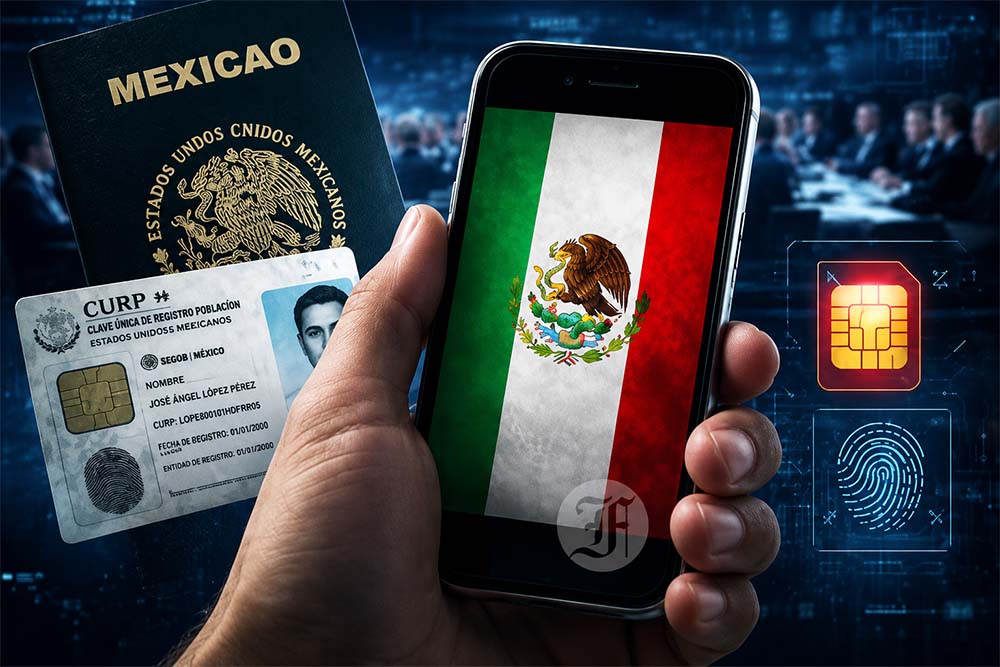
To register, a mobile line must be associated with a person’s identity and CURP. The government says the telephone companies—not the government—retain the identifying information.
President Claudia Sheinbaum says the objective is straightforward: combat telephone extortion and fraud.
And there is no question that Mexico has a serious crime problem.
INEGI’s National Survey of Victimization and Perception of Public Security found that fraud and extortion were among Mexico’s most frequent crimes in 2024. An estimated 33.5 million crimes occurred that year, and 93.2 percent were either never reported or never resulted in a criminal investigation.
Sheinbaum said this month that approximately 80 percent of extortion comes through telephone calls. She described the investigative problem: when someone reports an extortion number, authorities may ask the carrier who owns it, only to discover that an anonymous prepaid SIM was purchased at a convenience store.
That is a legitimate problem.
But a legitimate problem does not automatically make every proposed solution legitimate, necessary or proportionate.
The government is effectively reasoning that because criminals exploit anonymous telephone lines, anonymity must disappear for everybody.
That deserves scrutiny.
The central question should be whether the government has demonstrated that identifying virtually every mobile subscriber is necessary to stop criminals—or whether the state has chosen the broadest possible instrument because it makes investigation easier.
There is also an obvious weakness: criminals adapt.
Eliminating anonymous Mexican SIM cards does not eliminate anonymous criminal communication. Criminal organizations can attempt to exploit internet-based communications, foreign services, stolen identities, compromised accounts and other technologies. Registration may make one avenue more difficult, but it cannot make criminals incapable of concealing themselves.
The ordinary citizen, meanwhile, cannot simply evade the requirement. If that citizen wants normal mobile service, he or she must become identifiable.
That produces an uncomfortable paradox: the sophisticated criminal will search for another method, while the law-abiding citizen remains permanently inside the identification system.
The government insists this is not a surveillance program.
Sheinbaum explicitly rejected accusations that the registry is designed so the government can spy on citizens. She says carriers hold the subscriber information and authorities obtain it when necessary for an investigation.
We should acknowledge that distinction. Registration does not mean that a government employee is sitting behind a computer watching the movements of every Mexican citizen. Nor does registering a SIM, by itself, give authorities unrestricted access to every conversation or location.
But that does not settle the issue.
Civil liberties are not protected merely by assurances about what today’s government intends to do.
Governments change. Presidents change. Prosecutors change. Laws change. Political circumstances change.
And technology built for one purpose can later be used for another.
That is why the proper question is not simply: Do we trust the current government?
It is: What power are we creating that a future government could inherit?
Imagine an administration years from now that is less respectful of political opposition, investigative journalists, activists, whistleblowers or protesters. A telecommunications environment in which every ordinary mobile number has been deliberately connected to an identity could become extremely valuable to authorities interested in much more than extortion.
That is not an accusation that such persecution is occurring through this system today. It is a warning about institutional power.
Democracies are supposed to design safeguards before abuses occur, not after.
There is another question the government should answer: Where is the evidence that universal identification is the least intrusive effective solution?
The existence of telephone extortion proves that Mexico has an extortion problem. The existence of anonymous SIM cards establishes that criminals can exploit anonymity.
But neither fact, standing alone, proves that identifying every cellphone user will substantially reduce the crime.
Even Sheinbaum’s argument is ultimately predictive. She said she is convinced telephone extortion will decline dramatically once numbers are associated with individuals.
Perhaps it will.
If so, the government should publish the results. How many extortion investigations were previously blocked specifically because a SIM was anonymous? After registration, how many suspects are identified because of the new system? How many prosecutions result? How many criminals simply migrate to other technologies?
Those numbers would allow Mexicans to judge whether the loss of anonymity produced a corresponding security benefit.
There are alternatives to treating every citizen as someone whose identity must be established before using ordinary mobile communications.
Authorities can concentrate investigative resources on numbers repeatedly reported for extortion, improve rapid evidence-preservation procedures, trace financial transactions connected to extortion payments, investigate fraudulent bulk activations and strengthen judicial oversight for access to sensitive telecommunications information.
The principle should be simple:
Investigate a person because there is evidence of criminal activity. Do not place an entire population inside an identification system simply because a criminal may be hiding among them.
Security and liberty inevitably require compromises. A government has a responsibility to protect people from extortion, kidnapping, fraud and organized crime.
But it has another responsibility that is just as fundamental: protecting citizens from unnecessary government power.
Mexico’s cellphone registry may have been created with legitimate intentions. It may even help solve crimes.
But intentions are not permanent safeguards.
Once a society creates the technological and legal infrastructure to connect communications systematically with identified human beings, that infrastructure does not disappear when today’s officials leave office.
That is why Mexicans should demand measurable evidence that the system works, strict judicial controls over government access, independent auditing, penalties for misuse, strong data-security protections and transparent reporting about how authorities use subscriber information.
The question is bigger than a SIM card.
It is about the relationship between the citizen and the state.
A free society should pursue criminals without requiring every innocent person to surrender privacy simply to prove that he is not one.