by México Desconocido
Due to the works of the Mexico–Querétaro Passenger Train, the notable finding of an altar in Tula was carried out. Let us discover its secrets!
The works of the Mexico City–Querétaro Train are being a relevant project for different reasons. In addition to the fact that they give continuity to the return of passenger trains in the country, they are being accompanied by diverse archaeological salvage works. It is for this reason that, in the state of Hidalgo, an ancient altar has been found in Tula. The structure gives account of the extension of the ancient Toltec capital.
The discovery of the altar in Tula
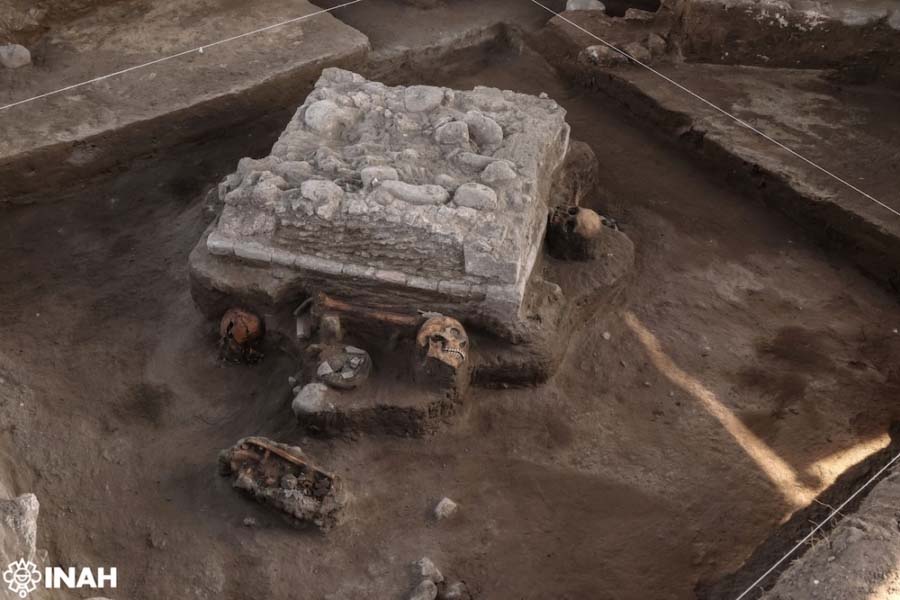
In archaeological salvage labores for the route of the Mexico City–Querétaro Passenger Train, specialists of the National Institute of Anthropology and History (INAH) discovered an altar in Tula, state of Hidalgo. Known in the Nahuatl language as momoztli, this structure measures around one meter per side. It was raised with natural stones and was composed, probably, of three low bodies without stairways. The base is of quarry stone, while the second has modular slabs of the same mineral. Finally, the upper part is made of rounded stones and basalt rock.
On the other hand, on three of the sides of the plan of the altar, offerings of human bones were found. The set is composed of four skulls and long bone remains. Ceramic vessels, fragments of obsidian and small blades were also unearthed. Regarding what was observed in the skulls, one was oriented toward the upper part and another toward the southwest. Thanks to this, it was detected that there was a compacted layer with stucco, perhaps lime with sand. Below this level was where the other skeletons were found.
Revealing the dimensions of Tula
The discovery of the momoztli in the works of the new Mexico–Querétaro Train is very important. The altar is located in the proximities of the archaeological zone of Tula, near the area known as Tula Chico. It has been dated in the constructive phase Tollan (900–1150 A.D.). Having been found only 300 meters from the perimeter wall of the site, it is known with certainty that that point was also part of the pre-Hispanic city.
Precisely, having formed part of the Toltec urban complex and being on compacted ground, it is known that the shrine was in the middle of a patio; remains of wall confirm this fact. That is to say, the structure formed part of a house, and was a fundamental part of domestic worship. The archaeologists of INAH speculate that that dwelling and its rooms were within an elite context. For this reason, it is probable that there also exist vestiges of palatial complexes in that place.
As of today the experts know that at the ends of Tula were located the neighborhoods of the ruling classes, the priests and the officials, while in the distances rose the dwellings of the macehuales, that is, the common people. Thanks to the recent finding, a clearer image is being shaped of how that Mesoamerican capital must have been.