by the El Reportero wire services
Several Latin American countries began 2026 with increases in the minimum wage as part of their strategies to protect purchasing power, in a context of lower inflationary pressure. However, the differences between economies remain noticeable, both in income levels and in purchasing capacity.
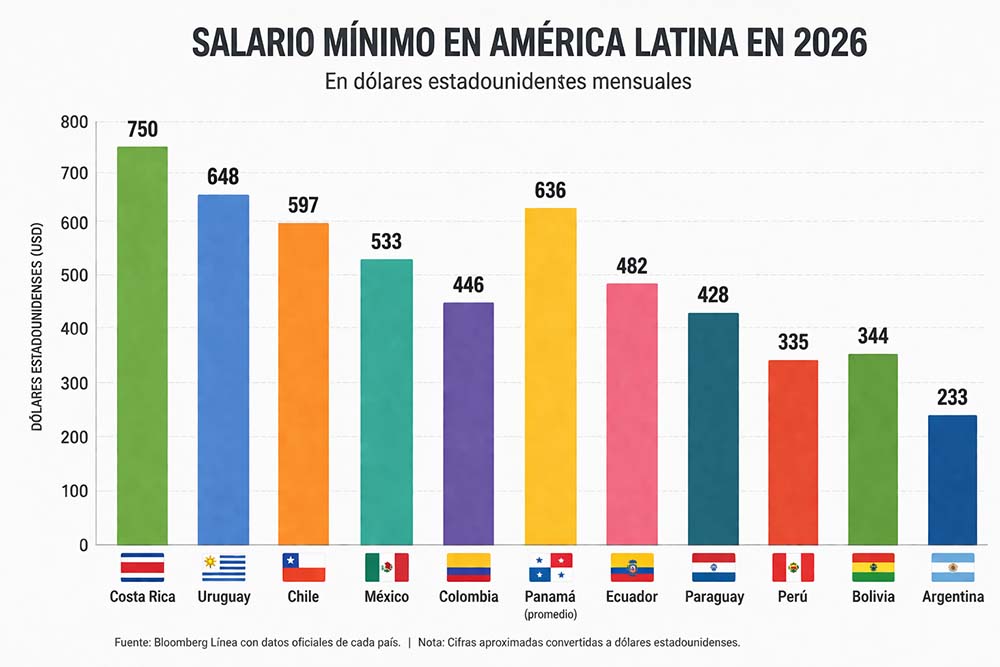
According to an analysis by Bloomberg Línea based on official figures, the highest minimum wages measured in dollars are concentrated in Costa Rica, Uruguay and Chile. These countries reach or come close to 600 dollars per month, positioning themselves as the best paid in terms of basic income in the region.
Costa Rica leads the list with a minimum wage close to 750 dollars for unskilled workers, after an adjustment applied at the beginning of 2026. It is followed by Uruguay, with approximately 648 dollars, and Chile, which is around 597 dollars per month.
At an intermediate level appear economies such as Mexico, with a minimum wage of 533 dollars, and Colombia, with 446 dollars. Both countries applied relevant increases this year, highlighting the Colombian case with one of the highest increases in the region, close to 23.8 percent. Panama also appears among the highest levels, with an average close to 636 dollars, although its system is based on differentiated scales according to sectors and regions, instead of a single national wage.
Other countries are located in middle ranges. Ecuador records a minimum wage of 482 dollars, while Paraguay reaches 428 dollars after its most recent adjustment approved by the government.
Further behind, although with recent increases, are Peru (335 dollars), Bolivia (344 dollars) and Argentina (233 dollars), whose levels remain below 350 dollars per month at the reference exchange rate, reflecting a lower purchasing capacity compared to other economies in the region.
According to the International Labour Organization, the real minimum wage —that is, adjusted for inflation— has shown improvements in most Latin American countries in the last decade, with increases ranging from 10 percent to 60 percent since 2012.
Even so, the organization warns that the effective impact of these incomes depends on structural factors such as labor informality, price evolution and the tax burden. These variables explain why, despite generalized increases, the wage gaps between countries continue to be significant.