by the El Reportero staff
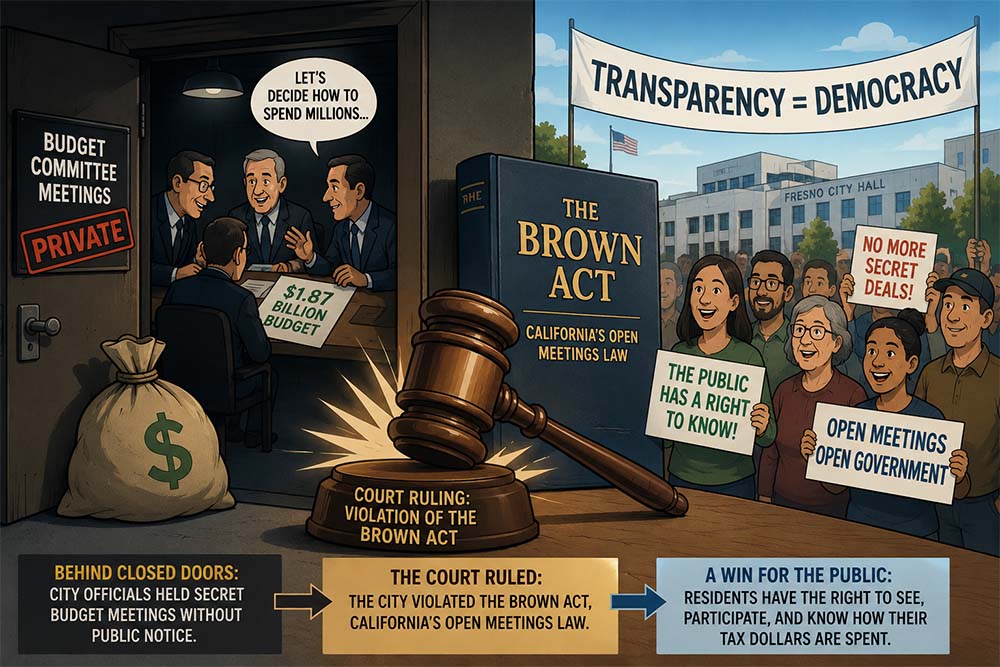
A Fresno Superior Court judge has ruled that the City of Fresno violated California’s open meetings law by conducting private budget negotiations behind closed doors, marking a significant victory for government transparency and public oversight.
The decision stems from a lawsuit filed by the First Amendment Coalition and the ACLU of Northern California following investigative reporting by Fresnoland. The reporting revealed that Fresno City Council’s budget committee had been holding closed-door meetings for years to negotiate key portions of the city’s multi-billion-dollar budget without public notice or participation.
Judge Robert Whalen found that these practices violated the Brown Act, a California law requiring that meetings of local government bodies be open and accessible to the public. The law is intended to ensure that residents can observe and participate in decisions involving public funds and policy.
According to court findings, the budget committee met privately from at least 2018 through 2023, often outside the formal budget adoption period. These meetings included discussions about how to allocate tens of millions of dollars, decisions typically expected to occur in public sessions.
During a June 2023 press conference, Fresno Mayor Jerry Dyer acknowledged the nature of the process, stating that “a lot of sausage was being made in the back room,” a comment that later drew scrutiny as evidence of the lack of transparency.
City officials argued in court that the budget committee was an informal “ad hoc” group and therefore exempt from the Brown Act’s open meeting requirements. However, the judge rejected that claim, concluding that the committee functioned as an ongoing body with consistent membership and influence over budget decisions, making it subject to the law.
Legal advocates say the ruling reinforces the principle that public business must be conducted openly. David Loy, legal director of the First Amendment Coalition, said the decision affirms residents’ right to understand how taxpayer money is allocated and debated.
Transparency groups also noted that the ruling could have broader implications across California, where similar informal committees are sometimes used to shape policy decisions outside public view.
The court’s decision sends a clear message: even in complex budget negotiations, local governments must comply with open meeting laws and ensure the public has a seat at the table.