by the El Reportero staff
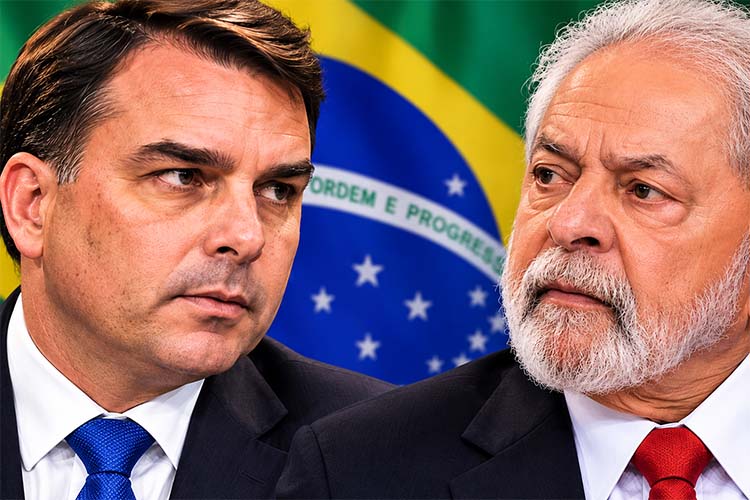
Brazil’s presidential election has placed Latin America’s shifting political landscape under renewed scrutiny after conservative Senator Flávio Bolsonaro unexpectedly finished ahead of President Luiz Inácio Lula da Silva in the October 4 first round, setting up a closely contested runoff.
Bolsonaro received 47.03 percent of valid votes, compared with Lula’s 45.16 percent, according to Brazil’s Superior Electoral Court. Neither secured the majority required for victory, sending both candidates into an October 25 runoff.
The outcome exceeded expectations for Bolsonaro, whose campaign demonstrated the continuing influence of his father, former President Jair Bolsonaro. It also highlighted divisions among Brazilian voters over economic management, public security and the country’s political direction.
A Datafolha survey released October 8 placed Flávio Bolsonaro at 52 percent and Lula at 48 percent of valid voting intentions. The difference falls within the poll’s statistical uncertainty, underscoring the competitiveness of the race.
Brazil’s election comes amid broader political changes across Latin America. Conservative electoral victories in Chile, Colombia and Peru, alongside Javier Milei’s presidency in Argentina, have altered the region’s ideological balance.
However, the political pendulum has not moved uniformly. Mexico and Uruguay remain governed by left-leaning administrations, demonstrating that national political developments cannot be reduced to a single regional trend.
Analysts point to inflation, public safety, economic uncertainty and dissatisfaction with incumbent governments as recurring concerns influencing elections. Their importance varies considerably according to each country’s circumstances.
In Brazil, the campaign has entered a new phase as candidates seek support from voters whose preferred contenders were eliminated in the first round. Third-place finisher Augusto Cury announced his support for Bolsonaro on October 8, adding another development to the runoff campaign.
The October 25 vote will determine whether Lula continues in office or Brazil undergoes a change in leadership. Beyond domestic politics, the result could influence regional diplomacy, trade relationships and environmental policy.
For Latin America, Brazil’s election offers another indication of how rapidly political alignments can change, even as the region remains divided among competing political visions and economic priorities.
– Sources: Brazil’s Superior Electoral Court, Agência Brasil, Reuters, Datafolha, Associated Press and Americas Quarterly.