by the El Reportero staff
As Mexico and its communities abroad continue celebrating the anniversary of independence, the occasion also invites a closer look at Miguel Hidalgo y Costilla—not only as the priest who launched the uprising of 1810, but as an intellectual who read ideas considered dangerous by the viceregal authorities of New Spain and the Spanish Inquisition.
Hidalgo’s famous call to rebellion on Sept. 16, 1810, marked the beginning of Mexico’s struggle for independence. Long before that historic moment, however, the Father of the Nation had developed an intense interest in books about political authority, individual freedom, education and religious power.
Born in 1753, Hidalgo received an extensive education at the Colegio de San Nicolás Obispo in Valladolid, now Morelia. He studied Latin, philosophy and theology, allowing him to read classical writers such as Cicero, Ovid and Virgil, as well as important Catholic scholars.
His intelligence earned him the nickname “El Zorro,” or “The Fox.” Hidalgo also learned French and Indigenous languages, including Nahuatl, Otomí and Purépecha. As a parish priest, he encouraged residents to develop trades and industries that could improve their economic lives.
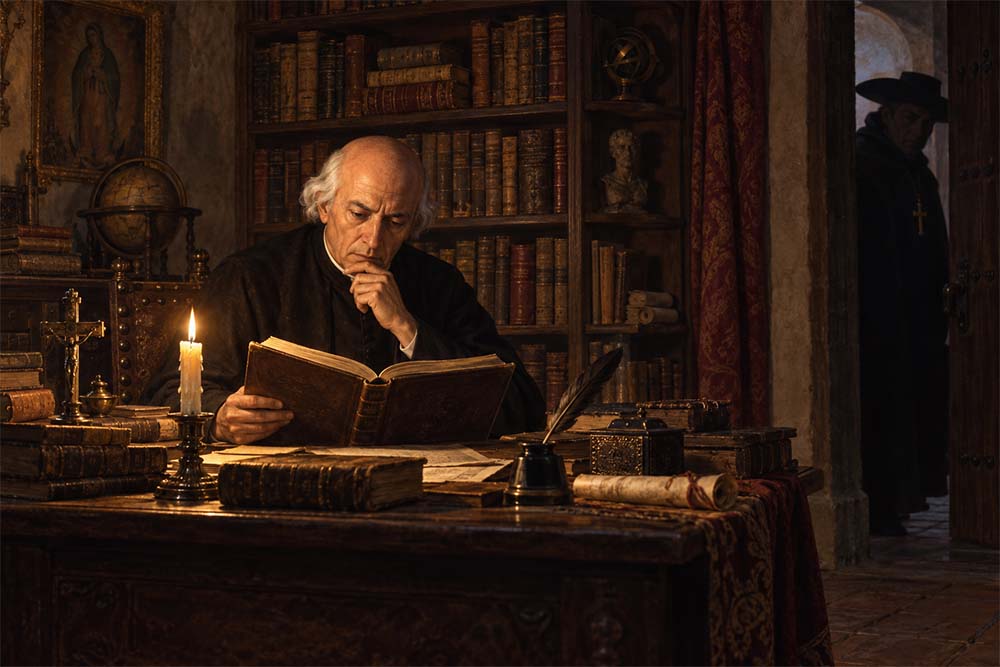
His curiosity, however, extended beyond the intellectual boundaries permitted in New Spain. Hidalgo reportedly accumulated a personal library containing works prohibited by the viceregal authorities and the Tribunal of the Holy Office.
In 1809, Franciscan friar Diego Miguel Bringas accused Hidalgo of possessing and reading banned books without the required ecclesiastical license. Bringas specifically mentioned writings by French Dominican theologian Jacques-Hyacinthe Serry. The complaint did not immediately result in punishment, but the case resurfaced during Hidalgo’s trial in 1811.
Historian Roberto Ramos later identified other controversial works associated with Hidalgo. They reportedly included Voltaire’s Philosophical Dictionary and Jean-Jacques Rousseau’s The Social Contract and Emile. These writings questioned established authority and explored popular sovereignty, individual conscience and education.
Hidalgo was also linked to the Napoleonic Code, whose legal principles challenged traditional monarchy. His literary interests included theater: he reportedly translated Molière’s Tartuffe, a satire about religious hypocrisy, and owned works by French playwright Jean Racine.
Some historians have claimed that the Quran was another of Hidalgo’s preferred readings, although no surviving primary evidence conclusively confirms it.
As Mexicans commemorate the birth of their independence, Hidalgo’s library reveals the ideas behind the insurgent. Before challenging Spanish rule with a call to rebellion, he had already challenged the restrictions placed upon knowledge and independent thought.
Sources: México Desconocido; Roberto Ramos, Books Read by Don Miguel Hidalgo y Costilla (1952).