Monday, October 19, 2026
spot_img
Home Blog Page 331

Hair is dead, it’s just a hard shell

by Ben Fuchs

Hair is dead! By the time the skin appendage has left its hidden home and birthplace in the follicle, and becomes a visible strand of substance, it is nothing more than a hard shell. Because this shell is largely composed only of dead cells filled with protein, the same stuff that makes up human fingernails as well a horse hoofs and rhino horns, trying to enhance hair’s appearance and texture with topical products is like putting lipstick on a corpse. But that doesn’t mean we can’t try!

Throughout history luxurious locks have been honored as a sign of fertility, virility, overall vigor and well-being. Men and women around the world have used a wide range of materials to improve its appearance. From ingredients, like the olive oil infused dead lizards or boiled bulls blood (!) used by ancient Egyptians and Greeks, to the more sophisticated high tech chemicals with difficult to pronounce monikers, like “quaternary ammonium complexes” and “polysiloxanes”, all manner of substances synthetic, natural, benign and toxic have been applied to the tresses to encourage growth, shine, thickness and bounce among other desirable characteristics.

Hair is mostly made up of protein. That’s why the more popular hair care ingredients found in modern shampoos and conditioners are the chemically modified extracts of protein-rich grain and seeds. These derivatives purport to enter into the surface of the nonliving hair shaft to provide support and protection by filling in gaps and repairing microscopic defects. Most include an amino acid called “cysteine”. Cysteine contains a little piece of sulfur, the element that is responsible for hair’s resilience and strength. From a quantum chemistry perspective the electronic nature of sulfur makes it very magnetic. It holds on to things and doesn’t let them go, like a really powerful heavy duty magnet.
This micro-magnetic grip creates hardness on the macro level. Thus defining cysteine’s role in strengthening the hair shaft (as well as bone, joints and cartilage).

There are various ways manufacturers can leverage the power of cysteine for their hair care products. While you’ll rarely see the actual amino itself listed on your product’s ingredient deck, what you will often find is some kind hydrolyzed protein. Whether it’s from wheat, barley, soy or some other plant product, these hydrolyzed proteins, which contain a significant amount of the hair hardening amino acid, can, theoretically at least, be released and delivered into the hair shaft as your shampoo or conditioner is being applied.

The major cysteine containing protein in the hair (and for that matter in nails and skin) is called “keratin” and oftentimes shampoos and conditioners manufacturers will include it as an ingredient in their formulations. L’Oréal, Jason and TRESemme among other companies all have hair products that feature keratin and there’s also hair styling products that have keratin in them. If you do a google search for keratin and shampoo, you’ll find over 5 million hits and if you just take a walk through the shampoo section at Walmart or your favorite grocery store you’ll find dozens of shampoos with names like Keranique and Keralique and Suave with keratin as well as keratin hair oils and keratin conditioners.

Do they work? Probably not. Remember, hair is dead and while keratin is composed of cysteine it isn’t going to be able do much to permanently change the quality of hair by simply applying it topically via a shampoo or conditioner. Keratin containing hair products are more about marketing and misinformation than actual keratin effects; at best keratin may soften hair a little bit by acting as a moisturizer. It’s possible that keratin may get deposited in the hair shaft allowing for a temporary strengthening effect, although that too is unlikely.
Read more: http://criticalhealthnews.com/health-news/25-ben-fuchs-articles/157-hair-is-dead

spot_img

In the shadow of Trump’s walls, locals remain unimpressed

by Julia Carrie Wong

Reported by the Guardian — Between San Diego and Tijuana, eight prototype border walls are ready for testing – but will any get built, and will it make a difference if they do?

It’s 9:15 a.m. and Ralph DeSio of US customs and border protection (CBP) is standing at the front of a tour bus full of journalists, pointing out notable features of the fencing that separates the United States from Mexico.

Furthest south is the 10ft tall primary fence – a low-slung structure of rusted, corrugated steel salvaged from Vietnam war-era helicopter landing pads. About 100 yards north is the secondary fence, 18ft of steel mesh added in the 1990s to create an “enforcement zone” between the two fences.

The scene feels a bit like the film Jurassic Park: a jovial guide explains how the fence will keep sightseers safe from untold terrors. This fence, though, is designed to keep out people, not unadvisedly resurrected dinosaurs.

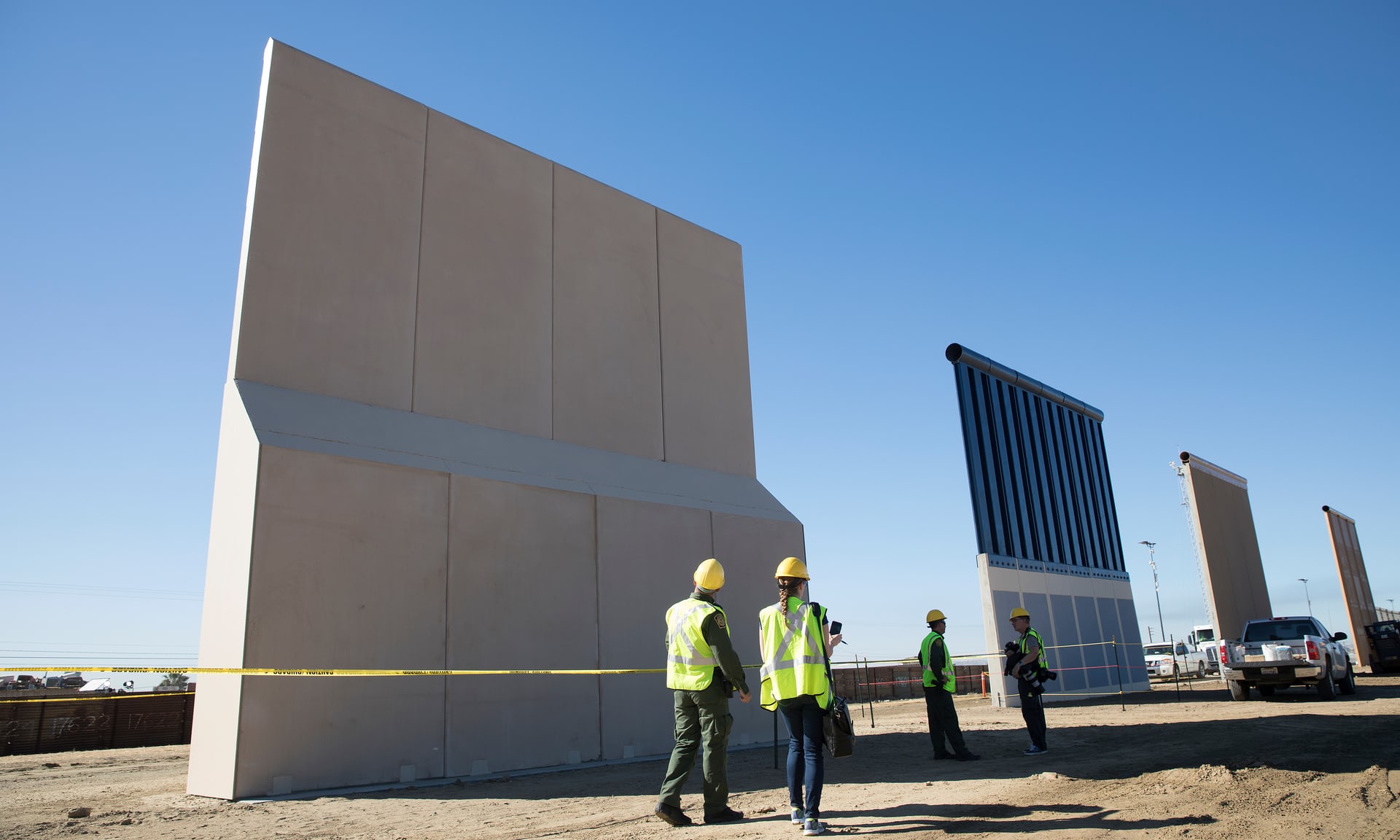
The bus moves east from the Otay Mesa border crossing, to a site where eight brand new edifices – 30ft tall and 30ft wide – arise from the desert like a postmodern art exhibition.

These are prototypes for Donald Trump’s “big, beautiful wall”: eight designs selected by CBP from hundreds of entrants in a bidding process that began in March. Contractors had 30 days to construct the prototypes and, in late November, the concrete and steel edifices will be tested to see how they hold up against attempts to climb over, tunnel under, or bash through them.

At that point, according to the Trump campaign narrative, a winner would be selected and the process of erecting the chosen design across the United States’ 2000-mile southern border would begin, at an estimated cost of $21bn. But the CBP agents ferrying TV crews and photographers to the construction site were noncommittal about the prospect of this bidding process actually leading to a grand prize.

“Ultimately, the winner is the US government,” said Roy Villareal, chief of the San Diego border patrol sector. The process has provided the government with new ideas for border infrastructure, he said, so even if Congress does not approve funding for the wall, the agency can use aspects of the designs as it replaces and repairs existing fencing.

“Irrespective of whether the border wall is funded,” he said, “there is always funding for maintenance.”

Villareal demurred from picking a favorite of the eight, saying that he would wait for the testing, but DeSio praised the easternmost model – a solid concrete structure with terracotta colouring and a slightly tapered profile – as “svelte” and something he wouldn’t mind having enclosing his garden. Still, DeSio pointed out that the wall by itself is no panacea: “You can’t just lay a wall out there and say, ‘That’s it.’”

Jason Bush, another CBP agent, concurred, and said that he would personally prioritize spending money on personnel. “If the wall is there and someone gets over and is working me over,” he said, “the wall isn’t going to reach down and help me.”

The border wall is highly controversial and the bidding process was politically fraught, with major global contractors eschewing the opportunity and several state and local governments proposing blacklists of companies involved. But anticipated protests at the construction site never materialized, with local immigrant-rights activists choosing to greet the exercise with what San Diego photographer Maria Teresa Fernández called “the sound of silence.”

Fernández has been documenting the border fence since 2000, and she called the new models “a symbol of weakness”. The prototype site is closed to the public, but easy to view from south of the primary wall, in Tijuana’s Rancho Escondido neighborhood, where she has climbed up a little hill of dirt and debris to look over the corrugated steel fence and track the construction of the prototypes day by day.

She thinks of the wall as a living being, one that she’s been in a complicated relationship with for 17 years. “It was born, it’s growing, it’s reproducing, it changes, and I hope it will die someday,” she said. “I wish with all my heart to be able to live long enough to see it die.
“It’s hard to think of that, but we all have dreams.”

Residents of the impoverished neighborhood thought little of the efficacy of the new wall samples that jutted above the fence. Guillermina Fernández, who sells plants from her neat little house abutting the fence, complained that noise from the construction began early in the morning, but was otherwise disinterested. “It doesn’t affect us,” she said in Spanish.

Magdalena Palacios, whose eclectic home overflows with the car parts she salvages from the nearby recycling centre, can see the tops of the prototypes from a bench outside her front door. The 57-year-old lived in East Los Angeles for 16 years, but moved back to Tijuana after the death of her American husband.

“Anywhere, anyhow,” Palacios said, “people will continue to cross.”

At 1:30 p.m. every Sunday, as border patrol agents prepare to close off the site for another week, a pair of pastors lead a service across and through the border.

Guillermo Navarrete, the Mexican priest, said that he works hard to convince migrants in Tijuana not to attempt to cross the border, but to stay and live and work in the city instead. “We tell them there is no American dream any more,” he said. As for Trump, he added: “He is sick. We need to pray for him.”

John Fanestil, the pastor on the American side of the fence, saved his politics for his sermon. Reading from the Book of Isaiah, he preached: “And it will be said: ‘Build up, build up, prepare the road! Remove the obstacles out of the way of my people.’” (By the Guardian).

spot_img

The Latino and Black ‘Sacrifice Zones’ of Hurricane Harvey

Houston’s lack of zoning and regulations maximized the impact of Hurricane Harvey, with “fence-line communities” deliberately put in harm’s way

by Emma Fiala

In this second installment of special coverage Hurricane Harvey’s aftermath, Abby Martin explores how the petrochemical industry dominates the city and why its low-income, Black and Latino areas are in the highest-risk areas for flooding and pollution, earning them the name “sacrifice zones.”

Abby explores Houston’s unique lack of zoning and regulations that maximized the impact of the storm, the “fence-line communities” deliberately put in harm’s way, inhumane treatment of incarcerated people in the disaster, and how the ownership of the city by Big Oil puts thousands of lives in peril.

Featuring interviews with Dr. Robert Bullard, professor of Urban Planning and Environmental Policy at Texas Southern University; Azzurra Crispino, co-founder of Prison Abolition Prisoner Support (PAPS); and Yvette Arellano of the Texas Environmental Justice Advocacy Series.

In the first installment in a series on Hurricane Harvey recovery, Abby Martin introduced viewers to a neighborhood ignored by both state and national officials during and after the hurricane. It quickly became clear that the neighborhoods Abby drew attention to, specifically Lake Forest Park, were home to working-class Houston residents of a lower socioeconomic status, many of which are Latino or Black. Was it a simply a coincidence that these neighborhoods were affected by the deadly flooding more than others? Is it by chance that these neighborhoods are now receiving far less attention than those filled with middle to upper-class white Houstonians?

According to the evidence presented in the second installment in the series on Hurricane Harvey, the answer is a very clear no – there was no coincidence and nothing was left to chance. In fact, these very neighborhoods are referred to as “sacrifice zones,” having numerous shortcomings in addition to the tendency to flood.

Houston is unique in that it lacks zoning laws. It is also overrun with petrochemical corporations operating with few rules and regulations.

Neither of these things lend to a safe and healthy city for those with few resources. Houston has a high amount of residential segregation and housing discrimination which forces residents seeking affordable housing into marginalized areas where they are exposed to higher amounts of pollutants, less access to amenities, and are often at a higher risk of flooding. Abby spoke with Dr. Robert Bullard, Professor of Urban Planning at Texas Southern University, about these issues including Houston’s history, gentrification of the city, where wealth is focused, and how modern weather events affect these communities.

Not only were Houston residents affected adversely by the structure of the city, inmates being held in three prisons in the area were all but ignored during the disaster. Abby spoke with Azzurra Crispino, from Prison Abolition Prisoner Support, about what inmates experienced, including standing water, the inability to bathe for at least 10 days, and reports that when portable toilets were finally made available, they were only accessible to prison staff. In one unit, 500 men were evacuated to a gymnasium where they stayed and slept in close quarters without air conditioning or functioning fans, near portable toilets that were not being emptied or cleaned, and with insects and reptiles roaming the floors at night. Despite being located on a floodplain, the facility does not have an evacuation plan in place, lending to numerous health and safety concerns for inmates.

Abby also spoke with Yvette Arellano of the Texas Environmental Justice Advocacy Services. Yvette shared details surrounding the dangerous situation that unfolded at a chemical plant in Houston after Hurricane Harvey hit the area. As the emergency at the chemical plant began, the surrounding community was not informed of the situation, despite seeing smoke and flames at the plant. As time went on, few details were shared about what chemicals were stored at that particular plant and if the situation posed any immediate threat to the surrounding residents.

Chemical plants like this are no longer required to be transparent when it comes to their operations due to the supposed threat of terrorist attacks. While hiding behind Homeland Security in an effort to keep the country safe, the communities surrounding these facilities are left in an unsafe position, completely unaware of potential disasters looming right around the corner. In fact, FEMA stepped up to make the community aware of the threat posed to the community as the emergency unfolded, but the very next day rescinded those statements due to pressures from above. Not only were communities subjected to significantly polluted air due to emergency situations at individual chemical and oil plants in the area, floodwaters were contaminated as well, putting residents at risk in the midst of harrowing rescues.

Shockingly, there is a 16 mile stretch of residential communities located on the edge of the second largest petrochemical complex in the world, running from Houston to Louisiana, filled with cancer clusters and extremely high emissions. Not only is this harmful situation allowed in the United States, there were no extra precautions taken to protect these communities during the disaster, communities full of children. These communities are subjected to harmful emissions daily and those emissions increased dramatically after the hurricane. The correlation is obvious – the higher the poverty rate in these areas, the greater the rate of harmful emissions. Human lives are sacrificed for the profit of the petrochemical industry, with major plants in view of elementary school playgrounds.

Houston is dominated by the petrochemical industry with little regard to the health and safety of it’s most vulnerable residents. Hurricane Harvey did not cause this problem but it has finally brought more of the shocking situation to light. Profits are valued over people in Houston and the basic structure of the city along with it’s laws and regulations are proof.

spot_img

FEMA had a plan for responding to hurricane in Puerto Rico

It does not want you to see it

by the El Reportero’s wire services

The disaster-relief agency, under fire after Hurricane Maria, will not release the plan, even as a comparable document for Hawaii remains public

The Federal Emergency Management Agency, citing unspecified “potentially sensitive information,” is declining to release a document drafted several years ago that details how it would respond to a major hurricane in Puerto Rico.

The plan, known as a hurricane annex, runs more than 100 pages and explains exactly what FEMA and other agencies would do in the event that a large storm struck the island. The document could help experts assess how well the federal government had prepared to storm the size of Hurricane Maria and whether FEMA’s response matches what was planned. The agency began drafting such advance plans after it was excoriated for poor performance and lack of preparation in the wake of Hurricane Katrina in 2005.

ProPublica requested a copy of the Puerto Rico hurricane annex the part of its reporting on the federal response to Maria, the scale and speed of which has been the subject of scrutiny and criticism. More than a month after the storm made landfall, 73 percent of the island still lacks electricity.

Early last week, FEMA spokesman said she would provide a copy of the plan that afternoon. It never came. After a week of follow-ups, FEMA sent a statement reversing its position. “Due to the potentially sensitive information contained within the Hurricane Annex of the Region II All Hazards Plan, there are legal questions surrounding what, if any, portions of the annex can be released,” the statement said.

“As such, the documents that you seek should be reviewed and analyzed under the Freedom of Information Act (FOIA) by FEMA.” The statement did not explain what legal questions apply.

The ProPublica has previously reported, FEMA’s Freedom of Information process is plagued by dysfunction and yearslong backlogs. For example, FEMA has not responded to a request for documents related to Sandy Superstorm that we have filed more than three and a half years ago.

After FEMA declined to release the Puerto Rico hurricane plan, we found the agency’s equivalent plan for Hawaii posted, unredacted, on the internet by the Department of Defense. The Hawaii plan includes granular details down to, for example, how many specially outfitted medical aircraft the federal government would send to Hawaii after a Category 4 hurricane. It also describes an 85-step process to restore electricity on the islands.

Asked why the Puerto Rico plan was too publicly read while the Hawaii plan was not, FEMA spokesman said: “We are not able to speak for DoD or the State of Hawaii.”

Do you have information about FEMA or other agencies’ responses to Hurricane Maria in Puerto Rico? Contact Justin at justin@propublica.org or via Signal at 774-826-6240.

Evo Morales to debate on an issue with Pope Francisco

President Evo Morales will address with Pope Francis the key issues of foreign policy such as the maritime demand and the claim for Silala spring during a meeting at the Vatican, the Foreign Ministry confirmed today.

The visit to the Pope is important for Bolivia and the world, because both will debate Venezuela’s institutionality and sovereignty, Huanacuni said.

spot_img

Cavaranserai 20 year anniversary with Patron and percussionist Adrián Areas – the son of Chepito Areas

Compiled by the El Reportero’s staff

Caravanserai brings their Santana Tribute show to Club Fox to celebrate their 20 year anniversary. It has grown to include material from all eras of Santana’s 47-year history.

The Caravanserai show with raising great percussionist, Adrian Area, explosively recreates the rhythms, drive and the atmosphere of sounds that have made Santana a mainstay in the history of Rock Music for the past five decades. Areas is the older son of Chepito Areas from Santana, who has grown with the music talent as his father.

This show will also include a special guest appearance from Tony Lindsay, former lead vocalist for Santana.

Patron Latin Rhythms is a collaboration of well-seasoned professional musicians with a number of diverse backgrounds. The combining of varying musical roots enables the band to play different styles of Latin Music such as, Latin Jazz, Latin Rock, Mambo, and even O’l Skool R& B/Latin Funk! 

Patron’s goal is simple: to inspire the dancing spirit in everyone with driving percussion rhythms, hair raising guitar licks, and a horn section that is reminiscent of Tower of Power. Patron not only will we leave you dancing on the dance floor, but we promise you’ll leave dancing all the way home!
Saturday, Nov 4, 2017, $15 adv / $20 door. 7 p.m. doors open, and show is at 8 p.m.

For more information call 415-285-7719 or write DrBGMalo@aol.com

Ticket link below:
http://www.clubfoxrwc.com/event/1571670-caravanserai-santana-redwood-city/  

Golden Gate Symphony Orchestra & Chorus to Open Season with

¡Viva Mexico! Beyond Border Walls

Prompted by President Donald Trump’s proposed border wall, the Golden Gate Symphony Orchestra & Chorus (GGSOC), led by Maestro Urs Leonhardt Steiner, Music Director, opens its 2017-2018 season with, a special program of live classical music that celebrates the rich musical traditions and cultures of Mexico and beyond. Featuring special guest conductor Martha Rodriguez-Salazar and a noteworthy variety of special guests from Mexico and the Bay Area.

The concert will take place at the Herbst Theatre, 410 Van Ness Ave. in San Francisco. To purchase tickets, please visit: http://www.cityboxoffice.com/ggsocwww.cityboxoffice.com/ggsoc or call 415-392-4400.

For tickets, please visit: http://www.cityboxoffice.com/ggsoc, www.cityboxoffice.com/ggsoc or call 415-392-4400.

Big musical blowout in the middle of Halloween

The girls of the company, The House Entertainment, invites you to really enjoy celebrating the traditional Halloween event. It will be an unforgettable night full of many models and actresses of flesh and bone that will delight the atmosphere organized by the model, actress and businesswoman Luz Cabrera and her group of beauties. You will not find a better place to have fun that day. And if you’re single, you might find your soul mate that night. And if you come with your partner, you also will have the best time. Do not miss it!

On Friday, Oct. 27 at 8 p.m., at the great joy center of La Chalaka Annex, at 428 3rd Street, Oakland. For more information call 415-235-0340.

spot_img

Great surprises at the Colombian Film Festival

by the El Reportero’s news services

A selection of 55 films from 32 countries make up the luxury exhibition of the third edition of the ‘’Bogota International Film Festival’’ which will be held until next Thursday.

The event shows films such as Western, Happy End, Zombillenium, Good Time and La Cordillera (The Hill), five of the films that were included in the Official Selection of Cannes Film Festival last edition.

There are also feature films and documentaries from Brazil, Chile, Argentina, Portugal, Belgium, France, Italy and the United States, among other nations.
Colombia is premiering different films directed by Samir Oliveros, Ana Salas and Laura Martínez Duque.

Among the films you cannot miss, is the Big Big World from Turkey and directed by Reha Erdem. It tells a love story between two orphaned teenagers who are seeking for a better world.

We can also mention My Happy Family, from Georgia. The story of a middle-class woman who realizes, in her forties, that she is always at her son, husband and mother´s back and call; and she has ever had the chance of being worried about herself.

The Bogota festival also pays homage to the young Chilean film director Alejandro Fernández, who in the last decade has become one of the most talented filmmakers in Latin America.

Children’s Museum reopens with free admission to fire victims
The Children’s Museum of Sonoma County is offering free admission to the victims of the recent wildfires in Sonoma and Napa Counties.  The Museum sustained minimal damage in the fire and is now open to the public. Parents and Caregivers are encouraged to use the Museum as a resource for kid-friendly and indoor activities during this period.  Free admission for victims of the recent fires has been made possible, in part by a generous donation from PG&E.

Chile courts culture along with another tribute to Violeta Parra

It would be hard to have a better closing than Thanks to life to remember Violeta Parra and celebrate the creation of the Ministry of Culture, Arts and Heritage in Chile.

A long evening that began inside the La Moneda Palace, with the promulgation by the President of the Republic, Michelle Bachelet, of a law that provides new cultural institutions in the southern country.

‘Cultures, arts, and heritage cannot have other than the main status in State policies, a place as important as education, economy, health or justice,’ Bachelet said.

‘Chile mestizo, diverse, sometimes conflictive, melancholic or festive, deserved a public cultural institution to live up to their dreams,’ she said.
In a remarkable symbiosis, first the presentation of the Orquesta Andina, directed by Félix Cárdenas, and the band Bombo Trío, before giving way to the concert of tribute to the 100 years of the birth of Violeta Parra. (by Fausto Triana).

From the balconies of La Moneda Palace and the Plaza de la Constitución (Constitution Square), the concert, open to the public, brushed the night with the petals of the most emblematic songs of the also Chilean painter, potter, embroiderer, and poet.

Golden opportunity to enjoy a good part of the Clan of the Parra, with Isabel (daughter) and Tita (granddaughter), with other national musicians as Álvaro Henríquez, Gepe and Vasti Michel.

spot_img

Understanding the ‘fake news’ hysteria

The mainstream media’s hysteria over “fake news” is aimed less at the few instances of intentionally fabricated stories than at well-reported articles that challenge the U.S. government’s dubious official narratives

by David P. Hamilton

For the most part, “fake news” is a fake concept designed by the corporate news media to discredit those who challenge the official U.S. hegemonic narrative. The typical MSM fake news accusation starts with some egregious fictionalization and then morphs over to the real targets: the subversives, those who would dispute foundational elements of the official history or its recent approved updates.

These subversive elements are likely to question important myths, such as the necessity of the nuclear incineration of Hiroshima or – before the Iraq War – Saddam Hussein possessing WMD, and hence must be silenced.

There are people in this world who write what they know to be fiction and try to pass it off as fact. Many of them work for the CIA and related institutions. Then, there are satirists like The Onion who write fictionalized truth. These professional prevaricators are not what draws the ire of the corporate “news.”

The approved rendition of U.S. history is a composite of lies, euphemisms and dubious rationales taught in schools, public and private, since the nation’s founding. It is continuously updated by the corporate news media. There is an army of PR types and psy-op warriors working constantly on this project; some private sector, some public, who often switch roles and sectors, but work hand-in-glove regardless. 

The real fake news is the fake narrative that flows perpetually forth from these functionaries of the MSM to dominate the discourse which the billionaire owners allow voiced via their facilities. In this manner, we are all being played, all the time, and have been since birth.

For the record, the official narrative follows certain principles.  Among them are:

The U.S. is never wrong in any conflict with other nations.

If the U.S. ever happens to be wrong, it was a reasonable mistake.

U.S. intentions are always benign and honorable.

U.S. judgment is always objective and fair.

The U.S. is a democracy and always supports democracy.

Americans are a peaceful people.

Americans are a superior people, so American lives matter more.

Americans are always on the high moral ground because God is on our side.

The word of our leaders is sufficient proof of any assertion.

The U.S. is the greatest nation in history.

Private is always better than public.

Individualism is always better than collectivism.

In application of these principles, NPR’s All Things Considered never considers the Maduro government’s position in Venezuela, nor is Noam Chomsky, often voted the world’s foremost public intellectual, to be heard on this “public” radio. Nor will North Korea’s negotiating position relative to their nuclear weapons program be explained. It requires the U.S. military to refrain from conducting war games on North Korea’s border in exchange for freezing their weapons program; unmentionable because the U.S. militaristic leadership is unwilling to consider the proposal and because it sounds too rational.

You will hear from the world’s greatest exporter of terrorism that Iran, which hasn’t invaded a neighbor since Darius I in 500 BCE, is the world’s greatest exporter of terrorism. And that apartheid Israel is a democracy. And that the Saudis are jolly guys in silk robes you want to hold hands and dance with.

Are the New York Times, Washington Post, CNN, et al, lying knowingly? Not exactly. The news media doesn’t have to invent the lies, only repeat them. They are mainly the stenographers of governmental agencies that provide the raw material to be quoted, invariably substantiating the validity of the official position. The owners of those news outlets likely believe that narrative, but mainly they want you to believe it.

The pundits and talking heads of those news media, the on-camera personalities, must think within the parameters the official narrative or they wouldn’t have been hired to the position of highly paid spokesperson for it. Wolf Blitzer is a Zionist true believer who used to do P.R. for the American Israel Public Affairs Committee (AIPAC).  Anderson Cooper is a Vanderbilt heir worth $100 million.

How objective can you be about issues of income inequality when you’ve been the top .0001% for six or seven generations? And if one dare to go off the reservation, the next thing you know you’ll be working for RT for a lot less money like Ed Schultz.

This process of narrative creation is principally a matter of focus, parameters and interpretation. On major U.S. cable news channels, the great bulk of coverage involves domestic politics, mass murders and “natural” disasters. In Europe, the focus is far more on international relationships.

The spectrum of opinion allowed in the U.S. is limited to the point that Hillary Clinton is considered “the left” and the anti-capitalist left might as well not exist. The range of permissible opinion typically stretches from pro-capitalist social liberals to pro-capitalist social conservatives. This is hardly surprising if one considers that billionaire investors own the controlling interest in all major U.S. news media. One outcome is that the U.S. is the only major industrial nation without a significant socialist political party.

The private interests that own the news media don’t have to get together and compare notes because they all have a high level of ruling-class consciousness that includes shared economic fundamentals, e.g., socialize debts and privatize profits. Their message control is described far more clearly by Noam Chomsky and Edward S. Herman in Manufacturing Consent, chapter 1 on “the propaganda model.”

It is generally accurate to assume that there is an entirely reasonable interpretation of news events that contradicts what you are being told to believe by the corporate news media. Cases of official duplicity are notorious and legion: the Gulf of Tonkin, WMD in Iraq, the black kid killed by the police had a gun, etc. (Note: This article was to fit space).

spot_img

9/11 and America’s “War on Terrorism” – Part 4 and Final of a series

FROM THE EDITOR

Dear readers:

I share with you this piece of text from a book, published by Michel Chossudovsky, which by its preface I can see that it carries enough detailed and researched information of the facts that have led us to be, from a free, democratic nation and the threshold of the world , to a nation with less freedom, less democracy, and no longer the threshold of freedom – and all in the wake of the events of September 11, 2001.
Due to its length, this article will be published in parts. This is PART 4 and Final of a series.

by Michel Chossudovsky

The livelihood of millions of people throughout the World is at stake. It is my sincere hope that the truth will prevail and that the understanding provided in this detailed study will serve the cause of World peace. This objective, however, can only be reached by revealing the falsehoods behind America’s “War on Terrorism” and questioning the legitimacy of the main political and military actors responsible for extensive war crimes.” (Michel Chossudovsky, August 2005)
Below is the preface of  Michel Chossudovsky’s 2005 bestseller:  America’s “War on Terrorism“. 

America’s “War on Terrorism”

The first ten chapters,with some changes and updates, correspond to the first edition of the book published in 2002 under the title War and Globalization: The Truth behind September 11. The present expanded edition contains twelve new chapters, which are the result of research undertaken both prior as well as in the wake of the invasion of Iraq. (Parts III and IV.) The sequencing of the material in Parts III and IV corresponds to the historical evolution of the post 9/11 US military and national security agendas. My main objective has been to refute the official narrative and reveal—using detailed evidence and documentation—the true nature of America’s “war on terrorism”.

Part I includes four chapters on September 11, focusing on the history of Al Qaeda and its ties to the US intelligence apparatus. These chapters document how successive administrations have supported and sustained terrorist organizations with a view to destabilizing national societies and creating political instability.

Part II entitled War and Globalization centers on the strategic and economic interests underlying the “war on terrorism”.

Part III contains a detailed analysis of War Propaganda and the Disinformation Campaign, both prior and in the wake of the invasion of Iraq.

Part IV entitled The New World Order includes a review of the Bush administration’s preemptive war doctrine (Chapter XIX), a detailed analysis of the post-Taliban narcotics trade protected by US intelligence, and a review of the 9/11 Commission Report focusing specifically on “What Happened on the Planes on the Morning of 9/11”.

Chapter XX focuses on the system of terror alerts and their implications. Chapter XXI follows with an examination of the emergency procedures that could be used to usher in Martial Law leading to the suspension of Constitutional government. In this regard, the US Congress has already adopted procedures, which allow the Military to intervene directly in civilian police and judicial functions. In the case of a national emergency—e.g., in response to an alleged terror attack—there are clearly defined provisions, which could lead to the formation of a military government in America.

Finally, Chapter XXII focuses on the broad implications of the 7/7 London Bombs Attacks, which were followed by the adoption of sweeping Police State measures in Britain, the European Union and North America.

Writing this book has not been an easy undertaking. The material is highly sensitive. The results of this analysis, which digs beneath the gilded surface of US foreign policy, are both troublesome and disturbing. The conclusions are difficult to accept because they point to the criminalization of the upper echelons of the State. They also confirm the complicity of the corporate media in upholding the legitimacy of the Administration’s war agenda and camouflaging US sponsored war crimes.

The World is at an important historical crossroads. The US has embarked on a military adventure which threatens the future of humanity. As we go to press, the Bush Administration has hinted in no uncertain terms that Iran is the next target of the “war on terrorism”.

Military action against Iran would directly involve Israel’s participation, which in turn is likely to trigger a broader war throughout the Middle East, not to mention an implosion in the Palestinian occupied territories.

I have attempted to the best of my abilities to provide evidence and detailed documentation of an extremely complex political process.

The livelihood of millions of people throughout the World is at stake. It is my sincere hope that the truth will prevail and that the understanding provided in this detailed study will serve the cause of World peace. This objective, however, can only be reached by revealing the falsehoods behind America’s “War on Terrorism” and questioning the legitimacy of the main political and military actors responsible for extensive war crimes.

I am indebted to many people, who in the course of my work have supported my endeavors and have provided useful research insights. The readers of the Global Research website at www.globalresearch.ca have been a source of continuous inspiration and encouragement.

(Michel Chossudovsky is an award-winning author, Professor of Economics (emeritus) at the University of Ottawa, Founder and Director of the Centre for Research on Globalization (CRG), Montreal, Editor of Global Research. He is the author of eleven books including The Globalization of Poverty and The New World Order (2003), America’s “War on Terrorism” (2005), The Global Economic Crisis, The Great Depression of the Twenty-first Century (2009) (Editor), Towards a World War III Scenario: The Dangers of Nuclear War (2011), The Globalization of War, America’s Long War against Humanity (2015). He is a contributor to the Encyclopaedia Britannica.  His writings have been published in more than twenty languages. In 2014, he was awarded the Gold Medal for Merit of the Republic of Serbia for his writings on NATO’s war of aggression against Yugoslavia). THE END.

spot_img

7 super health benefits in just one celery stalk

by Mayimina
Natural News

Whether raw and filled with peanut butter for a healthy snack or added to a stir-fry, celery is one of the most versatile vegetables out there. It is used in a variety of cuisines not only in America but in countries all around the world and is well-loved for its crunchy texture, fresh taste, and the richness it lends to soups and stews. The combination of celery, onions and carrots, for instance, is at the base of many French dishes.

The good news is that, while celery does not get the same attention as vegetables like kale, it may be one of the great unsung heroes of the produce aisle. Its health benefits are numerous and range from reducing inflammation to improving eyesight. Read on to find out more about what this amazing vegetable can do for the body.

Diet Aide

For someone who is trying to shed extra pounds to achieve their weight loss goals, celery is a wonderful thing to keep around the house. Its crisp texture makes in an excellent snack food and one stalk will only bring in 10 calories, making it perfect to munch on in between meals without getting off one’s diet.

Anti-Inflammatory

Celery is also a perfect food choice for someone who has PCOS or other chronic, inflammatory condition. This super food has compounds which act as natural anti-inflammatories agents and can reduce, for instance, pain and stiffness in the joints for those who suffer from arthritis.

Stress Reliever

Believe it or not, celery can help not only physically, but mentally and emotionally as well. Celery is an incredibly rich source of magnesium, a mineral which naturally helps to calm the nerves and help the body fight off stress and anxiety. It makes an excellent bedtime snack to help with a good night’s sleep.

pH Balancer

Due to its high mineral content, eating celery can help promote the acid-base balance (or pH balance) in the body. Keeping this balance slightly alkaline can help reduce inflammation as well as lowering the risk of developing serious conditions like cancer.

Digestive Aide

Celery is incredibly rich in fiber. A fiber-rich diet has been shown to help improve the health of the entire digestive system and helps to avoid problems like chronic constipation. Fiber intake is also associated with decreased chances of developing colon cancer.

Eye Health Promoter

Even a single celery stalk can provide the body with a generous amount of Vitamin A. This vitamin is essential to maintaining visual acuity and the health of the eyes and can help protect against conditions like age-related macular degeneration, a leading cause of blindness.

Cardiac Health Support

Regular celery consumption can also promote cardiac health. It has been shown that adding celery to the diet helps to lower unhealthy LDL cholesterol levels while at the same time raising the levels of good HDL cholesterol, thus improving one of the biggest risk factors for heart attacks.

So eat up! Celery is not only incredibly delicious and a wonderful addition to soups, salads and stir-fries, it can bring in a wealth of healthy benefits ranging from better pH balance to a healthier heart.

spot_img

China to force Saudi Arabia to market oil in Chinese yans

China, the largest global oil importer, is putting pressure on Saudi Arabia and this could end petrodólar as world reserve currency

by Jay Syrmopoulos

This week, a leading economist predicted a major paradigm shift, as Carl Weinberg, chief economist and managing director at High Frequency Economics told CNBC that China will “compel” Saudi Arabia to abandon the petrodollar, and instead, begin trading oil in yuan—a move he says is likely to precipitate the rest of the oil market following suit and abandoning the U.S. dollar as the global reserve currency.

Weinberg noted that China is poised to clearly dominate the global landscape in terms of oil demand since surpassing the U.S. as the “biggest oil importer on the planet,” adding that Saudi Arabia will “pay attention to this because even as much as one or two years from now, Chinese demand will dwarf U.S. demand.”

“I believe that yuan pricing of oil is coming and as soon as the Saudis move to accept it—as the Chinese will compel them to do—then the rest of the oil market will move along with them,” Weinberg said.

Commensurate with the rise of the U.S. use of the petrodollar as a weaponized financial instrument, numerous states that oppose the dollar holding the status of world reserve currency, have worked to minimize their dependence on dollars in bilateral transactions.

For example, China and Russia have agreed to exclude the dollar, and use the yuan and ruble for bilateral oil trading. Additionally, both states have worked to significantly increase their physical gold reserves in an effort to hedge against a future collapse of the dollar.

In fact, the World Gold Council has reported that the Central Bank of Russia has more than doubled the pace of its gold purchases, bringing its reserves to the highest level since Putin took power 17 years ago, according to Jim Rickards, author of the book Currency Wars.

Russia’s desire to break away from the hegemony of the U.S. dollar and the dollar payment system is well-known. Over 60 percent of global reserves and 80 percent of global payments are in dollars.

After the failed “reset” in U.S./Russian relations by the Obama administration, and the continued deterioration of the countries’ relationship, Washington began targeting entire sectors of the Russian economy, as well as specific individuals, meant to impose an economic burden so severe that it would force Moscow into compliance.

Instead of decimating Russia, what it precipitated was a Russian response of gradually weaning themselves off of the hegemony of the U.S. petrodollar, and working with China to create an alternative to the SWIFT payment system that is not solely controlled by Western interests (see Asian Infrastructure Investment Bank, New Development Bank).

While still suffering from the economic warfare being waged by the U.S., Russia, as well as China have long since realized that as long they are subservient to the petrodollar, there remains a clear and present danger of their respective economies being devastated by the whims of Washington.

The current petrodollar alliance between the U.S. and Saudi Arabia began with a 1974 agreement between U.S. President Richard Nixon and Saudi King Faisal. Since that time Saudi Arabia has denominated all oil exports in US dollars. Since China is now the global leader in oil demand, having to purchase Saudi oil in U.S. dollars is becoming increasingly irritating to Beijing.

In fact, in recent years, China has sought to increase pressure on Saudi Arabia over being forced to transact in dollars, by purchasing less oil from the Saudis.

When Weinberg was asked what would take place if Saudi Arabia and the global oil market move oil trade out of the dollar and begin to use the yuan, he said it would create a dynamic that would result in “lesser demand for U.S. securities across the board.”

“Moving oil trade out of dollars into yuan will take right now between $600 billion and $800 billion worth of transactions out of the dollar,” Weinberg said. “[That] means a stronger demand for things in China, whether it’s securities or whether it’s goods and services. It is a growth plus for China and that’s why they want this to happen.”

It is clear that China is now moving to assume their rightful place as a global superpower, and that along with Russia, they clearly are working to hedge against allowing their nations to remain vulnerable to the petrodollar being wielded as a weapon by Washington.

The distinct reality is that the United States is $20-plus trillion in debt, a debt that will almost certainly never be paid, and when the time comes that the U.S. economy begins to implode, anyone stuck holding fiat paper dollars and US debt will be left out in the cold.

When the Saudis begin to switch from exports being denominated in dollars, to pricing exports in yuan, you can be virtually certain that the clock is counting down to a U.S. economic implosion the likes of which you have never seen.

spot_img