Monday, October 19, 2026
spot_img
Home Blog Page 330

Why the army of reality always needs more soldiers

by Jon Rappoport

What we call Reality is a hall of mirrors. It reflects itself back and forth and builds up a consensus.

People do the same thing. They confirm with one another that the reality they believe is real is, in fact, real.

And having established that, they live out their lives and make the best of it.

But what happens if you defect? What happens if you’re not satisfied to live out the rest of your life inside the space of what everyone assumes is real?
More to the point, what happens if you’re not satisfied to live out the rest of your life inside the space of what YOU assume is real?

This is where a lot of people get off the train. They assert, with great assurance, that what they have discovered is the ultimate frontier. They’ve broken through the illusion. They’ve found out who is running the show from behind the curtain.

And with those discoveries in their pocket, they will live out their lives, confident in the knowledge that they can’t be fooled. They’ve won the prize.
Actually, peering behind the curtain and seeing what’s there is step one. The journey has barely begun.

No matter what degree of truth one has found, living out the rest of a life in that truth is going to be disappointing. It’s eventually going to be boring. It’s eventually going to be insufferable.

You want to lift that curtain, and you should. You should find out everything you can about who and what is behind it, and how they operate. But how long before you stop patting yourself on the back?

How long before you decide to create, with great passion and commitment, your own reality, the one you profoundly desire?

The process of creating reality never ends. It’s the ongoing voyage. It’s the reason things become new. It’s the reason boredom loses. It’s the reason you have no end. It’s the reason you can’t be stopped.

It’s the means by which you don’t decline. It’s the means by which you keep imagining something you haven’t imagined before.

It’s the reason you don’t “live out your life.”

It’s the reason “living out your life” seems about the worst thing you can do.

No excuses will suffice to rationalize staying in one place. No complaints will make you feel better. No “ultimate” space or time is good enough, as it is, to convince you that you should just play out the string inside it.

Right now, we are witnessing tech giants—Google, Facebook, You Tube, Twitter—hiding and de-listing news they deem “fake.” On one level, this is an obvious attempt to control political content. But on a much deeper level, this is an effort to shore up They want to consolidate their Army of believers and expand its ranks. Outsiders and their ideas and analyses are a threat.

Outsiders, heaven forbid, might decide to launch other creative realities that bleed into the consensus and dissolve it.

The independent and free individual mind has its own immune system. It responds when it detects the intrusion of collectivist concoctions.
“Alert! Fake collective reality is showing up. Take action. Resist. Reject.”

Yes, but then?

The individual then has the power to invent his own future, according to his own vision. This is where the journey really gets interesting.

This is where new space and new time emerge, and the space of consensus shrinks and withers.

This is where the Army of Reality has no answer.

In my private consulting practice, I’ve worked with a number of clients, each of whom has his own invention of reality—a project and an enterprise that spills over the conventional boundaries.

Each enterprise is quite different. Each approach is quite different.

What’s similar is the available energy for the work.

Where does that energy come from?

It comes from the individual himself.

When imagination and the creative impulse are unleashed, energy appears in large quantities. New and fresh energy.

Frontier energy.

Cutting-edge energy that quite naturally and automatically begins to shred Army of Reality energy.
Life renews. Life begins again.

The fabric of old limiting ideas falls apart, and the individual steps out on to a unique launching platform.
His own.

This is the voyage that can never be stopped.

Because it doesn’t depend on the fake news and fake consensus and the fake illusion of power of The Group.

(Jon Rappoport, is the author of three explosive collections, The Matrix Revealed, Exit From The Matrix, and Power Outside The Matrix).

spot_img

Six Thanksgiving myths and the Wampanoag side of the story

EDITOR’S NOTE:

Dear readers:

I share this unique article about the truth of the history of Thanksgiving – told by the native Indians themselves to show you what other media do not tell you. – MR.

The Thanksgiving Day celebration originated from a massacre

by Vincent Schilling

Considering Indian Country Today has published its fair share of the true history of Thanksgiving, in which 90 Wampanoag shared provisions with the Pilgrims in 1621, we thought we would take a bit of time delving into some of the most common misconceptions about the November holiday, especially since many Americans think it’s the only thing happening in November.

The Thanksgiving Day celebration originated from a massacre

In 1621, though Pilgrims celebrated a feast, it was not repeated in the years to follow. In 1636, a murdered white man was found in his boat and the Pequot were blamed. In retaliation settlers burned Pequot villages.

Additionally, English Major John Mason rallied his troops to further burn Pequot wigwams and then attacked and killed hundreds more men, women and children. According to Mason’s reports of the massacre, “We must burn them! Such a dreadful terror let the Almighty fall upon their spirits that they would flee from us and run into the very flames. Thus did the Lord judge the heathen, filling the place with dead bodies.”

The Governor of Plymouth William Bradford wrote: “Those that escaped the fire were slain with the sword; some hewed to pieces, others run through with their rapiers, so that they were quickly dispatched and very few escaped. It was conceived they thus destroyed about 400 at this time. It was a fearful sight to see them thus frying in the fire…horrible was the stink and scent thereof, but the victory seemed a sweet sacrifice, and they gave the prayers thereof to God, who had wrought so wonderfully for them.”

The day after the massacre, William Bradford who was also the Governor of Massachusetts Bay Colony, wrote that from that day forth shall be a day of celebration and thanks giving for subduing the Pequots and “For the next 100 years, every Thanksgiving Day ordained by a Governor was in honor of the bloody victory, thanking God that the battle had been won.”

Native Americans and the Pilgrims were “besties”

The above statement is straight from the mouth of a fifth-grader at Long Elementary School in Ohio, who stated the Indians (Wampanoag) and Pilgrims were not “besties” or best friends. True to this statement, the pilgrims in Massachusetts were far from friendly. Soon after arriving in Plymouth, Massachusetts, Pilgrims went into Indians’ dwellings and cornfields and took whatever they wanted leaving beads behind. But that isn’t the picture that is painted by many accounts of the first Thanksgiving.

According to one colonist’s account in Lies My Teacher Told Me: Everything Your American History Textbook Got Wrong by James Loewen: “The next morning we found a place like a grave. We decided to dig it up. We found first a mat, and under that a fine bow… We also found bowls, trays, dishes, and things like that. We took several of the prettiest things to carry away with us, and covered the body up again.”

The Pilgrims settled in an area that was once Patuxet, a Wampanoag village, but it had been abandoned four years prior because of a deadly outbreak of a plague brought by European traders. Before 1616, the Wampanoag numbered 50,000 to 100,000, occupying 69 villages scattered throughout southeastern Massachusetts and eastern Rhode Island. The plague, however, killed thousands, up to two-thirds, of them. Many also had been captured and sold as slaves.

Native Americans and Pilgrims came together to give thanks and celebrate

In 1621, when the Pilgrims were celebrating a successful harvest, they were shooting guns and cannons into the air. The Wampanoag chief and 90 warriors made their way to the settlement in full warrior mode—in response to the gunfire. As the Huffington Post’s Richard Schiffman puts it, “It remains an open question, however, whether the Wampanoag were actually invited, or if they crashed the party.”

The Pilgrims were most likely nervous—the Wampanoag outnumbered the Pilgrims two to one, but it certainly wasn’t the happy picture put forth in many history books. According to Mashpee Wampanoag Tribal Historic Preservation Officer Ramona Peters, “It was Abraham Lincoln who used the theme of Pilgrims and Indians eating happily together. He was trying to calm things down during the Civil War when people were divided. It was like a nice unity story.”

They ate turkey, sweet potatoes and cranberry sauce at the first Thanksgiving

According to many historical accounts, there is no proof of turkey gobbling at the 1621 meal, but there was wild fowl (most likely geese or duck). Sweet potatoes were not yet grown in North American and cranberries are not a likely dessert food because sugar was an unaffordable luxury. Other items on the table included such things as venison, pumpkin, succotash and Indian corn.

Europeans appreciated Squanto’s help

Many have heard the story of the friendly Indian Squanto who learned English from fishermen and later taught the Pilgrims how to plant corn and other vegetables. But what many history books don’t share is that Squanto was kidnapped as a boy and sold into slavery in Spain. After several years, Squanto struggled to get back to Cape Cod.

When he returned to his village, he discovered he was the only member of his tribe that remained—the rest were either killed in battle or died of disease during his absence.

Another myth here would be to note that Squanto did not learn English solely to help the colonists—it was a necessity to facilitate his escape so he could return home.

Pilgrims taught Indians about Thanksgiving

The Pilgrims did not introduce the sentiment of Thanksgiving to the Indians. According to Loewen, “Thanksgiving is full of embarrassing facts. The Pilgrims did not introduce the Native Americans to the tradition; Eastern Indians had observed autumnal harvest celebrations for centuries. Our modern celebrations date back only to 1863; not until the 1890s did the Pilgrims get included in the tradition; no one even called them ‘Pilgrims’ until the 1870s.”

spot_img

Forum promotes ways to stop AIDS infection

by Fernando A. Torres

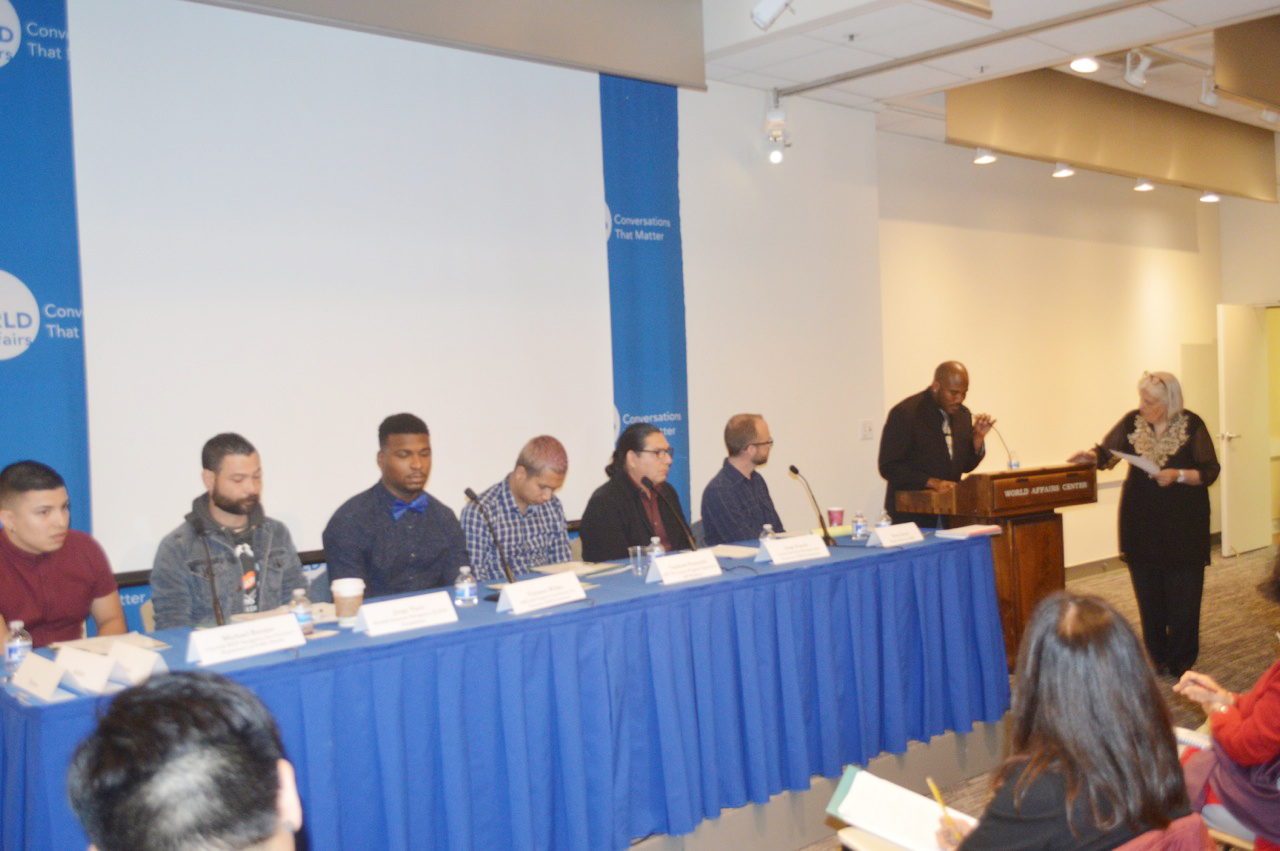
Meeting at the World Affairs Council in San Francisco on Oct. 31, leaders and public health experts warned this week that despite the marked decrease in deaths attributed to AIDS, the numbers continue to be disturbingly high in the African-American and Latino communities in relation to unprotected sexual conduct.

The experts met in a public forum organized by the New America Media organization and the San Francisco Department of Public Health.

Deaths from the virus are at an all time low – last year there were 223 cases in San Francisco. However, according to estimates from the Centers for Disease Control and Prevention, one in two African-American men and one in four homosexual Latino men will become infected with the virus during their lifetime.

The lack of communication and education, religion, lack of public funds, fear produced by the attacks of the federal government on immigrants and idiosyncrasy itself, are some of the problems cited by experts that affect the scope of prevention.

According to the director of Latino services of the foundation against AIDS, Jorge Zepeda, the typical advertising messages are intended for the white community. “The messages we hear do not resonate with our culture, linguistically speaking. The ads we see throughout the city are very sterile, they are more like ads that do not reach the heart and for Latinos and Latinas we like it with more texture with more flavor, with more seasonig,”said Zepeda.

The event also served to promote the use of the preventive pill known as PrEp (Pre-exposure prophylaxis). This appeared on the scene five years ago, however there is a wide ignorance of its existence within the Latino community. The pill can prevent HIV from entering and spreading throughout the body. If used as prescribed and consistently, the pill is effective in preventing the virus.

“PrEp is for everyone. It’s a pill, a drug that has been approved by the FDA (Food and Drug Aministration) that can help prevent HIV by more than 90 percent,” said Jorge Vieto, a public health worker at the Glide Memorial Foundation.

“But people do not have enough information. We are seeing that a majority of people do not know that PrEp is available. People who do know, do not know how to get it and do not know that can be covered by their insurance. If you have questions ask your doctor and if your doctor says no, find another doctor, “Vieto added.

Medicine is not cheap. A bottle of 30 pills PrEp costs $1,600. But according to Michael Barajas, a public health worker in San Francisco County, there are programs that help get it for free for a period of three to six months. These can be obtained regardless of the migratory status of the patients.

“With PrEp we can apply for a program of assistance from the company Gilead (Sciences) which is the one that manufactures the drug. They provide the medication for three to six months for free,” said Barajas who also reported that the advertising campaign initiated by the county two weeks ago is managing to reach the Latino community. They have already received more than 60 calls and the number is expected to increase in the coming days.

“I think that in general the Latino community is very conservative and has a lot of prejudices and stigmas in our minds because of our culture and how we have grown. Many are still afraid, Many still have stigma, prejudice and do not even want to talk about sexuality,” said Adrián Vargas, a 29-year-old Colombian man who a year ago was diagnosed with the Human Immunodeficiency Virus (HIV) that causes AIDS, the Acquired Immunodeficiency Syndrome.

“Let’s have this conversation, and not be afraid, let’s ask and also take care of ourselves using condoms, using all the services that exist in the city of San Francisco to get an HIV test, which is very easy. So it is to take care of ourselves a bit and as a community to have that conversation, be together and not judge, and support our other friends and people who are going through this,” Vargas concluded.

Despite the efforts of these organizations to educate on the subject, they exclude the issue of sexual promiscuity that affects the homosexual community, including the expiritual education that leads to monogamy, which can be factors that would help the prevention of this disease.
These issues, according to Zepeda, are not included as they would scare away those who practice homosexuality – and therefore open sex – because the plan is to avoid contagion without feeling guilty about their actions.
It was decided, says Zepeda, not to judge, but to respect the individual and not to break his sexual identity and sexual orientation, his exercise of his sexuality.
“When you put words like promiscuity, you’re saying you’re wrong, because you put weight on that word. But if you say, look, it does not matter what you are saying, I want to help you stay healthy … and more people are going to approach you, in contrast to say, do not do this because you are promiscuous. The people are going to go away. So what do you prefer, a community that is healthy or one where people get sick?”
(Marvin Ramírez contributed to this article).

spot_img

Time for a vigilante celebration in Venezuela

by Nino Pagliccia
Global Research

In one day, on Oct.15, Venezuela has achieved several outstanding landmarks in our region at a time when we face dangerous world conflicts and unrest. By carrying out fair elections for governors of the 23 states, Venezuela has shown that people value the opportunity to participate in decision-making even under hard circumstances.

The Gran Polo Patriotico (Great Patriotic Pole), a coalition of ten parties, including the governing United Socialist Party of Venezuela (Partido Socialista Unido de Venezuela – PSUV), and the Communist Party of Venezuela (PCV), have won 17 governorships and lost five to the coalition Democratic Unity Roundtable (Mesa de la Unidad Democratica – MUD) (One State still pending at the time of writing).

This represents winning a significant battle, but the war may still be brewing.

The significance of this victory lies in the different fronts in which Venezuela has established a clear claim.

On the democratic front 64 percent of the voters who participated in the elections have made an implicit statement that there is no dictatorship in Venezuela, contrary to the propaganda of Western right wing corporate media. In fact, there has been no shortage of elections in Venezuela. This has been the 22nd free, secret ballot in the last 18 years, including a failed referendum to revoke Hugo Chavez from the presidency in 2004.

This display of building democracy flies in the face of the recent action of the OAS Secretary General, Luis Almagro, who staged a swearing in ceremony in Washington, DC of a “supreme court” whose members are Venezuelans opposing the Maduro government who have left the country. This is a fragrant illegitimate, anti-democratic interference in internal affairs of Venezuela. Luis Almagro has no shame to show his personal antipathy for Nicolas Maduro but he should be ashamed to involve the organization he represents.

This victory for democracy in Venezuela has been succinctly expressed by Bolivian President, Evo Morales, who posted a tweet that said,
“Democracy has won over intervention and conspiracy. The people defend their sovereignty and dignity.”

The second front where this election can claim a victory is likely the most welcome: Desire of people to live in peace. The large turn out of voters is both a testimonial to fearless defiance and a statement of aspiration for a country at peace. Around 10 million Venezuelans have agreed to engage in this electoral dialogue in the understanding that violence cannot be a bargaining chip.

Telesur reported the president of the National Constituent Assembly, Delcy Rodríguez praising the Venezuelan people for going to the polls and ratifying their desire to live in peace.

“This was an election convened by the National Constituent Assembly and we were not mistaken,” said Rodríguez. “This election has allowed us to consolidate the peace and to defend (our) sovereignty.”

The victory of Chavismo on the political front is perhaps the most tangible for political analysts. Despite the economic hardship in Venezuela caused by harsh US sanctions, despite negative media propaganda, and despite months of street violence triggered by the opposition that caused 126 deaths, Venezuelans are still putting their trust in support of the governing party, the PSUV, with a 54 percent overall popular vote.
Considering that the PSUV is a party openly anti-imperialist that fiercely advocates for independence and sovereignty, the vote signals a rejection of any direct intervention by the United States. Evo Morales rightly interpreted this sentiment in his tweet:

“the people triumphed over the empire. Luis Almagro lost with his boss Trump.”

The opposition MUD has not performed badly if we take into account that they gained two more states compared to the three they had in the 2012 elections. (States gained by the opposition in the 2017 elections: Anzoategui, Merida, Nueva Esparta, Tachira and Zulia).

However, early indications suggest that the opposition will not respect the democratic process in the days to come, will reject the offer of peace and dialogue, and will not recognize the elections results. In fact, they have already called for a recount and at the same time for “street actions” in protest.

In a true democracy differences in state politics is not a ground for revolt, but the continued belligerent attitude of the opposition MUD is dangerously fueled by the US, Canada and increasingly by the EU. This is precisely the kind of interference that Venezuela does not need and the Bolivarian Revolution is fighting back. Under these circumstances, the opposition cannot be trusted and nobody can lower the guard.
For now, we join all Venezuelans in a vigilant celebration for their victory for democracy over violence.

spot_img

Day of the Dead in Mexico, but life must go on

por Orlando Oramas Leon

Mexicans celebrate on Oct. 31 through Nov. 2 the Day of the Dead, one of the oldest and most representative traditions in this country.
Also in Colombia. Woman Kneeling by Gravestone on Dia de los Muertos.

Ecuador. Dia de Los Muertos in San Pablo del Lago, Ecuador, El Salvador, Haiti, Nicaragua, Peru, and Venezuela.

The festivity has a pre-Hispanic origin, when the current borders did not exist, so neighboring peoples joined the celebrations consisting of popular parties with altars, favorite food for the dead and the living, flowers, candles and tequila.

In a nation of federal union and multicultural communion and peoples, the celebration differs, although 55 percent of Mexicans believe, according to a survey, that there is life after death, above all in a country that has been compared to others in a war situation (that is, Iraq, Afghanistan and Syria) due to the victims caused by the drug cartels, whose bosses build luxury mausoleums with air conditioning for themselves.

But despite drug traffickers, the Day of the Dead is a celebration in which eight of ten Mexicans participate, either by building an altar, visiting a pantheon, bringing flowers or taking a tequila shot on behalf of an ancestor or a friend in the other world.

In the end, it is a very particular way of reunion between two dimensions that have different modalities in this country.
It has to do with the singular meaning of death for Mexicans.

According to the survey ‘De las Heras’, 69 percent of those polled were not concerned at all, although 24 percent were scared but not terrified by death.

Among them, 31 percent believe in ghosts, but surely, almost all of them on days like today remember their deceased relatives and friends, build altars to them and offer them their favorite food and drinks, amid flowers, especially yellow ones.

It is a cult to the Holy Death, which is celebrated here flat out, although it is a celebration to live life. (Wire services contributed to this report).

Governor of Puerto Rico Travels to USA after Meeting with US General

Governor Ricardo Rossello Nevares traveled to the United States along with various members of the Front for Puerto Rico, after holding a meeting with U.S. General Jeffrey Buchanan, in charge of delivering the supplies for the municipalities.

Minister of Public Affairs Ramon Rosario Cortes said that Rosello will discuss the management of the crisis in Puerto Rico, seeking to achieve a fair approach within the federal tax reform.

This time, the agenda will focus on additional aid to handle the crisis with the recovery plan and to ensure that the federal tax reform turns that territory into a competitive country to keep and create jobs. (Prensa Latina).

spot_img

Discovery En Español exposes the sex tourism industry in Medellín, Colombia

Compiled by the El Reporter’s staff

The long-gone Medellin Cartel has left a cursed legacy: sex tourism. Discovery en Español takes its cameras deep into Pablo Escobar’s hometown to showcase the business of the continuously expanding criminal networks and the journey of hundreds of minors as they enter a world of drugs and prostitution. El Mercado De La Inocencia will premiere Sunday, Nov. 5 at 10 p.m. E/P as part of the Discovery a Fondo investigative programming block.

Over the last two decades, Medellin has gone from being globally known as a drug traffic and extreme violence destination to becoming a thriving cosmopolitan city. Progress and peace have resulted in an exponential increase of tourism, but have also caused unexpected collateral damage: the rise in sex tourism in this Colombian city. Many of the illegal networks run by foreigners in the United States and Europe, offer Medellin guided tours that include underage prostitutes in their packages available for online purchase.

Narrated and directed by ‘’Clandestino’s journalist and researcher David Beriain,
El Mercado De La Inocencia is a one-hour documentary that portrays criminal networks and witnesses teenagers entering Medellin’s illegal business as they start a journey that often begins by selling their virginity to the best foreign bidder.

El Mercado de la Inocencia is a Discovery en Español production by Michela Giorelli, Rafael Rodríguez and Carlos Cediel. It was made by the production house 93 meters.

Performance all ages free family day at SFMOMA

Explore the galleries, check out Louise Bourgeois Spiders on Floor 5, and continue the festivities with Performance All Ages, which invites you and your family to join us for a day of spooky and wildly fun performances. The artists of Whoop Dee Doo team up with local collaborators to present a ghoulish variety show for audiences of all ages.

Admission is always free for visitors 18 and under. On Free Family Day, general admission is also free for up to two adults accompanying each visitor 18 and under.

Sunday, Nov. 5, 2017, 11 a.m. – 4 p.m. Tickets are available onsite only, and cannot be purchased in advance.

Annual fundraising event honoring excellence in film craft

SFFILM has announced the date and venue for SFFILM Awards Night (formerly Film Society Awards Night), its annual fundraising celebration honoring achievement in filmmaking craft. The historic 60th anniversary edition of this glamorous dinner event and awards presentation will take place the evening of Tuesday, Dec. 5 at San Francisco’s Palace of Fine Arts, 39 Mesa Street, Suite 110, The Presidio, San Francisco.

spot_img

Oakland ballet company presents Luna Mexicana

Compiled by the El Reportero’s staff

After making a successful debut last season, the Oakland Ballet Company announces the return of Luna Mexicana, a Mexican Day of the Dead celebration, appropriate for the whole family.

The one-hour program includes a cast of five dancers and five dancers, with a festive choreography by Artistic Director Graham Lustig, vivid costumes, striking make-up and a mix of folk and modern Mexican music.

Luna Mexicana is based on the traditional Mexican celebration of the Day of the Dead, in which the living honor the spirit of the deceased with offerings of food, music and dance. The production tells the story of a young woman whose deceased loved ones return to life and dance happily as staggering skeletons, girls who wave their skirts, a dancer who plays the deer dance and a duet of rickety boyfriends.

It will take place on Friday, Nov. 3 at 7 p.m. at the Paramount Theater, Oakland. Tickets range from $20 to $45. There are discounts for seniors, university students and children under 18 years. Tickets are available online at www.ticketmaster.com or in person at the Paramount Theater box office.

The San Francisco Symphony announces its annual holiday concert season

The San Francisco Symphony’s (SFS) 2017 holiday season at Davies Symphony Hall offers a festive array of concerts for all ages, from traditional Christmas classical concerts including Handel’s Messiah, J.S. Bach’s Christmas Oratorio and Holiday Brass to family-friendly events including A Charlie Brown Christmas—Live!, the circus feats of Cirque de la Symphonie, the Orchestra’s annual Deck the Hall concerts, and the SF Symphony Youth Orchestra’s annual performance of Prokofiev’s Peter and the Wolf with Zachary Quinto narrating.

Special guest performers include Seal, Peaches Christ & Armistead Maupin, Mariachi Sol De México® de José Hernàndez, which will present A Merry-achi Christmas, with its blend of Mexican and American holiday favorites the Oakland Interfaith Gospel Choir brings an uplifting program of gospel, soul, and jazz favorites in Holiday Soul, and Armistead Maupin is the featured guest artist in Holiday Gaiety with the SFS. And there is much more!

Nov.30—Dec. 31, 2017. All concerts are at Davies Symphony Hall, 201 Van Ness Avenue in San Francisco.

Tickets for all holiday concerts are on sale now at sfsymphony.org, by phone at 415-864-6000, and at the Davies Symphony Hall box office on Grove Street between Franklin Street and Van Ness Avenue.

For more detailed information visit: sfsymphony.org.

spot_img

Play on Pérez Prado by Cuban plywright to be performed in Mexico

by the El Reportero’s wire services

The Mexican independent theater company Conjuro Teatro will perform in this country the play ‘’Yo soy el rey del mambo’’ (I’’m the king of Mambo), written by Cuban playwright Ulises Rodríguez Febles, said sources today here.

The performance will pay homage to outstanding musician Damaso Pérez Prado, who would turn into 100 years old on Dec. 11 and was born in Matanzas, 100 kilometers east of Havana.

Artists from Mexico and Cuba will celebrate this date that fondly links the two countries and will pay homage to Perez Prado and his contribution to the world music, said the online cultural magazine Mar Desnudo.

Following the premiere of the play late this year in Matanzas, Cienfuegos and Havana, Conjuro Teatro will perform Yo soy el rey del mambo in Mexico.

The group, directed by Dana Stella Aguilar, said that the play will be performed in Mexico from April 13th to 15th by artists from both countries.

The performance includes live music by the group from Matanzas ‘Atenas Brass Ensemble’, directed by maestro Rodolfo Jorge Horta, with musical direction by Leonardo Heiblum, renowned Mexican composer.

Storm in Dubai with Announced Presentation of Jennifer López

Perhaps a sandstorm is similar to the presentation of the North American actress and singer Jennifer López scheduled for November 15 in this country, the organizers predict today.

In charge of Dubai Airports, JLO will show her art to about 3,500 special guests a few weeks after intervening in a charity show, One Voice: Somos Live, which raised funds for victims of disasters in Puerto Rico, Mexico and the Caribbean.

Dubai Airports CEO Paul Griffiths commented that the artistic quality of Jennifer López widespread how the power of music can connect the world.
Fourty-eight-years-old and still with a sculptural figure, JLO must shake the exclusive auditorium that will concentrate figures of the royalty of this country and those who decide to pay a few thousand to see the Hollywood star.

The US actress will join a select group of guests that Dubai Airports brought to this country, including Sir Tom Jones, Diana Ross, Stevie Wonder and Katy Perry.

Dies Fats Domino, Blues and Rock star

The legendary American pianist and singer Fats Dómino, a blues and rock n ‘’roll star, passed away today at age 89 in his native New Orleans, local media reported.

Domino, whose real name was Antoine Dominique Domino, died surrounded by his relatives, and his death was confirmed by forensic authorities, although they did not reveal the cause.

Performer of hits such like Walking to New Orleans, Is not That a Shame, and Blueberry Hill, the artist debuted in the record industry in 1949 with the album The Fat Man, which expert consider the first rock n ‘roll recording history.

His legacy extends to about 50 albums, of which he sold more than 65 million copies worldwide, and for which he received about thirty gold records.

Active until years 2000, Fats Domino received in 1986 a Grammy in recognition to its career, and in 1998 the National Medal of the Arts given to him by President of the United States Bill Clinton.

spot_img

The plot to overthrow America – oh that’s just a fantasy

by Jon Rappoport

Socialism for the good of all, sponsored by “the people?”

Please. If you buy that one, I have beachfront condos for sale on the dark side of the moon.

I continue to expose the expansion of socialism—“the revolution by and for the masses,” which is in fact a plot of ultra-rich monopolists.
Echoing across 45 years, here is an excerpt from Gary Allen’s 1971 classic, “None Dare Call It Conspiracy”:

“What we are witnessing is the Communist tactic of pressure from above and pressure from below, described by Communist historian Jan Kozak as the device used by the Reds to capture control of Czecho-Slovakia. The pressure from above comes from secret, ostensibly respectable Comrades in the government and Establishment, forming, with the radicalized mobs in the streets below, a giant pincer around middle-class society. The street rioters are pawns, shills, puppets, and dupes for an oligarchy of elitist conspirators working above to turn America’s limited government into an unlimited government with total control over our lives and property.”

“The American middle class is being squeezed to death by a vise…In the streets we have avowed revolutionary groups such as the Students for a Democratic Society (which was started by the League for Industrial Democracy, a group with strong C.F.R. ties), the Black Panthers, the Yippies, the Young Socialist Alliance. These groups chant that if we don’t ‘change’ America, we will lose it. ‘Change’ is a word we hear over and over. By ‘change’ these groups mean Socialism. Virtually all members of these groups sincerely believe that they are fighting the Establishment. In reality they are an indispensable ally of the Establishment in fastening Socialism on all of us. The naive radicals think that under Socialism the ‘people’ will run everything. Actually, it will be a clique of Insiders in total control, consolidating and controlling all wealth. That is why these schoolboy Lenins and teenage Trotskys are allowed to roam free and are practically never arrested or prosecuted. They are protected. If the Establishment wanted the revolutionaries stopped, how long do you think they would be tolerated?”

“Instead, we find that most of these radicals are the recipients of largesse from major foundations or are receiving money from the government through the War on Poverty. The Rothschild-Rockefeller-C.F.R. [Council on Foreign Relations] Insiders at the top ‘surrender to the demands’ for Socialism from the mobs below. The radicals are doing the work of those whom they hate the most.”

“Remember Bakunin’s charge that Marx’ followers had one foot in the bank and the other in the Socialist movement.”

“That is the strategy. The landscape/ painters focus your attention on the kids in the street while the real danger is from above.”

“As Frank Capell recently observed in The Review Of The News:”

“Of course, we know that these radical students are not going to take over the government. What they are going to do is provide the excuse for the government to take over the people, by passing more and more repressive laws to ‘keep things under control’.”

“The radicals make a commotion in the streets while the Limousine Liberals at the top in New York and Washington are Socializing us. We are going to have a dictatorship of the elite disguised as a dictatorship of the proletariat.”

“The poor are merely pawns in the game…only those who understand that the Establishment’s game plan is SOCIALISM understand what is going on before their very eyes.”

Does that excerpt from “None Dare Call It Conspiracy,” written in 1971, sound familiar today? Of course it does. It reflects the same old strategy of pressure applied from both the top and bottom. The squeeze play.

The super-rich monopolists pretend to “bow to the socialist wishes” of the underclass and the protestors and the rioters.

It’s a straight con.

Don’t get caught in the word game which confuses Communism, Socialism, the Corporate State, Fascism, and Crony Capitalism.

When you put all these terms through the wash, they come out looking the same. They mean power at the top, disguised to appear as popular movements.

“None Dare Call It Conspiracy” describes the dark alliances that congeal in the ubiquitous Rockefeller Council on Foreign Relations, a group whose goal is a new international order, a Globalist society:

“Today [1971] the C.F.R. remains active in working toward its final goal of a government over all the world—a government which the Insiders and their allies will control.”

“International banking organizations that currently have men in the C.F.R. include Kuhn, Loeb & Company; Lazard Freres (directly affiliated with Rothschild); Dillon Read; Lehman Bros.; Goldman, Sachs; Chase Manhattan Bank; Morgan Guaranty Bank; Brown Bros. Harriman; First National City Bank; Chemical Bank & Trust, and Manufacturers Hanover Trust Bank.”

“Among the major corporations that have men in the C.F.R. are Standard Oil, IBM, Xerox, Eastman Kodak, Pan American, Firestone, U. S. Steel, General Electric and American Telephone and Telegraph Company…National Broadcasting Corporation, Columbia Broadcasting System, Time, Life, Fortune, Look, Newsweek, New York Times, Washington Post, Los Angeles Times, New York Post, Denver Post, Louisville Courier Journal, Minneapolis Tribune, the Knight papers, McGraw-Hill, Simon & Schuster, Harper Bros., Random House, Little Brown & Co., Macmillan Co., Viking Press, Saturday Review, Business Week and Book of the Month Club.”

Here is the kicker:

“Also in the C.F.R. are men from such openly Leftist organizations as the Fabian Socialist Americans for Democratic Action, the avowedly Socialist League for Industrial Democracy—(formerly the Intercollegiate Socialist Society), and the United World Federalists which openly advocates world government with the Communists. Such devotedly Socialist labor leaders as the late Walter Reuther, David Dubinsky and Jay Lovestone have also been members of the C.F.R. In theory, these men and organizations are supposed to be the blood enemies of the banks and businesses listed above. Yet they all belong to the same lodge. You can see why that fact is not advertised.”

Politically Left, Right or Center, it doesn’t matter. This massive collection of power players are all “socialists.” Meaning: they’re power-mad monopolists.

But of course, they’re also the messiahs bringing a happy and glorious future to the downtrodden, to “the people.”

If you buy that one, I’ll not only sell you beachfront condos on the dark side of the moon, I’ll sell you the whole moon. No money down. Easy terms.

So easy, when the balloon payment comes due, you won’t know what hit you.

At that point, you’ll need to sign your property and liberty and life away.

For the greater good, of course.

In a socialist system.

spot_img

When our loved ones are gone on Day of the Dead

EDITOR’S NOTE

Dear Readers:

Today is a very sad day for those human beings who have lost a loved one, and even more so for those who lost them just a few days ago, because it takes away the opportunity to even give space in their hearts to celebrate their life.

In commemoration of the Day of the Dead, I wanted to take a little walk around searching for information on how this event is being held in the different countries of Latin America, and this is what I found.

And I want, through this writing, to honor my late father, Don José Santos Ramírez Calero, who was a journalist warrior in Nicaragua. Wherever you are, my father, you will always be in my heart remembering that you were a light in the sky that continues to illuminate me after you left that day June 12, 2004, amidst pain and suffering for the cancer that killed you.

And just a day or so I take a chance to say a few words to dear Godfather who passed away a few years in Nicaragua, Mr. Evaristo Gómez.

And I offer my most sincere condolences to the family of two beloved Nicaraguan people whom I met here in San Francisco, who this week lost their loved ones by giving their soul to our Creator.

The first is the mother of my friend Sergio Iván Gutiérrez, Mrs. Gloria de los Angeles Berrios de Gutiérrez. She was 90 years of age. She died in the morning of Oct. 26 at her home in the Excelsior District of San Francisco surrounded by her family. Sergio could not attend due to forces beyond his will, and I imagine the pain he must be feeling unable to say goodbye to the woman who gave him the sincere self and love of a mother.

The second person to leave this world was the brother of Maria Elena Noguera, a lady dear and well-known in San Francisco for the rich dishes she prepared when she was the owner of the popular Red Baloon Restaurant on Mission Street.

Her brother, Orlando Antonio Noguera, who was 73 years old and suffering from extreme obesity, leaves his large family in pain for his departure.

And for them I say a prayer that their souls may be diluted in the fountain of life of the Most High.

Celebration of the Day of the Dead

As described in Notimérica’s writings, although Day of the Dead is normally related to Mexico, several Latin American countries commemorate this date, each in its own way.
The feast of this day comes from the indigenous cultures of the Aztecs, Mayas, Purepechas, Nahuas and Totonacas.
For 3000 years, they performed rituals in honor of their ancestors, rites that symbolized death and rebirth.
The Spanish conquerors of the fifteenth century were terrified by the practices of the natives on this day and, in their attempt to convert the Native Americans to Catholicism, changed the date of the celebration for the beginning of November. In this way, they coincided with the Catholic celebrations of the Day of All Saints and All Souls.
In Latin America, the Day of the Dead is celebrated on November 1 and 2. The first is the day when souls return to children, and the second is the day they return to adults.
Mexico
The most important moment on this day is when people go to the cemetery during the night and adorn the tombs, usually with an orange flower called ‘xempazuchitl’.
In the houses, an altar is built in memory of the ancestors, where photographs of them, food and drinks are arranged so that the deceased can remember the flavors of his past life.
Among some of the elements of folklore used only at this time of year, we highlight the sweet bread – known as ‘bread of death’ – skulls made of sugar or small skulls, which are given away to friends.
Guatemala
In this country, there is a belief that blessed souls come out of cemeteries and appear in some places. For this reason, many people, like in Mexico, put water and a photograph of the deceased in the homemade altars. Days before the celebration, they cleaned the tombs and decorate them with the flower of the dead, of yellow color, that only flowers at this time.
Peru
As in Mexico and Guatemala, altars are also dedicated to the deceased. Offerings of candles and flowers are made in the cemetery and, once the food and drink is prayed for the deceased, the family members enjoy a banquet in their honor.
Venezuela
In Venezuela, there are no major celebrations. Relatives take advantage of this day to visit the cemetery, clean the graves and bring flowers.
El Salvador
In this country, the Day of the Dead is celebrated on November 2 and, rather than remembering their ancestors, take advantage of this day to celebrate the lives of those who are still alive.
Nicaragua
Nicaraguans attach great importance to this date and go further, celebrating this day in the cemetery during the night. They spend one night ‘sleeping’ with their dead, lying down beside the pantheons.
Honduras, Colombia and Costa Rica
In these three countries, believers go to cemeteries to bring offerings as a symbol of gratitude to the favors performed by the saints to their relatives.
Ecuador
  Ecuadorian families celebrate this day by gathering around a typically traditional meal: bread guaguas – bread figures shaped like children – and purple dressing, a drink made with black corn flour, fruits such as blackberry, pineapple and naranjilla, and blueberries.
The Altar of the Dead
It is a fundamental element in the celebration of the Day of the Dead.
The bereaved have the belief that the spirit of their deceased returns from the world of the dead to live with the family that day, and thus to comfort them and to comfort them by the loss.
The altar is characterized by its cheerful colors and photographs of the deceased, as well as some dishes of his preference in life.
The Dead Bread
There are different theories about the elements that make up this delicious and special piece of Mexican bakery.
For example, some say that the bones made of mass refer to those of the deceased one who is remembered, others who represent the four cardinal points. Even in some places there is the belief that its ingredients are associated with the fruits of the earth and life.
The Offering
It is to share with the deceased the bread, the salt, the fruits, patillos, the water and if they are adults, the wine. To offer is to be close to our dead to dialogue with his memory, with his life.
The offering is the reunion with a ritual that summons to the memory.
The Sugar Skulls
No Day of the Dead offering would be complete without the traditional sugar skullcuts. These sweet skulls are the product of a technique brought by the Spaniards.
One of its peculiarities is to carry in the upper part the name of the person to whom it is destined, since it is a form of reminder that the only thing that has the human being is death.

spot_img