Monday, October 19, 2026
spot_img
Home Blog Page 332

Failures of affordable care act push patients to relay on urgent care centers

by Roqayah Chamseddine

In the United States, where health care costs are bankrupting Americans more than any other type of debt, urgent care centers (UCC) are on the rise, and more Americans are leaving their primary care physicians behind in favor of them.

At John Peter Smith Hospital (JPS) in Fort Worth, Texas, there’s a program for low-income residents called JPS Connections, which intends to act as a kind of “service of last resort” for those unable to access health care via state, federal, or pharmaceutical assistance.

JPS Connections currently serves around 50,000 Tarrant County residents each year, all of whom are forced to reapply annually or else face being bumped off of the program.
http://squiglit.com/donate-to-mintpress/
 
Norma, who asked to use only her first name to discuss private information about her family’s medical care, said that while Obamacare helped a number of those in her neighborhood in Fort Worth, she and her family struggled with deductibles and high premiums. JPS Connections was a lifesaver.

“When we first heard of Obamacare, a lot of us over here thought it would be easier, and that things would get better. But for my family it was really difficult because the premiums were just too high. I lost my job, my husband got sick, and then things just kept getting worse,” Norma shared.

But joining JPS Connections is not easy. An avalanche of paperwork, long waits, and piling medical debt make it difficult to handle.

“I don’t understand why basic medical stuff costs so much, and why we even have to pay for it. My family didn’t choose to be sick,” Norma lamented.

The thought of being pushed off JPS Connections gave Norma intense anxiety, and she started to look towards urgent care centers because maybe it would be “easier, instead of going through JPS and worrying about when they’ll deny us care.”

Norma continued, “I feel like the only way to make ends meet is to do work under the table or else, if our income goes over the [maximum income level], then we can’t use it anymore. But for my family, with the debts we have, and the cost of living out here, it doesn’t give us any breathing room.”

Another caveat is that one must first sign up for insurance if they’re eligible under the Affordable Care Act in order to access the JPS Connections program.

The urgent health care market is profitable and on the rise. According to a report from Business Insider, “patient volume will continue to expand through 2021 to about 300 patients per week, with revenue per UCC increasing to almost $1.7 million.”

Some 10,000 urgent care centers have expanded across the U.S., which provide everything from intermittent health services to full-service speciality care. Instead of driving to a medical center headed by a general practitioner, one can find these clinics inside office buildings and shopping malls.

U.S. health insurance companies, including Cigna, and UnitedHealthCare, advertise these facilities as the most reasonable and accessible options for those in need of non-emergency care when compared to an emergency room visit. What this means for patients is affordable care is possible, to some extent (although truly humane health care remains remote).

Speaking to urgent care center patients, it became evident most have good experiences with the rate of service and the overall costs.

Matt McGowen, a 27-year-old software developer in San Francisco and student at the City College of San Francisco, said urgent care facilities were a substitute when he was unable to see a doctor.

“I’ve gone in for a minor sports injury and a stomach bug while on a trip out of the Bay Area. I made sure that the urgent care facility was in my insurance network and the bill was on par with a doctor’s office co-pay plus treatment,” McGowen added.

For McGowen, health care in the U.S. is horrific “for just about everyone except insurance executives, hospital owners, and specialists”.

McGowen—echoing the sentiment of many other Americans struggling with medical programs—described the industry as “an overpriced, over-complicated mess that most people don’t know how to access effectively, or are simply priced out of good care.”

“I don’t think health care will get better in America,” he said. “[Not] without a universal program like Medicare for All. As long as health care remains a commodity, people with less money will get worse care and people will suffer across the board. It will continue to look like it does now, basically, with the caveat that it can absolutely get more cruel and more unjust.”

Twenty-six-year-old Pete Volk, a Washington, D.C., resident and editor at Vox Media, used urgent care centers because of their location, how relatively inexpensive they are, and the fact that they do not require an appointment. He does not have a primary care practitioner and found that these facilities have short wait times. The staff is also friendly and knowledgeable.

“I’ve gone in for cold/flu symptoms and an issue where mucus was building up in my throat (that time I went to urgent care in part to get a referral to an ENT [ear, nose, and throat doctor]). My bill has been $35 each time, with no cost for prescriptions. I chose to go to urgent care instead of a conventional doctor route to avoid the weeks-long wait to be seen,” Volk shared.

While Volk has experienced little trouble with these centers, he joined others in calling for a revolution in the health care industry. “Single-payer or bust.”

(This article was cut to fit space).

spot_img

Mexico must abandon NAFTA, peasant group assures

by the El Reportero’s wire services

Mexico must abandon the renegotiation of the North American Free Trade Agreement (Tlcan), said the National Coordinating Plan of Ayala (CNPA), a peasant group opposed to neoliberalism.

Jose Narro, the leader of the group, considered that in the long run Mexico will have benefits for abandoning the treaty, which is renegotiated at the Donald Trump’s administration, whose representatives maintain exclusive and rigid positions against their Mexican and Canadian partners.

‘The position is that we withdraw from NAFTA. Mexico does not deserve that deal. Let’s make a treaty with Canada alone and strengthen agreements with the rest of the world, ‘Narro stressed.

He condemned in a press conference that the Mexican negotiators ‘are sitting there enduring mistreatments; that is unworthy.’

If there is no deal of respect they should get up from the table, he underlined.

Alan Cruz, an economic analyst at the CNPA, acknowledged that in principle Mexico would pay a fee to leave the treaty, mainly because of the depreciation of the Mexican peso against the dollar.

However, he predicted that in the future the country would be better off by reducing dependence on imports.

Narro assured that many countries have turned their backs on the neoliberal and globalizing model. ‘Let us promote a development model for Mexicans. This is possible and necessary, ‘he concluded.

Dominican Republic to modernize education

The Ministry of Education of the Dominican Republic will reportedly invest nearly 400 million dollars in technology to modernize education in this country in the next tree years.

According to statements by the Education Minister, Andrés Navarro, in the American Chamber of Commerce of the Dominican Republic, computers will be delivered to 950,000 high school students ‘to be the daily instrument of students in the classroom.’

In addition, 80,000 teachers throughout the country will also receive computers and blackboards will be installed in classrooms.

86 people sign up for presidential race
But the road ahead is long. Each must gather 866,593 signatures of support

There could be a wide range of choices when voters elect a new president next year: 86 people registered as independent candidates by Saturday’s deadline, the National Electoral Institute (INE) announced.

The INE reported that it had received statements of intent to run in the July 1 election from 79 men and seven women.

It will be the first presidential election to allow the participation of candidates who are unaffiliated with political parties.

But the final ballot is likely to contain somewhat fewer names.

Of the 86 declared aspirants, eight have already been ruled ineligible because they failed to comply with at least one of the requirements set by the INE, while a further 38 were given an additional 48 hours to fulfill all of the relevant criteria. The remaining 40 have received accreditation.

The final number will not be finalized until February after candidates have gathered signatures to demonstrate they have enough popular support to warrant inclusion.

To qualify, each candidate is required by law to collect 866,593 signatures of support by February 12, a number that corresponds to 1 percent of all voters on the electoral roll.

spot_img

Big musical blowout in the middle of Halloween

The girls of the company, The House Entertainment, invites you to really enjoy celebrating the traditional Halloween event. It will be an unforgettable night full of many models and actresses of flesh and bone that will delight the atmosphere organized by the model, actress and businesswoman Luz Cabrera and her group of beauties. You will not find a better place to have fun that day. And if you’re single, you might find your soul mate that night. And if you come with your partner, you also have the best time. Do not miss it!

On Friday, October 27 at 8 p.m., at the great joy center of La Chalaka Annex, at 428 3rd Street, Oakland. For more information call 415-235-0340.

spot_img

#Schoolnotprisons Arts and Music Festival caming to Adelanto

Compiled by the El Reportero’s staff

Los Rakas and Ceci Bastida will be joined by special guest artists in Adelanto for a free, community #SchoolsNotPrisons concert, to advocate for fair treatment of immigrants who are awaiting a decision on their request to stay in the U.S., as well as the closure of all immigrant prisons.

The concert comes just two weeks after Governor Jerry Brown signed a new bill by Sen. Ricardo Lara, which will limit the growth of immigrant prisons and takes a strong stand against profiteering by private prison interests.

About 1,600 people are incarcerated in Adelanto’s immigrant prison, which is owned and run by the for-profit prison company GEO Group.

The #SchoolsNotPrisons tour stop in Adelanto will take place at the Adelanto Stadium. Guest speakers will include those who’ve been incarcerated inside the Adelanto immigrant prison.

Admission to the concert is free, but people are encouraged to register in advance through this Eventbrite link (https://www.eventbrite.com/e/schoolsnotprisons-adelanto-tickets-38553387219) because the event is expected to reach capacity.

The concert is an all-ages peaceful community event, and will be a tobacco-free, alcohol and drug-free zone.

On Oct. 20, with gates opening at 5 p.m. and the concert starting at 6 p.m., in Adelanto, California.

2017 Fiesta on the Hill

Bernal Neighborhood Center presents 2017 Fiesta on the Hill, celebrating the 50th Anniversary of the Summer of Love. Come dressed for the summer of love.

Join your neighbors at this family-friendly and alcohol-free while benefiting BHNC’s youth, seniors, affordable housing, community engagement and employment programs.

Live music, food trucks, local artisans, dancing in the streets, family fun.

On Sunday Oct. 22, at 10 a.m. to 4 p.m. At Cortland Avenue. Sponsored by the Bernal Heights Neighborhood Center. For more info call 415-206-2140 or visit: fiesta@bhnc.org.

Free Financial Planning Day at the Library

San Francisco, CA –The Financial Planning Association of San Francisco, in partnership with the City and County of San Francisco Treasurer’s Office and the San Francisco Public Library, are pleased to announce the 8th annual San Francisco Financial Planning Day on October 28, 2017 from 9 a.m.–3 p.m.

Bay Area residents will be able to meet one-on-one with dozens of highly qualified Certified Financial Planner™ professionals to discuss their personal finance questions, concerns and interests.

The event is a great opportunity for a free, private consultation with an expert on a wide variety of personal finance issues, including debt management, retirement planning, investment strategies, income taxes, insurance, and estate planning, among many others.

Programs will run throughout the day covering budgeting and credit counseling.

Best of all, there are no strings attached. Financial planners are volunteering their time and will not pass out business cards, marketing materials or sell products or services. They will be stationed at tables and will meet with one individual or a couple at a time. In addition to one-on-one consultations, there will be a series of informative classroom workshops presented by top financial planners on a wide range of financial topics. Prior events have served 300-400 Bay Area residents each year.

For the completed schedule, please visit:

http://financialplanningdays.org/event/san-francisco-financial-planning-day
Financial Planning Day – Oct. 28, 9 a.m. – 3 p.m., Main Library, 100 Larkin Street.

spot_img

Nicaraguan documentary “Heir of the wind” to premiere in Amsterdam

by the El Reportero’s news services

The historical events that marked Nicaragua in 1980, whose sequels have not been cured, merge with the present and family history of filmmaker Gloria Carrión in the documentary Heredera del Viento, a film that will be released worldwide at the International Film Festival Documentary from Amsterdam (IDFA) from November 15 to 27.

Among more than 3,000 applications received by IDFA in each of its annual editions, Gloria Carrión’s film was selected along with another 300 and will be one of four productions that will represent Latin America in Holland.

“It will be a pleasure to share screen with other stories of the world. Without a doubt, it fills me with a lot of emotion that this movie that began as a dream now meets the audience, “says Gloria Carrión, director and producer of the film.

It was four years to bring to the big screen this production, which was filmed in León, Managua and Masaya with a technical team from Spain, Mexico, Colombia, the United States and Guatemala.

(Reporting from Nicaragua by Franklin Villavicencio.) Read the full article at: http://niu.com.ni/heredera-del-viento-documental-gloria-carrion-nicaragua-amsterdam/).

United States abandons UNESCO

The United States government decided to abandon the Organization of United Nations for Education, Science and Culture (UNESCO), announced today director general of that entity, Irina Bokova.

When communicating that decision, Bokova said the U.S. withdrawal from that specialized agency of the UNO, means ‘a loss for multilateralism’ at a crucial moment when ‘the fight against violent extremism asks for a renewed investment in education and the intercultural dialogue to prevent hate’.

Since 2011, the northern nation had suspended its financial contributions to UNESCO as reprisal for the admission of Palestine as a member state.

In July this year, the Department of State of that country announced it would review its membership to the organization after describing as an ‘offense to history’ the decision taken, on the proposal of Palestine to consider the old city of Hebron in occupied West Jordan as ‘World Heritage in danger’.

A note emitted today by the U.S. foreign ministry argues that the withdrawal, to be effective on December 2018, is due to the fact that Washington considers that in UNESCO there exists an alleged ‘anti-israelite bias’ and demands ‘a fundamental reform’ that in the opinion of observers, may adapt the objectives and actions of that institution to its interests.

Theater Festival for Children and Teenagers Continues in El Salvador

The 2nd National Theater Festival for Children Festi-2017, continues today with the play Sopa de Sueños, by the cultural project La Colmenita de Sonzacate.

The festival, opened with a moving story of grief and hope performed by the group from El Mozote, shows the progress of a social project fostered by President Salvador Sanchez Ceren.

The initiative goal is to contribute to the happiness and the promotion of values in Salvadoran children.

The golden rule of the group is to do good, to boost values such as equity, brotherhood, respect for the elderly, love of the homeland and coexistence over political or religious barriers. Las Colmenitas were firstly founded in El Salvador in November 2015.

spot_img

Trump’s racist immigration plan

by Stephen Lendman
Global Research

Earlier he banned travel to America from targeted countries, majority Muslim ones plus North Korea and Venezuelan officials.
He absurdly claims America is the only country, putting “the needs of other nations ahead of our own” when it comes to immigration.

He named three core principles of “immigration reform” as follows:

“1. A nation without borders is not a nation. There must be a wall across the southern border.”

“2. A nation without laws is not a nation. Laws passed in accordance with our constitutional system of government must be enforced.”

“3. A nation that does not serve its own citizens is not a nation. Any immigration plan must improve jobs, wages and security for all Americans.”

Fact: Fortress Israel revealed the delusion of great wall protection. Trump’s proposed wall along America’s southern border won’t stem the immigration tide.

It’ll be breached, tunneled under, or gone around by water or air to reach America. The only conceivable way to keep out unwanted immigrants is by walling-in the entire country and putting an impenetrable roof over it. Even that wouldn’t likely work. Trump’s scheme is hugely ill-conceived.

Fact: America is a nation of men and women in high places, not laws, routinely ignored and disobeyed.

Fact: Washington serves its privileged class exclusively, no matter which right-wing branch of government controls things, acting unacceptably harshly against its most disadvantaged.

Fact: Immigration is unrelated to jobs and security, related to wages for failing to enact a minimum livable one, undocumented immigrants a rich source of near-slave labor.

Fact: Trump’s immigration plan has nothing to do with putting US workers first. Helping them requires halting the free-flow of good, high-paying jobs to low-wage countries and re-industrializing America. No plans for either.

Fact: His immigration plan is more about further militarizing America than enacting responsible policies. Polar opposite what he proposed is needed, stressing fairness.

Besides his oppressive border wall, he wants an additional 370 immigration judges, a thousand more Immigration and Customs Enforcement (ICE) attorneys, 10,000 more ICE officers (an immigration Gestapo), and 300 more federal prosecutors exclusively for immigration cases.

He wants more including:

1. deporting undocumented children and relatives;

2. stricter standards for individuals requesting asylum or refugee status;

3. expediting the deportation process;

4. making sanctuary cities ineligible for federal funding;

5. ending visa overstays;

6. ending catch and release;

7. deporting so-called “gang members,” targeting refugees, asylum seekers and other unwanted immigrants – wanting them removed even for minor offenses too insignificant to matter, responsibility to prove innocence on them;

8. stiffening E-Verify vetting;

9. limiting green cards for spouses and minor children of legal immigrants;

10. establishing a point-based system for awarding green cards;

11. eliminating the “Diversity Visa” lottery, awarding 50,000 green cards randomly to foreign nationals; and

12. limiting the number of refugees and asylum seekers to an undefined “appropriate level.”

Trump is open to deal-making with undemocratic Dems on so-called Dreamers – undocumented immigrants entering America before age-16 prior to June 2007.

Constitutional due process and equal protection under the law apply to every individual in America, regardless of immigration status.

Bush/Cheney changed the rules, breaking the law. Obama worsened things, earning himself the dubious nickname of “Deporter-in-Chief.”

Trump aims to outdo the deplorable agenda of his predecessors, circumventing constitutional law, treating undocumented immigrants like criminal aliens – his scheme unrelated to job creation and economic growth, targeting immigrants of color, no wall or harsh policies planned along the Canadian border.

In early October, the ACLU filed a class action lawsuit on behalf of Dreamers and the Inland Empire – Immigrant Youth Collective, a grassroots southern California immigrant youth organization.

According to the ACLU, its “lawsuit seeks to hold the administration to the promises it made and ensure that DACA provides protection from deportation for however long the program exists.”

In April, Trump said Dreamers “should rest easy… We are not after (them). We are after the criminals.”

Asked if he’ll let Dreamers stay, he said:

“Yes. Yes. That’s our policy. I am not saying… longterm. We are going to have to fix the problem.”

Trump lied. In September, he said he’d end the Deferred Action for Childhood Arrivals (DACA) program in six months, affecting nearly a million immigrant children and youths.

Many face deportation back to the home country of their parents even though America is the only nation they know.

The ACLU stressed no one should “be stripped of a benefit as important as DACA without basic due process protections.”

“The Trump administration’s arbitrary decision to end the program makes it clear that we cannot leave these young people’s fate to whoever happens to be sitting in the White House.”

Congressional action is needed to protect them, not likely with hardliners dominating both houses.

The ACLU called Trump’s immigration plan a “Dreamer deportation outline.” On Tuesday, he tweeted:

“The problem with agreeing to a policy on immigration is that the Democrats don’t want secure borders, they don’t care about safety for USA.”

The “problem” with Trump’s immigration plan is it discriminates against unwanted people of color, including children, largely Latinos from Mexico and Central America – coming to the US for jobs NAFTA and CAFTA-DR destroyed in their home countries.

spot_img

7/11 and America’s “War on Terrorismo” – Part 3 of a series

FROM THE EDITOR

Dear readers:

I share with you this piece of text from a book, published by Michel Chossudovsky, which by its preface I can see that it carries enough detailed and researched information of the facts that have led us to be, from a free, democratic nation and the threshold of the world , to a nation with less freedom, less democracy, and no longer the threshold of freedom – and all in the wake of the events of September 11, 2001.
Due to its length, this article will be published in parts. This is PART 3 of a series.

by Michel Chossudovsky

The livelihood of millions of people throughout the World is at stake. It is my sincere hope that the truth will prevail and that the understanding provided in this detailed study will serve the cause of World peace. This objective, however, can only be reached by revealing the falsehoods behind America’s “War on Terrorism” and questioning the legitimacy of the main political and military actors responsible for extensive war crimes.” (Michel Chossudovsky, August 2005 )

Below is the preface of Michel Chossudovsky’s 2005 bestseller: America’s “War on Terrorism“.

The London 7/7 Bomb Attack

A new threshold in the “war on terrorism”was reached in July 2005, with the bomb attacks on London’s underground, which resulted tragically in 56 deaths and several hundred wounded.

On both sides of the Atlantic, the London 7//7 attacks were used to usher in far-reaching police state measures. The US House of Representatives renewed the USA PATRIOT Act “to make permanent the government’s unprecedented powers to investigate suspected terrorists”. Republicans claimed that the London attacks showed “how urgent and important it was to renew the law.”

Barely a week prior to the London attacks, Washington had announced the formation of a “domestic spy service” under the auspices of the FBI. The new department—meaning essentially a Big Brother “Secret State Police” — was given a mandate to “spy on people in America suspected of terrorism or having critical intelligence information, even if they are not suspected of committing a crime.” Significantly, this new FBI service is not accountable to the Department of Justice. It is controlled by the Directorate of National Intelligence headed by John Negroponte, who has the authority of ordering the arrest of “terror suspects.”

Meanwhile, in the wake of the 7/7 London attacks, Britain’s Home Office, was calling for a system of ID cards, as an “answer to terrorism”. Each and every British citizen and resident will be obliged to register personal information, which will go into a giant national database, along with their personal biometrics: “iris pattern of the eye”, fingerprints and “digitally recognizable facial features”. Similar procedures were being carried out in the European Union.

War criminals in high office

The anti-terrorist legislation and the establishment of a Police State largely serve the interests of those who have committed extensive war crimes and who would otherwise have been indicted under national and international law.

In the wake of the London 7/7 attacks, war criminals continue to legitimately occupy positions of authority,which enable them to xviii America’s “War on Terrorism” redefine the contours of the judicial system and the process of law enforcement. This process has provided them with a mandate to decide “who are the criminals”, when in fact they are the criminals. (Chapter XVI).

From New York and Washington on September 11 to Madrid in March 2004 and to London in July 2005, the terror attacks have been used as a pretext to suspend the writ of habeas corpus. People can be arbitrarily arrested under the antiterrorist legislation and detained for an indefinite period.

More generally, throughout the Western World, citizens are being tagged and labeled, their emails, telephone conversations and faxes are monitored and archived. Thousands of closed circuit TV cameras, deployed in urban areas, are overseeing their movements. Detailed personal data is entered into giant Big Brother data banks. Once this cataloging has been completed, people will be locked into watertight compartments.

The witch-hunt is not only directed against presumed “terrorists” through ethnic profiling, the various human rights, affirmative action and antiwar cohorts are also the object of the antiterrorist legislation.

The national security doctrine

In 2005, the Pentagon released a major document entitled The National Defense Strategy of the United States of America (NDS), which broadly sketches Washington’s agenda for global military domination. While the NDS follows in the footsteps of the Administration’s “preemptive” war doctrine as outlined in the Project for a New American Century (PNAC), it goes much further in setting the contours of Washington’s global military agenda. (See Chapter XIX.)

Whereas the preemptive war doctrine envisages military action as a means of “self defense” against countries categorized as “hostile” to the US, the 2005 NDS goes one step further. It envisages the possibility of military intervention against “unstable countries” or “failed nations”, which do not visibly constitute a threat to the security of the US.

Meanwhile, the Pentagon had unleashed a major propaganda and public relations campaign with a view to upholding the use of nuclear weapons for the “Defense of the American Homeland” against terrorists and rogue enemies. The fact that the nuclear bomb is categorized by the Pentagon as “safe for civilians” to be used in major counter-terrorist activities borders on the absurd.

In 2005, US Strategic Command (STRATCOM) drew up “a contingency plan to be used in response to another 9/11-type terrorist attack”. The plan includes air raids on Iran using both conventional as well as tactical nuclear weapons.

Michel Chossudovsky is an award-winning author, Professor of Economics (emeritus) at the University of Ottawa, Founder and Director of the Centre for Research on Globalization (CRG)

He is a contributor to the Encyclopaedia Britannica. His writings have been published in more than twenty languages. In 2014, he was awarded the Gold Medal for Merit of the Republic of Serbia for his writings on NATO’s war of aggression against Yugoslavia.

(IT WILL CONTINUE NEXT WEEK WITH AMERICA’S “WAR ON TERRORISM”).

spot_img

Ten common habits that seriously damage your kidneys

by Amy Goodrich

Our kidneys are super important for our health. They filter our blood, produce hormones, absorb minerals, produce urine, eliminate toxins, and neutralize acids. So as one of the most important organs in your body, your kidneys deserve some love.

Damage or steady decline of your kidneys can often go unnoticed for years as your kidneys can still do their job with as little as 20 percent of their capacity. Therefore kidney diseases are often referred to as “The Silent Diseases”. That’s why it is so important to take care of them before it is too late.

Here’s a list of 10 common habits that put a lot of pressure on your kidneys and can cause serious damage over time.

1. Not drinking enough water

Your kidney’s most important function is to filter blood and eliminate toxins and waste materials. When you don’t drink enough plain water during the day toxins and waste material start to accumulate and can cause severe damage to your body.

2. Too much salt in your diet

Your body needs sodium or salt to work properly. Most people however consume too much salt which may raise blood pressure and put a lot of stress on the kidneys. As a good rule of thumb, no more than 5 grams of salt should be eaten on a daily basis.

3. Frequently delaying the call of nature

Many of us ignore the urge to go because they are too busy or want to avoid public bathrooms. Retaining urine on a regular basis increases urine pressure and can lead to kidney failure, kidney stones, and incontinence. So listen to your body when nature calls.

4. Kick the sugar habit

Scientific studies show that people who consume 2 or more sugary drinks a day are more likely to have protein in their urine. Having protein in your urine is an early sign your kidneys are not doing their job as they should.

5. Vitamin and mineral deficiencies

Eating a clean, whole food diet full of fresh vegetables and fruits is important for your overall health and a good kidney function. Many deficiencies can increase the risk of kidney stones or kidney failure. Vitamin B6 and magnesium, for instance, are super important to reduce the risk of kidney stones.

An estimated 70 to 80 percent of Americans isn’t getting enough magnesium, so there may be a good chance that you are one of them.

6.Too much animal protein

Over consumption of protein, especially red meat, increases the metabolic load on your kidneys. So more protein in your diet means your kidneys have to work harder and this can lead to kidney damage or dysfunction over time.

7. Sleep deprivation

We have all heard how important it is to get a good night’s rest. Chronic sleep deprivation is linked to many diseases and kidney diseases are also on the list. During the night your body repairs damaged kidney tissue, so give your body the time to heal and repair itself.

8.Coffee habit

Just as salt, caffeine can raise blood pressure and put extra stress on your kidneys. Over time excessive consumption of coffee can cause damage to your kidneys.

9. Painkiller abuse

Way too many people take painkillers for their small aches and pains, while there are many all-natural, safe remedies available. Excessive use or painkiller abuse can lead to severe damage of liver and kidneys.

10. Alcohol consumption

Although there is nothing wrong with enjoying a glass of wine or having a beer once in a while, most of us don’t stop after just one drink. Alcohol is actually a legal toxin that puts a lot of stress on our kidneys and liver.

To stay healthy and avoid kidney issues it is important to eat lots of fresh, whole foods and if you keep the above information in mind and avoid these common habits as much as possible, your kidneys will not be under constant stress and your body will thank you for that. (Natural News).

spot_img

Trump demands Congress fund border wall as price for keeping dreamers

White House wants hardline measures in return for deal on DACA

Democrats, Dreamers and advocates slam ‘immoral’ and ‘shameful’ list

by Lauren Gambino

The Trump administration on Sunday issued a list of hardline immigration demands, including funding for a wall on the Mexico border and a crackdown on admittance of children from Central America, as its first move in negotiations for a deal to allow young undocumented migrants known as Dreamers to stay in the US legally.

Analysis What is DACA and who are the Dreamers?

Donald Trump is scrapping the Obama-era program for children brought to the US illegally. Here is everything you need to know about it
Read more: https://www.theguardian.com/us-news/2017/sep/04/donald-trump-what-is-DACA-dreamers

Democrats rejected the list as “immoral” and “far beyond what is reasonable”, setting up a likely showdown in Congress. On Monday Michelle Lujan Grisham, a Democrat from New Mexico and chair of the Congressional Hispanic Caucus, said if Republicans and the White House refused to back off, Democrats led by the CHC were prepared to derail legislation.

“They are not going to have Democrats to get them over the finish line on anything they need,” she said on a conference call with reporters, adding: “We’ll use every leverage point we have at our disposal to protect these Dreamers.”

Dreamers and groups who advocate for them also reacted with horror. Christian Ramírez, director of the Southern Border Communities Coalition (SBCC), said the decision to use Dreamers as a “bargaining chip” was “shameful”.

The list of principles also called for withholding federal grants for “sanctuary cities” and limiting legal immigration by issuing fewer family-based green cards to spouses and the minor children of US citizens and lawful permanent residents. It also demanded the creation of a points-based system for migrants to gain entry to the US.

On a call with reporters on Sunday, White House aides said the demands fulfilled campaign promises made by Donald Trump. As president, Trump has issued executive actions to restrict immigration that have included ramping up deportations and banning travelers and refugees from some Muslim-majority nations from entering the US.

Last month, the Trump administration announced plans to end Deferred Action for Childhood Arrivals (DACA), a program established by the Obama administration that issued renewable two-year permits to people brought to the country illegally as children, shielding them from deportation and allowing them to work and attend school. About 690,000 recipients are enrolled in the program. The last such work permits are due to expire in March 2018.

Congressional Democratic leaders had been optimistic about striking a deal. After a dinner with the president last month, Senate minority leader Chuck Schumer and House minority leader Nancy Pelosi said they had agreed to consider bolstering immigration enforcement as part of a deal to codify the DACA program and give Dreamers legal status.

Riding ‘the beast’: child migrants reveal full horror of their journeys to America

“The administration can’t be serious about compromise or helping the Dreamers if they begin with a list that is anathema to the Dreamers, to the immigrant community and to the vast majority of Americans,” Schumer and Pelosi said in a joint statement on Sunday.

“We told the president at our meeting that we were open to reasonable border security measures alongside the Dream Act, but this list goes so far beyond what is reasonable. This proposal fails to represent any attempt at compromise. The list includes the wall, which was explicitly ruled out of the negotiations. If the president was serious about protecting the Dreamers, his staff has not made a good faith effort to do so.”

Trump has previously said funding for the wall could be addressed separately and suggested that he did not expect it to be included in any DACA bill.
Lujan Grisham also condemned the decision to use the futures of hundreds of thousands of people to further White House policy goals. “It is immoral for the president to use the lives of these young people as bargaining chips in his quest to impose his cruel, anti-immigrant and un-American agenda on our nation,” she said in a statement.

On the White House call, a senior administration official said the agreement between the president and Democratic leaders had been mischaracterised. “There was a deal to work on a deal as fast as possible,” the official said.

Democrats and activists want any deal to include a pathway to citizenship for Dreamers. The White House official said: “We are not interested in granting citizenship.”

The attorney general, Jeff Sessions, an immigration hardliner who announced the rollback of DACA, welcomed the proposals, which he said “will restore the rule of law to our immigration system, prioritize America’s safety and security, and end the lawlessness”.

“These are reasonable proposals that will build on the early success of President Trump’s leadership,” Sessions said in a statement. “This plan will work. If followed it will produce an immigration system with integrity and one in which we can take pride. Perhaps the best result will be that unlawful attempts to enter will continue their dramatic decline.”

Bruna Bouhid, a Dreamer and spokeswoman for the advocacy group United We Dream, said the list contradicted Trump’s past promises and showed immigration policy was being steered by Sessions and White House adviser Stephen Miller, not the president.

“With this wishlist it’s pretty clear who is controlling the White House,” Bouhid told the Guardian on Monday, adding that United We Dream, the largest immigrant youth-led organization in the US, would continue to push for legislation to protect Dreamers.

Ramirez, director of the SBCC, noted that one out of five Dreamers live in border communities and would be directly affected by more aggressive border patrols.

“The president has an obligation to act in the interest of the people of the United States and not in continuing to promote divisive policies that undermine our safety and fail to ignore the contributions of immigrants to our nation,” he said.

While Trump’s list will appeal to a number of conservative Republicans, some lawmakers in the party are wary of sweeping reforms.

At a Senate hearing last week, Thom Tillis, a Republican from North Carolina who has proposed legislation to protect DACA recipients, warned: “If Congress has proven an extraordinary ability to do anything, it’s to fail at comprehensive immigration reform.” (The Guardian).

spot_img

NAFTA talks resume amid growing doubts

Mexico is bigger than the trade agreement, foreign affairs secretary tells senators

Compiled by Mexico Daily News

Trade talks resumed today amid growing doubts on both sides of the border about the likelihood of a successful conclusion to renegotiating the North American Free Trade Agreement (NAFTA).

Some observers say there is a real possibility that a new NAFTA deal will not be reached while Mexico has given further indications that it is prepared to walk away from the 23-year-old agreement.

The fourth round of renegotiation talks in Washington comes on the heels of further threats by United States President Donald Trump to terminate the accord.

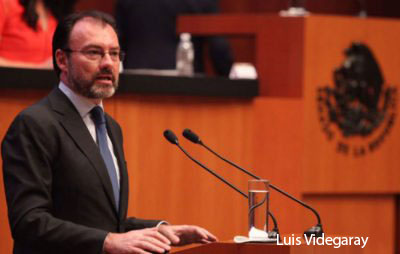
Speaking in the Senate yesterday, Foreign Affairs Secretary Luis Videgaray warned that Mexico would leave NAFTA if it wasn’t favorable to its interests and took aim at President Trump’s predilection for firing broadsides and threats via Twitter.

“We are not negotiating the agreement on social networks, we are not negotiating NAFTA through Twitter, we’re doing it with professionals, acting in good faith and that’s how we’ll continue. But we’ll only continue with this process and in this agreement if it’s in the national interest,” he said.
Videgaray also said that the objective remained to reach an agreement that is beneficial to all three countries but stressed that Mexico’s prosperity didn’t depend on it.

“Mexico is much bigger than the North American Free Trade Agreement and we must be prepared for the different scenarios that could result from this negotiation.”

Videgaray’s comments came after Trump once again weighed in on the issue by making another threat to abandon the trilateral trade treaty.

“I happen to think that NAFTA will have to be terminated if we’re going to make it good,” Trump said in an interview published by Forbes yesterday, adding, “I like bilateral deals.”

As a result of the increased uncertainty, the peso has sunk to its lowest level since June and is now trading at just below 19 to the dollar.
Trump’s hardline stance also attracted renewed criticism this week from business groups and farmers within the United States, including the country’s most powerful business lobby.

The U.S. Chamber of Commerce sent a letter to the White House yesterday, co-signed by over 300 other U.S. business groups, to express their support for NAFTA as it currently stands.

Chamber president Thomas Donohue reiterated the organization’s views, saying that some of the proposals pursued by the Trump administration would undermine trade between the three NAFTA countries — Mexico, the U.S. and Canada — that is worth more than US $1 trillion annually.

“There are several poison-pill proposals still on the table that could doom the entire deal,” Donohue said at a business event in Mexico City.
He specifically referred to the controversial rules of origin proposal which would force automotive manufacturers to source more parts in North America, changes that have been proposed to a dispute resolution mechanism and a “sunset clause” that would force the three countries to reaffirm their commitment to the agreement every five years in order for it to continue.

The “existential threat” to NAFTA also threatened regional security, Donahue said.

Mexico and the U.S. cooperate on a range of bilateral issues beyond trade including the fight against drug trafficking and illegal immigration. Videgaray also said that an end to NAFTA would hurt bilateral cooperation.

At this week’s talks, the U.S. is expected to push a proposal that would require vehicles made in Mexico to have 85 percent NAFTA content in order to remain free of tariffs, up from the 62.5 percent content rule currently in force. Fifty per cent U.S. content may also be proposed, sources told CNBC.

But auto makers in Mexico say that any such move would have a detrimental impact on the industry’s competitiveness while Donohue said that it may have an opposite effect to the one intended because industry would seek to source more input from Asia.

He also criticized the emphasis that Trump has placed on reducing the US $64-billion trade deficit the country has with Mexico.

“It’s the wrong focus and is impossible to achieve without crippling the economy,” Donohue said.

Several analysts believe that there is a definite possibility that the talks — and the agreement — could break down as negotiations continue on the most contentious issues.
Karen Antebi, a senior economic advisor to the Mexican embassy in Washington, said “the risks of withdrawal are high, and we are preparing for that possibility,” while Juan Carlos Hartasánchez, a senior director at the consultancy Albright Stonebridge, said “I definitely think there’s a real chance this could fall apart.”

The chief global strategist at Horizon Investment was a bit more optimistic. Although Greg Valliere described NAFTA as being on “very thin ice” he said that even if threats to abandon the talks became a reality it would not necessarily put a final end to the agreement.

“I do think there is a chance the U.S. or Mexico could walk out,” Greg Valliere said.

“[But] I think people would consider it a stunt and maybe we could resurrect the talks.”

The Washington round is scheduled to conclude on Sunday although there is a possibility it could be extended by two days to Oct. 17.

Source: El Economista (sp), Reuters (en), CNBC (en)

Environment officials plan to oppose wall
Arguments have been prepared against Donald Trump’s border wall

Mexico is set to oppose United States President Donald Trump’s border wall on environmental grounds. But the debate will not begin until the wall’s construction is confirmed.

Environment and Natural Resources Secretary Rafael Pacchiano Alamán said this week it was clear that the project could cause considerable environmental damage.

Construction of eight prototypes for the border wall began September 26 in San Diego, California. Six contractors from across the U.S. were selected for the process, which is expected to take about 30 days.

Four of the prototypes are to be built out of concrete while other materials will be used for the other four. The walls are to range between 5.5 and 9-meter high and must succeed in one prevailing goal: “deter illegal crossings in the area in which they are constructed.”

Once built they will be tested by the Department of Homeland Security, which will pay between US $300,000 and $500,000 for each one.

Testing will be based on the walls’ capacity for “anti-scaling, anti-climbing, anti-digging and safety of border patrol agents,” said Tekae Michael of the U.S. Border Patrol.

Several of the prototypes have been erected.

Mexico’s environment secretary said his department has the necessary environmental arguments against the project.

He also said there are international organizations that have been kept informed of the border wall and that they would collaborate with Mexico.

Source: El Sol de Tijuana (sp), NPR (en), WREG (en)

spot_img