Wednesday, August 5, 2026
Home Blog Page 290

Peru to withdraw its ‘gender ideology’ school curriculum

The Peruvian government will withdraw a 2016 national school curriculum that has been widely criticized for its “gender ideology”

by the El Reportero’s wire services

The First Civil Chamber of the Superior Court of Justice of Lima granted a precautionary measure to the collective Parents in Action (PEA) so that the Ministry of Education (Minedu) partially suspends the implementation of the National Basic Education Curriculum; specifically in a text referring to the gender approach.

The room, chaired by Judge Ana Valcárcel, ordered the suspension of the effectiveness of Ministerial Resolution No. 281-2016-Minedu, “only in the extreme” that approves the curriculum regarding the gender approach, in the part that is consigned : “Although what we consider feminine or masculine is based on a sexual biological difference, these are notions that we build day by day, in our interactions”.

In August of last year, the same court declared partially based the popular action lawsuit filed by the PEA collective and annulled that same text in the pedagogical guide. The group of parents requested the total elimination of the curriculum, due to the fact that, according to the Minedu, it included provisions on sexuality that were not in accordance with what the parents had agreed upon.

Vote pending

Both the Minedu and the collective appealed, and the case was assumed by the Permanent Constitutional and Social Law Chamber of the Supreme Court. The Education sector requested the reversal of the judgment in first instance of the Civil Chamber, considering that the court had issued a “subjective opinion” in its decision.

Meanwhile, the PEA collective appealed for the pedagogical guide to be completely eliminated, since – they indicated – the partial cancellation of the approach and the text that is currently in dispute did not suppress the notions that, according to them, were collected from the so-called ‘gender ideology.’

Precisely, last Tuesday the Chamber of Constitutional and Social Permanent Law of the Supreme Court of the Judicial Power (PJ) left to the vote the appeals filed by both parties. This instance, which is the final one in the ordinary way, has a maximum period of 30 days to cast its vote. Meanwhile, the application of the precautionary measure is immediate.

Trump vows to end birthright citizenship with an executive order, Speaker Ryan says no way.

Some constitutional scholars believe it’s protected by the 14th Amendment and cannot be changed by a stroke of the president’s pen.

US President Donald Trump said on Tuesday he plans to end the “ridiculous” law that allows the right to citizenship to all children born in US territory, something explicitly established by the country’s Constitution.

“We are the only country in the world where a person comes and has a baby, and the baby is essentially a US citizen for 85 years, with all the benefits, “Trump said in an interview with the digital newspaper Axios.

Trump did not mention that, in addition to the United States, Canada also has a similar norm that grants citizenship to those born in its territory. “It’s ridiculous. Ridiculous. And it has to end, “he added.

During the 2016 election campaign, Trump already explored the idea, although experts believe that it faces significant obstacles and would trigger a protracted legal battle to be an explicit part of the country’s Constitution.

In the fourteenth amendment of the US Magna Carta, it states that “all persons born or naturalized in the United States, and therefore subject to its jurisdiction, are US citizens. and the state in which they reside.

“Omar Jadwat, director of the ACLU’s Immigrants’ Rights Project, had this reaction.

“The president cannot erase the Constitution with an executive order, and the 14th Amendment’s citizenship guarantee is clear. This is a transparent and blatantly unconstitutional attempt to sow division and fan the flames of anti-immigrant hatred in the days ahead of the midterms.”

spot_img

The Electoral College debate

NOTE FROM THE EDITOR

Dear readers:

I’ve often been asked the question and have heard concerns from people on the street, whether we should abolish the Electoral College (EC) in the U.S. And this has been more accentuated after Donald Trump successfully won the presidential election thanks to the majority vote of the EC. My answer has always been, that if we do that, the US as we know it: a politically stable nation, it would easily become a dictatorship. The following article, written by Walter E. William, just hits the nail.
I believe it answers most, if not all, most questions about the role of the EC. In election time, It is something we should learn about, and why we should not listen to the extreme left suggestion to abolish the EC. – Marvin R

by Walter E. Williams

Democratic socialist Alexandria Ocasio-Cortez, seeking to represent New York’s 14th Congressional District, has called for the abolition of the Electoral College. Her argument came on the heels of the Senate’s confirming Brett Kavanaugh to the Supreme Court. She was lamenting the fact that Chief Justice John Roberts and Justice Samuel Alito, nominated by George W. Bush, and Justices Neil Gorsuch and Kavanaugh, nominated by Donald Trump, were court appointments made by presidents who lost the popular vote but won the Electoral College vote.

Hillary Clinton has long been a critic of the Electoral College. Just recently, she wrote in The Atlantic, “You won’t be surprised to hear that I passionately believe it’s time to abolish the Electoral College.”

Subjecting presidential elections to the popular vote sounds eminently fair to Americans who have been miseducated by public schools and universities. Worse yet, the call to eliminate the Electoral College reflects an underlying contempt for our Constitution and its protections for personal liberty. Regarding miseducation, the founder of the Russian Communist Party, Vladimir Lenin, said, “Give me four years to teach the children and the seed I have sown will never be uprooted.” His immediate successor, Josef Stalin, added, “Education is a weapon whose effect depends on who holds it in his hands and at whom it is aimed.”

A large part of Americans’ miseducation is the often heard claim that we are a democracy. The word “democracy” appears nowhere in the two most fundamental documents of our nation — the Declaration of Independence and the U.S. Constitution. In fact, our Constitution — in Article 4, Section 4 — guarantees “to every State in this Union a Republican Form of Government.” The Founding Fathers had utter contempt for democracy. James Madison, in Federalist Paper No. 10, said that in a pure democracy, “there is nothing to check the inducements to sacrifice the weaker party or an obnoxious individual.” At the 1787 Constitutional Convention, Virginia Gov. Edmund Randolph said that “in tracing these evils to their origin, every man had found it in the turbulence and follies of democracy.” John Adams wrote: “Remember Democracy never lasts long. It soon wastes, exhausts and murders itself. There never was a Democracy Yet, that did not commit suicide.” At the Constitutional Convention, Alexander Hamilton said: “We are now forming a republican government. Real liberty” is found not in “the extremes of democracy but in moderate governments…. If we incline too much to democracy, we shall soon shoot into a monarchy.”

For those too dense to understand these arguments, ask yourselves: Does the Pledge of Allegiance say “to the democracy for which it stands” or “to the republic for which it stands”? Did Julia Ward Howe make a mistake in titling her Civil War song “Battle Hymn of the Republic”? Should she have titled it “Battle Hymn of the Democracy”?

The Founders saw our nation as being composed of sovereign states that voluntarily sought to join a union under the condition that each state admitted would be coequal with every other state. The Electoral College method of choosing the president and vice president guarantees that each state, whether large or small in area or population, has some voice in selecting the nation’s leaders. Were we to choose the president and vice president under a popular vote, the outcome of presidential races would always be decided by a few highly populated states. They would be states such as California, Texas, Florida, New York, Illinois and Pennsylvania, which contain 134.3 million people, or 41 percent of our population. Presidential candidates could safely ignore the interests of the citizens of Wyoming, Alaska, Vermont, North Dakota, South Dakota, Montana and Delaware. Why? They have only 5.58 million Americans, or 1.7 percent of the U.S. population. We would no longer be a government “of the people”; instead, our government would be put in power by and accountable to the leaders and citizens of a few highly populated states.

Political satirist H.L. Mencken said, “The kind of man who wants the government to adopt and enforce his ideas is always the kind of man whose ideas are idiotic.”

(Walter E. Williams is a professor of economics at George Mason University).

spot_img

Global economy: between a rock and a hard place

NOTE FROM TE EDITOR:

Dear readers:

I found this article so interesting and educating in how the global economy as it is developing in front of our own eyes, affects the whole world. And we all are affected by it, for being in the middle. Do you understand how the banking system – as a monetary paradigm – is imposed on all of us under the barrel of a gun?

by James Corbett

Well, it’s official: “Japan Inc.” is now “Bank of Japan Inc.”

Oh, OK, not officially official, but just about. As the Nikkei Asian Review reports, the Bank of Japan (BOJ) is now a top-10 shareholder in a whopping 40 percent of the listed companies in the country. That’s right, having purchased 25 trillion yen ($227 billion) worth of exchange-traded funds in the past eight years, Japan’s central bank is now one of the top 10 shareholders in 1,446 out of 3,735 companies listed on the Tokyo Stock Exchange.

Even the banksters admit they’ve painted themselves into a corner with their stock buying frenzy. BOJ Governor Kuroda concedes that if the bank persists in pumping its funny money into the markets there will be serious “side effects” that could harm the entire banking sector. So they should turn off the spigot and drain the monetary swamp by raising rates, right? Nope. As BOJ board member Yutaka Harada points out, the banksters can’t reverse the tide and raise interest rates because “bond and stock prices would decline and the yen would appreciate,” completely negating the entire point of the asset purchases in the first place.

So what does all of this mean?

Well, if you’re Japanese it means your central bank is creating (as one Japan-based asset manager puts it) “a new form of financial socialism” from which “Nobody can see a smooth exit strategy.”

But more broadly, the economic pickle that Japan finds itself in right now is merely a small-scale example of the dilemma that the global economy is facing. Caught between the low interest global liquidity trap and the high interest global debt trap. Caught between the globalist “free trade” nightmare and the emerging trade war/hot war nightmare. Caught between the expansion of a predatory system that is designed to drain the wealth of the average worker and the collapse of that system, which will assuredly drain the wealth of the average worker.

The straits between these economic rocks and hard places couldn’t be any narrower. It’s enough to make Scylla and Charybdis look like a cakewalk.

But for those who fail to comprehend the bigger picture here, it should be stressed that this isn’t just about interest rates and bond yields. The point here isn’t what level the stock market is at or whether some trader in Jeddah is going to be selling oil in dollars or yuan. The real point, as I have been trying to stress in this column for some time, is that economics is never just economics. The global economy rests on a monetary paradigm. That monetary paradigm emerges not from some economic calculation but, more often than not, the barrel of a gun.

It’s no coincidence that the Bretton-Woods system instituting the US dollar reserve paradigm arose from the ashes of WWII. It’s no coincidence that that paradigm began to break down when the US started using its reserve currency privileges to run up the debt for the military-industrial complex. It’s no coincidence that the petrodollar paradigm which replaced Bretton-Woods rested on a military and geopolitical alliance with the Saudis. It’s no coincidence that the erosion of that paradigm is giving rise to worries about a Third World War and, presumably, a monetary reset.

It’s no coincidence because all of these things are directly related. The breakdown of the economic order is intimately tied to the breakdown of the geopolitical order. It’s part and parcel of the change that is occurring in the monetary order. And it is inseparable from the rising military tensions that accompany the decline of the American unipolar order.

Let’s highlight another “small” story that fills in one of the pieces of this giant jigsaw puzzle.

Earlier this week, China pitched an idea to EU diplomats attending a Sino-European summit in Beijing: “Join us in an anti-US trade alliance and together we can win the global trade war!” Multiple suggestions were proffered for what form such an alliance might take. China could open up more of its market to EU business as a gesture of good will, for instance, or the two powers could launch a joint action against the US at the World Trade Organization.

The EU’s reaction was swift: “Thanks, but no thanks!”

You have to admit, it was a bold gambit. The idea of the EU throwing Uncle Sam (and the almighty dollar) overboard for a few paper promises about “freer trade” from the notoriously mercantilist ChiComs is absurd.

But think about what it means that such an idea was even proposed. A few years ago, even a few months ago, such a plan would have been unthinkable. Today, it is merely fanciful. And tomorrow…?

This is what the breakdown of the global trading order is really about: Not the fluctuations in the trading accounts or currency reserves of this or that nation, but the reorganization of the alliances between those nations. And, if push comes to shove, the possible crossing of swords between nations.

Now couple this story with the BOJ shareholder story (or the Argentinian peso story, or the emerging market bond story, or the Iranian oil story, or any number of other stories from the world of economics, finance and trade) and the picture becomes even clearer: We are heading toward a crisis. The only question is what new order will emerge from that crisis.

As I discussed in my most recent edition of the “Questions For Corbett” series, a period of chaos, breakdown and crisis is necessary for a change in world order to occur. And whether that change leads to the New World Order that the powers-that-shouldn’t-be are constantly lusting after or a new flowering of human freedom is still very much up in the air.

In the end, that question will not be answered by the central bankers of the world. It will be answered by us. That answer lies in us withdrawing our support for the current system, choosing where to re-direct our energy and resources, refusing to fight the banksters’ wars for them, and creating the alternative system we want to see emerge from the chaos . . . or lying back and doing nothing. And I think we all know where that option leads.

spot_img

Benefits of regular fasting

by Ben Fuchs

One of the healthiest lifestyle strategies is easy and won’t cost you anything. In fact you’ll probably end up making money in the long run. I’m talking about intermittent fasting (IF), a healthy idea that’s been practiced for thousands of years. Intermittent fasting turns on genes that stimulate growth and repair and anti-aging, especially in combination with exercise. If done correctly it can help keep the body in fat burning mode. And it’s got important effects on stimulating motivation and drive and brain power. After all when someone is young and ambitious we often say that they are… “hungry”

In a famous experiment in the 1940’s scientists from the University of Chicago showed that they could increase the lifespans of animals by up to 20 percent simply by denying them food every 3rd day. And in a review by that was published in 2007 in the American Journal of Clinical Nutrition, researchers from U C Berkeley found that alternate day fasting could save lives by decreasing risks for heart disease and cancer, and diabetes, the three leading causes of death in the United States, Moreover they found that they’re important for the nervous system and the brain, improving cognitive function and providing protection from Alzheimer’s Disease and Parkinson’s Disease.

There’s also an important insulin connection to the benefits of fasting. Insulin is a type of Master hormone, in the sense that it up-regulates many different cell activities; and it affects every single cell. The prime stimulus for insulin secretion is food. When we eat any carbs our protein cells get drenched in insulin. In addition to feeding cells, insulin tells cells to divide and grow. Insulin turns on cellular activates. Biochemists call that up-regulation, which, while important, is helpful only in the right context. For instance, if we’re lifting weight and we’re building muscle, exercising etc. If we live the typical American sedentary lifestyle, this up regulation is not necessarily a good thing. Elevated blood fats, hypertension, skin problems like acne and psoriasis, cysts and growths and endometriosis are all possibilities if cells are stuck in overdrive from too much exposure to insulin.

Even worse if we’re constantly eating and insulin is constantly being secreted eventually cells become immune to insulin’s effects on cell nourishment and feeding.
Unfortunately, you’ll still have enough insulin around to stimulate cell growth and division, and up-regulation activates, except now cells will be upregulated in state of starvation that’s VERY, VERY BAD!! This unfortunate insulin issue is behind every single chronic degenerative disease you can name. Doctors call the various breakdowns in the body that are associated with dysfunctional, messed up insulin, Metabolic Syndrome. Which means basically everything or anything can go wrong. High blood pressure, elevated blood fats and cholesterol, heart disease, cognitive breakdown etc. eye diseases, and osteoporosis are all examples of Metabolic Syndrome symptoms that can be traced back to elevated insulin secretion.

Of course using nutrients to potentize insulin is always a good idea. Vitamins like niacin, thiamine, Vitamin A and minerals, like chromium, vanadium and zinc can be helpful. You want make sure you’re getting some regular exercise too. But there is no quicker way to get insulin back in line and to improve longevity, increase muscle growth and generally slow down the aging process, than to reduce caloric intake and make it habit to fast once or twice a month. (Natural News)>

spot_img

Marriott Hotel workers on strike stay tough on the picket lines

Essay by David Bacon

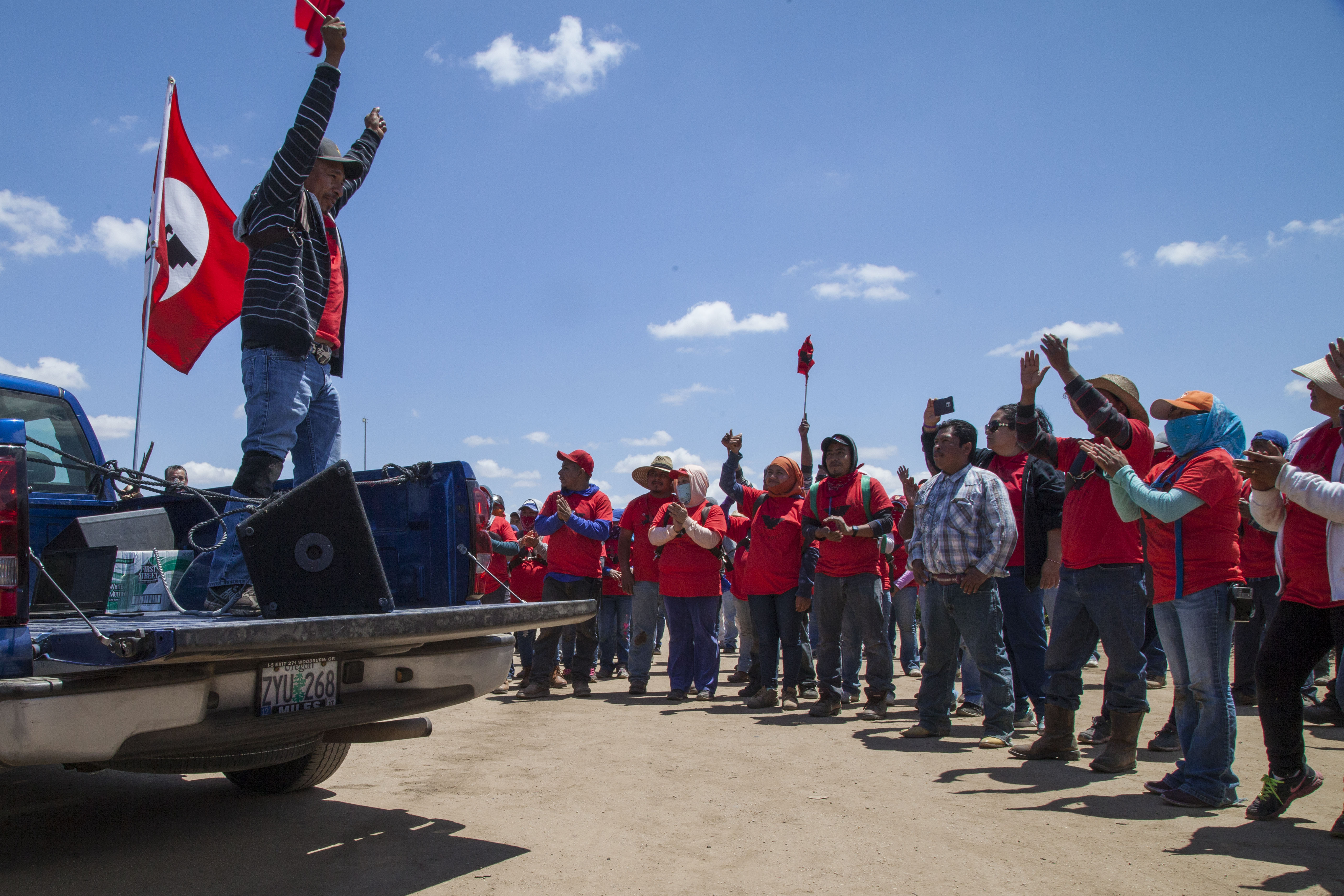
Three weeks on the picket line will either weaken a strike or make it stronger. But workers at the Marriott hotels in eight cities around the US show no signs of wanting to go back to work anytime soon, at least not without resolving the reasons why they went on strike to begin with. Instead, the noise on the picket line is getting louder. Workers bang on pots, drums — even old folding chairs — making a racket loud enough to penetrate thick walls and double-paned windows. As a result, many hotel guests not dissuaded by their initial encounters with picketing workers are giving up and leaving.

“Over 20 guests have told me they’re checking out and moving to the Waterfront Hotel,” said Kenneth Walker, the veteran head doorman at the Marriott City Center Hotel in Oakland, California. The Waterfront Hotel, just a dozen blocks down Broadway, is not on strike.

It’s not just happening in Oakland. The San Francisco Chronicle’s Roland Li reports that organizers of the 2018 ComNet conference (a network of foundations and non-profits discussing better communications), which normally draws 1,000 attendees, moved their events out of the struck St. Francis Hotel. The St. Francis used to be a Westin property, but became part of the 700-hotel Marriott empire when Westin was bought out by what is now the world’s largest hotel chain.

Other organizations pulling out of commitments at the Bay Area Marriotts include the Human Rights Campaign, the Shanti Project, the Chicana Latina Foundation and Bay Area Wilderness Training. In response, a huge wave of robocalls is hitting thousands of people in the region, trying to lure them into the Marriotts with offers of special deals.

However, not everyone is avoiding the hotels where workers are on strike. For instance, in Boston, the New York Yankees and Los Angeles Dodgers did not cancel hotel reservations for their baseball teams. Instead, ballplayers, themselves members of a union, snuck into the rear entrances of struck hotels as workers yelled questions to them about their apparent lack of solidarity.

Nevertheless, the picket lines and the creative tactics used by the workers and their unions have largely been the reasons hotel customers have turned away. The impact of housekeepers walking picket lines, instead of making beds, has been hard for the company to deny. According to Tonya Lee, a PBX(AYS) operator on the hotel telephone switchboard for the Oakland Marriott for 28 years, “If our manager had to clean seven rooms, he couldn’t do it. Right now he just strips the bed, which is the easy part. He doesn’t then make it or do what comes next. The managers have told me that the strike has made them respect what we just do every day.”

That’s also how Walker describes his experience as a member of the negotiating committee of his union, Unite Here Local 2850. “We’re going to win,” he said. “I feel the people across the table have learned to respect us.”

To get Marriott’s directors to pay attention to the union’s demands, the picket lines have been augmented by street actions and marches. Forty-one hotel strikers and supporters were arrested on October 12 for sitting on Fourth Street in front of Marriott’s San Francisco flagship, the Marquis. In Oakland, on the coordinated national day of marches a week later, hundreds of strikers and supporters took over the intersection of 10th Street and Broadway, outside the hotel entrance. As the police stood without intervening, children painted the strike’s slogan in huge letters on the asphalt: “One Job Should be Enough.”

Workers want protection from the increased use of automated equipment for doing jobs from checking in guests to mixing cocktails. The hotel chain has implemented a “green hotel” program, encouraging guests on cards left in the rooms not to ask for new linen and towels. Although it sounds like an environmentally friendly idea, workers accuse the hotels of using it to reduce the need for housekeepers, speeding up the work and putting their jobs in danger. Instead, the union seeks to reduce a punishing workload, especially for the housekeepers who clean the rooms and make the beds.

While Unite Here locals in each city holds bargaining talks for the hotels located there, the strike has coordinated actions by more than 7,700 workers in San Francisco, Oakland, San Jose, San Diego, Detroit, Boston, Maui and Honolulu. Seattle Marriott workers have also voted to authorize a strike.

At some hotels, workers are veterans of strikes like this. In 2004, a strike by Local 2 in San Francisco became a lockout by the city’s swankiest establishments. The struck corporations tried to force workers to return under their terms by ending their health coverage. Even after the union defeated the lockout and the workers returned without a contract, hotels refused to deduct workers’ dues payments, thinking this would force the union to agree to concessions. Instead, for two years, the workers paid their dues voluntarily, and at the end, won agreement on the contract they sought.

Since then, what was once a network of large hotels and the companies managing them has become much more of a monopoly. Marriott owns six hotels in San Francisco where workers are striking. At two non-union ones — Airport Marriott Waterfront near the airport and the downtown JW Marriott — workers have declared their open support for joining Unite Here Local 2. They are demanding that managers agree to a fair process for recognizing the union.

Local 2’s strategy, helping workers organize in the middle of a strike, contradicts accepted wisdom among some organizers, who fear managers will use strike threats to discourage workers from union support. Local 2 organizers say their experience is the opposite — that the strike shows that the union is willing and able to fight for improvements against their employer.

In Oakland, Marriott workers are experiencing their first strike. At the beginning, they were unsure if the rest of the workers would support them, even though the strike vote was 98 percent in favor. “We weren’t really prepared for this on the first day,” said Tony Scott, a bellman for 35 years. Lee adds, “I came to work on Friday [October] 5th, and when it was time, I went in and told my coworkers to come out. I wasn’t sure they would. When they all did, I felt I was 10 feet tall.”

Strikes are an education in power, and its lessons haven’t been lost on the picket lines. “Numbers are always important,” Walker explains. “Marriott has used its numbers — how much money they make and how many hotels they own. Now we’re using our numbers to show them they can’t do it without us.”

“This is my first time being on strike, and I see the union is a very powerful force if we stick together,” said Scott. “We have to stand for something. I’ll stay on the line until this is over.”

spot_img

Keiko Fujimori was held in the Annex Prison for Women in Chorrillos

The leader of Fuerza Popular in Perú will ramain in prison for 36 months by order of judge Richard Concepción

by El Comercio

The leader of Fuerza Popular, Keiko Fujimori, must serve preventive detention by decision of Judge Richard Concepción Carhuancho.

The leader of Fuerza Popular, Keiko Fujimori, was detained this morning in the Annex Prison for Women of Chorrillos, after being transferred, under strong security measures, from the jail of the Judicial Power, located in the Center of Lima.

A caravan of the National Police guarded the van of the National Penitentiary Institute (INPE), in which Fujimori Higuchi was traveling, along the Expressway of the Av. Paseo de la República and the Costa Verde. leaving the jail showed a smile for his supporters, who were in the outskirts.

Keiko Fujimori spent his first night of preventive detention on Wednesday, following the order of Judge Richard Concepcion Carhuancho in the framework of the investigation that is followed for allegedly receiving and laundering illegal contributions of the Brazilian construction company Odebrecht. It was visited by the congressmen Úrsula Letona and Karla Schaefer.

The place where the leader of Fuerza Popular will remain is next to the Chorrillos Women’s Prison and it is the same center where the former first lady Nadine Heredia was held for nine months when Concepción Carhuancho also ordered preventive detention against her and the former president. Ollanta Humala

The former presidential candidate must serve preventive detention for 36 months by order of the investigative judge Richard Concepción Carhuancho, who responded to the request made by prosecutor José Domingo Pérez to apply this measure against Keiko Fujimori and ten others investigated.

Although they have not yet finished discussing all the cases of the defendants (six were missing at the time that was ordered in custody against Keiko Fujimori), the magistrate decided to evaluate case by case and had enough elements to determine the case of the leader of Fuerza Popular.

Before this resolution, the defense of Keiko Fujimori presented an appeal that they expect to be heard within a period of about three weeks, after it is determined whether or not the recusations that have been filed against Richard Concepción Carhuancho and the National Chamber of Appeals filed by lawyer Giulliana Loza and prosecutor Rafael Vela Barba respectively.

spot_img

Peña Nieto seeks legal protection against Chihuahua corruption probe

Unprecedented move seeks to protect federal officials as embezzling investigation continues

by the El Reportero’s wire services

With its days in office numbered, the administration of President Peña Nieto has made a last-minute and unprecedented attempt to protect itself from a corruption investigation in which federal officials could face prosecution.

The president’s legal office this month filed a motion with the Supreme Court that seeks to prevent officials from being targeted by a corruption probe in Chihuahua relating to the alleged diversion of public funds to the Institutional Revolutionary Party (PRI).

It is the first publicly known case in which the president’s legal office has sought to protect him and other officials in a corruption investigation, the Associated Press reported.

Authorities in Chihuahua are investigating a suspected embezzlement scheme, allegedly operated by Alejandro Gutiérrez, a former federal lawmaker and high-ranking official in the PRI, the same party Peña Nieto represents.

The scheme allegedly diverted 250 million pesos (US $13 million) from the federal Secretariat of Finance to the administration of former Chihuahua governor César Duarte. The money is believed to have been used to fund PRI candidates’ campaigns in the 2016 state elections.

Gutiérrez was arrested last December and placed in preventative custody but he was released last month after a challenge against his acquittal was rejected.

Duarte fled Mexico to the United States last year and is considered a fugitive from justice but the federal government has so far failed to extradite him.

After Gutiérrez’s exoneration and release, current Chihuahua Governor Javier Corral of the National Action Party (PAN) called the entire process a “pretense.”

Official Complicity in Panamanian Farmers’ Eviction Denounced

The eviction of 400 farming families from their lands in the western Panamanian district of Baru, ordered by the justice system, is illegal, unconstitutional and deprives them of their rights, said defenders of the victims on Tuesday.

The contract-law between the State and the private company Banapiña Panama declared as ‘invaders’ those who produced food for almost two decades on public lands abandoned by a previous agricultural concessionaire, and this protects them legally under the Agrarian Code currently in force in the country, said lawyer Santander Tristan.

This law, in its article 157, establishes the right of anyone who maintains public agrarian possession and dedicates it to production ‘without interruption for fifteen years, with no need for a title,’ a condition met by those represented, according to the lawyer.

‘In the farms owned by THE STATE that are occupied by invaders at the signing of this Contract, THE STATE will assume, through the local police authorities, the pertinent legal actions so that, when THE COMPANY starts operations, the farms are unoccupied,’ the pact states.

Based on this affirmation, the government has demanded the ‘launch by intruders’ of the mentioned producers and the peace judge Ulsana Valdes has ordered the eviction to be executed, in spite of this competence being ‘privative and non-extendable’ of the agrarian jurisdiction, explained Tristan.

spot_img

Ninth Circuit affirms relief for immigrant teens wrongly arrested

by the El Reportero’s wire services

Civil rights and immigration advocate organizations have prevailed in the U. S. Court of Appeals for the Ninth Circuit on behalf of immigrant teenagers whom the Trump Administration had arrested and jailed for “gang affiliation,” despite there being no evidence of gang crimes.

In an opinion issued on Oct. 1, 2018, the Ninth Circuit affirmed a preliminary injunction requiring the government to give the teenagers notice of the reasons for their arrests, access to the evidence being offered against them, and a prompt hearing in front of a judge, in which the government would have the burden to justify their detention.

The case involves a class comprised of teenagers who were previously released by the federal Office of Refugee Resettlement (ORR) to the care of relatives while their immigration proceedings were pending. Starting in June 2017, many of these teenagers were rearrested by the Department of Homeland Security (DHS) based on unsubstantiated claims of gang affiliation, turned over to ORR and then held by ORR in jail-like detention facilities for many months without a hearing. The ACLU filed suit in the United States District Court for the Northern District of California, challenging their wrongful arrests and illegal detention, and in November 2017, the district court judge granted the plaintiffs’ motion for a preliminary injunction, ordering that all of the teenagers must be given hearings within one week. He also ordered that any additional children who were rearrested under similar circumstances in the future would be entitled to the same prompt hearing.

187,000 dreamers have renewed DACA

More than 187,000 Dreamers have been able to renew their deferred action and work authorization under DACA since January. This data was published in the latest quarterly report on DACA renewals, which the federal government is required to file as part of the preliminary injunction that California secured to preserve DACA, reported the California Attorney General Office.

Tensions escalate after 25 days of general strike in Costa Rica

The general strike for an undetermined period against the fiscal reform being promoted by the Government in Parliament turns 25 days on Thursday, amid an increase in protests and police repression against demonstrators.

Members of Unidad Sindical y Social Nacional (USSN), a coalition of workers’ and social groups, have increased regional actions as part of the general strike against the draft bill Strengthening Public Finance, plan or fiscal reform, which is also known as the fiscal combo by its opponents.

On its 25th day, the general strike will consist of regional protests as usual, amid an escalation in the tone of the demonstrations, including police repression against strikers in Puntarenas and Limon, and demands for President Carlos Alvarado to listen to the people.

According to reports from the USSN, police officers launched tear gas at people who were protesting peacefully on Road 27, in Calderas, in Puntarenas province, and they did the same in Limon.

Mexican Senate begins review of USMCAN treaty

The Mexican Senate begins on Wednesday the revision of the U.S.-Mexico-Canada (USMCA) Agreement by welcoming the team of President-elect Andres Manuel Lopez Obrador, who participated in the negotiation.

This was reported by the coordinator of the National Regeneration Movement (Morena), Ricardo Monreal, who stressed it is the first time that the Mexican Upper House will carry out the review of this agreement along with its U.S. counterpart.

About the agreement, he expressed his satisfaction with the energy issue, because the country’s sovereignty over its natural resources was safeguarded. But he advanced that he will wait for the revision of the text to give his definitive opinion.

Napoleón Gómez, who is also a senator from Morena, commented that he will study the USMCAN labor chapter with a lens, and the same will be done by the large trade union organizations in the United States and Canada, in order to reach a common platform of respect, justice and dignity for the workers of the three nations.

We need more push in Mexico, where wages are lagging behind, he said.

He said he hopes the labor chapter has covered the issues of safety at work, respect for the environment, as well as the obligation for multinational companies operating in Mexico to respect Mexican laws.

Next week the Secretary of Economy, Ildefonso Guajardo; and the Foreign Minister Luis Videgaray will appear before the Senate. From there, the 32 chapters of the agreement will be reviewed in commissions.

spot_img

Third migrants’ caravan scheduled to leave El Salvador within the next week

The number of migrants traveling through Mexico could soon reach 10,000

by Mexico News Daily

A third caravan of migrants is expected to leave Central America within the next week, which could bring the total number of people escaping poverty and violence by making the northward trek to nearly 10,000.

The third wave, believed to have been inspired by the caravan now traveling through Chiapas, is scheduled to leave El Salvador on October 28 and cross the border into via Tecún Umán, Guatemala, according to one report.

Organized on a Facebook group called El Salvador Emigrates for a Better Future, the caravan’s communications on social media are being monitored by the United States Department of Homeland Security, NBC News reported after obtaining an internal government report. That document indicated the departure date would be October 31, and that so far the migrants were largely families traveling with children.

The first and largest caravan entered Mexico via Ciudad Hidalgo, Chiapas, last Friday and according to the United Nations is composed of more than 7,000 people. Today it is en route to Mapastepec, Chiapas.

A second caravan of about 2,500 people from Honduras that is currently in Guatemala has divided into two smaller groups.

Guatemala police said one group of about 1,500 people is en route to Tecún Umán while the other group of about 1,000 is planning to cross into Mexico at El Ceibo, Tabasco. Local media reported that the second group’s numbers have been augmented by migrants in the Honduras caravan who were deported from Mexico last week.

“Several units of the police are accompanying the caravan for security reasons,” said police spokesman Pablo Castillo. He also explained that military personnel and police attempted unsuccessfully to stop the advance of the group on Monday.

The Guatemala government said it was adopting measures to stop the entry of more migrants from Honduras and El Salvador into its territory, although attempts by both Guatemala and Mexico to halt the flow have failed.

In El Salvador, the government has taken a different stance. President Salvador Sánchez Cerén expressed support yesterday for the first caravan of migrants and criticized the position of U.S. President Donald Trump despite the latter’s announcement that he would cut aid to El Salvador and other Central American countries for not preventing the migrants from leaving.

“For us, to migrate is a human right so the rights of migrants have to be protected; we are totally opposed to the policy of Donald Trump,” he said.

Emigration from El Salvador has contributed to the development of the U.S. and helped the North American economy, Sánchez continued.

Trump has claimed that there are “Maras,” or members of the criminal gang Mara Salvatrucha, among the migrants, although the gang originated in Los Angeles, California. However, most were originally from El Salvador.

Source: El Universal (sp), NBC News (en), Infobae (sp)

UN warns some migrants are in danger should they be deported
Refugee agency says they are fleeing ‘real danger’ back home

The United Nations Refugee Agency (UNHCR) has warned that the migrant caravan currently traveling through Mexico is likely to include people fleeing “real danger” in their countries of origin.

UNHCR spokesperson Adrian Edwards told a press conference in Geneva, Switzerland, today that “in any situation like this it is essential that people have the chance to request asylum and have their international protection needs properly assessed, before any decision on return/deportation is made.”

The federal government last week warned members of the caravan, made up mainly of Hondurans, that if they enter Mexico illegally, they will be detained and deported.

However, after attempts to prevent the caravan from entering Mexico on Sunday proved futile, the migrants have walked and/or traveled on the back of trucks or in other vehicles through Chiapas unimpeded.

The government invited the UNHCR to help attend to the migrant caravan, whose numbers have been estimated as high as 7,000 people.

Most of the migrants don’t have visas and haven’t formally requested asylum with the National Immigration Institute (INM).

Around 200 migrants remain camped out on the bridge in Ciudad Hidalgo, Chiapas, on the border between Guatemala and Mexico waiting to enter Mexico legally, the newspaper Milenio reported.

Edwards said that as of yesterday there were 45 UNHCR staff in Tapachula, Chiapas, and that others are en route.

spot_img

AMLO promises visa and work for Central American migrants

“We are going to offer employment, work for Central American migrants,” said the president-elect, Andrés Manuel López Obrador

by Jorge Monroy

“We are going to offer employment, work for Central American migrants,” said the president-elect, Andrés Manuel López Obrador, reiterating that in order to reduce the migratory phenomenon, it is necessary to create welfare conditions.

At a press conference in Tamaulipas, after meeting with Governor Francisco Garcia Cabeza de Vaca, Lopez Obrador was questioned about whether the Mexican government should allow the passage of the caravan of migrants from Honduras. In response, Obrador said that migrants should be seen beyond the free passage.

He reiterated that one of the solutions is that the president of the United States, Donald Trump, accept the plan that he proposed to generate development in Mexico and the Central American region.

“It has to do with the same, we are asking the government of the United States, the government of Canada, the implementation of a development plan in Mexico and in the Central American countries, we are making a proposal for cooperation for development. The one who leaves his town does it out of necessity, not for pleasure, and we want the migration to be optional, not compulsory, and for people to work, be happy where they were born, where their relatives are to temper the migratory phenomenon, they have to take care of the causes; there must be investment to generate employment, improve living conditions, work in Central America and in our country; I explained this to President Donald Trump; He will accept our proposal, is carrying out a bilateral consultation process, we have information about what is happening in Central America and our position is to face the migratory phenomenon with development, with work, with well-being in Central America and in the country ” he commented.

But should the caravan be allowed in? -She was asked.

“There are options, there are alternatives. It’s not just about that (letting the caravan go by), it’s about giving options, giving alternatives, that those who leave their villages have job opportunities, we in Mexico, from December 1, we will offer employment I work with Central American migrants, that is a plan that we have; that who wants to work in our country, will have support, will have a work visa, we are seeing that. It is not dealing with the issue only with deportations or with measures of force, but by giving options, alternatives. This plan will be announced as of December 1, and we are looking for joint support, and progress is being made. In the last call I had with President Donald Trump, we celebrated the signing of the free trade agreement with the three countries, a trilateral agreement, and I told him that the second step is the development plan that includes Central America to promote productive activities , create jobs, and in this way confront the migratory phenomenon, not with deportations, not with measures of force, but giving people who leave their villages looking for work, “he said.

López Obrador said that the migratory phenomenon must be approached with respect to human rights and giving work options to those who are forced to leave their villages.

“The plan is that nobody is forced to emigrate, that’s the ideal, and if they already make the decision to leave their villages, they have options in Mexico. The plan of our development are like curtains to give job opportunities, all the south will have possibilities of occupation, of employment, for thousands of workers, because we will plant in the south-southeast 1 million hectares of timber trees , 400,000 jobs will be created, the Mayan train will be built, it is an investment of 8,000 million dollars, the Isthmus of Tehuantepec will be developed, that is another curtain. What results from the consultation on the airport in Mexico City will involve investment that will greatly strengthen industrial development in the Bajío. Here in the north there will be a free zone from Matamoros to Tijuana, taxes will go down from 16 to 8 percent VAT, to 20 percent the ISR, will increase the minimum wage to double in the border area, then, they are opportunities so that nobody is forced to leave the country, “he said.

In another related news in Mexico under Peña Nieto administration

Mexico to migrants: you will be deported if you do not have documentation
As many as 4,000 migrants are believed to be heading for Mexico’s southern border

The federal government has warned to caravan of Central American migrants traveling to the United States via Mexico that if they enter the country illegally they will be detained and deported.
In a joint statement, the secretaries of Foreign Affairs (SRE) and the Interior (Segob) said that in accordance with the law, anyone who enters Mexico “irregularly” will be “rescued” and subjected to review.

If they do not have the required documentation they will be returned to their own country.

The statement said the measure “responds not just to compliance with national legislation” but also to the government’s interest in avoiding migrants becoming “victims of human trafficking networks.”

More than 200 Federal Police officers arrived in Tapachula, Chiapas, yesterday to help the National Immigration Institute (INM) secure the southern border. The organization’s chief, Manelich Castilla, traveled to the border city earlier this week.

As many as 4,000 mainly Honduran migrants fleeing poverty and crime are planning to travel through Mexico to the United States, infuriating U.S. President Trump.

Many are traveling on foot, some with babies and small children, while others are in buses.

One Honduran whose legs had to be amputated after he fell from a Mexican freight train during an attempt to get to the United States in 2015 is trying again. This time a fellow migrant is pushing his wheelchair.

spot_img