Saturday, October 17, 2026
spot_img
Home Blog Page 289

Oscar®-Nominated ROMA Star Yalitza Aparicio to Appear as Keynote Speaker During International Labour Organization (ILO) Centenary Celebration

Appearance to Commemorate International Women’s Day on March 8

by the El Reportero’s wire services

GENEVA – March 6, 2019 – Today, it was announced that Yalitza Aparicio, the Oscar®-nominated star of three-time Academy Award®-winning film ROMA, will make a special appearance during the International Labour Organization (ILO) centenary celebration at its headquarters in Geneva. The event kicks off March 7 with a free screening of Oscar® winner Alfonso Cuarón’s ROMA, followed by a panel discussion with Aparicio, Marcelina Bautista, Secretary-General of Mexico’s National Union of Workers and Domestic Workers, and Claire Hobden, ILO Technical Officer on Vulnerable Workers.

In addition to the screening, Aparicio will take part in the ILO’s International Women’s Day celebration held on March 8. Titled, “A Quantum Leap for Gender Equality: For a Better Future of Work for All,” the event will include Aparicio as the featured speaker offering insights into her personal experiences as an indigenous woman, as well as her work experiences as an educator and actress. Aparicio will be part of a high-level conversation, moderated by journalist Femi Oke, that also will include Guy Ryder, Director General of the ILO, and public and private sector leaders on gender and the world of work and entertainment.

spot_img

Oakland teachers fight for public education

Article and photo by David Bacon

Students and parents have come out en masse to join the marches and picket lines of the ongoing teachers strike in Oakland, California. All say that they are trying to save the city’s public school system.

“This is a strike to save our district,” said Heath Madom, who’s taught 10th grade English for three years at Oakland Technical High School, which is referred to as “Tech” by educators and pupils. “Our Tech community is committed to saving public education. Twenty-four schools are on the chopping block. We could become like New Orleans, with no public schools and all charters, if this keeps going.”

Like other teacher strikes around the country, the Oakland conflict is fueled both by a determination to protect the public school system itself and by the crisis in funding that has led to huge classes and deteriorating conditions in the schools themselves. According to Madom and the Oakland Education Association, only 5 percent of the district’s 37,000 students have passed through their schools’ doors over the last three days – evidence of vehement parent and community support.

Parents, students and teachers all condemn the rise in class sizes. “My class is a catch-all, because all students have to take it, so class size is a huge issue,” said Rho Seidelman, who’s taught ethnic studies at Tech for three years. “There’s no tracking, which is great, because we have students from all backgrounds and previous schools. But it’s hard to build community among the students when there are so many. The contract says 32 is the limit, and I routinely have at least 33. Research shows that the best learning environment is in a class of 18, where students can really learn and build community. When students are absent and my class size goes down to 28 or 26, I’m really happy.”

Madom says most classes at Tech have 35-40 students, and the school, built for 1,800, has a student body of 2,000. “We only have two part-time nurses for 2,000 students, and they don’t have the time or resources to deal with all their medical problems. We have a beautiful library, but haven’t had a librarian for years. Our counselors have a caseload of 500 students apiece. If they saw every student, they would only be able to spend a few minutes with each,” Madom said. The hiring of more nurses, librarians and counselors is part of the strike demands of the union, the Oakland Education Association, which is affiliated with the National Education Association (NEA).

Teachers’ pay is also part of the strike demands. The union wants a 12 percent raise over 3 years, and the district is stuck at 7 percent with a bonus. “The only reason I can live in Oakland is because I live with a partner who has a good income,” Seidelman said. “What I make is not enough to live here. I’m still paying off my school loans, and rent takes up almost half my income. My job would clearly be improved if we won the demands of our strike, and I, and other teachers too, would be more likely to stay.”

“People here are struggling,” Madom added. “Some teachers are commuting long distances to get here. We had seven excellent teachers leave this year, including two English teachers with more than five years [of] experience.”

Prior to the strike, a state fact-finder’s report found that the teacher retention crisis in Oakland is worse than most other districts in the state, which the state attributes to substandard pay, the lowest among the Bay Area’s districts. The fact-finder also mandated reducing class sizes, especially for special education classes, and concluded that school privatization was hurting students.

Slating 24 schools for closure is part of the privatization regime, Madom argued, adding that the closures are hitting communities that have been historically underserved the hardest. “At the same time, the district has allowed charter schools to proliferate, which is a direct reason why enrollment has declined in public schools they now want to close,” Madom added. “Yet there’s no discussion of closing any of the charters.” Those charter schools already enroll 13,000 students in Oakland.

Seidelman said these priorities are part of a culture in Oakland that favors development to benefit the affluent. “If it was up to a popular vote, our community would support the strike’s demands overwhelmingly. But our community is not in control of the basic decisions in the city. The strike has exposed the political corruption in Oakland city politics. The terrible condition of our schools is a consequence of the policies imposed by business interests. The resources of the city go to gentrification, which benefits them, but not our communities. It’s true all over the country, which is why there are strikes now in so many places. It’s not just a problem of Oakland.”

But the national teachers’ strike wave is challenging those priorities. “It’s shifting the narrative on public education,” Madom said. “The charter industry has claimed that poor students don’t get the education they deserve because of poor teachers. Public school teachers haven’t been heard until now. We do need great teachers, but the problems of our schools aren’t due to individual teachers. The district for years hasn’t funded classrooms adequately, but the state also has grossly underfunded education. California has a massive amount of wealth. I can’t believe we’re living in one of the richest states in the country, and yet there’s no money for education. We’re tired of putting up with austerity. The strike wave is happening because teachers are standing up, and saying ‘enough is enough’.”

After talks broke down on February 24, sending the strike into its third day, Keith Brown, president of the Oakland Education Association, told reporters that the district had “returned to the table without a proposal that would begin to meet our core bargaining demands [which include an obligation to] fully fund our schools and provide a living wage to keep teachers in Oakland.”

Novelist Alice Walker was among many celebrities and political figures to rally behind the teachers. “You should be given, really, anything you ask for,” she said in a letter. “It is criminal that you are not. Especially when we see it is the war effort, more often than not, that is supported lavishly. An effort that often cuts short the very lives you have lovingly prepared to live with understanding and intelligence in this world. Know that you have sisters and brothers who stand with you, heart to heart.”

The majority of the following photographs were taken on the strike’s first day, February 21, when teachers, parents and students rallied in front of the Oakland City Hall, and then marched through downtown streets to the offices of the Oakland Unified School District.

spot_img

IN MEXICO: Refineries showing some signs of life as production numbers rise

Crude oil processing, fuel production showing increases

by Mexico News Daily

Mexico’s six petroleum refineries are showing new signs of life: fuel production and crude processing capacity are up and unscheduled stoppages have been reduced to zero.

State oil sector reports seen by the newspaper El Universal show that production of regular and premium gasoline in the third week of February was 86.7 percent higher than in the first week of January.

Diesel and aviation fuel production also increased, by 98.3 percent and 68.7 percent respectively in the same period.

The month-over-month figures are not quite as impressive but positive nonetheless.

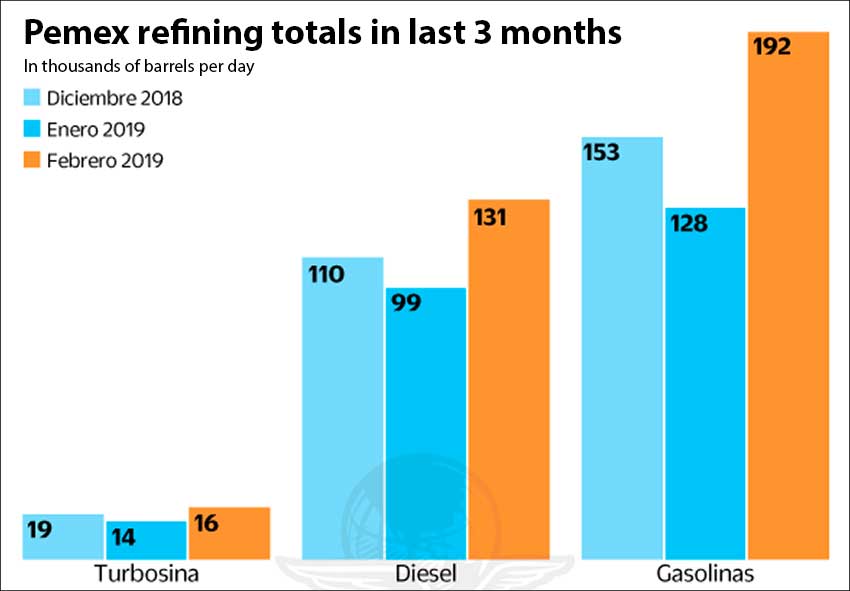
Daily gasoline production this month has averaged 192,000 barrels per day (bpd) compared to 128,000 bpd last month – a 50 percent increase – and 153,000 bpd in December. Diesel production was up 32 percent to 131,000 bpd in February compared to 99,000 bpd last month.

While the signs are promising, the National Refining System (SNR) is still a long way from getting back to production levels seen a decade ago when they reached their highest point in 29 years.

During the last two weeks of this month, automotive fuel production has averaged 213,000 bpd – just 42.3 percent of the average daily production of 504,100 bpd in January 2009.

With regard to crude oil processing, the six oil refineries achieved an average capacity of 484,000 bpd during January but this month, the figure has increased by 15.7 percent to 560,000 bpd.

Looking at figures for the first week of last month and the third week of February, the increase is even more impressive.

Crude processing has increased from 309,500 bpd to 664,00 bpd in the period, a 114 percent surge. However, the figure represents less than 40 percent of the refineries’ combined processing capacity if they were operating at an optimal level.

Another good result for the oil sector is that there hasn’t been a single work stoppage at refineries this month compared to 40 in January and 48 in December.

According to the oil sector reports, Mexico’s oil production and processing problems were, as of the end of the third quarter last year, primarily linked to “operational problems” at the refineries in Ciudad Madero, Tamaulipas, and Minatitlán, Veracruz.

At the time both facilities were only operating at a minimal capacity.

To improve production and processing capacity across the SNR, an oil sector report said, it was “essential to continue general maintenance and preventative programs” at all refineries.
Petroleum production has been declining in Mexico for years.

Earlier this month, President López Obrador announced a 107-billion-peso (US $5.5-billion) rescue plan for Pemex aimed at reducing the state oil company’s financial burden and strengthening its capacity to invest in exploration and production.

He has pledged to reduce Mexico’s dependency on petroleum imports and part of his rescue plan for the sector includes the construction of a new refinery in Tabasco.

But while the president is optimistic, financial institutions rejected the government’s plan, describing it as insufficient and disappointing, while Fitch Ratings warned that it doesn’t insulate the state oil company against future cuts to its credit rating, which it currently rates at just one notch above junk.

Source: El Universal (sp).

In other news, in Nicaragua

Nicaragua talks on crisis begin, dozens of prisoners freed

MANAGUA, Nicaragua – Representatives of President Daniel Ortega and the opposition sat down face-to-face in a restart of long-stalled talks on resolving Nicaragua’s political crisis Wednesday, shortly after authorities released dozens of people arrested in last year’s crackdown on anti-government protests.

The meeting at a business institute south of the capital, Managua, was held behind closed doors and journalists were not allowed access.

The first day had been expected to be used to set the agenda and format for talks, and at its end the sides released a statement saying they agreed to nine of the 12 points on a preliminary road map and would meet again Thursday. The statement read by Apostolic Nuncio Waldemar Stanislaw Sommertag did not provide details about what the points were.

Ortega did not take part in the talks but was represented by his foreign minister, a magistrate, several lawmakers and a student leader. The opposition delegation included several prominent business leaders, a noted academic, a politician and a university student. Sommertag, the Vatican’s ambassador to Nicaragua, and Managua’s cardinal were present as observers.

Last year’s protests demanding Ortega leave office and allow early elections prompted a deadly crackdown by security forces and armed, pro-government civilian groups. At least 325 people were killed, 2,000 wounded, hundreds imprisoned and more than 50,000 fled into exile.

One of the opposition’s primary demands has been the release of the estimated 770-plus people considered political prisoners jailed for participating in demonstrations.

Hours before talks began Wednesday, several vans carrying people in inmates’ uniforms left the Modelo prison in the capital escorted by heavily armed police in trucks.

Source: Associated Press.

spot_img

Essential nutrients you need to live a longer, healthier life

by Edsel Cook

We all want to live as long and healthy as possible, but our diets are not providing enough of the right nutrients that slow down the aging process. Indeed, the unhealthy foods we eat are making us age faster. So, an American study helpfully identified 41 different “longevity vitamins” that can promote healthy aging.

These nutrients are made up of 14 vitamins and 16 essential minerals. All of them are known to nutritional researchers.

The former group are comprised of vitamins A, C, D, E, K, four B vitamins, and five other vitamins. The mineral group is made up of calcium, chloride, chromium, cobalt, copper, iodine, iron, manganese, magnesium, molybdenum, phosphorus, potassium, selenium, sodium, sulfur, and zinc.
The last 11 nutrients are healthy compounds that do not count as either vitamins or minerals. However, the nine amino acids and the pair of omega-3 fatty acids play big roles in important bodily functions.

University of California Berkeley (UC Berkeley) researcher Bruce Ames came up with the term “longevity vitamins” to describe these vital nutrients. He believes they are vital to both long life and good healthy. (Related: Taking vitamin C and quercetin together can suppress inflammation and decrease cellular damage.)

The body prioritizes short-term survival over long-term health

Many years ago, Ames proposed the “triage theory,” an idea where the body normally has a limited amount of nutrients available. The theory suggests that the body prioritizes processes that ensure the survival of the organism for the time being.

These biochemical processes include fight-or-flight reaction and reproduction. They ensure the organism survives long enough to reproduce and spread its genes to a new generation.

Conversely, the body skimps on supplying processes that are involved in maintaining its health over long periods of time. For example, DNA contains the blueprints for the body’s many parts and functions. But the healing process for this genetic data doesn’t get the levels of energy and raw materials it needs to work properly.

If DNA repair and similar processes for maintaining the organism’s long-term health are deprived of nutrients for long periods of time, the body’s ability to recover from illnesses and injuries will diminish. This makes the organism much more vulnerable to chronic diseases that could lead to its early demise.

Longevity vitamins are vital to supporting these long-term survival processes. Ames therefore recommends increasing the intake of these nutrients as much as possible, if you want to live long enough to see your grandchildren instead of just your children.

Natural foods are often better sources of “longevity vitamins” than supplement pills
Furthermore, Ames endorses obtaining longevity vitamins from food rather than taking vitamin supplements. He suggests eating various foods that contain plenty of these important vitamins, essential minerals, and nutrients.

Most of these recommended foodstuffs are derived from plants. Fruits, legumes, sea veggies, vegetables, and whole grains are considered to be naturally therapeutic when consumed as food.

spot_img

Abel Sánchez & the Song for Cesar Allstar Revue, introducing The Paper Thin Band

Compiled by the El Reportero’s staff

Founded in 2017, The Paper Thin Band plays a wide variety of fun, dancable music with a good dose of classic rock and soul.

Whether you enjoy quality orignal music or cover tunes, The Paper Thin Band delivers a great show and fun for all!

Inspired by rhythm guitar and songwriter Rubin Morales, Paper Thin is a classic hits variety band with a carefully crafted and always evolving song list.
Paper Thin runs tunes from Tower of Power, Tom Petty, Rare Earth, Wild Cherry and James Brown just to name a few.

San Francisco native Al Sánchez brings his own style of Latin Rock inspiration to the tenor Sax. Roland Morales adds an aura of arena-rock to soaring guitar riffs.

An event you can’t miss, on Saturday, March 2. Advance: $20/ Door: $25
Doors open 7 p.m. Show a 8 p.m. At Club Fox- 2209 Broadway, Redwood City. Call 415-285-7719 or write DrBGMalo@aol.com.

SF art exhibition by Antony Holdsworth and Beryl Landau
Anthony Holdsworth features the start of a new series entitled “Day and Night in the Mission”. Using a LED lamp attached to his easel, he documents locations as they transition into night.

The Mission District opens a window on Latin America while simultaneously enriching the culture of San Francisco. He works on site to channel the unique energy of this community and also to bear witness to the changes that are being forced on it by gentrification.

The exhibition includes works El Farolito by Day and Night, by Anthony Holdsworth, oil/panel, and Rise and Shine, by Beryl Landau.

Beryl Landau calls her work “symbolic landscape”. The acrylic paintings in this show depict geographical locations but evoke inner feelings. Each image draws the viewer into a particular space and mood. Landau’s clear colors range from high contrasts to subtle gradations.

Images of changing San Francisco are prevalent in her recent work. The paintings often convey the juxtaposition of nature and the modern world.

Alley Cat Gallery, 3036 24th Street, San Francisco. Exhibition from March 2 to 31
Reception: March 2, 7 to 9 p.m.

California Hispanic Business Policy Summit
Join the California Hispanic Chambers of Commerce in Sacramento, California for the California Hispanic Business Policy Summit. This annual summit is the premier legislative conference for California’s small businesses and the Hispanic community to learn and engage in the key issues impacting the growth of California’s economy. Meet the policymakers, community leaders, and subject matter experts who are working to provide solutions.
During the Summit, we will use our collective voice to advance legislative issues for the small business community. Participants will take part in issue briefings and engage with members of the legislature and Sacramento insiders, while gaining in – person perspectives in the legislative process. Registrants will have the opportunity to meet with their local elected officials in their state offices, as well as, legislative leaders at the Legislative Reception.
Program at 10:00 a.m. The Citizen Hotel, doors open at 11 a.m. Lunch is served at 12:15 p.m. – 3:15 p.m.
Annual Hispanic Small Business Luncheon, at the State Capitol, from 3:30 p.m. – 5:30 p.m.
Legislative Appointments at the State Capitol, participants attend advocacy meetings with Legislators. From 6 p.m. – 8 p.m. – Leland Stanford Mansion
Annual Hispanic Appointees’ Reception
Celebration of California’s Hispanic Appointees
On Wednesday, March 13, at The Citizen Hotel, 926 J St, Sacramento, CA

Greening Economic Summit
This year’s Economic Summit happens with an exciting, fully revamped program.
From our redesigned, interactive Equity Lab to an array of exciting racial justice panels to a fireside chat with an internationally renowned headliner to be announced shortly, you don’t want to miss your chance to attend the Bay Area’s largest racial equity conference. On April 26, 2019, The Greenlining Institute, 360 14th Street, 2nd Floor, Oakland,

spot_img

In Oaxaca, ‘Yalitza effect’ triggers move to revitalize Oaxacan culture

Indigenous art, culture and domestic workers’ rights get new attention in the state

by the El Reportero’s news servicesW

Oscar-nominated actress Yalitza Aparicio is an international agent of change, according to the governor of Oaxaca, where her fame is prompting authorities to act.

The success of the 25-year-old Mixtec star of Alfonso Cuarón’s film Roma has triggered a swift reaction from Oaxaca authorities, who have announced plans to revitalize the artistic and cultural life of the state’s indigenous communities and pledged to improve the labor rights of domestic workers.

Oaxaca Governor Alejandro Murat has also announced a new tourist route from Mexico City to Aparicio’s home town of Tlaxiaco.

The preschool teacher-turned-actress missed out on an individual Oscar at Sunday night’s Academy Awards but Murat still described Aparicio – who plays the role of a domestic worker in Roma – as a winner and a star who is capable of helping to change discriminatory attitudes towards indigenous people around the world.

The governor said that state authorities are looking at proposals to improve the labor rights and benefits of domestic workers, stating that the government will provide them with social security, a retirement pension and housing credits.

Murat added that his government will seek to create a culture in which people treat women working in their homes as another member of the family rather than just an employee.

The governor also said the people of Oaxaca are very proud of Aparicio, the success of Roma at the Oscars and the fact that Cuarón continues to help promote the state as he did in his 2001 film Y Tú Mamá También, which features the Oaxacan coastline.

Murat explained that there was a possibility that the state government would invite Cuarón, his production team and the cast of Roma to Oaxaca to work together on a new project.

Murat added that his government will seek to create a culture in which people treat women working in their homes as another member of the family rather than just an employee.

The governor also said the people of Oaxaca are very proud of Aparicio, the success of Roma at the Oscars and the fact that Cuarón continues to help promote the state as he did in his 2001 film Y Tú Mamá También, which features the Oaxacan coastline.

Murat explained that there was a possibility that the state government would invite Cuarón, his production team and the cast of Roma to Oaxaca to work together on a new project.

She added that the city will be invited to participate in this year’s Guelaguetza, an annual festival that celebrates Oaxacan culture, with a specific focus on Tlaxiaco’s food and architecture.
Aguilar also said that state authorities will seek to reinvigorate the Mixtec artistic, cultural and music scene and, with the support of the National Autonomous University (UNAM), work to preserve the native languages spoken in Oaxaca.

Meanwhile, the mayor of Tlaxiaco has announced that the municipal government will bestow its highest honor on Aparicio in recognition of her status as a distinguished citizen.

The actress has also inspired at least two murals, one in the market of her hometown and another in the Mexico City borough of Iztapalapa while singer-songwriter Humberto Reyes has composed a ballad called El Corrido de Yalitza Aparicio.

Although Aparicio’s success has triggered a negative reaction from some, many people are celebrating the actresses’ emergence as a new –and different – role model and her representation of Mexico on the world stage.

Congratulating Cuarón for taking home three Oscars, federal Culture Secretary Alejandra Frausto wrote on Twitter: “Congratulations, you made the world see the diversity of the country we are.”
Source: Milenio (sp)

spot_img

86 years ago, Hitler carried out a “false flag”

NOTE FROM THE EDITOR

Dear readers:

Perhaps many of you have used – in political discussions – a political arguments that you picked up in the internet, and which contradicts a government statement, but it hasn’t been publicized in the mainstream media – which is the thermometer that people use to consider a story to be true. So then, you don’t believe it.

In other words, if it hasn’t been published in your everyday news outlet, then it can’t be true – you assume. Then your statement is considered a ‘conspiracy theory,” not believable. But as we will see in the following article, written by John Vibes, a lot of times we find out later, that the so called “conspiracy theory, was true. – Marvin Ramírez

86 years ago, Hitler carried out a “false flag” showing how gov’t can control with lies and fear

Today is the anniversary of one of the most pivotal false flags in history as Hitler burned down Reichstag and blamed it on his political enemies so he could seize total control of the country

by John Vibes
The Free Thought Project

“The whole truth about the Reichstag fire will probably never be known. Nearly all those who knew it are now dead, most of them slain by Hitler in the months that followed.” ~ Historian William Shirer, The Rise and Fall of the Third Reich.

On this date, 86 years ago, the headquarters for the German parliament, known as the Reichstag building, was burned down due to arson. Immediately after the fires, the Nazis passed a piece of tyrannical legislation called the “decree for the protection of state and people,” which gave them total police state control over the population.

The fires were blamed on Hitler’s political rivals, which allowed the regime to be extremely aggressive against anyone they deemed to be their enemies. However, many historians believe that it was actually the Nazi party who started the fire, in a plot to control the masses through fear.
This strategy is actually common in history, and has been used by many governments and has come to be known as a “false flag attack.” Unfortunately, over the years this legitimate military term has been grossly overused to the point where people think that it is some throw-away conspiracy theory. False flag attacks do happen though, and there is even verified proof that the US government has been involved in such operations.

For example, it was a false flag attack that caused the United States to enter the Vietnam war, but it wasn’t until 40 years later that we learned the truth about the Gulf of Tonkin Incident.
Initially, the American public was told that American ships were attacked by North Vietnamese boats, but the whole story was a twisted web of lies. In reality, the US warships initiated conflict with the North Vietnamese, and then later staged an attack against themselves to justify further action in the region.

Since the beginning of empire, the ruling class has created chaos in their societies so they could be given more power, under the pretense that they would clean up the mess that they actually created. The first ruler that we know of to perfect the art of creating chaos was the Roman emperor Diocletian who came to power in 284 AD.

This is the “leader” that was responsible for changing Rome from a developing civilization into a covert dictatorship. Since the Roman people had a history of freedom and financial prosperity, they were not going to give up their rights unless they were carefully manipulated into doing so. Diocletian needed to create an enemy that he could use as a scapegoat so he could raise taxes, expand his military, and take away the rights of the Roman citizens.

His policies were unpopular and he was having difficulty getting his people to fall in line, so he set his own palace on fire twice in two weeks and blamed it on his political and religious rivals. With his new powers, Diocletian completely reorganized the Roman political system to work like a dictatorship, but he continued to call it a democracy so the people would still think they were free. Diocletian’s approach has been used over and over by authoritarian rulers throughout history who manipulated their people into giving up their freedom.

Many people doubt that these types of plots are possible since they seem so elaborate and require so much cooperation and secrecy, but it is not far-fetched to think that the government is capable of pulling something like this off, and there is evidence of this in history to prove this as well.
The US government has even released documentation, proving they planned multiple false flags.
According to minutes from a meeting on March 22, 1962, held by the “Special Group (Augmented),” which according to an encyclopedia on the Central Intelligence Agency, included Attorney General Robert Kennedy, CIA Director John McCone, National Security Advisor McGeorge Bundy and chairman of the Joint Chiefs of Staff Lyman Lemnitzer, detailing the creation of a false flag attack on the United States to be blamed on the Soviets.

According to the documents, the US government wanted to manufacture or obtain Soviet aircraft so they could launch an attack on America or friendly bases and use those attacks as a pretext for war.
According to the previously Top Secret classified documents:

“There is a possibility that such aircraft could be used in a deception operation designed to confuse enemy planes in the air, to launch a surprise attack against enemy installations or in a provocation operation in which Soviet aircraft would appear to attack U.S. or friendly installations in order to provide an excuse for U.S. intervention.”

Many of the accusations that are brought up against the government that get labeled as conspiracy theories are eventually proven to be true way after the fact. The official stories of many world-changing events, including the USS Maine, USS Lusitania, Pearl Harbor, Vietnam, are all drastically different than the government and media have led us to believe.

spot_img

The deeper reason for drug ads on television

by Jon Rappoport

Television viewers are inundated with drug ads from Big Pharma. It’s a flood.
Have you ever heard of these drugs? Otezla, Xeljanz, Namzaric, Keytruda, Breo, Cosentyz? Not likely. If you have, do you know what conditions they treat? Highly unlikely. But there they are, splashed in commercials.

Why? Who is going to remember to ask their doctor whether these and other obscure meds are right for them?
What’s going on here?
The answer is: it doesn’t matter what drugs are being advertised.

If Pharma can pay enough total money for ads, for ALL drugs, and dominate the allotted TV time for commercials, it can control the news—and that is exactly what it wants to do.

Pharmaceutical scandals are everywhere. Reporting on them, wall to wall, isn’t good for the drug business. However, as an industry ponying up billions of dollars for TV ads, Pharma can limit exposure and negative publicity. It can (and does) say to television networks: If you give us a hard time on the news, we’ll take our ad money and go somewhere else. Boom. End of problem.

Face it, the billions of dollars Pharma is paying for TV ads are a drop in the bucket, compared with its profits gained from selling the drugs. The ads are a good investment. As a bribe.

Control the news.

There is another reason for the insane flood of TV drug ads:
By their sheer number, they convince viewers that medical drugs (no matter what they are) are absolutely necessary.

Hour by hour, viewers numbly watch drug commercial after commercial. The overall message is: To keep illness from your door, to cure illness, to alleviate illness, you must take these medicines. This is life in the 21st century. You’re all sick, and you need help, and this is the only kind of help there is.

The drug companies could invent names of fake drugs that don’t even exist, advertise them in a cascade on television, with the same intent. Drugs are as vital to life as water or air.
But what about all those dire warnings of side effects from the drugs? By law, the companies must include them in their commercials. Well, the companies have calculated that, on balance, the stark, front-line, unending message of drugs, drugs, and more drugs will outweigh the warnings in viewers’ minds.

If the television audience is nailed with the idea that they can’t escape; that their health always hangs in the balance; that dire illnesses are always waiting in the shadows to strike; that the slightest ache or pain could be a precursor to a crippling or fatal disease; and drugs are the only solution and protection—they’re going to overlook the warnings about side effects.
ALL IN ALL, DRUG ADS ARE NEWS.

That’s the approach. Pharma is blasting out 24/7 news asserting modern medicine’s central and commanding role in the life of every human.

It’s a gigantic and stupendous piece of mind control, but when did that ever stop tyrants from inventing reality for the masses?
Implicit in “ask your doctor if drug X is right for you,” is the message: “go to your doctor.” That’s the key. If the ads can put a viewer into the system, he will be diagnosed with something, and he’ll be given a drug for it.

So, the drug ads are also promotions for doctors, who are the arbiters and the decision makers. Some kind of medical need (drugs) always exists—and the doctor will tell you what it is. And all patients should OBEY. Even if, in the process, they go broke.

Take the case of Opdivo, a drug that treats squamous non-small cell lung cancer. Cost? $12,500 a month. Patients on Medicare will pay $2500 a month out of their own pockets. And the result?
Wall St, Journal: “In the clinical study on which the Opdivo ad bases its claims, the drug extended median patient survival to 9.2 months from the start of treatment…”
The cancer patient pays $22,500 for nine months of survival, during which the suffering continues, and then he dies.

The ad isn’t mentioning that.

The ad relies on the doctor to convince the patient to go along with this lunatic program.

(Jon Rappoport is the author of three explosive collections, The Matrix Revealed, Exit From The Matrix, and Power Outside The Matrix).

spot_img

Lopez Obrador calls for peaceful solution in Venezuela

by the El Reportero’s wire services

Mexican President Andres Manuel López Obrador on Tuesday called on all parties involved in the conflict in Venezuela to seek a negotiated solution through dialogue and non-violence.

In his morning press conference at the National Palace, López Obrador was asked about the US pressures to recognize the artificial president created by the White House in the figure of a lawmaker in contempt, Juan Guaidó, and he said that Mexico’s stance in accordance with the Constitution is invariable.

Respectfully, I ask all parties in the conflict to sit to talk and seek a peaceful solution. I can do that because our Constitution speaks about non-violent solutions to disputes.

I call for that, not for polarization, not for confrontation, not for manipulation, least of all for violence. I don’t want to give any kinds of opinions. We have established our position, which is in the Constitution, he repeated. López Obrador confirmed that Mexico is willing to assist in a dialogue to achieve peace in any nation. The doors to our territory are open to dialogue and that mediating role can be done not only by us, but also by the Uruguayans, diplomats of world prestige, the UN, even the Church has already done so.

It means that there are ways to find a peaceful solution to the conflict in Venezuela and the parties must show their will to that. That is one of the reasons why we don’t want to take sides.

What I don’t want is to get involved in an affair that is very polarized. I don’t want to be lamp in the street, darkness in the house. First to attend to our problems and follow the principles which have always been applied on the best times of the country: non-intervention, self-determination of the peoples, peaceful solution.

Mexico is respectful of the decision made by other peoples and other governments, and no one likes that our neighbors interfere in the colony, in the affairs of our families, in our homes, the president added.
Let us not forget that respect for the rights of others means peace. Who are we to interfere in and judge what is happening in that country? He wondered in reference to Venezuela.

PAHO Warning of possible dengue outbreaks in LATAM, Caribbean
The Pan American Health Organization (PAHO) today urged countries in Latin America and the Caribbean to prepare for possible outbreaks of dengue, a disease endemic to the region.

Marcos Espinal, director of the Department of Communicable Diseases and Environmental Determinants of Health of the entity, explained in a statement that ‘dengue is the viral infection transmitted by mosquitoes of greater spread in the Americas.

He stressed that the complexity of the disease increased over time due to factors such as unplanned urban growth, water and sanitation problems, climate and environmental change, as well as the simultaneous circulation in some countries of the four existing types of dengue.

According to the latest epidemiological update of PAHO on dengue published on February 22, 560,586 cases were reported last year in the Americas, including 3,535 severe patients and 336 deaths. In the first six weeks of 2019, almost 100,000 cases were reported, of which 632 were serious and 28 people dead.

PAHO provides technical cooperation to its Member States to prevent and control the disease.

spot_img

AMLO attacks his predecessors for ‘pillage’ during ‘neoliberal period’

Looting began with Salinas, the president charged, calling him ‘the father of modern inequality’

by Mexico News Daily

President Andrés Manuel López Obrador delivered a scathing attack on five past presidents yesterday and Wednesday, accusing them of “pillage” during the “neoliberal period” of the past 30 years.

He also said that the Mexican people could be asked in a public consultation if they want Carlos Salinas, Ernesto Zedillo, Vicente Fox, Felipe Calderón and Enrique Peña Nieto to be put on trial for their alleged crimes.

Speaking at his morning press conference yesterday, López Obrador said that the corruption and looting started during the 1988-1994 government led by Salinas, who he dubbed “the father of modern inequality.”
“We’re cleaning the government of corruption because the entire neoliberal period was characterized by pillage, not just the previous administration. This started in the government of Salinas,” he said.

“To speak clearly, the problems we are suffering from now originated then – when the assets of the people, of the nation, were handed over. When the policy of privatization was started is when inequalities in Mexico deepened and I can prove it, with information from the World Bank, I have the proof,” López Obrador said.

The president said that at the start of Salinas’ administration, only one Mexican appeared on Forbes’ billionaires list but at the end of his six-year term “24 appeared on the list of the world’s richest men.”
The 24 billionaires shared wealth of US $48 billion, López Obrador said, claiming “that was the size of the transfer of resources, the delivery of national assets to private citizens.”

Zedillo, who continued the rule of the Institutional Revolutionary Party between 1994 and 2000, perpetuated Salinas’ privatization push by selling off Mexico’s state-owned railway company and systems, the president said.

Zedillo also misused Fobaproa – a contingencies fund –turning debt owed by banks into public debt and costing the country a billion pesos in interest payments, López Obrador charged.

The leftist then turned his attention to Fox, who governed Mexico for the National Action Party (PAN) between 2000 and 2006, saying that the “preponderance of corruption and waste” during his presidency was “notorious.”

López Obrador also took aim at the ex-president for awarding favorable mining concessions and on Wednesday accused him of masterminding fraud in the 2006 presidential election that he lost narrowly to Calderón.

“We want to try Fox for being a traitor of democracy. Because after he reached [the presidency] through a movement to establish democracy, he headed an electoral fraud operation to impose Felipe Calderón,” he said.

Once in power, Calderón “acted with indolent irresponsibility,” López Obrador charged, because he started the so-called war on drugs by deploying the military to combat cartels without first carrying out a proper analysis of the security situation.

“He stirred up the hornet’s nest,” the president remarked, explaining that Calderón’s strategy unleashed a wave of violence and disappearances.

Peña Nieto “did the same,” López Obrador continued, referring to the previous government’s perpetuation of the militarized crime fighting strategy.

He added: “There was corruption with Peña but it came from before, that’s why a cleansing is taking place, it’s going to take time, not a lot but there are people [in positions] above who are not going to be in our government.”

The president defended his attack by saying that “I have to provide the background because sometimes there is amnesia and the conservatives tend to be very biased.”

Past governments left “a garbage dump, a mess,” López Obrador declared.

On Wednesday, the president explained that he has asked Congress to make changes to Article 35 of the constitution in order to make public consultations legally valid after which “the people will decide” if the five past presidents should be pursued legally for their alleged wrongdoings.

As he has said before, López Obrador indicated that his personal preference was to let bygones be bygones but stressed that the people will have the “final word” on the matter.

In his typical outspoken and colorful fashion, Vicente Fox fired back at López Obrador, declaring on Twitter that he too will face legal judgement for his actions.

“You’re also going on trial,” Fox wrote, listing a range of crimes López Obrador could be tried for including the deaths of 175 people who were “burned alive,” ruining Pemex and environmental damage resulting from his proposals to build the Maya Train on the Yucatán peninsula and a new oil refinery on the Tabasco coast.

Calderón also took to Twitter to respond to López Obrador.

“Accusing without proof violates the constitution because it breaks the presumption of innocence . . . Doing it from the power of the presidency and without even mentioning a specific crime is abusive, dishonest and immoral,” he wrote.

López Obrador has also accused the former PAN president of being complicit with fuel theft and corruption because in 2016 he accepted a position on the board of an energy company that was awarded contracts during his presidency.
The Morena party leader has made combating corruption the raison d’etre of his government and vowed not to take a backward step in his crusade against it.

At a January press conference, the president said that his predecessors were either accomplices to corruption or they turned a blind eye — “there’s no way [they] didn’t know.”

“. . . All the juicy business done in the country, deals of corruption, were greenlighted by the president.”

Source: Milenio (sp), Sin Embargo (sp).

spot_img