Wednesday, August 5, 2026
Home Blog Page 288

‘Out Hondurans, we don’t want you here:’ anti-migrant sentiment continues

There were marches in Tijuana yesterday both for and against the caravan from Central America

by Mexico News Daily

Residents of Tijuana are divided over the presence of large numbers of Central American migrants in their city.

Protests both for and against members of the first migrant caravan were held yesterday in the northern border city.

Around 500 people gathered in front of a statue of Aztec ruler Cuauhtémoc that stands atop a Tijuana traffic circle and began an anti-migrant march towards a sports complex serving as a temporary shelter for about 2,500 Central Americans.

During the march, protesters demanded that the caravan members be sent back to their countries of origin.

“Out Hondurans, we don’t want you here” and “long live Mexico” were among the slogans chanted by the demonstrators as they waved Mexican flags and held up signs declaring “Basta de migración” (Migration, enough already) and “Primero nuestra gente” (Our people first).

Some protesters claimed that there are gang members, thieves and rapists mixed in with the migrants in the first caravan, whose members began arriving at the border city early last week.

“Their presence here makes me very afraid. I don’t know if something is going to happen to me or my neighbors . . . They could break into a business . . . or assault someone. That worries me,” Tijuana business owner María de Jesús told the newspaper Milenio.

Others said they are not against migration per se but rather the way in which many of the caravan members entered the country.

“They arrived and kicked down the door and that makes them criminals,” said Emilio Zúñiga, a Guanajuato native who has called Tijuana home for the past 20 years.
The marchers were stopped from reaching the entrance to the Benito Juárez sports center by a large contingent of municipal police sporting riot gear.

A standoff lasted for several hours, with protesters throwing water and beer cans at the officers before eventually dispersing.

Just one street away from where the anti-migrant march started, a smaller group of demonstrators held their own rally at which they denounced racism and discrimination and declared that the migrants are welcome in Tijuana and that their human rights must be respected.

Yesterday’s protests followed a week of heightened tension in Tijuana during which some residents made it clear that the migrants are not welcome.

Social media posts aimed at inciting violence against the Central Americans began appearing in anti-migrant groups on platforms such as Facebook virtually as soon as they arrived in the city.

Rumors circulating on the mobile messaging service WhatsApp that the migrants had looted stores, referred to Mexicans as “dogs” and even murdered someone only served to fuel the anti-migrant sentiment.

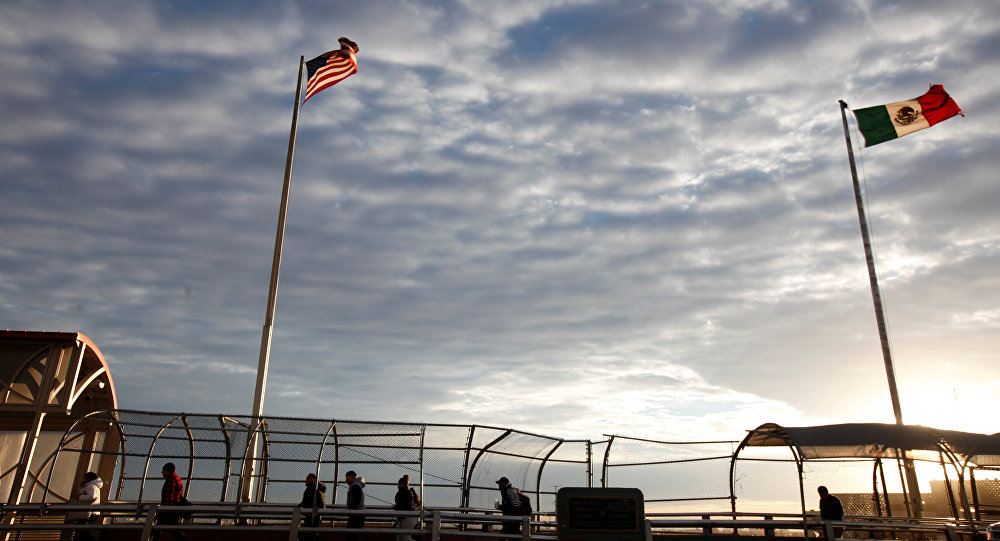
A confrontation occurred Wednesday night between an angry mob and migrants sleeping on the beach next to the border fence that separates Mexico from the United States.

Mayor Juan Manuel Gastélum, who has been labeled Tijuana’s Trump, has also spoken out against the caravan, declaring that the migrants are not wanted.

United States President Trump yesterday seized on the mayor’s opposition to the migrants, writing on Twitter that “The Mayor of Tijuana, Mexico, just stated that ‘the City is ill-prepared to handle this many migrants, the backlog could last 6 months.’”

In the same tweet, he added: “Likewise, the U.S. is ill-prepared for this invasion, and will not stand for it. They are causing crime and big problems in Mexico. Go home!”

In a subsequent Twitter post, Trump wrote: “Illegal Immigrants trying to come into the U.S.A., often proudly flying the flag of their nation as they ask for U.S. Asylum, will be detained or turned away. Dems must approve Border Security & Wall NOW!”

The United States government has deployed 5,900 troops to the southern border to bolster security and barbed wire is also being affixed to the border fence to act as an additional deterrent to any attempts to scale it illegally.

With two other caravans currently traveling through Mexico, Tijuana officials have estimated that the number of migrants in the city could reach 10,000, stoking concerns about the city’s ability to cope with such a large cohort.

There are already around 3,000 migrants on a waiting list to apply for asylum in the United States, meaning that the new arrivals, and future ones, face a lengthy wait just to have the opportunity to plead their case.

But after traveling more than 4,000 kilometers to reach Mexico’s northern border, the vast majority are determined to do all they can to enter the United States, even if that means attempting to cross illegally.

“If I die on the way, at least I will have fought for something,” 24-year-old José Adan Núñez told The New York Times.

Source: El Universal (sp), Milenio (sp).

spot_img

Immigrant rights groups oppose Trump’s cutting off access to citizenship

Advocates rush to challenge changes that would eliminate Obama-era policy allowing fee waivers for elderly and working poor immigrants applying for citizenship

by the El Reportero’s wire services

A growing group of immigrant rights advocates is demanding that the Department of Homeland Security (DHS) withdraw its proposed regulation cutting off access to citizenship for hundreds of thousands of eligible immigrants and condemning it as a un-American measure that would target elderly and working poor immigrants.

The regulation would reverse a policy enacted by the Obama administration, whereby an applicant for citizenship can apply for a fee waiver if they are unable to afford the expensive fee of $725, among other applications and their fees.

Under current policy, one way to show this inability to pay is through an applicants’ use of a means-tested public benefit (like SNAP, Medicaid, SSI, and TANF). The proposed regulation would make that use of public benefits no longer a sufficient reason for receiving a fee waiver, effectively blocking over 244,000 eligible immigrants from citizenship because they simply cannot afford it.

“Encouraging citizenship is part of our tradition of welcoming immigrant communities. By excluding people from citizenship based on their level of wealth or class, the Trump administration is once again undermining our national values of equal treatment and diversity,” said Gustavo Torres, Executive Director of CASA.

The National Partnership for New Americans (NPNA) and others fought for the fee waiver policy during the Obama administration and won in 2010. Since then, well over a million immigrants applied for the fee waiver in conjunction with their citizenship application. In 2017 alone, around 370,000 applicants for citizenship requested a fee waiver.

The proposed regulation would make it more difficult for eligible immigrants to apply for citizenship with U.S. Citizenship and Immigration Services (USCIS), which, according to new data released by the agency in late October, currently has a backlog of over 750,000 citizenship applications.

IACHR’s MESENI expresses concern over Nicaragua’s strategy to prevent social protest

Nov. 20, 2018 – The Special Follow-Up Mechanism for Nicaragua (MESENI) of the Inter-American Commission on Human Rights (IACHR) confirms with concern that the State of Nicaragua has adopted a strategy to prevent any form of social protest or demonstration.

Since the publication of press releases by the National Police, which first blamed those who called for public demonstrations for the violent events that occurred there, and later declared illegal any demonstration that did not have prior authorization from the police authority, the MESENI identified limitations that violate international human rights standards.

The disproportionate preventive deployment of riot police personnel, as well as other police units in traditional protest locations, now joined the occupation of commercial establishments where small acts of protest had taken place. Thus, this pattern of extreme limitation of the right to protest manifested itself more concretely.

The arrests in Somoto and in a shopping center in Managua in recent days, with the subsequent indictment of criminal charges for singing the national anthem in a small act of public protest or for photographing the police deployed in the shopping center, now show the decision to criminalize any demonstration of dissent.

As the IACHR has insistently told the State of Nicaragua, social protest and freedom of expression cannot be seen as a threat in democratic societies. In particular, in the context in which the country lives today, social protest and freedom of expression are tools that will contribute to exploring dialogue mechanisms that ensure peace, reconciliation and guarantee truth, justice and reparation to which the victims are entitled, especially the hundreds of families who have lost their loved ones.

The IACHR calls for the generation of actions that also ensure the non-repetition of the human rights violations that have been observed during the crisis that the country has been facing since last April. The exercise of freedom of expression and the right to protest will also contribute to the construction of these actions in dialogue.

spot_img

Veracruz dancers break a Guinness record with La Bamba

Over 2,000 people danced simultaneously to the famous anthem

by the El Reportero‘s news services

Yet another Guinness World Record was set on Mexican soil yesterday: 2,370 men, women and children danced simultaneously to the Mexican folk song La Bamba.

The successful record attempt took place in the historic center of Xalapa, the capital of Veracruz.

La Bamba, an example of Veracruz’s son jarocho musical style, is considered an anthem of the Gulf coast state.

The song was played live during yesterday’s mass dance by the group Tlen Huicani.

However, it was not just jarochos, as natives of Veracruz are known, who had the honor of claiming the new record as dancers from México state, Puebla, Hidalgo and Morelos, among other states, also took part.

All the participants dressed in traditional white costumes adorned with red neck ties for men and red scarves for women.

The annual record attempt was organized by the folkloric ballet ensemble of the University of Veracruz.

The previous La Bamba record was set a year ago by 1,938 professional and amateur dancers.

All manner of weird and wonderful Guinness World Records have been set in Mexico.

They include the world’s biggest marzipan, the biggest bead mosaic, the largest foosball tournament and – of course – preparation of the largest number of flautas, or crispy, fried tacos.

Source: Excélsior (sp), Al Calor Político (sp).

Matar a Jesus, Winner of the Macondo Awards in Colombia

The film Matar a Jesus, premium film by Colombian Laura Mora, was the big winner in this capital of the 2018 Macondo Awards, winning five out of 11 nominations.

The film won the categories of Best Film, Best Direction, Best Screenplay, Best Sound and Best Supporting Actor for Camilo Escobar.

The film, which is also a candidate from Colombia to Goya, recounts the life of Paula (Natasha Jaramillo), a 22-year-old girl who knows her father’s murderer and decides to take justice into her own hands.

The movie was filmed with non-professional actors for 36 days in the city of Medellin, where the father of the filmmaker was murdered in 2002.

‘This is a film that invites the recognition of the other at a very relevant moment in our political history where we have to recognize ourselves,’ said its director, whose debut has received multiple awards around the world in the last year.

The film Virus Tropical won the Macondo for Best Animation, Best Original Song for Adriana Garcia Galan and popularity; while Amazona was selected as Best Documentary and received two other awards: Best Original Music and Best Editing.

On the other hand, Amalia la Secretaria, directed by Andrés Burgos, was the winner in the categories of Best Leading Actress for Marcela Benjumea, Best Lead Actor for Enrique Carriazo and Best Supporting Actress for Patricia Tamayo.

The film Sal won the categories of Best Direction of Photography for David Gallego, Best Costume and Best Art Direction for Marcela Gómez.

The annual gala of the Colombian Academy of Cinematographic Arts and Sciences also awarded two prizes to the production Siete Cabezas: Best Makeup and Best Visual Effects.

The Macondo de Honor Prize was awarded to the actor Alvaro Rodriguez, for his long professional career in the seventh art.

Presidio’s Exclusion awarded the 2018 Charles Redd Award for Exhibition Excellence by the Western Museums Association for Work Illuminating the American West
Presidio’s exhibition Exclusion: The Presidio’s Role in World War II Japanese American Incarceration was awarded the 2018 Charles Redd Award for Exhibition Excellence by the Western Museums Association at their Annual Meeting on October 22. It is the major exhibition accolade granted annually by the professional industry organization that serves the Western United States, Western Canada, and the Pacific. Winners are chosen regardless of geographical location, size, budget, or discipline. Past winners have included the Boise Art Museum, the Oakland Museum of California, the Museum of Vancouver, and the J. Paul Getty Museum among others.

Western Museums Association wrote, “Exclusion: The Presidio’s Role in World War II Japanese American Incarceration truly exemplifies exhibition excellence for its important examination of a complex issue as it impacts the Western United States – and beyond.”

The award recognizes outstanding achievement of temporary exhibitions that encourage museums and the public to study the American West; utilize innovative exhibition and public programming; result from creative collaboration with outside communities or organizations; and engage audiences in the exhibition subject in compelling ways.

spot_img

El Chapo’s lawyer claims cartel bribed presidents Peña Nieto, Calderón

Both have rejected the accusation, which claims that the Sinaloa Cartel paid them millions of dollars

by Mexico News Daily

A lawyer for former drug lord Joaquín “El Chapo” Guzmán claimed yesterday that the Sinaloa Cartel paid huge bribes to the current Mexican president and his predecessor.

In his opening statement at the New York trial of the former capo, Jeffrey Lichtman said that the “real” Sinaloa Cartel leader, Ismael “El Mayo” Zambada, paid millions of dollars in bribes to President Peña Nieto and ex-president Felipe Calderón to avoid capture.

Zambada has been left free because he “bribes the entire government of Mexico including up to the very top, the current president of Mexico and the former,” Lichtman said.

Presidential spokesman Eduardo Sánchez and Calderón, who left office in 2012, quickly rejected the claim.

“The government of Enrique Peña Nieto pursued, captured and extradited the criminal Joaquín Guzmán Loera. The assertions attributed to his lawyer are completely false and defamatory,” Sánchez wrote on Twitter.

Lichtman’s assertions “are absolutely false and reckless,” Calderón tweeted. “Not him [Zambada] nor the Sinaloa Cartel or any other person made payments to me.”

On the first day of Guzmán’s trial for drug smuggling, conspiracy, firearms offenses and money laundering in a Brooklyn federal court, Lichtman told the judge and jury that Zambada is the real mastermind of the cartel and that Guzmán is no more than a “scapegoat” — a “nobody” with a second-grade education.

“He’s blamed for being the leader while the real leaders are living freely and openly in Mexico. In truth, he controlled nothing. Mayo Zambada did,” he said.

“The world is focusing on this mythical El Chapo creature,” Lichtman continued. “The world is not focusing on Mayo Zambada . . . Mayo can get people arrested and get the Mexican army and police to kill who he wants.”

The lawyer said that since El Chapo’s extradition to the United States in January last year, “the flow of drugs [to the U.S.] hasn’t stopped.”

Prior to Lichtman’s opening remarks, federal attorney Adam Fels presented the United States government’s case, asserting that prosecutors would prove that Guzmán rose from a small-time marijuana trafficker in the 1970s to chief of the Sinaloa Cartel.

Guzmán, 61, established relationships with Colombian cartels that allowed him to move massive amounts of cocaine into the United States, bringing him billions of dollars in profits, Fels told jurors.

Cocaine shipments seized by authorities add up to “more than a line of cocaine for every single person in the United States,” he said.

Fels also told jurors that Guzmán was responsible for turning parts of Mexico into war zones as he fought against rival cartels to expand the Sinaloa Cartel’s influence and power.

The jury will hear about how Guzmán personally shot two members of a rival cartel and ordered that their bodies be thrown into holes and burned, he added.

“He was a hands-on leader,” Fels said, referring to Guzmán’s involvement in day-to-day cartel activities.

All told, Guzmán faces 17 criminal charges and, if convicted, a possible life sentence. He appeared in court yesterday dressed in a dark suit and remained calm as he listened to proceedings with the aid of a translator.

The notorious drug lord, who has been held in solitary confinement in a Manhattan prison for almost two years, appeared almost happy and blew a kiss to his 29-year-old wife, Emma Coronel, who was sitting in the public gallery.

Prosecutors’ witnesses are expected to include former Sinaloa Cartel members and Guzmán associates including Zambada’s brother, Jesús “El Rey” Zambada, and son Vicente Zambada.

The latter, known by the nickname El Vicentillo, last week pleaded guilty to drug trafficking charges in a United States federal court.

Vicente Zambada, a former logistics chief for the Sinaloa Cartel, said in a plea agreement that he will cooperate with prosecutors in the hope that in exchange he will receive a reduced sentence and protection for his family from cartel retribution.

Lichtman, an experienced criminal lawyer who previously defended New York mobster John A. Gotti, attacked the credibility of the potential witnesses.
“Why is the government going so far in this case using these gutter human beings as the evidence?” he asked.

“It’s because the conviction of Chapo Guzman is the biggest prize this prosecution could ever dream of.”

Lichtman also urged the jury “to keep an open mind” and consider that law enforcement authorities in both Mexico and the United States could be corrupt.

“They work together when it suits them, Mayo [Zambada] and the United States government,” he said.

Almost immediately after Lichtman’s opening remarks, Judge Brian M. Cogan excused the jury and cautioned the lawyer against making statements that might not be supported by evidence.

The trial is being held under extraordinarily tight security. Jurors are escorted to and from the court by armed federal marshals.

Guzmán, who twice escaped from prison in Mexico, has been accompanied by heavily armed federal officials and New York police on his journeys from his cell to the federal court.

The trial, which is expected to last between two and four months, continues today.

Source: AFP (sp), Reuters (sp), El Financiero (sp).

spot_img

Central American migrants are now traveling in at least 12 states

A first contingent has already arrived in Tijuana, where authorities are seeking aid for shelters

by Mexico News Daily

Central American migrants are now traveling through at least 12 Mexican states en route to the United States, according to authorities.

Members of the first migrant caravan began to split into smaller groups after leaving Mexico City over the weekend as they travel towards the Mexico-United States border at Tijuana.

One group, made up of around 80 women, children and members of the LGBT community, arrived in Tijuana on Monday, according to José García, who works at a migrant shelter in the northern border city.

Nine buses carrying about 350 more migrants reached Tijuana early today. A Honduran flag was seen fluttering outside a bus window.

Other members of the caravan have splintered off in different directions to reach other northern cities including Hermosillo, Sonora; Escuinapa, Sinaloa; and Monterrey, Nuevo León.

Authorities in Nayarit are continuing to provide buses to transport migrants to the state’s border with Sinaloa.

That leg of the journey is likely to come today or tomorrow for the largest contingent of the first caravan, located farther south in the country.

Most members of the group arrived in Guadalajara, Jalisco, on Monday and stayed last night in an auditorium in the neighboring municipality of Zapopan.

However, some migrants stayed in the city of La Piedad, Michoacán, around 160 kilometers southeast of Guadalajara.

Early Monday morning, a huge contingent of migrants arrived at the entry to the Irapuato-Guadalajara highway to try to hitch rides to the Jalisco capital.

Two hours after their 5:00am arrival, some 500 migrants had managed to clamber on to passing trucks but a much larger number was still waiting for rides, the newspaper Milenio reported.

One 65-year-old man identified only as Luis Enrique climbed onto a tank truck only to be ordered by Federal Police to get off.

“I know it’s dangerous to travel this way but when one is poor there is no other choice,” he told Milenio as he waited for another ride.

A 32-year-old Guatemalan man who suffered first-degree burns to his face and chest while juggling fire torches to earn money at traffic lights in Irapuato was also among the migrants traveling towards Guadalajara yesterday.

One truck driver said that it was impossible to stop the migrants from boarding.

“. . . They climb on themselves, there’s no way of telling them no and getting them off . . .” he said.

Those who reached Guadalajara yesterday endured a five-hour journey exposed to the sun, strong wind and the constant risk of falling from the fast-moving and often-overcrowded trailers.

Members of the second caravan, made up of more than 1,000 migrants, began arriving in Mexico City yesterday from Puebla.

The third caravan, made up of around 450 Salvadoran migrants who entered Mexico legally, remain in Tapachula, Chiapas, awaiting immigration documents.

Meanwhile, a fourth caravan that crossed the southern border earlier this month is currently traveling through Veracruz en route to Puebla and Mexico City.

The Federal Interior Secretariat (Segob) announced yesterday that it has agreed to a proposal by the Business Coordinating Council (CCE) to offer employment opportunities to Central American migrants in several Mexican states on the condition that they formally register with immigration authorities.

President Peña Nieto announced a program last month called “Estás en tu Casa” (You are at home), offering shelter, medical attention, schooling and jobs to the migrants on the condition that they formally apply for refugee status with the National Immigration Institute (INM) and remain in Chiapas or Oaxaca.

However, most migrants rejected the offer and remain determined to reach the United States’ southern border, where they intend to apply for asylum.

In Tijuana, where most members of the first caravan are headed, migrant advocates warned that shelters in the city are already 75 percent full.

According to a report in the newspaper Reforma, there are 2,800 migrants — including Central Americans, Africans and Mexicans — who have been in Tijuana for up to a month waiting for the opportunity to lodge requests for asylum in the United States.

Baja California Interior Secretary Francisco Rueda said that state authorities are requesting 80 million pesos (US $3.9 million) from the federal government to pay for shelter, food, health care and humanitarian assistance while caravan members are in Tijuana.

While migrants have stayed in other Mexican cities for short periods, they could be in Tijuana for weeks or even months as they await the opportunity to request asylum.

“Other cities have welcomed them for two or three days, but one can foresee that a good number of them will stay in Tijuana for a long period . . .” the city’s Catholic archdiocese said in a statement Friday.

Some migrants are likely to be transferred to the state capital of Mexicali, located about 200 kilometers east of Tijuana, where shelters have capacity for 500 caravan members.

Rueda said that state and municipal authorities want the federal government to petition United States authorities to speed up the process to seek asylum.

However, United States President Trump is seeking to make it more difficult for caravan members to enter the country.

Trump has described the first caravan as an “invasion” and said that as many as 15,000 troops could be deployed to the U.S. southern border to meet the migrants.

Source: El Universal (sp), Milenio (sp), Reforma (sp), Expansión (sp), The San Diego Union Tribune (en).

spot_img

We don’t need a license to let our children play

NOTE FROM THE EDITOR:

Dear readers:

I’ve been following for almost a decade, the slowly loss of freedom in the land of the free, the United States, and how a police state has been emerging before our own eyes while we are brained-washed and entertained by crappy TV programs, junk music, and the destruction of our traditional family values without knowing it.
And I have commented on it. And not only the omnipotent State has assumed ownership of our children deciding among many other things, their sexual education, now I just ran into the following article makes it a crime if we let the children play. Written by Kerry McDonald, it shows how the State power is really getting out of hands for our detriment. – Marvin R.

D.C. bureaucrats are trying to make parents get a license to let children play together

by Kerry McDonald

Let’s say you and some of your friends decide to gather your young children together a couple of days a week for a few hours of free play. Maybe you switch off who leads the gaggle of kids each week, allowing for some shared free time and flexibility. Sounds like a great arrangement for all, right? Your kids get to play freely with their friends, and you get some occasional free babysitting.

According to government officials in Washington, DC, arrangements like this are violations of the law. They are cracking down on what they call an illegal “child development facility” operating without a license.

The Regulation of the Playdate

Back in the 1970s, a group of parents got together to create an informal playgroup for sand their two-year-olds have enjoyed these three-hour playgroups, which children can attend up to three days a week. The playgroup is staffed by parents of the kids who attend, and they take turns watching the children. There is no paid staff.

The parents are outraged, arguing that this is an informal, parent-led playgroup that should not be regulated as a childcare facility.

According to a recent Washington Post article written by Karin Lips of the Network of Enlightened Women, “Some DC government officials now are trying to regulate the program, which they contend is an illegal child-care facility.” The Office of the State Superintendent of Education investigated the playgroup cooperative in early September and issued a statement saying the group is violating child care facility laws and must get a license to operate.

The parents are rightfully outraged, arguing that this is an informal, parent-led playgroup that should not be regulated as a childcare facility. Government officials argue that the playgroup doesn’t qualify for an exemption as an “informal” group because the parents, over the years, have established some simple “rules” for participation, including stating that parents can’t bring contagious children to the playgroup and asking for emergency contact information.

As a homeschooling mom, I host groups of children at my house all the time, sometimes with their parents and sometimes without, and my friends reciprocate. I have the same “rules” as this DC playgroup: Don’t bring sick kids to my house, tell me if they have any food allergies or medical issues, give me your phone number in case of emergency, oh, and take off your shoes.

Gross Overreach by the State

Could the government crack down on these types of playgroups, arguing they are not “informal” because of basic expectations for health and safety? Or are parents so incapable of voluntarily determining health and safety expectations that the government must do it for them?

The state does not need to insert itself into all aspects of private life. Parents are competent enough to create voluntary associations with other parents that benefit their children and themselves. As Lips writes in her article:

Ironically, if the Office of the State Superintendent of Education has its way and is allowed to regulate this playgroup out of existence, it would be creating a disincentive for parents to self-regulate, as a playgroup with no safety rules would presumably be on stronger legal standing.

If the parents in the DC playgroup were wary of its operations or procedures, they wouldn’t join the cooperative. Parents are highly capable of making judgments regarding their children’s well-being without government meddling.

The DC Council is currently deliberating on what to do with this long-time parent cooperative and similar playgroups. The fact that the Council is involved at all should concern everyone. This is a private, parent-organized group that has operated just fine for over four decades without the Council’s help. The government should leave parents alone and focus on more pressing responsibilities.

Lips warns:

This regulatory encroachment could be the District’s first step toward broader government overreach in this area and the crowding-out of voluntary associations. From nanny-shares to babysitting co-ops to regularly scheduled times to play at public parks, the Office of the State Superintendent of Education investigators could find new opportunities to crack down on the voluntary ways that D.C. families approach playtime and child care for their children.

In DC and elsewhere, government officials should stay clear of telling parents what to do or how to organize. We don’t need a license to let our children play.

spot_img

As El Chapo’s day in court begins, El Mayo fights to control the Sinaloa Cartel

The cartel is estimated to take in US $11 billion a year

by Mexico News Daily

As preparations proceed for Mexico’s most notorious drug lord to face trial in the United States, his successor continues to bring in massive profits for the Sinaloa Cartel.

Almost two years after his extradition to the United States, Joaquín “El Chapo” Guzmán is on the cusp of having his first day in court.

Selection of the jury to pass judgment on the former boss of the Sinaloa Cartel began in New York this week under tight security.

The names of all potential jurors will not be released and those selected to make up the panel will also remain anonymous and be afforded special security.

Opening statements in the trial, which is expected to last for between two and four months, are tentatively scheduled for Nov. 13.

Guzmán, who gained additional notoriety for his two prison escapes, faces the possibility of life imprisonment if convicted on charges of criminal enterprise, drug trafficking, money laundering and homicide, among other crimes.

Meanwhile, Ismael Zambada García, a 70-year-old former poppy-field worker and long-time partner of “El Chapo,” is fighting to continue the cartel’s lucrative illicit activities as other criminal organizations try to expand their influence.

During several decades, the trafficker better known as El Mayo, along with Guzmán and other Sinaloa Cartel members, built a multi-billion-dollar empire on cocaine and heroin among other drugs as well as human trafficking.

In addition to life imprisonment, authorities in the United States are seeking a US $14-billion forfeiture from Guzmán while the Bloomberg Billionaires Index estimates that Zambada has a net worth of at least US $3 billion.

Their vast riches are fruits of the cartel’s ability to switch the products it sells in response to demand, virtually monopolize key markets in the United States and expand its export links to countries on the other side of the world, such as Australia.

“Their reach is incredible,” said Anthea McCarthy-Jones, a professor at the University of New South Wales who researches the structure of transnational crime networks from Canberra, Australia.

“Sinaloa still remains the organization with the best international connections. That’s something that they seem to be really good at.”

The cartel has allegedly laundered ill-gotten gains through some of the world’s largest banks to subsequently invest in both Mexican and foreign companies or to shift funds to offshore accounts.

According to the United States Drug Enforcement Agency (DEA), leadership of the Sinaloa Cartel has injected cash into some 250 companies, many of which are still in business.

The network of cartel businesses, the news agency Bloomberg said, stretches from the Sinaloa capital of Culiacán to Honduras, Panama and Colombia.
A water park and a children’s daycare center allegedly run by Zambada’s daughter María Teresa are among El Mayo’s many interests.

“He has a very diversified portfolio,” said Mike Vigil, the former head of international operations for the DEA.

“Even though he’s only had maybe an elementary-school education, he’s received a Harvard-level education from some of the most prolific, knowledgeable and astute drug lords that Mexico has ever had,” he added.

A Bloomberg analysis based on seizure and pricing figures from the DEA found that the Sinaloa Cartel rakes in, on average, US $11 billion a year.

However, that figure is likely below the real dollar-amount because it doesn’t include revenue from markets outside the United States and it assumes that 50 percent of all drugs shipped to the U.S. are seized, the news agency said.

According to people with knowledge of the cartel’s activities who spoke to Bloomberg, at least 5 percent of the total revenue has gone to the criminal organization’s top leadership, meaning that since 2011 Zambada would have received US $3 billion.

But with a US $5-million reward from the United States State Department on his head and as he continues to hide out in the mountains of northern Mexico, “the last capo standing may be losing his grip on the world’s largest drug cartel,” Bloomberg said.

With Chapo’s former allies sensing a power vacuum and other criminal organizations – most notably the Jalisco New Generation Cartel (CJNG) – filling or aiming to fill it, Mexico’s homicide rate is going through the roof.

With more than 30,000 murders, 2017 was the most violent year in at least two decades and this year is on track to be even bloodier.

But as the blood flows in Mexico, so too does the money.

U.S. authorities have “shut down some of the businesses [the Sinaloa Cartel is involved in], not all,” Vigil said.

Mexican “asset-forfeiture laws and seizures have a lot of loopholes,” he added.

The Sinaloa Cartel also continues to diversify not only the products it deals in but also the markets it buys and sells in.

Under Zambada’s reign, the Sinaloa Cartel has widened its supply sources for precursor chemicals used to make drugs such as fentanyl and methamphetamine to markets as far away as China.

However, while the Sinaloa Cartel’s continued profits appear to be assured, there is less certainty about its long-term leadership.

Zambada, who suffers from diabetes, is getting on in years while one of his sons is set to be sentenced in Chicago next month on drug trafficking charges and another pleaded guilty to the same crime in California in 2013.

El Chapo, who has allegedly continued to wield some influence in the Sinaloa Cartel despite being behind bars, is about to face trial.
His sons, one of whom is on the DEA’s 10 most wanted fugitives list, are increasingly involved in the cartel’s operations but according to Vigil, they lack the criminal expertise of their father and Zambada.

For El Mayo, death – from illness or otherwise – or a decision to step down voluntarily, rather than capture by authorities, would appear to be the most likely ways for his reign to end.

“I have been up into those mountains and it’s very difficult to capture anybody,” Vigil said.

“Mayo Zambada is one of the most astute drug traffickers that Mexico has ever spawned.”

Unlike El Chapo, he has never escaped from prison. In more than half a century in the drug trade, he’s never had to.

Source: Bloomberg (en), USA Today (en).

spot_img

Local victories power California tenant movement, despite Prop. 10 loss

by the El Reportero’s wire services

Proposition 10, the proposed initiative to repeal the Costa-Hawkins Rental Housing Act, was stymied at the state ballot Tuesday thanks to an unprecedented $74 million in real estate industry opposition money, but there were also victories for rent control at local ballots across California.

In Oakland, voters approved Measure Y to close eviction loopholes, a significant expansion of Oakland’s local eviction protections to cover thousands of smaller buildings that were previously exempt. Nearby in Alameda, renters defeated Measure K, a real-estate industry measure to preempt rent control efforts, despite heavy spending in favor. Measure K was a trial balloon by the real estate industry of a recent strategy to gut local momentum for rent control and its failure has statewide significance.

In 2018, ten California municipalities gathered signatures, most for the first time, to put rent control on the ballot. With rent control maintaining broad popularity across the California electorate, more campaigns plan to launch for local rent control expansions, including the Sacramento rent control ballot measure already confirmed to appear on the November 2020 ballot. Los Angeles County is poised to adopt rent increase limits at a meeting next week, one of the most extensive expansions of renter protections in recent history. Meanwhile, a recent Los Angeles Times poll showed that “lack of rent control” was cited by Californians as the primary reason why housing in California remains unaffordable.

“Since the first new local rent control ordinances in over 30 years passed in Richmond and Mountain View, we’ve seen an incredible wave of interest in rent control to stabilize communities,” said Dean Preston, executive director of Tenants Together. “The more the real estate industry attempts to enforce a broken status quo at the expense of working-class renters, the harder California renters will fight for protections from unfair rent hikes and evictions. These local fights are the heart of this movement.”

Migrant minors and adolescents assisted in Mexico

The National System for the Integral Development of the Family (DIF) informed that 106 unaccompanied children and 45 teenage migrants who are now housed in the Palillo Martinez Stadium in this capital have been counseled.

The DIF also attended to 85 families from the first migrant caravan, mostly Hondurans, who remain in the sports facility of Iztacalco.

The institution said that it had restored the rights to six children traveling alone to begin the process of obtaining refugee status, and had assisted others to return to their countries.

The DIF added that it has provided immediate attention to the seven precautionary measures issued by the National Human Rights Commission (CNDH), which involve inter-institutional coordination, always aiming at the protection and restoration of the rights of children and adolescents. It said in a statement that it maintains coordinated work with the CNDH and agreed on actions with the United Nations Children’s Fund (UNICEF), the United Nations High Commissioner for Refugees (UNHCR) and the International Organization for Migration (IOM).

The DIF explained that it has been providing assistance to minors in the caravan since October 24, in the state of Chiapas, and now in the capital of the country.

spot_img

Two busloads of migrants reported missing; CDMX shelter at capacity

Human rights official claims about 100 are missing after they were kidnapped and turned over to criminals

by Mexico News Daily

Two busloads of Central Americans traveling as part of the first migrant caravan were kidnapped and handed over to a criminal organization, a human rights official claims.

The National Human Rights Commission (CNDH) said today that about 80 migrants are missing.

Oaxaca human rights ombudsman Arturo Peimbert said yesterday that both he and the Mexico office of the United Nations Refugee Agency (UNHCR) had received reports that around 100 migrants disappeared while traveling through the state of Puebla on Saturday.

Peimbert told the news website Huffington Post that the migrants were abducted by the bus drivers and handed over to suspected criminals who presumably belong to the Zetas drug cartel.

He said that neither state nor federal authorities have responded to reports of the incident.

Criminal groups have long preyed on Central Americans transiting Mexico, forcing men into working for them and pushing women into prostitution. Those who refuse to cooperate run the risk of being killed.

Edgar Corzo, a human rights academic who is serving as a caravan observer for the CNDH, told a press conference this morning that the commission is “taking the corresponding steps” to search for the missing migrants.

Contradicting Peimbert’s earlier claim, Corzo said the migrants had disappeared in Isla, Veracruz, and that the CNDH is “seeking information and questioning people” in that municipality in order to try to establish exactly what happened.

He added that the CNDH had warned migrants and authorities that the route the migrants took through Veracruz “is quite a complicated stretch in terms of security” due to “organized crime risks.”

As the two busloads of migrants remain missing, thousands of their erstwhile travel companions are camping at a sports stadium in the Mexico City borough of Itzacalco.
Borough chief Armando Quintero said today that 7,020 migrants have arrived at the makeshift shelter that is now at “the limit of its capacity.”

He explained that authorities had only expected around 4,000 people, adding that there are worried about how they will cope with the arrival of even more migrants who are still traveling through southern Mexico.

“We have no other option than to deal with the situation but we are worried because contingents continue to arrive,” Quintero said.

He added that medical personnel are attending to the migrants and that hygiene precautions are being taken to avoid the spreading of illness.

Mexico City Mayor José Ramón Amieva said that more migrants are expected to arrive today and tomorrow. He added that the stadium has a capacity for 5,500 people.

According to the Mexico City Human Rights Commission, there are 4,000 people currently at the shelter, meaning that it is only 72 percent full, contradicting Quintero’s claim.

The second caravan of migrants, made up of around 1,500 people, is resting today in Tapanatepec, Oaxaca, while yet more migrants are even farther away from the capital and the United States border.

As the thousands of Honduran, Salvadoran and Guatemalan migrants have traveled through southern Mexico over the past two weeks — walking long distances and hitching rides when possible — they have depended on municipal authorities for food and shelter.

Mexicans in large numbers have also handed out food and water to the migrants and offered transportation.

However, a poll conducted by the research firm Consulta Mitofsky shows that opinion is divided over whether migrants should be offered assistance as they travel through the country towards the United States border.

Asked whether Mexico should protect migrants and provide humanitarian aid or conversely not offer help and pressure them to return to their countries of origin, 51.4% of 1,000 survey respondents supported the former proposal.

Almost 34% of those polled said that migrants shouldn’t receive any government assistance while just under 15% didn’t respond or said they didn’t know.

Women, people living in rural areas and those of lower socio-economic status said that migrants should be helped and protected in greater numbers than men, people living in urban areas and wealthier respondents, the poll showed.

At least 160 migrants have been deported by Mexican authorities while an even greater number has voluntarily sought assistance to return home.

Some migrants are expected to remain in Mexico to seek work but most remain determined to reach the United States border to seek asylum despite warnings from U.S. President Trump that they won’t be made welcome.

Source: EFE (sp), Huffington Post (sp), Milenio (sp) El Economista (sp)

In other news in México:

Guerrero bishop seeks Christmas truce through dialogue with feuding narcos
Salvador Rangel intends to discuss the proposal with cartel leaders

A bishop in Guerrero is aiming to broker a Christmas truce between feuding cartels in the state’s Sierra region.

Salvador Rangel, bishop of the Chilapa-Chilpancingo diocese, said he is seeking to hold talks with cartel leaders to that end.

“If wars stop at Christmas even at the world level, why not in Guerrero? Let’s make that period, the most beautiful of the year, one in which we can live in peace,” he said in an interview after attending the first day of a peace forum held this week.

Warring cartels previously agreed to a truce during the electoral process leading up to the July 1 elections, Rangel said.

spot_img

The “truth” about anti-oxidants

by Ben Fuchs
First person

I get lots of letters.

Mostly they’re honest questions from folks trying to resolve health issues and get back on track with taking care of their bodies, getting off prescription drugs and getting on a good nutritional supplement program.

Sometimes I get positive feedback or kudos encouraging me to carry on with my efforts to wake people up to the power of nutrition.

And sometimes (not too often fortunately) I get letters criticizing my work or the positions I take on health care, prescription drugs or vitamin and mineral supplementation.

Yesterday, I received a note that falls into that last category from a gentleman in Texas that referenced a story that appeared in the mainstream media questioning the health benefits of anti-oxidant type supplements.

The article threw cold water on the importance of these highly regarded nutritional substances and attempted to debunk the idea that they could have beneficial effects on health on longevity.

Even worse, it was headlined “We Spend Millions on Anti-oxidants, But Now Researchers Say They Make Our Bodies Age Faster” and implied that anti-oxidants may even have a harmful pro-aging effects.

Needless to say, as a longtime advocate for the use of these types of supplements, the letter and the title both grabbed my attention. However, after reading the study itself which was published online in the May 8, 2014 edition of the prestigious journal ”Cell”, what I discovered was, that despite the compelling and somewhat incendiary newspaper headline, that’s not what the researchers from McGill University in Canada actually concluded.

Rather than stating that anti-oxidantnutrients were harmful (the study actually never even mentioned the word “anti-oxidant”),the researchers were simply making the point that some toxic free radical effects that would ordinarily be neutralized by protective nutrients can potentially have longevity inducing effects.

This idea that substances that are toxic or poisonous may actually provide health benefits is based on the science of “hormesis”, a tried and true theory that says that small amounts of ordinarily harmful material may actually promote health. In other words, “what doesn’t kill you makes you stronger”. Clearly there’s lots of evidence to support this theory, which, for example, explains the body building benefits associated with the stresses of exercise-induced muscle trauma as well as homeopathic practices which involve giving infinitesimally small doses of poisons to activate healing mechanisms.

But this idea of stresses and toxins supporting health should not be misconstrued to mean that the use of protective nutrients like anti-oxidants are somehow hurtful and can have an anti-health and anti-longevity effects. If that were the case then the next logical next step would be to immerse ourselves in toxicity and keep ourselves deprived of essential and protective nutrients lest we interfere with the hormetic, health promoting effects of toxins.

Clearly that’s nonsensical.

While no one disputes that some stresses whether they’re in the form of exercise, homeopathic medicines OR free radicals can be beneficial and can stimulate growth as well as health and longevity, to make that obvious truth mean that anti-oxidants, by virtue of their protective effects against cell damage, can somehow accelerate the aging process, is an inaccurate conclusion is at best a stretch and at worst a misleading unwarranted conclusion that flies in the of logic and common sense.

spot_img