Friday, October 16, 2026
spot_img
Home Blog Page 287

López Obrador vows to sign accord that he won’t seek another term

Opposition claimed constitutional change would let the president run again

by Mexico News Daily

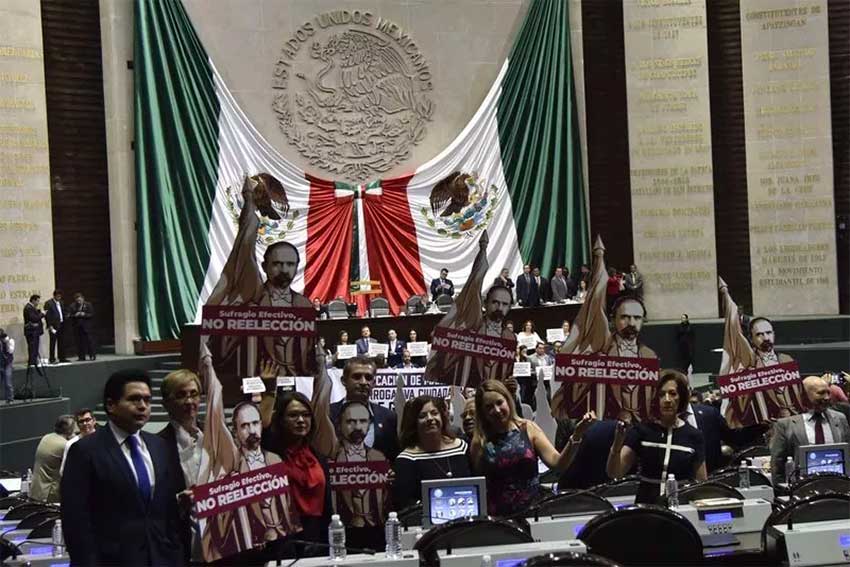
President López Obrador vowed today to sign a declaration that he will not seek another term in office after opposition lawmakers said that a constitutional change allowing for a referendum to cut short the six-year presidential term opened the door to his re-election.

The president said at his morning press conference that he will present a signed commitment on Monday declaring that he will not stand for re-election in 2024.

“I give my word and what I consider most important in my life is honesty, but in any case, I’m going to make a public commitment,” López Obrador said.

The Chamber of Deputies yesterday approved a constitutional amendment that would allow voters to have their say on a president’s performance three years after taking office.

The vote would be held on the same date as mid-term congressional elections. López Obrador says that if citizens choose to revoke his mandate, he will resign.

Supported by lawmakers from the ruling Morena party and its coalition partners, the reform received the required support of two-thirds of members in the lower house. The reform will now be passed to the Senate for debate and another vote.

“It’s a trick,” said National Action Party (PAN) Deputy Marcos Aguilar Vega of the midterm vote.
“We must switch on all the warning signs because the examples are clear: revocation of mandate was proposed in Venezuela and that opened the door to the ambition of Hugo Chávez to perpetuate his power.”

PAN Deputy Xavier Azuara said “these changes will allow the executive [branch of government] an intense political campaign in a shameless way in 2021 just when this chamber and 13 governorships are renewed.” It’s a “path to re-election,” he added.

On Twitter, PAN national president Marko Cortés wrote: “Today Morena and the Mexican government begin their quest to perpetuate themselves in power. The National Action Party categorically rejects the terms in which the popular consultation and revocation of mandate proposals were presented . . .”
Politicians from other opposition parties also voted against and criticized the approval of the constitutional reform.

“The next step is re-election,” said Institutional Revolutionary Party (PRI) Deputy María Alemán Muñoz Castillo, warning that Mexico could head down a path similar to that taken in Venezuela, Bolivia and Ecuador.

Citizens’ Movement lawmaker Alan Falomir charged that the reform is a political ploy designed to not only perpetuate López Obrador’s power but also to ensure that his Morena party is successful in the 2021 midterm elections.

“They need daddy AMLO” to campaign for the continuation of his rule in order to be swept to power by the tide of the president’s popularity, he contended.

López Obrador today acknowledged the criticism before reasserting his commitment to serve just one term.

“I heard the statements made by PAN lawmakers, saying that it [the revocation of mandate vote] is a rehearsal for re-election,” the president said before outlining details of what he intends to say in his public declaration.

“I will say that I am a supporter of democracy, that I agree with the [revolutionary and former president Francisco Madero’s] maxim of ‘effective suffrage, no re-election,’ that I am a maderista [adherent of Madero], that I’m not overambitious.”

Three and a half months after he was sworn in as president, López Obrador continues to enjoy strong public support, according to recent opinion polls.

A poll published earlier this month by the newspaper El Financiero showed that 78 percent of respondents approved of the president’s performance, while another published by El Universal this week to coincide with the completion of the government’s first 100 days in office gave an almost identical result.
Considering the survey results, there appears to be little chance that Mexicans would choose to remove López Obrador from the top job in a referendum on his rule.

In other business, lower house lawmakers also passed constitutional amendments that make it easier for the government to hold public consultations such as those held on the Mexico City airport project and a thermal power plant in Morelos.

Source: El Financiero (sp), El Universal (sp), Noticieros Televisa (sp), Reuters(en).

Due to lack of confidence, indigenous communities say no to national guard
They don’t expect complicity between federal security forces and criminal groups to change

Representatives of community police forces that operate in 38 Guerrero municipalities and one in Puebla have spoken out against the entry of the national guard into their territory.

“The people of our communities don’t believe in a simple change of name or uniform of the police.

There is no confidence that the national guard will work in favor of indigenous peoples and their communities,” said Sabrás Aburto, a spokesman for CRAC, an umbrella group of community police forces.

About 12,000 community police, or self-defense force members, operate in the Costa Chica, Tierra Caliente, Sierra, North and Central regions of the state.


spot_img

López Obrador confirms meeting with Donald Trump advisor

by the El Reportero’s wire services

President Andres Manuel López Obrador described Wednesday as a meeting in good terms the one held with Jared Kushner, son-in-law of Donald Trump, to finance with 10 billion dollars development plans in Mexico and Central America.

We are reaching a commitment of understanding to foster cooperation for investment, employment generation and economic growth in Mexico and Central American countries, he pointed out.
We insist, he said, that to face the migratory phenomenon the best thing is to develop in Central America and in the south southeast of our country.

There has been progress in this purpose, we deal with this issue in a friendly way, there is a very good relationship with the U.S. government and that is why this meeting was held, he added.

He revealed that the meeting was in a private home of a mutual friend, and were present Marcelo Ebrad (Foreign Minister) and the charge d’affaires of the U.S. Embassy.

“We were talking until 11 p.m. about development cooperation, a bilateral agreement to guarantee 10 billion dollars investments in Central America and the south of our country, so that there will be job, work and that migration will be optional, voluntary, not forced by the lack of opportunities or by violence,” he said.

The other issue discussed, he said, was to reaffirm the commitment to approve a trade treaty in which we can maintain the current terms to avoid misunderstandings because what was already achieved was good for both countries.

There will be work, he said, the Sowing Lives programs already benefit 80,000 farmers who are already receiving resources to work their own plots and so on in almost all states of the country.

Just the Mayan Train, he said, will result in the creation of 300,000 jobs, and we will have employment throughout the country. People don’t go to the United States just because they like it, but because they need it.

We are talking about a 5 billion dollars Mexican investment and the same for Central Americans, that is what is most important to us, not because of what the money means but because it is an investment to generate jobs and so that people do not have to abandon their comforts, customs and cultures, stated the president.

In other news in Mexico:

López Obrador affirms that Mexico leaves neoliberalism behind

President Andres Manuel López Obrador said on Friday that Mexico leaves neoliberalism behind and replaces it with a new policy, including the economic one, and that he will soon announce his new post-neoliberal project.
In his morning press conference at the National Palace, he promised that next Monday he will announce what he called the new national development plan, which is, in practice, a post-neoliberal project, a model that has sunk the country.
The president didn’t go into many details on the matter and created expectations for the next conference on Monday by admitting that many are wondering what is the government’s alternative proposal to neoliberalism, its economic policy and how this new era will be distinguished from the previous one.
What is sought, he said, is to do everything necessary for the country to move forward, to bring about the rebirth of Mexico. He added that consultations and forums will be held to define the national development plan.

spot_img

Study reveals turmeric is more effective at killing cancer cells than chemo or radiation

by Isabelle Z.

The mere mention of cancer strikes fear in the hearts of many people, and rightfully so. Having certain types of cancer often means you’ll be facing years of brutal treatments – if you’re lucky enough to live that long. Although it’s hard to imagine the disease could one day be considered non-threatening the way that many of the illnesses that used to kill people hundreds of years ago are viewed now, scientific breakthroughs like a recent study exploring turmeric’s effects on cancer cells are starting to give patients some hope.

This ancient Indian spice has been the subject of many studies in recent years as it continues to demonstrate its strength when it comes to fighting and preventing a host of diseases. Its inflammation-fighting properties are already well documented, and now a study published in Anticancer Research provides a comprehensive view of how the primary polyphenol in turmeric extract can selectivity kill cancer stem cells safely in ways that put radiation and chemotherapy to shame.

Many natural cures are valued for their simplicity, but turmeric is surprisingly complex in the way it fights cancer. It uses multiple molecular mechanisms to attack cancer stem cells, which are responsible for producing the cells in tumors. These stem cells resist chemotherapy and radiation, and surgery can sometimes even cause them to spread, which is why they’re often behind conventional treatment failures and tumor recurrence.

One aspect of curcumin’s intelligent approach is its ability to downregulate interleukin-6. The over-expression of this cytokine has been linked to inflammation progressing to cancer, and curcumin stops it from being released and stimulating cancer stem cells. It also directly and indirectly downregulates interleukin-1, which plays a vital role in the growth of cancer cells, and interleukin-8, which stimulates the regrowth of tumor-forming cancer stem cells.

Another way curcumin can fight cancer is by decreasing the binding of CXCR1 and CXCR2 and modulating pathways like the Wnt Signaling Pathway, the Notch Pathway, the FAK/AKT/FOXo3A Pathway, and the Hedgehog Pathways. If those terms are unfamiliar to you, you’re not alone – cancer is a complicated disease, but the bottom line is that curcumin targets deadly cancer stem cells in eight different and very powerful ways.

Curcumin is a very efficient cancer fighter, targeting the most dangerous cells of all, cancer stem cells, without touching normal cells. Contrast this with chemotherapy, which damages the DNA of quickly-replicating cells while they’re vulnerable during the mitosis stage of cell division. It does this without determining if the cells are cancerous or completely healthy.

This is essential because normal stem cells are needed to maintain good health. They differentiate into the cells needed to replace those cells that become damaged or sick, and killing them is one of the biggest problems of chemotherapy and radiation.

Scientists aren’t exactly sure why curcumin doesn’t have these negative effects on normal stem cells. One possible explanation is that malignant cells simply take in more curcumin than normal cells do. It’s also possible that curcumin encourages cancer stem cells to differentiate into more benign cells. Others theorize that it changes cells’ microenvironments in ways that benefit normal stem cells and harm cancer stem cells.

We might not yet know precisely how it works its magic, we do know that it can be very effective. Perhaps even more importantly, it’s very safe compared to the currently available cancer treatments. Curcumin has been safely used as a cooking spice in many cultures for hundreds of years, and it causes very few, if any, side effects in trials.

Scientists are still trying to determine the best ways to harness curcumin’s healing power as a cancer therapy and the amounts needed to safely make a difference, but in the meantime, you can enjoy some of the benefits on a smaller scale by adding this bright yellow spice to your cooking. Remember to use a bit of black pepper as well to boost its bioavailability, and stay on top of the latest curcumin research. It’s possible that cancer will eventually become a far less frightening prospect as researchers develop curcumin-based treatments for the disease.

Sources for this article include:
WakingTimes.com
AR.IIARJournals.org

spot_img

Presidio picnic’s eighth season begins

Compiled by the El Reportero’s staff

Multi-cultural community celebration unveils new mobile food creators and cultural dance groups at San Francisco’s Presidio National Park

This month, the Presidio of San Francisco, in partnership with Off the Grid, unveils an 8th season of Presidio Picnic with an exciting line up of new and returning mobile food creators and cultural dance performances.

Presidio Picnic takes place every Sunday from 11 a.m. to 4 p.m., rain or shine, through early October on the Presidio’s beautiful Main Parade Ground, an expansive seven-acre lawn with views of the park, the city skyline, and the San Francisco Bay. In addition to the monthly dance performances, Presidio Picnic will feature the return of other family-friendly elements that visitors love: more than 30 international mobile food creators representing the best of the San Francisco food scene, free bike safety classes for kids offered by the Presidio YMCA, nature-based arts and crafts for kids, lawn games, yoga from LubbDubb, music, and free bike valet by the SF Bicycle Coalition.

Cultural dance performances will be offered the third Sunday of each month and will be announced shortly.
Returning creators include Oakland-based Nashville-style hot chicken purveyors Hot Bird (easily identified at last year’s Presidio Picnic by their sizable queues), masters of Peruvian fusion Lamas Peruvian, and Pacific Island-meets-Philippines dessert favorite Hula’s Sweet Treats.
The season opens on March 31 at 11:30 a.m.

SF art exhibition by Antony Holdsworth and Beryl Landau
Anthony Holdsworth features the start of a new series entitled “Day and Night in the Mission”. Using a LED lamp attached to his easel, he documents locations as they transition into night.

The Mission District opens a window on Latin America while simultaneously enriching the culture of San Francisco. He works on site to channel the unique energy of this community and also to bear witness to the changes that are being forced on it by gentrification.
The exhibition includes works El Farolito by Day and Night, by Anthony Holdsworth, oil/panel, and Rise and Shine, by Beryl Landau.

Beryl Landau calls her work “symbolic landscape”. The acrylic paintings in this show depict geographical locations but evoke inner feelings. Each image draws the viewer into a particular space and mood. Landau’s clear colors range from high contrasts to subtle gradations.

Images of changing San Francisco are prevalent in her recent work. The paintings often convey the juxtaposition of nature and the modern world.
Alley Cat Gallery, 3036 24th Street, San Francisco. Exhibition through March 31.

¡Viva Cesar Chavez holiday on April 1!
On Monday, April 1, 2019 California will observe the official state holiday for labor and civil rights leader, César E. Chávez. San Francisco will celebrate this important Holiday with two special events: the Cesar E. Chavez Holiday Breakfast on Friday, March 29th;
and the César E. Chávez Holiday Parade & Festival, Saturday, April 13, 2019.

Greening Economic Summit
This year’s Economic Summit happens with an exciting, fully revamped program.

From our redesigned, interactive Equity Lab to an array of exciting racial justice panels to a fireside chat with an internationally renowned headliner to be announced shortly, you don’t want to miss your chance to attend the Bay Area’s largest racial equity conference. On April 26, 2019, The Greenlining Institute, 360 14th Street, 2nd Floor, Oakland,

spot_img

Applause for Paul McCartney, jeers for Sebastian Piñera in Chile

by the El Reportero’s wire services

An extraordinary concert of 39 songs and a resounding rejection of President Sebastian Piñera sealed the return of Paul McCartney to Chile in a National Stadium crowded by more than 50,000 spectators.
A few days ago, Piñera had unexpectedly invited his entire cabinet to attend the concert, and last night the president, his wife and their ministers attended the presentation of the ex-Beatle on his fourth visit to Chile, now as part of his international tour Freshen Up.

In a gesture of courtesy, in the middle of his presentation McCarney announced the presence of Piñera in the stadium with a ‘I would like to greet the president, we are happy to see him here tonight’, totally alien to what would come immediately after: a resounding reckoning that was viralized by the images of the moment captured by thousands of cell phones.

The president and his staff had to face the public’s snub while the disconcerted visitor tried to save the situation by quickly returning to his songs.

Before and after that ‘parenthesis’ the night was a wide and excellent show of rock in which McCartney interpreted a score of emblematic songs of the boys of Liverpool, of Wings and of his most recent disc, Egipt Station, up to a total of 39 pieces making the public enchanted throughout the almost three hours that lasted the concert.

A show that excelled in sobriety, without too much paraphernalia, unnecessary to the artistic quality of a star like Paul McCartney.

Spain’s actress Penelope Cruz shoots film in Cuba
Spain’s actress Penelope Cruz is in Cuba to resume shooting Wasp Network film by French director Olivier Assayas, which will have its premiere this year.

According to local media, Cruz arrived Wednesday to Havana accompanied by her husband and scene partner Javier Bardem although they do not give further details about their stay.

Her arrival coincides with that of the US actors Susan Sarandon, Owen Wilson and Shailene Woodle, who these days visited the historical center and famous places in Havana such as the Boulevard of San Rafael and the Cuban Art Factory.

Before this visit, Penelope was in Cuba in February with the Mexican Gael Garcia Bernal and the Cuban Ana de Armas, as confirmed on that occasion by the team in charge of processing their trip and hosting.
The new work of the model and winner of an Oscar for Best Supporting Actress in 2008 by Vicky Cristina Barcelona, will focus on the story of a group of Cuban anti-terrorists infiltrated in the US during the 1990s.

The film will tell the story of Gerardo Hernández, Fernando González, Ramón Labañino, Antonio Guerrero, René González and Juan Pablo Roque, based on the book The Last Soldiers of the Cold War by Brazilian Fernando Morais.

No Manches Frida 2 triumphs in cinemas in the United States
No Manches Frida 2 raised $ 3,894,000 on its first opening weekend, with a solid $ 8,250 per room and received an A in CinemaScore rating. It is a great achievement for this Mexican film that exceeded the collection of the opening weekend of the original feature film and that premiered in only 472 screens in the American Union. This is another great triumph for Pantelion Films, after its previous Latin hits like Instructions Not Included, the highest grossing Spanish film in US history; How to Be A Latin Lover and Overboard.

The first film of No Manches Frida premiered during a long weekend (Labor Day – 2/9/16) and raised $ 3,600,00

spot_img

Two down, one to go – court rulings pile up against citizenship question

An Interview with Thomas Saenz by Pilar Marrero, La Opinion & Ethnic Media Services

Editor’s Note: Two federal judges recently ruled against the Trump administration’s plans to add a citizenship question to the 2020 Census. Thomas Saenz, President and General Counsel of the Mexican American Legal Defense and Educational Fund (MALDEF), is lead co-counsel on another lawsuit now pending before Judge George J. Hazel of U.S. District Court for the District of Maryland.

Saenz sat down for an interview with La Opinion and Ethnic Media Services to explain why the citizenship question is illegal, in his view, and what he thinks the intentions were behind the administration’s last-minute proposed change to the 2020 Census. Saenz anticipates an imminent favorable decision from the Maryland judge, which could add yet another ruling to prevent the question from moving forward.

The civil rights leader explained that so far the courts have found that Department of Commerce Secretary Wilbur Ross (whose agency oversees the Census Bureau) violated the laws and the Constitution because the bid to add the citizenship question to the Census questionnaire was “arbitrary and capricious, failed to adequately notify Congress and was pretextual.” Additionally, the California court ruled that Ross’ proposal violated the Census clause of the Constitution, which indicates that any last-minute change must “fulfill a reasonable governmental purpose” and not interfere with the actual enumeration.

MALDEF is involved in another lawsuit now pending in front of a federal judge. Why is another lawsuit necessary and what’s different about the MALDEF suit?
There were actually seven different lawsuits filed against the citizenship question. Six were consolidated into three. Our case went to trial a little later but we expect a decision soon.
What’s unique and still to be determined in our case is whether there was a conspiracy to intentionally discriminate against the Latino community and the Asian American community by adding the citizenship question.

Would a favorable ruling in your lawsuit strengthen the challenge to the citizenship question that will be heard by the Supreme Court on April 23?
The first case, ruled on by the federal court in New York, has been taken up by the Supreme Court, bypassing the appropriate court of appeals in order to get a final decision to the Census Bureau in time for its June deadline for printing the questionnaire.

The Northern California case and MALDEF’s case – if we prevail – would go to the appeals courts and, I expect, then be taken up by the Supreme Court in some form, probably without a full hearing, to meet the Census Bureau printing deadlines.

The judge in California said it was clear that Ross was looking for any way to have the question added even though experts in the Census Bureau warned it would intimidate some groups from responding. What’s your view?
It’s clear from the two court rulings so far that Ross lied to the American public and to Congress about why the citizenship question was being added. He was acting to reduce the overall count of Latinos and thus reduce their political power. Latino voters have not demonstrated support for the extreme conservative positions of the Trump administration.

Even if the citizenship question is taken off the table, do you think there are good conditions to ensure a full count by the 2020 Census as required by the Constitution?
I think it’s quite clear there are a number of impediments to the 2020 Census that did not exist in previous Census counts.

First, in comparison to prior efforts, there’s inadequate investment by the Census Bureau in reaching hard-to-count communities.

Second, they intend for the first time to have households respond online, whether through a smart phone, laptop or desktop. That raises concerns about cyber security and access issues that didn’t apply before.

Even prior to the effort to add the citizenship question, the Census Bureau was seeing unprecedented levels of noncooperation with activities it engages in. Experts attribute that to the atmosphere of fear related to immigration enforcement created by the Trump administration.

Title 13, the U.S. law that governs the Census, protects the confidentiality of information given to the Census. Is that enough of a guarantee that people’s information will be secure?
Whether or not the citizenship question is there, people have to believe their data will remain confidential as it has by law for 72 years.

There are criminal penalties attached to violating confidentiality. Today, the federal law is very strong on this issue.

That said, we know that many people don’t trust this administration to follow the law, whatever it is, so MALDEF and other major advocacy organizations are forming a coalition to collectively commit, pledge, that if there’s any hint of a violation of census data, they will step in together, early on, to stop it.

The proposed citizenship question asks: “Is this person a citizen of the United States?” Does it ask about the individual’s immigration status?
People should understand it’s a citizenship question only and there are several options for responding: A “no” response and several “yes” responses about how you became a citizen ꟷ whether you were born in the U.S., or were naturalized or whether your parents are citizens, etc. It’s simply a question about your citizenship and how it was obtained.

Do you think Congress should take more actions to ensure the success of the Census?
Congress should do a number of things but for political reasons it’s unlikely Congress will do anything. The simple fact is that the Latino community and other hard-to-count communities are not communities Donald Trump sees as belonging to his base. He has concluded that an undercount is in his own interest, so is opposed to a vigorous outreach effort.

Why is the 2020 Census so crucial?
The data it collects determines political power by reallocating seats in the House of Representatives and electoral college votes in presidential elections. If a particular state faces a significant undercount, it could lose representation. States use Census data to redraw their congressional districts, state legislature districts and local jurisdictions. If a particular community is undercounted, it will not be represented as it should be.

Furthermore, the federal government uses the data to allocate hundreds of billions of dollars worth of annual federal funding for programs that impact every neighborhood – from improving infrastructure to providing support for families and students. So it’s critically important that everyone fills out the Census and that we get as complete a count as possible, particularly for Latinos, because we’re a growing community and stand to benefit from accurate Census data.

spot_img

‘No more migrants:’ Coahuila at maximum capacity, governor says

They should go to other states because Coahuila’s border is overwhelmed, said Riquelme governador of Coahuila

by Mexico News Daily

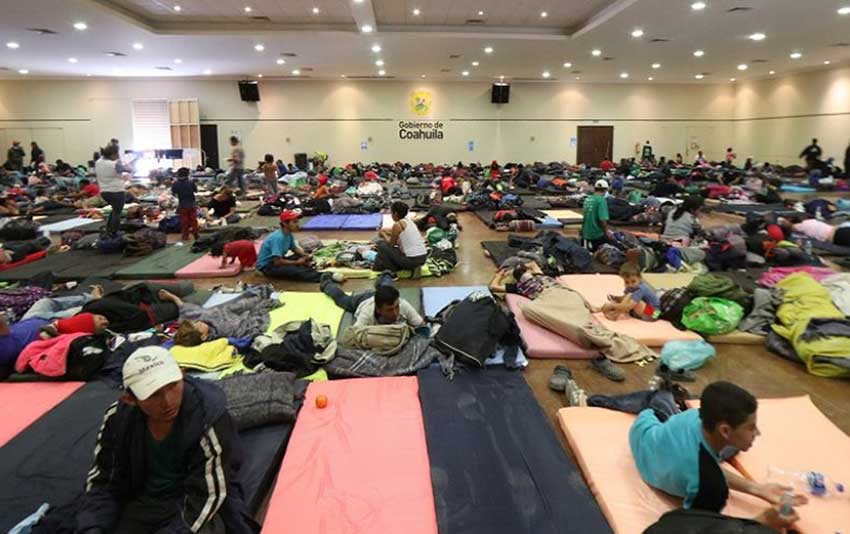
The governor of Coahuila has declared that no more migrants will be allowed into the state as thousands of Central Americans continue their journey through Mexico to the United States.

“We’re at maximum capacity,” Miguel Ángel Riquelme Solís said yesterday, referring to migrant shelters in the northern border city of Piedras Negras.

“We will not allow more migrants to travel through Coahuila because the border is overwhelmed, but neither will we invite chaos and therefore they should go to other states,” he said
The governor said that providing accommodation, food and services to more than 1,600 migrants who arrived in Piedras Negras yesterday had stretched the capacity of authorities, explaining that as a consequence, “we’ll block the entry to Coahuila.”

The Central Americans, mainly from Honduras but also Guatemala and El Salvador, entered Mexico in the middle of last month as part of a larger caravan of around 2,200. Authorities in Piedras Negras converted several old factories into shelters to house them.

State news agency Notimex said that 51 other migrants had gone to Monterrey, Nuevo León, where authorities provided them with shelter in a gymnasium and humanitarian aid.

Manuel González Flores, general secretary for the state government, said that 35 of the migrants have family members in Nuevo León and intend to remain there, while the others are expected to continue their journey to the United States’ southern border.

At the other end of the country, around 3,800 migrants are currently traveling through Chiapas and yesterday reached Mapastepec, a municipality about 140 kilometers north of the Mexico-Guatemala border.
Hondurans also make up the bulk of that group but are joined by 500 Guatemalans, 300 Salvadorans and 50 Nicaraguans, caravan organizers told the news agency AFP.

The migrants plan to travel to Mexico City, where local authorities are preparing to receive them at the same sports stadium-cum-shelter that has housed previous groups.

From there, they will decide which section of the northern border they will travel to in the hope of claiming asylum in the United States, although U.S. President Donald Trump continues to maintain a hard line on immigration.

In his State of the Union address last night, Trump described the approach of migrants to the border as a “tremendous onslaught” of “large, organized caravans” and continued to press for funding for his long-promised wall.

“The lawless state of our southern border is a threat to the safety, security, and financial well-being of all Americans,” he said.

“We have a moral duty to create an immigration system that protects the lives and jobs of our citizens… In the past, most of us, the people in this room, voted for a wall. But the proper wall never got built. I will get it built.”

In a Twitter post earlier in the day, Trump wrote: “Tremendous numbers of people are coming up through Mexico in the hopes of flooding our southern border. We have sent additional military. We will build a human wall if necessary. If we had a real wall, this would be a non-event!”

As has become his trademark in assessing the U.S. president’s comments about Mexico and border security, President López Obrador said Trump’s address last night was respectful.

“…There were some remarks [I didn’t agree with] but that’s his right, that’s his vision … He was very respectful of our government and we thank him,” he said.

Asked specifically about Trump’s claim that Mexico allows migrant caravans to freely travel through the country, López Obrador simply responded: “We very much respect the point of view of the president, Donald Trump.”

(Source: El Universal (sp), Animal Político (sp), Excelsiór (sp), Noticieros Televisa (sp).

In other news in Mexico:

AMLO enjoys 86 percent approval rating, strong support for fuel theft strategy

In baseball terminology, 34 percent said AMLO hit a home run. Just one in 10 said he struck out

Two months into his six-year term, President López Obrador enjoys an 86% approval rating, according to a new poll that also shows strong support for the government’s crackdown on fuel theft.

The survey, conducted by the newspaper El Financiero over two days last week, shows that just 13 percent of 410 people polled disapprove of the president’s performance while 1 percent of respondents were undecided.

In contrast, the highest rating ever earned by López Obrador’s predecessor, Enrique Peña Nieto, was just 57 percent, in May 2013, according to pollster Consulta Mitofsky. His lowest rating was 17 percent in February 2017 and he finished his term last November at 24 percent.

But AMLO, as Peña Nieto’s successor is commonly known, can do no wrong in the eyes of citizens.

Even though it caused widespread and prolonged gasoline shortages, the government’s anti-fuel theft strategy was very popular among poll respondents, with 80% saying they considered the move to be very good or good. Just 12% said that the strategy was very bad or bad.

López Obrador’s appearance at daily early-morning press conferences was considered very good or good by 72 percent of those polled, making them the second most popular measure implemented by the new government.

The response to the deadly petroleum pipeline explosion in Hidalgo, which 65 percent of respondents said was very good or good, was the next most popular government action followed by the decision to sell off government-owned armored vehicles, which garnered 64 percent support.

spot_img

López Obrador says no to ‘offensive’ contrast of grand hotels and poverty

8-billion-peso infrastructure program announced for leading tourism destinations

by Mexico News Daily

Putting an end to the “offensive” contrast between luxurious hotels and poor neighborhoods in Mexico’s most popular resort cities is the aim of a new government program launched yesterday by President López Obrador.

The central objective of the Mi México Late (My Mexico Beats) program is to build much-needed infrastructure in the working-class neighborhoods of Mexico’s leading tourism destinations.

“We no longer want there to be the offensive contrast between large hotels and marginalized, impoverished neighborhoods without water services, without drainage, without anything,” López Obrador said yesterday in Los Cabos, Baja California Sur.

Among the cities that will benefit from the 8-billion-peso (US $413.7-million) urban improvement program are Los Cabos, Cancún, Acapulco and Puerto Vallarta.

Urban Development Secretary Román Meyer Falcón said that 10 northern border cities will also receive funding for infrastructure projects through the same program.

López Obrador said the government chose to launch the program in Los Cabos because of its importance to tourism in the country.

Almost 600 million pesos (US $31 million) will be allocated to infrastructure projects in the city’s neighborhoods, he said, explaining that residents will also be able to access financial support in order to obtain deeds for their properties.

The president also said that a 1-billion-peso (US $51.7-million) water desalination plant has been authorized for the area.

López Obrador pledged to return to Los Cabos in a few months to assess the progress of the Mi México Late program and other government initiatives.

“Mexico has a lot of natural resources, a lot of wealth, good people, hard-working people. What was needed, we now have: a good government,” he said.

Meanwhile, López Obrador announced today that his government is planning to launch a tidy towns contest to encourage people to take more pride in the places where they live.

“We have to take care of the cleanliness of our towns … no to garbage, no to dirtiness . . . [societal] transformation also implies cleanliness,” he said.

After waxing lyrical about the beauty of the bougainvillea plant, the president explained that the cleanest, best-decorated towns in Mexico will be officially recognized at an awards ceremony at the National Palace.

A public infrastructure project that each winning town needs will also probably be part of the prize package, López Obrador said.

“There are very poor towns with humble people but they’re very clean. For example, I know all the municipalities of Oaxaca and they’re very clean, they’re careful not to contaminate the water, there are signs … so that people don’t throw detergent and fertilizer into the streams, there are trash cans, that is also very important.”

In other tourism news in Mexico:

Hospitality-travel firm says tourists with money are going elsewhere

Head of Apple Leisure Group says insecurity, sargassum and insufficient marketing are the causes

Mexico’s high-end tourism market has taken a hit so far in 2019, according to the CEO of a hospitality-travel firm who predicts that visitor numbers will decline further in coming months.

Alejandro Zozaya, CEO of Apple Leisure Group, estimates that the economic spillover from tourism is down 20 percent to date this year compared to the same period of 2018.

The problem: not as many wealthy Americans are coming to Mexico to vacation, get married at lavish ceremonies and honeymoon.

“The most important market we have lost is that which leaves the largest economic spillover, the high-end North American,” Zozaya told the news outlet Aristegui Noticias.

“We still have a lot of Americans but the highest segment [of the market] has stopped coming and we’ve replaced them with tourists from other countries and regions who leave a smaller spillover – they spend less at the destination, hotel rates go down,” he said.

The businessman claimed that the main reason well-off tourists are not coming to Mexico is insecurity but added that sargassum on Caribbean coast beaches and a lack of marketing following the government’s decision to disband the Tourism Promotion Council (CPTM) are also factors.

More United States citizens are traveling outside their country than ever before and there is not a decline in the international tourism market, but tourists are deciding to “go to other destinations that are not Mexico,” Zozaya said.

“[Americans] are going to the Dominican Republic, Costa Rica, Jamaica, and Mexico loses market share.”

He said that tourism is declining in Mexico’s most popular destinations at the same as the number of hotel rooms is going up.

“We have 30,000 additional rooms projected for Quintana Roo on top of those in Puerto Vallarta, in Los Cabos and other destinations in Mexico,” Zozaya said.

He stressed that advertising is the best way to attract greater visitor numbers to Mexico and that demand for accommodation and other tourism services must grow at a rate at least equal to supply growth in order to maintain profitability and employment in the sector.

Zozaya’s estimate of a 20 percent reduction in tourism spending this year is well above the 0.3 percent decline in air arrivals recorded in January but the businessman warned that “the most complicated” period for the tourism industry “is still to come.”

Contributing to the decline in international air arrivals in January was a reduction in the number of passengers flying into Cancún International Airport, the first year-over-year decrease for any month in almost seven years.

Earlier this year, the Secretariat of Tourism predicted that international visitor numbers could hit 43.6 million in 2019, which would represent a 5.2 percent increase on last year’s record figures.
Total tourism expenditure is forecast to reach just under US $23.7 billion, which would also be 5.2 percent higher than in 2018.

Last month, Tourism Secretary Miguel Torruco Marqués said the government is aiming to increase expenditure by tourists in Mexico by focusing more on attracting big spenders.

Among the nationalities that spend the most while visiting Mexico, the Japanese are in first place, spending an average of $2,008, not including airfare.

Source: Aristegui Noticias (sp.

spot_img

8 signs of sugar addiction… and tips to control your sweet tooth

by Michelle Simmons

Human are naturally wired to crave sugar because it plays an important role in survival. During ancient times, sugar was mostly available in the summertime. People during those times would indulge in it to store excess calories in the form of body fat to survive through the cold winter seasons. Today, however, sugar is readily available any time, which can lead to addiction. Here are eight signs of sugar addiction and how to fix them:

1. You want to eat or snack throughout the day:
You may be addicted to sugar if you feel the need to snack all the time, even when you are not actually hungry. If this is the case, the solution is to focus on eating a combination of fats, proteins, and carbohydrates at every meal or snack. Don’t eat carbohydrate-rich, sugary foods alone.

2. You eat plenty of fruits or drink a lot of juice:
You may think that eating lots of fruits or drinking fruit juices is healthy, but remember, many fruits are also high in sugar. If you often crave sweet fruits, you may be addicted to sugar. However, this does not mean that you should stop consuming fruits altogether. You just have to eat fruits that contain more nutrients but less sugar, such as berries. For juices, it’s best to drink fresh green juice that mainly comes from vegetables.

3. You crave for coffee and alcoholic drinks:
Coffee and alcoholic drinks often contain sweeteners and mixers that greatly contribute to sugar intake. Moreover, many people who quit drinking coffee or alcohol tend to crave other sugary foods or drinks. To fix this, don’t add sweeteners to your coffee. If you’re drinking alcohol, drink in moderation and avoid dark-colored liquors, mixers, and beer.

4. You’re always stressed:
Being chronically stressed increases your levels of cortisol, which promotes hunger and sugar cravings. Eating sugar can also increase cortisol levels. Elevated cortisol levels can lead to adrenal fatigue, which can further trigger sugar cravings and addiction. You can relieve stress by practicing breathing through your nose and belly breathing techniques. Additionally, avoid stress eating and take a walk instead.

5. You crave sweets during or after meals: You are most likely addicted to sugar if you always think of eating something sweet during or right after a meal. Craving sugar during or after meals can also be a symptom of adrenal fatigue and small intestinal bacterial overgrowth (SIBO). Get tested for adrenal fatigue or SIBO to address this problem.

6. When you’re hungry, you want to eat immediately:
If this sounds like you, you could be suffering from hypoglycemia, which occurs when blood sugar declines to below-normal levels. This condition makes you crave sugary foods. To prevent this from happening, do not eat carbs in isolation. Instead, eat protein and fat at every meal and snack.

7. You crave carbs early in the morning or late at night:
Eating a breakfast high in carbs can put you in the vicious cycle of spikes and drops in blood sugar levels throughout the day. Carbohydrates are metabolized as sugar once they reach the bloodstream. They spike blood sugar levels, which then drops shortly after. This “blood sugar roller coaster” can make you hungry more often and can intensify your sugar cravings. To solve this, eat a protein-rich breakfast containing healthy fats and non-starchy vegetables instead.

8. Your sugar craving intensifies when you try to give it up:
You may have tried to give up sugar, and when you did, your sugar cravings just became more intense and frequent. If this is the case, it is best to follow a Paleo diet. This type of diet helps you to naturally balance sugar levels by providing a healthy macronutrient ratio and focusing on low-glycemic carbs. This helps maintain steady blood sugar control throughout the day.
Sugar addiction harms your health in many ways. It can increase your risk of many health conditions, such as obesity, heart disease, diabetes, cancer, fatty liver, and depression. It can also be detrimental to your skin, kidneys, and teeth. (Natural News).

spot_img

Omar Sosa’s Transparent Water at the Freight in SF

Compiled by the El Reportero’s staff

The genius of Omar Sosa and his amazing trio as part of the RAICES series at the Freight!
Omar blurs the lines between the magical and the musical! He is constantly creating, innovating and evolving.

If you’ve seen him before, you know, if not, do yourself a favor – go watch him!
Hope to see you at the Freight both nights for this unique, inspirational and rare opportunity.
Transparent Water Trio is comprised of Omar Sosa – piano (Cuba) / Seckou Keita – kora, voice (Senegal) / Gustavo Ovalles – percussion (Venezuela).

On Wednesday & Thursday, March 20 & 21. Doors open at 7 p.m. / Show: 8 p.m.
$36 ADV / $40 door (plus fees). At The Freight & Salvage, 2020 Addison St., downtown Berkeley. One block from BART! (510) 644-2020 info@freightandsalvage.org.

Presidio picnic’s eighth season begins

Multi-cultural community celebration unveils new mobile food creators and cultural dance groups at San Francisco’s Presidio National Park

This month, the Presidio of San Francisco, in partnership with Off the Grid, unveils an 8th season of Presidio Picnic with an exciting line up of new and returning mobile food creators and cultural dance performances.

Presidio Picnic takes place every Sunday from 11 a.m. to 4 p.m., rain or shine, through early October on the Presidio’s beautiful Main Parade Ground, an expansive seven-acre lawn with views of the park, the city skyline, and the San Francisco Bay. In addition to the monthly dance performances, Presidio Picnic will feature the return of other family-friendly elements that visitors love: more than 30 international mobile food creators representing the best of the San Francisco food scene, free bike safety classes for kids offered by the Presidio YMCA, nature-based arts and crafts for kids, lawn games, yoga from LubbDubb, music, and free bike valet by the SF Bicycle Coalition.
Cultural dance performances will be offered the third Sunday of each month and will be announced shortly.

Returning creators include Oakland-based Nashville-style hot chicken purveyors Hot Bird (easily identified at last year’s Presidio Picnic by their sizable queues), masters of Peruvian fusion Lamas Peruvian, and Pacific Island-meets-Philippines dessert favorite Hula’s Sweet Treats.
The season opens on March 31 at 11:30 a.m.

SF art exhibition by Antony Holdsworth and Beryl Landau
Anthony Holdsworth features the start of a new series entitled “Day and Night in the Mission”. Using a LED lamp attached to his easel, he documents locations as they transition into night.
The Mission District opens a window on Latin America while simultaneously enriching the culture of San Francisco. He works on site to channel the unique energy of this community and also to bear witness to the changes that are being forced on it by gentrification.
The exhibition includes works El Farolito by Day and Night, by Anthony Holdsworth, oil/panel, and Rise and Shine, by Beryl Landau.

Beryl Landau calls her work “symbolic landscape”. The acrylic paintings in this show depict geographical locations but evoke inner feelings. Each image draws the viewer into a particular space and mood. Landau’s clear colors range from high contrasts to subtle gradations.
Images of changing San Francisco are prevalent in her recent work. The paintings often convey the juxtaposition of nature and the modern world.

Alley Cat Gallery, 3036 24th Street, San Francisco. Exhibition through March 31

Greening Economic Summit
This year’s Economic Summit happens with an exciting, fully revamped program.
From our redesigned, interactive Equity Lab to an array of exciting racial justice panels to a fireside chat with an internationally renowned headliner to be announced shortly, you don’t want to miss your chance to attend the Bay Area’s largest racial equity conference. On April 26, 2019, The Greenlining Institute, 360 14th Street, 2nd Floor, Oakland,

spot_img