In 2026, the Dominicans complete 500 years in Mexico. These friars have contributed to our country not only faith, but also struggle and knowledge
by México Desconocido
In this year 2026, 500 years of the Dominicans in Mexico are being commemorated. Their work of evangelization began precisely in 1526, a short time after the conquest of Mexico-Tenochtitlan, and was concentrated mainly in the southern part of our country. As the centuries passed and through the ups and downs of national history, the Dominican Order has continued to maintain a presence in the Mexican Republic. Its academic and intellectual work continues to enjoy enormous importance.
The Order of Saint Dominic of Guzmán
The Dominican Order, whose official name is the Order of Preachers, belongs to the Catholic Church. It was founded in 1206 by the Castilian priest Saint Dominic of Guzmán (1170-1221), in southern France. Years later, on December 22, 1216, Pope Honorius III officially approved it through a papal bull. Like their Franciscan brothers, this mendicant order had the objective of preaching the Gospel to the people of the cities of Medieval Europe. The work of Saint Dominic was a pastoral response to the heretical movement of the Cathars, which was very popular in Languedoc and Occitania. To accomplish this, the work was sustained through evangelical poverty, doctrinal formation, and the moral authority of its preachers.
Very early on, the Dominican Order gained political and intellectual relevance. Together with the Franciscans, they presided over inquisitorial tribunals. In the year 1231, Pope Gregory IX officially entrusted both orders with the task of investigating and judging cases of heresy. On the other hand, they developed a philosophical, scientific, theological, and mystical tradition of enormous relevance to the intellectual history of Europe in several universities of the Middle Ages. Among their most distinguished personalities in this field were Saint Thomas Aquinas, Saint Albert the Great, Meister Eckhart, Saint Catherine of Siena, and Saint Vincent Ferrer. Because of this, the name of the Dominican friars in Latin, Dominicanus, gave rise to their best-known nickname: the Domini canis, “the dogs of God,” a symbol of their religious mission.
Arrival of the Dominicans in New Spain
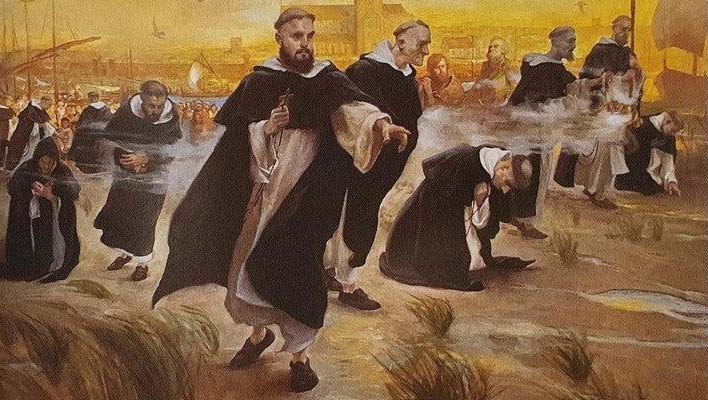
Following the conquest of Mexico-Tenochtitlan, which occurred on August 13, 1521, the evangelization of the Mesoamerican peoples began. For this purpose, the twelve Franciscan friars who initiated that task had arrived in 1524. Two years later, on July 2, 1526, twelve Dominican friars arrived, whose superior was Fray Tomás Ortiz. These religious men were Vicente de Santa Ana, Diego de Sotomayor, Pedro de Santa María, Justo de Santo Domingo, Pedro Zambrano, the deacon Gonzalo Lucero, and the lay brother Bartolomé de la Calzadilla, who came from Spain; from the island of Hispaniola came Fray Domingo de Betanzos, Fray Diego Ramírez, Fray Alonso de las Vírgenes, and the novice Vicente de las Casas.
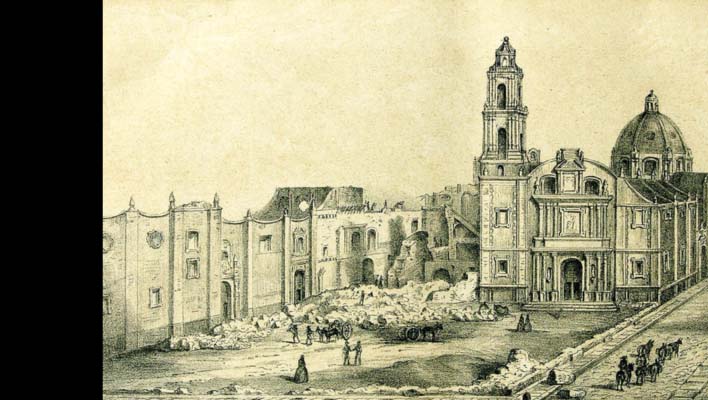
In Mexico City they founded the Convent of Santo Domingo in the year 1527, and from there they formed four ecclesiastical provinces that included, in addition to the capital, the present-day State of Mexico, Puebla, Morelos, Oaxaca, Chiapas, and Guatemala. After various difficulties, they succeeded in strengthening their presence in New Spain and carried out an enormous work of evangelization. This is especially notable in the territories that today comprise the southern region of our country. As examples, one may cite the famous Former Convent of Santo Domingo in the city of Oaxaca, the Temple and Former Convent of Nuestra Señora de la Natividad in Tepoztlán, and the Temple of Santo Domingo in San Cristóbal de las Casas, among others.
Crisis of the Dominican Order in the 18th Century and Independent Mexico
Beginning in the 18th century, the Bourbon Reforms considerably eroded the power of the Dominican Order and other congregations in New Spain. Later, with the consummation of Mexico’s independence, the first reforms of the young nation diminished the influence of the Catholic Church and, consequently, of the friars themselves. All of this reached its culmination with the Constitution of 1857 and the Reform Laws, which definitively separated the State from the Church. This caused the Mexican province of the order to be dissolved and led many of its members to leave the country. Their convent complexes were confiscated and nationalized.
During the Porfirian era, the restoration of cordial relations between the Mexican State and the Catholic Church led Dominican friars from Spain to come and reorganize the order in national territory. This began a long process of restoration that extended through the 20th century, including important historical events such as the Mexican Revolution (1910-1917) and the Cristero War (1926-1929). Finally, in 1961, the Dominican province in Mexico was formally reestablished.
500 years of the Dominicans in Mexico: a historic milestone
The significance of celebrating 500 years of the Dominicans in Mexico is enormous. The reason is that this religious order, together with the Franciscans and Jesuits, influenced the formation of several cultural and religious characteristics of our country. In fact, the person responsible for strengthening, expanding, and officially establishing devotion to the Virgin of Guadalupe was Mexico’s second archbishop, the Dominican Alonso de Montúfar. Another highly significant member of the order was Fray Bartolomé de las Casas. This religious man denounced the crimes of the Spanish conquerors and defended the dignity of all Indigenous peoples. As if that were not enough, a Dominican friar was also a distinguished insurgent who fought for the independence of Mexico: Fray Servando Teresa de Mier.
Today, after the passage of the centuries, the Dominicans continue to have an important presence in our country. Honoring their history and intellectual tradition, they maintain first-rate academic and social centers. For example, one can find the Tomás de Aquino Center for Philosophical Studies (CEFTA) in León, Guanajuato; the Dominican Institute of Historical Research (IDIH) in the city of Querétaro; as well as the Fray Francisco de Vitoria Human Rights Center and the Centro Universitario Cultural (CUC) in Mexico City. In addition, distinguished Mexican Dominicans such as Mauricio Beuchot and Fray Julián Cruzalta have set important standards in philosophy and theology.