by the El Reportero staff
California has enacted a new law requiring attorneys to verify information generated by artificial intelligence before submitting it to courts, responding to growing concerns about fabricated legal cases, inaccurate citations and the protection of confidential client information.
Senate Bill 574, signed by Gov. Gavin Newsom on September 30, takes effect January 1, 2027. The legislation establishes new safeguards governing how attorneys and arbitrators use generative artificial intelligence in legal proceedings.
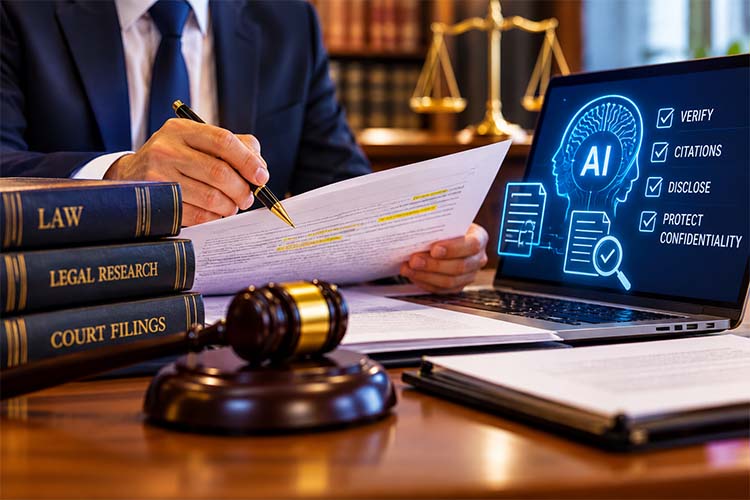
Under the law, attorneys must take reasonable steps to verify AI-generated information, correct errors and personally confirm legal citations included in court filings. They must also disclose the use of generative AI in documents submitted to courts.
The legislation prohibits attorneys from delegating the practice of law to artificial intelligence systems. It also restricts the entry of confidential client information into systems where access to that information is not appropriately protected.
Arbitrators, who resolve disputes outside traditional court proceedings, cannot delegate their decision-making responsibilities to AI tools. They must exercise independent judgment when evaluating evidence and reaching decisions.
The measure comes amid increasing reports of lawyers submitting documents containing nonexistent cases or inaccurate legal references produced by AI systems. Such errors, sometimes called AI hallucinations, can mislead courts and expose attorneys to disciplinary action or financial sanctions.
Earlier this year, a federal magistrate judge in San Francisco fined an attorney $1,000 and ordered additional ethics training after legal arguments included references to three nonexistent cases, according to information provided by JOTO PR Disruptors.
Crawford Appleby, a partner at the law firm Wisner Baum and member of its artificial intelligence committee, emphasized that requiring disclosure alone may not prevent mistakes.
“Disclosure rules alone do not solve the problem. What matters most is that firms and courts have screening systems in place,” Appleby said in a statement distributed to the media.
The legislation raises broader questions about how rapidly developing technology should be incorporated into the justice system without compromising professional accountability.
For California residents, including those involved in immigration, employment, housing or civil disputes, the safeguards could help protect the integrity of legal representation.
Although artificial intelligence can assist attorneys with research and document preparation, the new law reinforces a fundamental principle: responsibility for legal advice, court filings and judicial decisions must remain with qualified human professionals.
Sources: California Senate Bill 574, California Courts Newsroom, Reuters and JOTO PR Disruptors.