Indigenous Peoples’ Day gathering honors ancestral traditions and a historic struggle for sovereignty
by the El Reportero staff
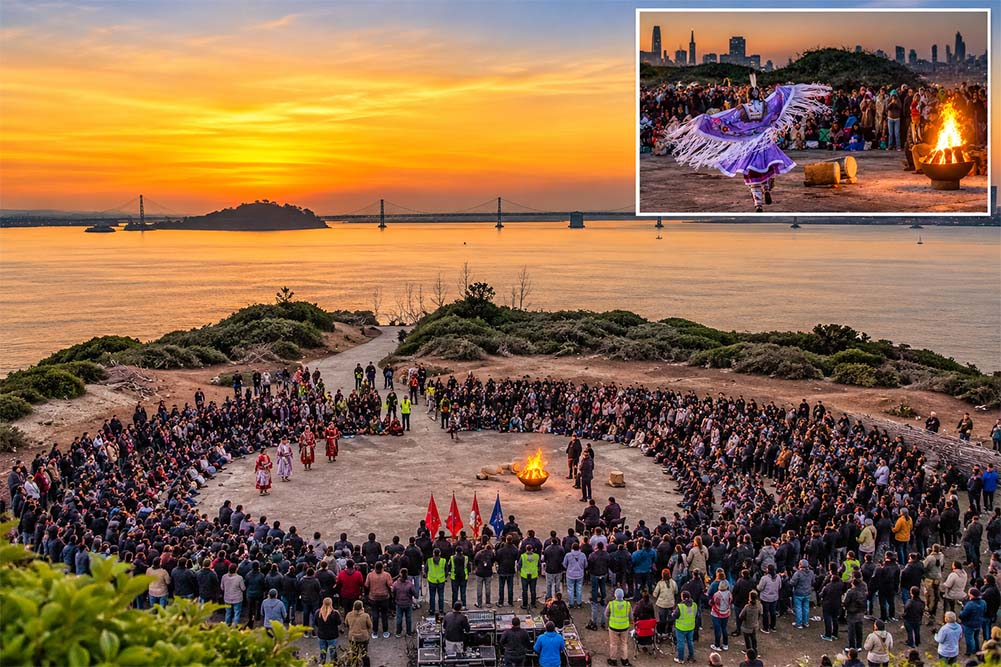
As the sun rose over San Francisco Bay on Monday, October 12, Native American families, elders and supporters gathered on Alcatraz Island for an Indigenous Peoples’ Day Sunrise Gathering, honoring their ancestors and reaffirming a continuing commitment to cultural survival and sovereignty.
The annual ceremony brought participants together for prayer, traditional songs, dancing and reflection. Against the backdrop of the bay, the gathering emphasized that Alcatraz is more than a former federal prison: it is a landmark in the modern struggle for Indigenous rights.
“In the face of many obstacles, Indigenous Peoples continue our commitment to keep our cultures alive, build our unity, and protect our sacred lands and waters from desecration, destruction, and contamination,” said Morning Star Gali, a member of the Pit River Nation and a lead organizer, in a statement released ahead of the ceremony.
The event was organized by the International Indian Treaty Council, which has helped sustain the island’s sunrise gatherings and their message of Indigenous solidarity across generations.
A history beyond the prison
Long before Alcatraz became internationally known for its prison, the island stood within a bay inhabited by Indigenous peoples, including the Ohlone. During the nineteenth century, federal authorities also used the island to imprison Native Americans, among them Hopi men who resisted government demands concerning their children’s schooling.
Alcatraz gained new significance in November 1969, when a group calling itself Indians of All Tribes occupied the island. The occupation lasted until June 1971, drawing national attention to broken treaties, land rights and federal policies affecting Native communities.
Although the occupation ended, its influence extended far beyond the island. It energized Indigenous activism and helped make Alcatraz an enduring symbol of self-determination.
Two commemorations, a shared history
The October 12 gathering took place on a date also associated with Columbus Day, commemorating Christopher Columbus’s arrival in the Americas in 1492. For many Italian Americans, the holiday honors heritage and exploration; for many Indigenous communities, it recalls the beginning of conquest, displacement and the loss of ancestral lands.
The encounter also shaped the Hispanic world. Under the Spanish Monarchy, territories including New Spain and Peru were organized into viceroyalties, with courts, municipalities and educational institutions. Universities founded in Mexico City and Lima in 1551, together with the spread of the Spanish language and traditions, contributed to the cultures that endure across Latin America.
Those developments unfolded alongside conflict, disease and profound disruptions to Indigenous societies, whose civilizations and knowledge existed centuries before Europeans arrived. Today’s Latin American identities reflect Indigenous, European and African contributions.
A living symbol
San Francisco officially recognizes Indigenous Peoples’ Day, while Columbus Day continues to be observed elsewhere in the country. Their coexistence reflects different understandings of a shared and often painful history.
On Alcatraz, the gathering was not simply an occasion to remember the past. The prayers, music and community participation expressed the determination of Native peoples to preserve their languages, sacred places and traditions for future generations.
As daylight spread across the bay, the island once associated with confinement again became a place where Indigenous communities publicly affirmed their presence and their future.