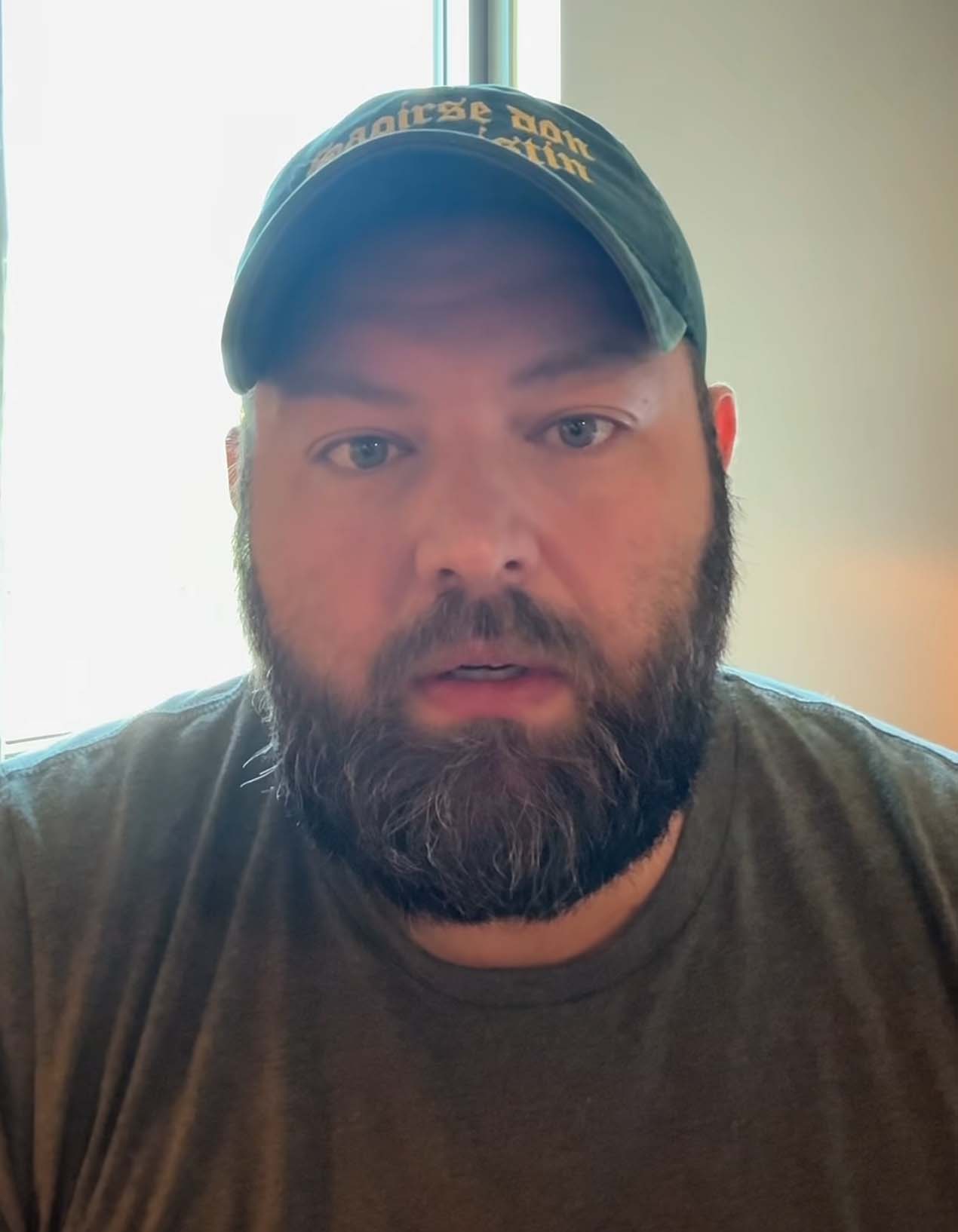
photo: Robert Arnold shares a video commentary reflecting on the human cost of immigration control operations. Screenshot from Robert Arnold’s Facebook video.
NOTE FROM THE EDITOR:
Bottom of Form
The debate over immigration in the United States often centers on laws, border security and statistics. Yet behind every immigration enforcement operation are individuals, families and communities whose lives can be changed forever. A video published on Facebook by content creator Robert Arnold offers a reflection on that human cost, recalling the cases of two workers who died during recent operations involving U.S. Immigration and Customs Enforcement (ICE).
Beyond the political debate over immigration, the message raises an important question: Can the law be enforced with greater planning, training and restraint to prevent innocent families from paying the ultimate price? This version has been adapted and condensed for El Reportero from Arnold’s original commentary.
––––––––––––––––––––––
A reflection on the human cost of immigration enforcement operations and the need to protect life during the enforcement of the law
His name was Lorenzo Salgado Araujo. He was fifty-two years old.
He was a husband. He was a father of three sons.
He’d spent more than three decades in Houston building homes, raising a family, and chasing the same version of the American dream that generations before him had crossed oceans to find.
Friends remember a man who loved ranchera music, who worked with his hands, who built not only houses, but a life.
And on July seventh, he left for work and never came home.
Federal agents were looking for someone else, someone driving a similar van, someone they believed resembled the man they were trying to find.
Instead, Lorenzo’s family buried him. Six days later, another family received a phone call that every family fears.
His name was Joan Sebastian Duran Guerrero.
He was twenty-six years old. He was a husband.
He was a father of a three-year-old little girl.
He had legal authorization to work in the United States, and like millions of other fathers, he got up that morning intending just to go to work.
Instead, during an ICE operation in Biddeford, Maine, he was shot and killed.
His wife now has to explain to a little girl why her father isn’t coming home.
And you and I and everyone else listening to this are just men and women of a certain age.
We’re fathers and mothers, daughters or sons, husbands or wives, and we leave for work in the morning, and we expect to come home.
And that’s the quiet promise that we all live by.
The difference here is not that Lorenzo or Joan were somehow different from us.
The difference is that this tragedy has not yet landed on our doorsteps.
Our loved ones have not received that phone call, not yet, because when that call comes, it’s already too late, and it’s too late for the families of these men.
And if we continue to accept and support tactics that make outcomes like this possible, we should not pretend it will always happen to someone else.
Eventually, it will knock on your door or the door of someone you love.
Before we argue about immigration, before we debate border policy, before we sort ourselves into Republicans and Democrats, can we just stop for one moment and simply say their names?
Lorenzo Salgado Araujo, Joan Sebastian Duran Guerrero.
Somewhere along the way, we have developed a terrible habit in this country where we talk about operations, about targets, about suspects.
We talk about collateral consequences, but we rarely talk about empty chairs at dinner tables, about a wife lying awake next to half a bed that’s cold and empty, reaching in the dark for a hand that she will never find.
About three sons who are standing beside their father’s casket, about a three-year-old little girl who will grow up with stories instead of memories, about another family now asking how a chase became a funeral.
And that is where this conversation has to start, not with immigration, with humanity.
And there are questions that I cannot shake, like why should any innocent person ever have to fear for their life at the hands of the state?
Not fear arrest after committing a crime, not fear prosecution after violating the law, but just fear because armed federal agents have decided that today is the day that they wanna talk to you.
And a free society should never ask ordinary people to accept that as the cost of living under the rule of law.
The defenders of these shootings will immediately ask whether the officers feared for their lives.
And that may be an important question, but it shouldn’t be the first question, and it damn sure shouldn’t be the only question.
The government has something no citizen possesses.
It chooses the time. It chooses the place.
It chooses the tactics. It writes the training manuals.
It established the culture. It decides whether success is measured by arrest or by everyone going home alive.
And if operation after operation after operation ends with grieving families asking why their husband, their father, their son is dead, then eventually we have to stop pretending these are only individual tragedies.
These have become institutional questions.
Why are these officers being taught this way?
Why are they so confident in making these decisions to end a life?
Why are these encounters escalating so quickly?
Why are high-risk vehicle stops and pursuits becoming a common feature of immigration enforcement?
How much emphasis is placed on slowing situations down rather than dominating them?
How much training is devoted to preserving life when fear predictably enters the equation?
Because fear is the most predictable part of this equation.
Anyone who believes they might be detained, deported, separated from their family, or simply does not understand what is happening will panic.
The government knows this. The government should plan for this.
The burden of anticipating imperfect human behavior belongs to the state because the state possesses overwhelming power.
That is the moral contract of democracy. The badge is not supposed to lower the threshold for taking a human life.
It’s supposed to raise it. Because again, the badge is a burden and not a shield.
That is what makes these deaths so unsettling.
Not simply because men have died, but because they force us to ask whether our institutions are becoming too comfortable with the idea that if an encounter becomes chaotic, a bullet is the acceptable conclusion.
Every democracy eventually has to answer this one question: What is the value of human life when weighed against the convenience of an enforcement tactic?
I know my answer. It’s worth slowing down.
It’s worth better training. It’s worth better planning.
It’s worth more restraint because if the government cannot be expected to exercise extraordinary care before taking a life, then who among us is truly safe?
Today it was Lorenzo. Today it was Joan. Tomorrow, the government assures us it will be someone else, but that’s precisely the problem.
In a free country, no innocent family should ever have to wonder whether their loved one will become the next name that we say aloud before we move on to the next news cycle.
Defiance till death.