Sunday, June 28, 2026
Home Blog Page 86

Ireland could become Europe’s most pro-censorship nation if ‘hate offenses’ bill is passed

The Irish ‘hate speech’ bill would allow authorities to criminalize private possession of memes or any content ‘likely’ to incite violence or hatred ‘against a person or group of persons on account of their protected characteristics

by Alliance Defending Freedom

(Alliance Defending Freedom) — Censorship. It’s an elusive term animated throughout history with growing relevance today. “Hate speech” laws loom large over Western political and social conversations. Blasphemy laws criminalize faith-based speech and belief in countries like Nigeria and Pakistan. By now, almost everyone is aware of censorship.

Some may think of George Orwell’s 1984; others, Ray Bradbury’s Fahrenheit 451. Censorship takes many forms – like book burning and imposing “newspeak” – but Ireland now leads the dystopian cause with its hotly debated “hate speech” bill.

And so, as the state-driven tide of censorship sweeps the world, Europe stands at the forefront of the ongoing conversation. Why? Because almost every Western nation has introduced “hate speech” laws enabling authorities to enforce penalties for certain speech they deem unpopular or unorthodox.

These laws are introduced under the guise of combatting “a rise of hate,” or offensive speech that can make people feel insulted or uncomfortable. But criminalizing speech is not the answer. Rather, allowing more robust speech that facilitates open debate instead. That’s why we stand against so-called “hate speech” laws like the proposed one in Ireland.

‘Hate speech’ dropped from new law – what it means

Thankfully, the Irish government has indicated it will not proceed with the most censorial elements of the proposed “Hate Speech” Bill.

With the world watching, the people of Ireland said “no” to state censorship, and it’s working.

The Incitement to Violence or Hatred and Hate Offences Bill 2022, currently stuck in the Irish Senate, will proceed without the draconian speech elements that had previously been advanced. Remember, incitement to hatred remains illegal under existing law.

Minister for Justice Helen McEntee has recognized that there is a lack of consensus on the proposed bill’s “hate speech” restrictions.

The minister for justice is reported as saying: “The incitement to hatred element [of the bill] does not have a consensus, so that will be dealt with at a later stage.”

Pro-censorship actors may seek to bring in a separate new law in the future.

The Irish “hate speech” bill seeks to criminalize the possession of material “likely” to incite hatred. This includes memes and photos saved on devices, with up to five years of jail time. Yes, photos on personal devices. Yet, there is no clear definition of what “hate” entails.

Therefore, this is a dangerous trajectory. ADF International highlights the dangers of the “hate speech” bill while briefing Irish lawmakers on how to uphold freedom of speech.

What are ‘hate speech’ laws?

So-called “hate speech” laws are ambiguously worded laws that criminalize certain speech beyond what is acceptable in a democratic society.

Despite having no basis in international law, all European Union member states have vague and subjective “hate speech” laws. The United NationsEU, and Council of Europe concur that “hate speech” lacks a universally agreed-upon definition. Nonetheless, the European Commission seeks to make “hate speech” an EU-wide crime on the same list as trafficking and terrorism.

These laws, with the wrong police and prosecutor, can be weaponized against any person and any form of speech. Thus, explicitly violating the state’s obligation to protect free speech.

Do ‘hate speech’ laws deter hate?

The short answer is no. But because “hate speech” laws rely on vague terms such as “insult,” “belittle,” and “offend,” they are inconsistently interpreted and arbitrarily enforced. Oftentimes, the threat of serious criminal penalties accompanies charges.

Rather than combat hate, the criminalization of speech based on subjective criteria creates a culture of fear and censorship.

An offence is considered hateful in reference to the hearer or reader, making it subjective with little to no regard for the content of the speech itself. They are incompatible with free societies.

How the proposed Irish ‘hate speech’ law is different than others

The Irish “hate speech” bill would move the needle further. If passed, we could expect commonplace prosecutions like Päivi Räsänen’s for posting a Bible verse on “X” in 2019 about her biblical worldview on marriage and sexuality. In fact, Ireland’s censorial law would go even further than Finland’s.

We’re ramping up public advocacy to expose the unprecedented dangers of what the Irish government is doing. All have the right to live and speak the truth without fear of censorship or retaliation. That’s why we’re asking Irish lawmakers to uphold their obligation to protect free speech under international human rights law.

Consequently, the Irish “hate speech” bill has two major facets that other laws like Finland’s do not include. For example:

– It leaves the issue of gender open-ended by including a list of “protected characteristics” allowing for unlimited “gender identities” like “non-binary” and “two-spirit.” These self-identities would receive protection supported by criminal law.

– It allows authorities to criminalize private possession of memes or any content “likely” to incite violence or hatred “against a person or group of persons on account of their protected characteristics.”

This means “misgendering” someone could land you a criminal prosecution, fine, or worse. If the Irish “hate speech” bill becomes law, Irish police would have the power to search phones, camera rolls, and emails for prosecutable content.

It’s paramount that we all spread awareness about the dangers of this bill.

Why Ireland is pushing this now

The Irish government claims that the law is necessary following rising incidents of violence in the country, which many tie to uncontrolled migration. But peace and security on the streets do not require “hate speech” laws suppressing peaceful speech.

With key terms deliberately undefined, how are we to know what kind of speech could be subject to prosecution? “Hate speech” laws are Western blasphemy laws by another name; both are state driven.

The thought of Irish police raiding homes and phones to seize banned books and memes invokes thoughts of Orwell and the darker moments of the last century.

Our right to freedom of expression is protected by numerous international human rights treaties. The European Court of Human Rights even affirmed that the right to freedom of expression protects not just popular ideas but also those that shock, offend, and disturb.

Yet, some argue that unpopular speech should be censored by the state. But where is the logical stopping point?

Have we learned nothing from Finland? 

“Hate speech” laws are detrimental to a society seeking to protect freedom of speech or thought. In Finland, we’ve supported Päivi’s defence for almost five years with two unanimous acquittals. She was charged with three counts of “hate speech” because of her “X” post, a pamphlet she authored for her church, and comments she made during a radio program.

In January 2024, the state prosecutor appealed her case to the Finnish Supreme Court. On April 19, the high court agreed to hear the appeal, so Päivi will face her third criminal trial in three years. However, the legal process is Päivi’s punishment because the state has unlimited funds to prosecute offenders of their “hate speech” laws. Prosecutions cost taxpayer funds, while reputations sometimes become irreparably harmed.

If Päivi’s now famous “hate speech” case took place in Ireland, she could be prosecuted for simply possessing the pamphlet she wrote for her church congregation on the biblical definition of marriage, even if it was never published online.

Ireland should be a place where important conversations about issues that matter – even about controversial and sensitive topics – thrive. When these conversations are shut down, we all lose out.

Conclusion: Ireland must reject its new ‘hate speech’ bill

In summary, “hate speech” laws leave the door wide open to state censorship and oppression. And yet, the Irish government has been moving forward with a new bill to criminalize “hate speech” since 2022.

This could be one of the most far-reaching clampdowns on free speech by a modern democracy. It implicates memes, jokes, and books. Instead of protecting free speech and public safety, this law is poised to set a draconian precedent of intolerance against those who express beliefs outside the state-approved orthodoxy.

Unpopular speech needs the most protection, and in a free society, free speech is required. Individuals should be able to express their beliefs without fear or oppression. The Irish “hate speech” bill is a far cry from the liberal democratic ideals the Irish government claims to profess.

The Irish government has chosen to uphold freedom of speech.

spot_img

Commemorate the Day of the Dead with various activities

by Magdy Zara

The Day of the Dead is a Mexican tradition that symbolizes the temporary return of the souls of the deceased, who come back home to the world of the living to reunite with their families and to nourish themselves with the essence of the food offered on the altars set up in their honor.

The commemoration of the Day of the Dead takes place on November 1st and 2nd. In Mexico, it has various regional or state-specific variants.

Mexican citizens who have left their homeland have not only taken their suitcases with them but also their beliefs and traditions, which now form part of the popular practices in different countries across America, especially in the United States. Below is a brief list of some activities organized for the Day of the Dead in 2024.

Teatro Visión in San José invites you to celebrate the Day of the Dead with Macario, a play filled with music, dance, spectacle, and song, presented in Spanish with English and Spanish subtitles.

Dead with Macario

Macario is the classic story of a poor woodcutter who dreams of having a day without hunger. When his wife makes that dream come true, he receives a healing power that could change the lives of his family and community forever.

The premiere of this season’s Macario will be on October 10th and will run until the 20th of the same month. Performances will be at 8 p.m. at the Mexican Heritage Plaza Theatre in San José, with tickets priced between $10 and $40.

Meanwhile, Latin GRAMMY-winning vocalist Lila Downs brings a special night of music to celebrate the Day of the Dead, where she will also present her latest album, La Sánchez, featuring folk dances and impressive visual projections inspired by various themes.

With “an impressive voice and a multicultural vision rooted in her Mixtec heritage,” she has built a career uniting cultures and languages as a musician and social activist for humanitarian causes.

The event is set for Saturday, October 12th at 8 p.m. at the Paramount Theatre, located at 2025 Broadway, Oakland.

The annual Día de los Muertos exhibition at SOMArts is one of the most internationally diverse Day of the Dead celebrations in the United States. It was founded 25 years ago by San Francisco artist and curator René Yañez.

This year’s exhibition has a different theme, serving as an “expression of solidarity, love, and justice,” as it will be dedicated to the genocide of the Palestinian people, reflecting on the impact of this ongoing trauma at personal, national, and international levels.

In line with the Day of the Dead tradition, the exhibition also features personal altars dedicated to loved ones who have passed away. Additionally, participating artists focus on creation as a form of resistance by setting up both traditional and contemporary altar installations that honor, celebrate, and mourn those who have died in Palestine.

The exhibition will be open to people of all ages until Nov. 4. The opening reception is this Friday, October 11th, from 6 to 9 p.m., with a suggested donation of $15 and free entry for children under 16. The SOMARTS Cultural Center is located at 934 Brannan Street, San Francisco.

Hija Pródigo Opens the SF Latino Film Festival

The documentary Hija Pródigo by filmmaker Mabel Valdiviezo will be the opening film of the San Francisco Latino Film Festival.

Mabel Valdiviezo

As the writer explains, the documentary narrates her journey after 16 years to reconnect with her Peruvian family, showcasing her experience as an immigrant in San Francisco.

Hija Pródigo is a cinematic exploration of family bonds, identity, belonging, and the transformative power of art through the narratives of human rights, gender, migration, belonging, and the transformative power of art.

Valdiviezo embarks on an emotional journey back home to Peru, filled with longing, to confront a whirlwind of emotions as old wounds reopen. Her mother’s perception of her absence adds to the complexity, leading to Mabel’s heartfelt confession about her troubled past marked by addiction and confusion as an immigrant in San Francisco.

This documentary also features intimate photographic paintings of the family, providing the audience with a broader view of life that distinguishes the “good migrant” from the “bad immigrant.”

The film will be screened this Friday, October 11th, at 6:30 p.m. at the Roxie Theatre in the Mission, located at 3117 16th St, San Francisco.

spot_img

The world of literature celebrated the 477th anniversary of the birth of the giant novelist Miguel de Cervantes

by Zurellys Villegas

Miguel de Cervantes is considered one of the greatest writers of the Spanish language. Last Tuesday, September 29, the 477th anniversary of the birth of the poet, novelist and playwright who is known primarily for his masterpiece, ‘Don Quixote de la Mancha’ was commemorated. This work is “the best literary work ever written” and is noted as the first modern novel in universal literature.

Miguel de Cervantes Saavedra was born in the city of Alcalá de Henares, in 1547, on September 29, in a Spain marked by great political and cultural changes.

Cervantes, the son of a surgeon and a family of humble origins, spent much of his life in difficult conditions, marked by war, poverty and imprisonment. Despite these challenges, his literary ability reached its exponential peak and his pen gave life to great immortal characters that, to this day, continue to captivate readers around the world.

The 477th anniversary of his birth is an opportunity to remember not only his impact on universal literature, but also his contribution to the development of the Spanish language and the influence he exerted on later generations of writers. In commemoration of his legacy, public readings, exhibitions and theatrical performances of some of his most famous works are held in many cities around the world.

‘Don Quixote de la Mancha’, a work of universal literature

The work ‘Don Quixote de la Mancha’ is divided into two different books. The first entitled ‘El ingenioso hidalgo don Quijote de la Mancha’ published in 1605 and the second, ‘El ingenioso caballero don Quijote de la Mancha’ which had to be published in 1615. The first work is the most outstanding work of Spanish literature and one of the main works of universal literature. It has been translated into more than 50 languages ​​and adapted in various forms, from theatre to film.

Through the adventures of the protagonist and his squire Sancho Panza, Cervantes presents a satire of the books of chivalry and addresses universal themes such as the struggle between reality and fantasy.

‘Don Quixote de la Mancha’ has endured throughout the centuries, consolidating itself as a pillar of global culture. On its 477th anniversary, Don Quixote remains a timeless reflection of human nature and an essential reference for novelists and writers who enter the world of literature.

They claim that Miguel de Cervantes was not born in Alcalá de Henares

The greatest figure of Spanish-speaking literature continues to be much talked about. Spanish researcher José de Contreras y Saro revealed last May that Miguel de Cervantes Saavedra was born in Córdoba (Seville) and not in Alcalá de Henares (Madrid) as the official story has maintained until now.

Screenshot

The academic explained that the biographical data of the author of Don Quixote had been confused with those of two other contemporary homonymous relatives of the famous novelist: a nephew born in Alcázar de San Juan (Ciudad Real) and a second cousin born in Alcalá de Henares.

During a conference at the Ateneo de Sevilla, De Contreras highlighted that Adolfo Rodríguez Jurado (1865-1933), a politician and lawyer from Seville, was the one who, in 1914, discovered the document that registered Miguel de Cervantes Saavedra as a native of Córdoba.

According to the researcher, the document found by Rodríguez Jurado remained in an unknown location until 2016. In addition, at the conference, De Contreras showed slides with the signatures of the three Miguel de Cervantes and the corresponding graphological analysis of the three people.

De Contreras, who is a national researcher and director of the research group Memoria de Cervantes, a specialist in the 16th and 17th centuries, and a member of the Sagasta Foundation for Political Studies, specialized in the 19th century, explains that the Miguel de Cervantes born in Alcalá de Henares would actually be a second cousin of the novelist. He also said in that conference that the third Miguel de Cervantes was the son of the eldest of the six brothers of the author of Don Quixote, Blas de Cervantes, and his birth certificate, found in Alcázar de San Juan, is from 1558.

“We have been able to identify which of the three Miguel de Cervantes married Catalina Salazar y Palacios, or Palacios y Salazar, and lived temporarily in Esquivias,” said De Contreras.

After stating that they have identified “which of them is buried in Madrid and which of them was the writer,” he points out that the Miguel de Cervantes born in Córdoba is the author of Don Quixote because “he is the only one in which a single document identifies his age, his place of birth, his occupation and his interest in writing comedies.”

— With information from EFE / Canal Sur Radio / Diario ABC

spot_img

Report: CA faces big shortage of bilingual mental health professionals

Pinturas de un proyecto comunitario de curación artística dirigido por una organización sin fines de lucro llamada The Camboyan Family en Santa Ana. Foto: pinturas de un proyecto comunitario de sanación a través del arte dirigido por una organización sin fines de lucro llamada The Camboyan Family en Santa Ana. Pinturas de un proyecto comunitario de curación artística dirigido por una organización sin fines de lucro llamada The Camboyan Family en Santa Ana. -- Paintings from a community art healing project run by a nonprofit called The Cambodian Family in Santa Ana. Photo: Paintings from a community art healing project run by a nonprofit called The Cambodian Family in Santa Ana. Paintings from a community art healing project run by a nonprofit called The Cambodian Family in Santa Ana. (The Cambodian Family)

by Suzanne Potter, Producer

One in four Californians is an immigrant and a new report showed many are refugees who may need mental health services but have trouble finding treatment.

Researchers from the California Pan-Ethnic Health Network found a pressing need for culturally-responsive behavioral health services.

Vincent Chou, community advocacy manager for the group, said many barriers can hinder access.

“These communities face distinct challenges such as trauma from displacement, stress, language barriers, and systemic discrimination,” Chou outlined. “All of which contribute to why they’re not really utilizing the mental health services that are available to them.”

Community groups said they have seen a huge increase in demand for mental health services since the pandemic. The report also called for training on trauma-informed care for providers and county workers who assist immigrants.

Mary Anne Foo, executive director of the Orange County Asian and Pacific Islander Community Alliance, said California faces a dire shortage of bilingual, bicultural mental health providers; people who can better connect with patients.

“When they see a counselor who can speak their language, they’re more apt to be able to describe what’s going on with them,” Foo pointed out. “Or to be able to participate fully in their care.”

Ruqayya Ahmad, policy manager for the network, said the state needs to better fund community-based organizations so they can recruit mental health professionals from the populations they serve and offer competitive pay to retain them.

“They’re the ones who have these trusted relationships,” Ahmad emphasized. “They’re helping to normalize mental health conversations and reducing that stigma that exists in some communities.”

Vattana Peong, executive director of The Cambodian Family Community Center in Santa Ana, said the state also needs to make it easier for groups like his to get credentialed to accept Medi-Cal insurance.

“There are a lot of barriers for community-based organizations who want to become Medi-Cal mental health providers,” Peong stressed. “That is something we need to fix.”

He added community groups often offer wraparound services, like child care and transportation, making it easier for low-income families to access health services.

In other health news

New treatment, tips for taming postpartum depression

More new babies are born in the fall than any other time of year which also means some people who give birth may be heading into the winter months with what is sometimes called the “baby blues.”

Experts said postpartum depression is more than just the fatigue and life changes that come with being a new parent. In California and across the country, there are more treatment options, including a relatively new, fast-acting pill for severe postpartum depression, called Zurzuvae.

Dr. Donna O’Shea, OB/GYN and chief medical officer for population health at UnitedHealthcare, advised women who feel they are struggling to seek help rather than trying to go it alone.

“One in five women experience pregnancy-related mental health conditions,” O’Shea pointed out. “Of women who have postpartum depression, 20% will face suicidal thoughts and even attempt self-harm.”

She noted people have a higher risk of postpartum depression if they have a history of anxiety or depression, if they come from an under-resourced community, use drugs or alcohol or if they experience fertility challenges, an unwanted pregnancy or a difficult birth.

Rhonda Smith, executive director of the nonprofit California Black Health Network, said equity issues are also at play here.

“Only about 4 percent of mental health providers are Black,” Smith stressed. “Trying to find a mental health service provider who looks like us, that is very, very difficult.”

Women are also urged to contact their doctors, activate their personal support network and find out if their company offers an employee assistance program including mental health resources.

spot_img

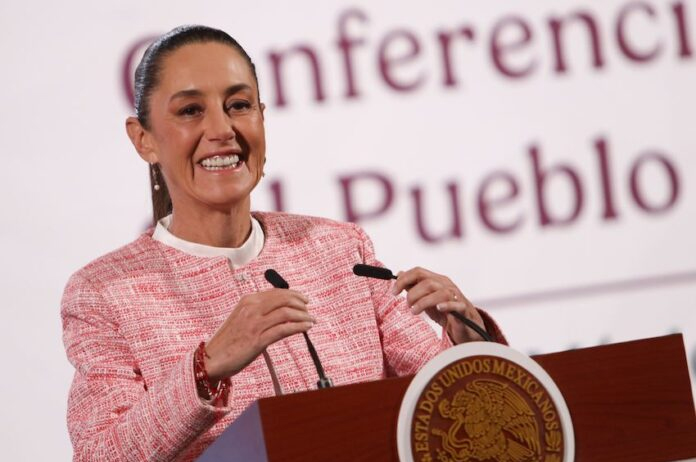
Claudia Sheinbaum is sworn in as president of Mexico

Claudia Sheinbaum Pardo asumió la presidencia el 1 de octubre de 2024. --Claudia Sheinbaum Pardo assumed the presidency on Oct. 1, 2024. (Mario Jasso/Cuartoscuro)

by Mexico News Daily

Claudia Sheinbaum Pardo was sworn in as president of Mexico on Tuesday morning, becoming the first woman to lead Latin America’s second most populous country.

Sheinbaum, who won the June 2 presidential election on a ticket backed by the ruling Morena party and its allies, was proclaimed presidenta during a ceremony at the Legislative Palace of San Lázaro in Mexico City. Her six-year term will run until Sept. 30, 2030.

Sheinbaum took the oath of office in front of Mexican deputies and senators, world leaders and other foreign and Mexican dignitaries who attended the General Congress session.

The 62-year-old environmental scientist succeeds Andrés Manuel López Obrador, who led Mexico for the past five years and 10 months. AMLO, as the president is best known, was also in attendance at the swearing-in ceremony, wearing the presidential sash for the final time.

The sash was passed on to Sheinbaum, who put it on over the white dress she wore to the inauguration ceremony. In her first address as president, she promised to “govern for everyone” and said she did not arrive to power alone, but with all women.

Sheinbaum, Mexico City mayor between 2018 and 2023, has pledged to build the “second story” of the so-called “fourth transformation” of Mexico initiated by López Obrador and the Morena party, which AMLO founded.

She takes office at a time when the Mexican economy is slowing and insecurity plagues various parts of the country, including the northern state of Sinaloa, where Sinaloa Cartel infighting has resulted in scores of deaths in recent weeks.

Beyond the economy and insecurity, Sheinbaum will face a range of other challenges, including in the areas of energy, water and health care.

She will also face pressure from international investors, and possibly foreign governments, to uphold the rule of law, especially after judicial elections are held for the first time next year. Critics of the government’s recently enacted judicial reform claim that the elections could result in courts — including the Supreme Court — being stacked with judges sympathetic to the federal government’s legislative agenda.

That agenda includes a number of constitutional reform proposals López Obrador sent to Congress in February, as well as ones to be put forth by the new president.

As president, Sheinbaum will have immense power as a coalition led by Morena has a supermajority in the lower house of Congress and a near-supermajority in the Senate.

Morena’s legislative dominance was on display in September when the Congress approved the judicial reform and a constitutional bill that placed the National Guard under military control.

Sheinbaum joins a significant number of incumbent female world leaders, including President Xiomara Castro of Honduras, President Dina Boluarte of Peru and Prime Minister Mette Frederiksen of Denmark.

United States Democratic Party presidential nominee Kamala Harris could soon join the group, although the Nov. 5 election in the U.S. appears likely to be a very close contest between Harris and former president Donald Trump.

Among the female Latin American leaders who preceded Sheinbaum are president Dilma Roussef of Brazil, president Cristina Fernández de Kirchner of Argentina and president Michelle Bachelet of Chile.

spot_img

Certain political groups attack the First Amendment, especially against people of faith, using “fact-checking” to delegitimize the truth

The First Amendment of the United States Constitution guarantees, among other freedoms, the freedom of speech, press, religion, and assembly.

This fundamental pillar of the U.S. democratic system protects both those who wish to express their opinions and those who openly practice their faith or religion. However, in recent times, there have been growing criticisms about how some sectors of the left are eroding these freedoms, particularly towards people of faith. Additionally, it has been pointed out that the use of fact-checking is being employed to silence or delegitimize voices that differ from certain dominant narratives. Below, we will explore how this is happening and what implications it has for freedom of speech and religious freedom.

Restricting speech in the name of political correctness 

One of the main arguments of those who believe that the left is attacking the First Amendment is the use of the concept of political correctness to silence or suppress speech that does not align with their values. While it is true that respecting different groups and fighting against hate and intolerance are noble causes, this effort has often resulted in censoring opinions that are not considered appropriate by certain standards. In many cases, those who hold traditional religious beliefs on topics such as marriage, sexuality, or life are labeled as “intolerant” or “discriminatory.”

For example, many religious groups have been criticized and censored on social media platforms for defending doctrines that have been part of their faith for centuries. Instead of fostering open debate, some platforms have chosen to remove posts or suspend accounts, claiming that these statements violate their “hate” policies, without considering that they are protected expressions under religious freedom.

The use of fact-checking as a tool of censorship 

Another concerning trend is the use of fact-checking, a tool initially designed to combat misinformation, but which in some cases has been misused to delegitimize opinions that simply do not align with the dominant current. Often, these verifications do not limit themselves to correcting objective errors but focus on discrediting arguments or viewpoints that, while controversial, are based on religious beliefs or philosophical convictions.

A clear example of this is the discussions around topics like abortion or same-sex marriage. When people of faith argue against these practices based on their beliefs, they are often labeled as “spreaders of misinformation” or their opinions are presented as “false” in fact checks, even though they are expressing a moral or philosophical point of view, not necessarily a false or incorrect fact. This strategy turns fact-checking into a tool for delegitimizing certain opinions, rather than an impartial way of verifying objective facts.

Religious freedom under threat 

The attack on freedom of speech is not limited only to the realm of opinions but has also begun to directly affect religious freedom. In several recent cases, religious institutions and faith leaders have been subjected to lawsuits or sanctions for adhering to their beliefs on controversial issues. A notable case is that of religious business owners who have refused to provide certain services, such as participation in same-sex marriage ceremonies, due to their religious beliefs. Instead of respecting their right to act according to their faith, these people have faced lawsuits accusing them of discrimination, even though their refusal was not motivated by hate but by religious principles.

Moreover, several recent laws and regulations have been criticized for attempting to impose a secular view of morality, forcing individuals and religious organizations to act against their beliefs. This not only represents a direct attack on religious freedom but also sends the message that religious beliefs are less worthy of protection than other forms of expression.

The debate over “truth” 

Part of the problem lies in the contemporary notion of “truth.” While in the past, freedom of speech allowed for a plurality of voices and the coexistence of different interpretations of reality, today, a more rigid view is being imposed, in which only certain viewpoints are considered valid or true. This has led to the term “misinformation” being broadly applied to include not only factually incorrect statements but also any speech that differs from the prevailing narrative. Thus, public debate is stifled, and important voices, including those of people of faith who, from their perspective, believe they are defending the truth, are excluded.

A clear example of this is the way certain scientific or social debates are handled in the public sphere. Issues about biological differences between sexes, the origin of life, or medical ethics are constantly labeled as “denialism” or “hate speech,” even when those defending these positions are basing their arguments on their religious convictions. By censoring these voices, not only is freedom of expression limited, but public debate is also distorted, depriving it of the richness that comes from the diversity of opinions.

Consequences for democracy 

The danger of these trends is that they erode one of the fundamental principles of democracy: the free exchange of ideas. Freedom of speech and religious freedom are complementary rights that allow pluralistic societies to flourish. By attacking these freedoms, there is a risk of creating a society where only a select group of opinions has a place in public debate, while others are systematically marginalized or silenced.

This is particularly serious in a nation like the United States, where the First Amendment has long been a symbol of individual freedoms. While it is necessary to combat hate and misinformation, it is equally crucial that these initiatives do not become excuses to censor or attack religious beliefs and dissenting opinions. The challenge lies in finding a balance that allows for the coexistence of different viewpoints and ensures that all citizens, regardless of their beliefs, can express their opinions freely.

Freedom of expression and religion is under attack, especially from sectors of the left that, in the name of political correctness and the fight against disinformation, use “fact-checking” to silence dissenting voices. This puts public discourse and democratic values at risk. To protect democracy, it is crucial to defend everyone’s right to express themselves without fear of being censored or delegitimized.

spot_img

How to fight rising imposter scams

Imposter scams are rising at alarming rates, thanks to sophisticated new tactics; here’s how to protect your money

by Selen Ozturk

Imposter scams are rising at alarming rates, thanks to sophisticated new tactics; here’s how to protect your money.

Of the millions of scam reports the Federal Trade Commission gets each year — 2.6 million in 2023 — the most common type by far are imposter scams, where scammers impersonate an entity, usually a business or government agency.

The first half of 2024 alone saw 360,000 impersonation scam reports, with $1.3 billion in reported losses and a median loss of $800.

Less than 5 percent of scam victims report at all, according to FTC and Better Business Bureau estimates.

“This is just the tip of the iceberg,” said Emma Fletcher, senior data researcher at the FTC at a Friday, September 20 Ethnic Media Services briefing about imposter scams. “Behind those numbers are people who’ve lost tens and hundreds of thousands of dollars. We’re really concerned about the volume of reports we’re getting on scams that take it all. People have emptied their bank accounts, even their retirement accounts.”

Over the past few years, reported losses to business and government impersonation scams have skyrocketed nearly fourfold.

One hundred seventy-five was lost to government impersonators in 2020 compared to $618 million in 2023, and $195 million was lost to business impersonators in 2020 compared to $751 million in 2023.

Scam tactics and stories

“This tremendous increase in reports from people who’ve lost enormous sums of money is tied to very concerning changes in the tactics these scammers are using,” said Fletcher.

These scams often involve bank transfer methods like Zelle, or cryptocurrency payment methods like Bitcoin ATMs, which are referred to by many scammers as “federal safety lockers.”

One reporter attending the briefing, Sunita Sohrabji, shared a personal example.

“My daughter tried to sell her bike via Facebook Marketplace,” Sohrabji said. “It was her first time selling anything, and someone messaged her saying they wanted to buy the bike, and that they’d pay through Zelle, but that she first had to establish a Zelle business account and put $400 in an account they’d sent her, which would be refunded once the transaction was made. Of course, that never happened.”

“With the endless daily time-sensitive messages, emails, deliveries, due dates and service invoices we already get, especially in the media, there are so many you have to resist and double-check nowadays,” added Elena Kuznetsova, a reporter for Slavic Sacramento.”

“There have been congressional hearings about Zelle and the role of financial institutions when fraud occurs,” said Kati Daffan, assistant director of the FTC Division of Marketing Practices. “It’s an open question right now. We encourage people to report it to us and their bank. If they’re unhappy with how their bank handles it, they can also file a report with the Consumer Financial Protection Bureau.”

Per a new FTC Impersonation Rule in effect since April, pretending to represent or be endorsed by a government or business is explicitly a violation, enabling the FTC to file federal court cases seeking to return money to victims and enact civil penalties against scammers.

“In our first case using the new rule, somebody pretending to be affiliated with the U.S. Department of Education would tell people: ‘This is a time sensitive notice, and you can get tax-free loan forgiveness,’ to entice consumers to call them,” said Daffan.

“Then the telemarketers, claiming to be affiliated with the government, would convince people to sign up for a debt relief program and collect hundreds of dollars in illegal upfront fees,” she continued. “Our case is ongoing.”

Daffan added that telltale signs of a scammer include urging the victim to act immediately; asking them to lie to someone, like a bank teller or broker; threatening them with arrest or deportation; and telling them not to hang up before money is withdrawn or transferred.

Also trending are “tag-team” scams blurring the line between business and government impersonation.

“These scams typically start out impersonating a business; say, your bank saying there’s suspicious charges on your account,” said Fletcher. “But when you respond, the situation escalates rapidly. Your accounts are at risk, so they connect you with a government agency. The aim is to create a sense of heightened alarm, to make it difficult to think clearly, recognize the scam, and hang up the phone.”

Furthermore, many scams now involve victims who believe they’re protecting their money from entities who want it.

“If you believe you’re paying someone, you’re going to be cautious about giving all you have. But if you believe you’re protecting your money, you’re more likely to empty your account, and these scammers will position themselves as someone informing you of this problem and helping you resolve it,” Fletcher continued. “They’re not necessarily posing as the aggressor anymore.”

There are many misconceptions about who’s impacted by scams,” she added. “They’re not, say, less intelligent or greedy. It’s really important to put those ideas to rest, because they’re barriers to people being receptive to messages about how to avoid scams … It’s people of all ages, people you know in your community.”

The FTC found in 2021 that adults aged 18 to 59 were 34 percent more likely to report losing money to fraud than older adults, with a median loss of $500.

However, older adults reported much higher median losses: $800 for those in their 70s, and $1,500 for those 80 and over.

“I’m always telling my audience: please be aware. Don’t do this. I’m 69 with 43 years of experience in journalism, and I fell in their hands completely,” said Celina Rodríguez, a journalist who got a call two years ago from scammers impersonating Bank of America.

“They said I bought an iPhone, and was it really me? It was so embarrassing having to explain ‘No,’” she said. “I was in a rush, I had to do a radio program, and I was panicking. I let them into my computer and sent money to them … Fortunately, Bank of America helped me shut my computer down, had IT come turn it on in a safe way and I changed my passwords.”

“The way they get you involved is amazing,” Rodriguez added. “We’re so vulnerable now. Even though we’re on top of things every day, we are human beings and any of us can become psychological targets.”

Those experiencing fraud can report it and find next steps at reportfraud.ftc.gov.

spot_img

New California law gives tenants more time to respond to eviction notices

Nancy Wiles sostiene su aviso de desalojo el 4 de diciembre de 2023. -- Nancy Wiles holds her eviction notice on Dec. 4, 2023. Photo by Manuel Orbegozo for CalMatters.

Tenant advocates say giving renters 10 days to respond to eviction notices, up from 5, will help those who live in rural areas and have trouble finding legal help. Some landlords argue it will increase their costs

by Felicia Mello, Calmatters

Tenants in California will have twice as much time to respond to eviction notices and potentially avoid losing their homes under a bill signed into law by Gov. Gavin Newsom today.

The new law comes amid a statewide housing crisis, and after a surge in evictions followed the expiration of pandemic-era tenant protections. Tenant advocates say Assembly Bill 2347, which doubles the time to respond from 5 to 10 business days, will help renters who live in areas where legal help is scarce or face other life circumstances that make it hard to meet the current deadline.

Under California law, landlords who sue to evict tenants must serve them with a formal notice, called an unlawful detainer. If a tenant doesn’t respond in writing within five business days, they can lose the case by default. The complex and technical answer form asks tenants to outline any disagreement about the facts or choose from more than a dozen possible legal defenses, which often requires them to seek help from someone who understands housing law.

“If you think about folks who are living in legal aid deserts, it may take them the entire five days just to get in the door and get that help,” said Lorraine López, a senior attorney with the Western Center on Law and Poverty, which sponsored the bill.  “Or they’re going 40 or 50 miles to their nearest courthouse to try to get there before 5 p.m. to file that paperwork.”

Language barriers, lack of transportation and work schedules can also slow tenants’ ability to respond, López said. About 40 percent of California tenants lose their cases by default, researchers have estimated.

The state’s major landlord lobby, the California Apartment Association, didn’t formally oppose the new law, which takes effect Jan. 1. But some local landlord groups have objected that any delay in evictions allows more unpaid rent to pile up, a cost that property owners will pass on to the new tenant.

“Every time there is an elongation of the process it creates more loss to owners,” said Daniel Bornstein, a San Francisco real estate attorney who represents landlords. He said that while the five-day window might seem short, it’s part of a larger eviction process that can take months and often begins only after tenants are months behind on their rent.

That process, however, still unfolds much more quickly than a typical lawsuit. For example, defendants in other civil suits have 30 days to file a response. Tenants facing eviction are much less likely than their landlords to get help from an attorney – fewer than 5% nationwide have legal representation compared to more than 80% of landlords, the National Coalition for a Civil Right to Counsel estimates.

While the new law, carried by Democratic Assemblymember Ash Kalra of San Jose, gives tenants more time to respond to an eviction notice, it also shortens the timeframe for their lawyers to file certain motions alleging errors in a landlord’s complaint.

Nancy Wiles, who narrowly avoided an eviction judgment over an apartment she left in the Contra Costa County city of Oakley, said the new law could help tenants like her.

Wiles was already moving out of an apartment that she said was infested with mold when her landlord served her with an eviction notice. By the time she realized she had to respond, the five-day timeline had elapsed and a court had ruled that Wiles had to pay her landlord $7,000.

“It was very stressful,” said Wiles, a retired hairstylist on a fixed income. She later sought help from a pro bono attorney who got the case withdrawn.

Tenant activists have also attempted to create more breathing room during an earlier step of the eviction process, when landlords notify renters of a problem before they file a case. California law gives tenants three days to correct the issue – for example, by paying back rent or fixing damage to the property – before an eviction can be filed.

San Francisco passed an ordinance in 2022 giving tenants an extra 10 days to correct problems. But a state appeals court judge last week overturned the local measure, ruling that cities have to defer to the state on eviction procedures.

And some California cities, including Los Angeles, are considering following in San Francisco’s footsteps and guaranteeing a right to legal counsel for tenants facing eviction.

Want to know which other new laws were passed this year, and how they will affect Californians? Check out CalMatters’ legislative tracker.

spot_img

Sujo” will represent Mexico at the 2025 Oscar and Goya Awards

by Zurellys Villegas

The film SUJO, by Astrid Rondero and Fernanda Valadez, has become one of the great promises of Mexican cinema this year and was recently selected to represent Mexico at the 2025 Oscar and Goya Awards.

The 97th edition of the Oscar Awards, organized by the Academy of Motion Picture Arts and Sciences (AMPAS), will be held on March 2, 2025 at the iconic Dolby Theatre in Los Angeles. It will be at this ceremony where it will be revealed if Sujo manages to obtain the coveted nomination for Best Foreign Film. The official nominations in all categories will be announced on Dec. 17, 2024, so until then, the expectation will be maximum.

In the European sphere, the 39th edition of the Goya Awards will take place on February 8, 2025 at the Granada Exhibition and Congress Palace, in Spain.

A powerful story in difficult times

Sujo is about a young orphan named Sujo, masterfully played by Juan Jesús Varela, who grows up in a rural Mexican environment marked by poverty and violence caused by drug trafficking. The protagonist must fight against the shadows of the past, including the legacy of his father, a hitman for the cartel, while trying to forge his own path. This profound story touches on social issues rooted in Mexican reality, which has allowed the film to resonate not only nationally, but also internationally.

Sujo’s cinematography has been praised for its sensitivity and depth, both in its narrative and artistic direction. Astrid Rondero and Fernanda Valadez managed to capture on screen a raw, but full of humanity vision of the struggles of their protagonist.

International recognition for Sujo

Sujo’s journey through international festivals has been remarkable. The film won the Grand Jury Prize at the Sundance Film Festival, a prestigious recognition that consolidated the film as one of the favorites of the independent circuit. In addition, at the Cinélatino Festival in Toulouse it won the Cine+ and Rail d’OC awards.

Other important awards include the Grand Prix at the Festival du Cinéma Espagnol et Latino-américain d’Ajaccio, the Canvas Award at the Mooov Film Festival, and the Audience Award at the Festival del Cinema Africano, d’Asia e America, which reinforces the film’s global appeal. In addition, at the Sofia Film Festival in Bulgaria, it was named Best Film.

International and Mexican releases

The film has begun its journey through international cinemas. It was released in Uruguay on Sept. 5, 2024, followed by German-speaking Switzerland on Sept. 19. In French-speaking Switzerland, its release is expected on Nov. 15. In addition, Canadian distributor The Forge has announced that Sujo will be released in select theaters in the United States and Canada on November 29, further expanding its presence in the North American market.

In Mexico, film fans will be able to enjoy Sujo starting in December of this year, when Pimienta Films releases it in national theaters, defining one of the most anticipated cinematic events in the country to close this year.

Without a doubt, Sujo’s career has only just begun, and with its participation in the Oscars and Goya 2025, expectations are at their highest for what promises to be one of the most important moments in recent Mexican cinema.

spot_img

Paradise, a play about political injustice in Puerto Rico — Celebrate Independence with the Viva Nicaragua Festival

by Magdy Zara

After its premiere on September 5, the play Paradise is giving people something to talk about as it shows life in Puerto Rico and the relationship that the United States has with Puerto Rico.

The production is by La Lengua Teatro en Español and Brava, and it is about the lives of Julián, Andrea, Tata and Quiko, who are a reflection of what it means to live on the island.

This is a new bilingual play by Tere Martínez, performed in Spanish, English or Spanglish, which will have projected subtitles to guarantee access and eliminate language barriers.

Paradise uses the tensions between compelling characters on stage to shed light on the exploitative relationship that the United States, after more than a century, has with Puerto Rico.

The play aims to draw attention to the unjust political situation on the island. Julian, an American resident in Puerto Rico, takes advantage of the tax incentives offered by the Puerto Rican government to foreign “investors” who agree to move to the island.

Andrea, a teacher at a local public school, teaches Spanish to Americans to make ends meet, while taking stock of the damage these incentives are doing to her country and the speculation of foreigners who contribute little while benefiting a lot. Tata needs to find a new home in a city plagued by Airbnbs, but clashes with Andrea and Julian because of her own perspective. And Quiko, who has lived his entire life between the island and the mainland, describes the harsh disparities suffered by “American citizen” residents of the United States territory.

The last performance of this season of El Paraíso will be this Sunday, Sept. 29, at the Brava Theater Center, located at 2781 24th Street San Francisco, starting at 6 p.m., tickets range in price from $25 – $100.

Celebrate Independence with the Viva Nicaragua Festival

As part of the celebration of Nicaragua’s independence, the Viva Nicaragua Festival has been organized for 14 consecutive years, a unique opportunity to share an afternoon with the family and relive the cultural traditions, typical foods and music of this beautiful country.

Among the artists who will perform are La Cuneta, Carlos Mejía Godoy, Banda Blanca and Marimba Flor de Pino.

The invitation is for the entire Nicaraguan community in northern California in the San Francisco Bay Area, to attend with the family what will be a Nicaraguan tradition. The place chosen for this celebration is Swiss Park, 5911 Mowry Ave., Newark, this Sunday, Sept. 29th starting at 10 a.m. Tickets are $30 for those over 10 years old.

More information through the number 415-424-8809.

La Moderna Tradición Orchestra in concert

For the first time this year, the La Moderna Tradición Orchestra comes to the San Francisco Bay Area to captivate audiences with the best of traditional and modern Cuban music.

Made up of 12 members, La Moderna Tradición brings its full repertoire, including sensual danzones and cha-cha-chás with contemporary rhythms infused with timba.

The Orchestra’s exceptional musicians inspire music lovers and dancers alike. Don’t miss this opportunity to experience the essence of Cuban music, where tradition meets innovation on the dance floor.

The date is this Wednesday, Oct. 2 of this year, at Yoshi, located at 510 Embarcadero West, Oakland, doors open at 7:30 p.m. and tickets are $25.

Agua Pura showcases their talent

The Agua Pura group is an acclaimed all-female salsa combo known for performing classic songs by artists such as Fania All-Stars and El Gran Combo with authority.

This initiative was initiated by conga player and vocalist Rebecca Rodriguez, who after participating in salsa and Latin jazz concerts, decided to take the step of forming her own band, which also showcases the female talent of the Bay Area.

Rodriguez defines Agua Pura as a creative hotbed that encourages women to spread their wings of improvisation.

The concert is this Thursday, Oct. 3, at 6 p.m., at the East Garden, Yerba Buena Gardens, located on 3rd St. between Mission and Howard Sts. San Francisco.

spot_img