Wednesday, July 29, 2026
Home Blog Page 430

Obama’s 2015 budget adopts contradictory stance on immigration

by the El Reportero’s wire services

Barack ObamaBarack Obama

The Obama Administration’s Fiscal Year 2015 budget proposal is of two minds about how to deal with the broken U.S. immigration system. On the one hand, the document calls for the creation of “a pathway to earned citizenship for hardworking men and women” who are in the United States without legal status. On the other hand, the budget would continue to devote significant sums of money to the detention and deportation of many of the same people for whom the administration would like to create a path to citizenship. In other words, the administration pledges that it will do its best to deport from the country the very same people it wants to help stay.

The budget’s commitment to continued deportations is evident from its proposed spending on immigration enforcement (found in the DHS Budget in Brief). Although the budget does contain little nuggets of pro-immigrant spending—such as “$10 million to continue support for immigrant integration grants that assist lawful permanent residents in preparing for naturalization and citizenship”— the fact is that a few million dollars spent on integration pales in comparison to the billions spent on enforcement: $2.6 billion for Enforcement and Removal Operation within Immigration and Customs Enforcement (ICE). $124 million to expand the E-Verify employment authorization system. $24 million for ICE’s 287(g) program, which deputizes local and state law -enforcement of – ficials to enforce federal immigration laws. A reduction of only 10 percent—from 34,000 to 30,539—in the controversial “bed quota,” which specifies how many immigration-detention beds must be filled every day.

Cuba allows users to access E-Mail on mobile devices

Cuba announced Saturday a new service that will allow access to a local e-mail account on mobile devices, a novelty on the island due to existing restrictions on Internet connections for cell phones and home computers.

“For now the only email that can be read on a mobile phone must arrive on a nauta.cu account, which is obtained by signing up for an e-mail account on the Nauta service,” the daily Juventud Rebelde said.

“It is still not possible for a mobile to access other services like free webmail or e-mail on the Internet, so it is recommended that messages received on them be redirected to the Nauta account,” the newspaper said.

According to the published rates, Cubans will pay 1 convertible peso (CUC, the equivalent of $1.00) for each megabyte of e-mail received or sent, a high price for most inhabitants of the island, where the average monthly wage is around $20. In Cuba, the government grants the “social” use of Internet in public centers.

Last June, 100 new state cyber-centers were opened where, through the national portal Nauta, permanent and temporary accounts are offered for navigating the Internet, among other services.

The appearance of these centers initiated a series of small steps by the government in recent months to improve Internet access in a country where the percentage of people with connections is around 15 percent, and where the great majority of inhabitaants are not allowed access to the Web at home.
Up to now, that possibility is only permitted for certain professionals like doctors, journalists, academics, intellectuals and artists.

Brazil discovers 17 Peruvians working in slave-like conditions in Rio

Officials of the Labor and Employment Ministry found 17 Peruvians working in conditions of slavery at a sewing workshop in the Brazilian city of Sao Paulo, officials told Efe on Saturday.

According to the consul general of Peru in Sao Paulo, Arturo Jarama, some of his compatriots had their documents confiscated and severe limitations imposed on going outdoors, particularly the ones who had been working there only a short time and had yet to win the trust of the owners, who are of Peruvian descent.
“I got the impression that some of the workers were kidnapped, above all those who have been there less time,” Jarama said, adding that “some had freedom and others didn’t.”

The complaint was filed by the Peruvian Consulate before the Justice and Defense of Citizens Secretariat after one of the workers escaped from the sweatshop and spilled the whole story.

spot_img

Obama’s former foreign policy adviser said – in 1977 – that the U.S. had to gain control of Ukraine

The Grand Chessboard: Ukraine, the game key in the game of world control.
Neoconservatives planned regime change throughout the Middle East and North Africa 20 years ago. Robert Parry correctly points out that the Neocons have successfully “weathered the storm” of disdain after their Iraq war fiasco. But the truth is that Obama has long done his best to try to implement those Neocon plans.

Similarly, ever since the Soviet Union collapsed in 1991, the U.S. has pursued a strategy of encircling Russia, just as it has with other perceived enemies like China and Iran.

In 1997, Obama’s former foreign affairs adviser, and president Jimmy Carter’s national security adviser – Zbigniew Brzezinski – wrote a book called The Grand Chessboard arguing that the U.S. had to take control of Ukraine (as well as Azerbaijan, South Korea, Turkey and Iran) because they were “critically important geopolitical pivots.”

A 2008 news report describes some of Zbigniew Brzezinski ideas in his book, to send the U.S. into war for world domination:

Zbigniew Brzezinski, once endorsed the creation and support of militant Islamic forces in Afghanistan, that were directed by accused 9/11 mastermind Osama Bin Laden. Brzezinski had admitted to the provocation of a Soviet-Afghan war that claimed the lives of 1 million people in Afghanistan during the 1980s. Brzezinski also sanctioned the support of a southeast Asian regime that claimed the lives of up to 2 million during the 1970s, through execution, starvation and forced labor.

And in an interview, cites the same article, Zbigniew Brzezinski, President Carter’s National Security Adviser, admits that it was U.S. policy to support radical Islamists to undermine Russia. He admits that U.S. covert action drew Russia into starting the Afghan war in 1979. Asked if he has regrets about this, he responds, “Regret what? That secret operation was an excellent idea. It had the effect of drawing the Russians into the Afghan trap and you want me to regret it? The day that the Soviets officially crossed the border, I wrote to President Carter: We now have the opportunity of giving to the USSR its Vietnam war.” Then he is asked if he regrets “having given arms and advice to future terrorists,” and he responds, “What is most important to the history of the world? The Taliban or the collapse of the Soviet empire? Some stirred-up Muslims or the liberation of Central Europe and the end of the Cold War?”

From the History Commons: October 1997: Brzezinski Highlights the Importance of Central Asia to achieving world domination:

American Primacy and its Geostrategic Imperatives, in which he portrays the Eurasian landmass as the key to world power, and Central Asia with its vast oil reserves as the key to domination of Eurasia. He states that for the U.S. to maintain its global primacy, it must prevent any possible adversary from controlling that region. He notes: “The attitude of the American public toward the external projection of American power has been much more ambivalent. The public supported America’s engagement in World War II largely because of the shock effect of the Japanese attack on Pearl Harbor.” He predicts that because of popular resistance to U.S. military expansionism, his ambitious Central Asian strategy cannot be implemented, “except in the circumstance of a truly massive and widely perceived direct external threat.” [Brzezinski, 1997, pp. 24-25, 210-11] The book also theorizes that the U.S. could be attacked by Afghan terrorists, precipitating a U.S. invasion of Afghanistan, and that the U.S. may eventually seek control of Iran as a key strategic element in the US’s attempt to exert its influence in Central Asia and the Middle East. [Brzezinski, 1997]

Regarding Ukraine, Brzezinski said (hat tip Chris Ernesto):

Ukraine, a new and important space on the Eurasian chessboard, is a geopolitical pivot because its very existence as an independent country helps to transform Russia. Without Ukraine, Russia ceases to be a Eurasian empire.

However, if Moscow regains control over Ukraine, with its 52 million people and major resources as well as access to the Black Sea, Russia automatically again regains the wherewithal to become a powerful imperial state, spanning Europe and Asia.

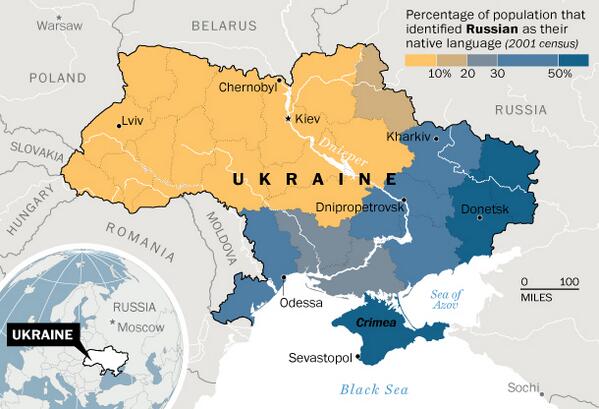
And now Obama is pushing us into a confrontation with Russia over Ukraine and the Crimea.

As Ernesto notes:

Late last year when Ukraine’s now-ousted president Viktor Yanukovych surprisingly canceled plans for Ukrainian integration into the European Union in favor of stronger ties with Russia, the U.S. may have viewed Ukraine as slipping even further out of its reach.

At that point, with the pieces already in place, the U.S. moved to support the ousting of Yanukovych, as evidenced by the leaked phone conversation between US Assistant Secretary of State Victoria Nuland [arch-Neocon Robert Kagan’s wife] and U.S. Ambassador to Ukraine Geoffrey Pyatt. When peaceful protests were not effective in unseating Yanukovych, the violence of the ultra-nationalist Svoboda party and Right Sector was embraced, if not supported by the west.
In today’s Ukraine, the U.S. runs the risk of being affiliated with anti-Semitic neo-Nazis, a prospect it probably feels can be controlled via a friendly western media. But even if the risk is high, the U.S. likely views it as necessary given the geopolitical importance of Ukraine, as Brzezinski mapped out in 1997.

In other words, Obama is following the same old playbook that the Neocons have been pushing for more than a decade.

(Aidan Monaghan’s 911 Blogger contributed to this report).


by Washington’s Blog

spot_img

Chemotherapia-free cancer treatment uses body’s own inmune system to attack diseased cells

by J. D. Heyes

A revolutionary breakthrough in cancer treatment that is being described as a “game-changer” would see the body’s own immune system utilized to attack diseased cells, rather than rely on sickening chemotherapy, researchers announced lately.

Scientists at Memorial Sloan Kettering Cancer Center in New York say they have successfully experimented with the new procedure, using 16 people who had advanced leukemia and had otherwise run out of treatment options. The researchers said the patients underwent targeted T cell therapy, which then eliminated the cancerous cells in most of the patients, CBS News reported.

Dr. David Agus, a CBS News expert contributor who leads the Westside Cancer Center at the University of Southern California, called the team’s work “remarkable research.”

‘This was no fluke’

“They took 16 patients with advanced leukemia, who had failed chemotherapy or not responded at all to chemotherapy, so they classically have weeks to months to live. They took their own immune cells out… and inserted a homing mechanism to target the cancer cells,” said Agus.

“The cancer cells were growing on their own, unrelentingly, and these immune cells came in and they could target and kill them. They become assassins. So, making their own immune cells become assassins and it worked.”

Study senior author Dr. Renier Brentjens, an oncologist at Memorial Sloan Kettering, told HealthDay News: “First and foremost, we’ve shown that this isn’t a fluke. This is a reliable result. … We’re still very much in the early stages of development. … [T]his is potentially the first promising new therapy [for advanced B-cell ALL] in a long time.”

In additional comments to Agence France-Presse, Brentjens said, “Basically, what we do is re-educate the T cell in the laboratory with gene therapy to recognize and now kill tumor cells.” Following 15 years of study on the procedure, Brentjens said that “it seems to really work in patients with this particular type of cancer.”

Of the 16 patients who took part in the study, 14 achieved total remission. But, Agus said, the treatment does not cure cancer on its own.

“What we know is this cancer comes back and the only way to cure it is with a bone marrow transplant,” he said. “You can only go for a bone marrow transplant if you’ve first eliminated the cancer cells in the blood.”

The research oncologist said the therapy was able to remove cancer cells from the blood effectively, and that “most of the patients were able to go on to transplant.” At that point, he said, patients can actually be cured of the disease.

‘Treatment might work too well’

Some of the biggest problems with current cancer treatments such as chemotherapy are the side effects: The drugs involved in chemotherapy can make patients very sick and weak. And while Agus said all treatments will have some side effects, the new therapy might actually work “too well.”

“These cells kill all of the cancer at once and it’s actually the toxins from the dead cancer cells that cause the side effects,” he said, adding that, since the initial success among the 16 patients, between 60 and 80 in the U.S. have signed onto trials, which are also being launched in Europe. The oncologist said the breakthrough treatment was not possible even a decade ago, because it was built on years of prior trial-and-error involving gene therapy. At present, the therapy has not been approved by the U.S. Food and Drug Administration. Agus said the treatment can cost upwards of $100,000 per patient, but he said that cost should decrease as the therapy advances. (Natural News).

Learn more: http://www.naturalnews.com/044254_chemotherapy_cancer_treatment_immune_system.html#ixzz2vjJdB8R1.

spot_img

The intelligence bureaucracy that ate our world – Part 1

by Marvin Ramirez

Marvin J. RamirezMarvin Ramirez

NOTE FROM THE EDITOR: Many of you, dear readers of El Reportero, might not have any idea of what the government is really doing with all the data accumulated in their databases – our information. How much information it has about all of us and what this means for the preservation of civil liberties in this world of super high technology, where almost everything – from the TV set on which you watch your favorite soap opera to every phone call you make on your cell phone – is being recorded. And our Congress – if we can call it our Congress – is an accomplice on this rape of our liberties. The following article, that was found hidden somewhere in the internet, brings a lot of fine information for you and me to know a little bit more how we are becoming their slaves in a more and more sinister way. Most of us live our lives just coming and going to our jobs or watching our favorite ball games – like zombies, looking dumbly at our iphones, doing nothing about it. Due that this article is too long for our space availability, we have split it into two parts. This is Part One.

by Tom Engelhardt

Data mining you: how the intelligence community is creating a new American world

I was out of the country only nine days, hardly a blink in time, but time enough, as it happened, for another small, airless room to be added to the American national security labyrinth. On March 22nd, Attorney General Eric Holder and Director of National Intelligence James Clapper, Jr. signed off on new guidelines allowing the National Counterterrorism Center (NCTC), a post-9/11 creation, to hold on to information about Americans in no way known to be connected to terrorism – about you and me, that is – for up to five years. (Its previous outer limit was 180 days.) This, Clapper claimed, “will enable NCTC to accomplish its mission more practically and effectively.”

Joseph K., that icon of single-lettered anonymity from Franz Kafka’s novel The Trial, would undoubtedly have felt right at home in Clapper’s Washington. George Orwell would surely have had a few pungent words to say about those anodyne words “practically and effectively,” not to speak of “mission.”

For most Americans, though, it was just life as we’ve known it since September 11, 2001, since we scared ourselves to death and accepted that just about anything goes, as long as it supposedly involves protecting us from terror1ists. Basic information or misinformation, possibly about you, is to be stored away for five years – or until some other attorney general and director of national intelligence think it’s even more practical and effective to keep you on file for 10 years, 20 years, or until death do us part – and it hardly made a ripple.

If Americans were to hoist a flag designed for this moment, it might read “Tread on Me” and use that classic illustration of the boa constrictor swallowing an elephant from Saint-Exupary’s The Little Prince. That, at least, would catch something of the absurdity of what the National Security Complex has decided to swallow of our American world.

Oh, and in those nine days abroad, a new word surfaced on my horizon, one just eerie and ugly enough for our new reality: yottabyte. Thank National Security Agency (NSA) expert James Bamford for that. He wrote a piece for Wired magazine on a super-secret, $2 billion, one-million-square-foot data center the NSA is building in Bluffdale, Utah. Focused on data mining and code-breaking and five times the size of the U.S. Capitol, it is expected to house information beyond compare, “including the complete contents of private emails, cell phone calls, and Google searches, as well as all sorts of personal data trails – parking receipts, travel itineraries, bookstore purchases, and other digital ‘pocket litter.’”

The NSA, adds Bamford, “has established listening posts throughout the nation to collect and sift through billions of email relamessages and phone calls, whether they originate within the country or overseas. It has created a supercomputer of almost unimaginable speed to look for patterns and unscramble codes. Finally, the agency has begun building a place to store all the trillions of words and thoughts and whispers captured in its electronic net.”

Which brings us to yottabyte – which is, Bamford assures us, equivalant to septillion bytes, a number “so large that no one has yet coined a term for the next higher magnitude.”

The Utah center will be capable of storing a yottabyte or more of information (on your tax dollar).

Large as it is, that mega-project in Utah is just one of many sprouting like mushrooms in the sunless forest of the U.S. intelligence world. In cost, for example, it barely tops the $1.7 billion headquarters complex in Virginia that the National Geospatial- Intelligence Agency, with an estimated annual black budget of at least $5 billion, built for its 16,000 employees. Opened in 2011, it’s the third-largest federal building in the Washington area. (And I’ll bet you didn’t even know that your tax dollars paid for such an agency, no less its gleaming new headquarters.)

Or what about the 33 post-9/11 building complexes for top-secret intelligence work that were under construction or had already been built when Washington Post reporters Dana Priest and William Arkin wrote their “Top Secret America” series back in 2010?

In these last years, while so many Americans were foreclosed upon or had their homes go “underwater” and the construction industry went to hell, the intelligence housing bubble just continued to grow. And there’s no sign that any of this seems abidingly strange to most Americans. NEXT WEEK , PART TWO: A SYSTEM THAT CREATES ITS OWN REALITY.

spot_img

Final goal of the surveillance state

by Jon Rappoport

Surveillance is coming at us from all angles. Chips, drones, TSA checkpoints, smart meters, back-doored electronic products, video cameras, spying home appliances; our phone calls and emails and keystrokes and product purchases are recorded.

The government and its allied corporations will know whatever they want to know about us.

What then?

What happens when all nations are blanketed from stem to stern with surveillance?

Public utilities, acting on government orders, will be able to allot electricity in amounts and at times it wishes to. This is leading to an overarching plan for energy distribution to the entire population.

Claiming shortages and limited options, governments will essentially be redistributing wealth, in the form of energy, under a collectivist model.

National health insurance plans (such as Obamacare) offer another clue. Such plans have no logistical chance of operating unless every citizen is assigned a medical ID package, which is a de facto identity card. In the medical arena, this means cradle-to-grave tracking.

Surveillance inevitably leads to: placing every individual under systems of control. It isn’t just “we’re watching you” or “we’re stamping out dissent.” It’s “we’re directing your participation in life.”

As a security analyst in the private sector once told me, “When you can see what every employee is doing, when you have it all at your fingertips, you naturally move on to thinking about how you can control those patterns and flows of movement and activity. It’s irresistible. You look at your employees as pieces on a board. The only question is, what game do you want to play with them?”

Every such apparatus is ruled, from the top, by Central Planners. When it’s an entire nation, upper-echelon technocrats revel in the idea of blueprinting, mapping, charting, and regulating the flows of all goods and services and people, “for the common good.”

Water, food, medicine, land use, transportation—they all become items of a networked system that chooses who gets what and when, and who can travel where, and under what conditions.

This is the wet dream of technocrats. They believe they are saving the world, while playing a fascinating game of multidimensional chess.

As new technologies are discovered and come on line, the planners decide how they will be utilized and for whose benefit.

In order to implement such a far-reaching objective, with minimal resistance from the global population, manufactured crises are unleashed which persuade the masses that the planet is under threat and needs “the wise ones” to rescue it and us.

We watch (and fight in) wars and more wars, each one exacerbated and even invented. We are presented with phony epidemics that are falsely promoted as scourges.

The only response, we are led to believe, is more humane control over the population.

On top of that, we are fed an unending stream of propaganda aimed at convincing us that “the great good for the greatest number” is the only humane and acceptable principle of existence. All prior systems of belief are outmoded. We know better now. We must be good and kind and generous to everyone at all times.

Under this quasi-religious banner, which has great emotional appeal, appears The Plan. Our leaders allocate and withhold on the basis of their greater knowledge. We comply. We willingly comply, because we are enlisted in a universal army of altruistic concern.

This is a classic bait and switch. We are taught to believe that service for the greater good is an unchallengeable goal and credo. And then, later, we find out it has been hijacked to institute more power over us, in every way.

The coordinated and networked surveillance of Earth and its people is fed into algorithms that spit out solutions. This much food will go here; that much water will go there; here there will be medical care; there medical care will be severely rationed. These people will be permitted to travel. Those people will be confined to their cities and towns.

Every essential of life—managed with on-off switches, and the consequences will play out.

An incredibly complex system of interlocking decisions will be hailed as messianic.

Surveillance; planning; control.

This is the vision.

It isn’t ours. It never was. But we are not consulted.

Instead we are made witness to watershed events: the 1995 Oklahoma City bombing; the 1993 attack on the World Trade Center; the 2001 assault on the Trade Center and the Pentagon. These ops paralleled the unleashing of better and more far-ranging methods of surveillance.

We are profiled down to the threads on our clothing and DNA in our cells. But what is our profile of the technocrats and their bosses?

They are divorced from human life. They live in a vacuum. They take pleasure from that vacuum.

In 1982, I interviewed Bill Perry, who had just left his job as PR chief at Lawrence Livermore Labs, where scientists design nuclear weapons. Perry had been given the kind of job PR people long for. But one day, when he passed the desk of a researcher and listened to his plaints about budget limitations, Perry said, “Listen, America already has the means to blow up the whole planet eight times. What more do you need?”

The researcher looked up at him with a genuinely puzzled expression. He said, “You don’t understand, Bill. This is a problem in physics.”

In the same detached sense, the technocrats who want to calculate and direct our future, move by move, minute by minute, see us as components of a complex and very interesting problem.

Yes, they indeed expect to exercise power and control. But they also live in an abstraction. They deal their answers from that realm. They exercise cool passion.

They see, for example, that not every single twitch of thought of every person on earth is yet mapped, so they want to finish constructing the means by which they can chart those “missing elements.” They want to complete the formula.

They view their research as a wholly natural implication of the mathematics they can manipulate. They swim in technology and they want to extend its architecture. To abandon the program would be tantamount to denying their own intelligence. They climb the mountain because it is there.

They do perceive that one factor does not fit their algorithms: the free individual. It’s the wild card. Therefore, they are compelled to analyze freedom and break it down into DNA functions and brain processes. They assume, because they must, that the free individual is an illusory idea that flows from some older configuration of synaptic transmission, at a time in our evolution when we needed it. But now, they suppose, the engineering of human activity and thought has superseded such quaint notions. Now we all can be tracked, traced, and studied on a different and wider scale. Now we can be seen for what we really are: a hive.
Therefore, we must be instructed, within tight limits, about our various functions.

Today’s technocrats flourish with great optimism as they design the future world and its single society. If they run out of pieces of their puzzle to study, they’ll try to track the motion of every atom and electron and quark in the universe. They’ll delight in it.

Knowing all this, we know the terms of the war we are in.

The Central Planners have an equation: “free=uncontrolled =dangerous.”

By the gross terms of that equation, they lump us in with thugs and murderers and terrorists. They even see the normal functioning of the brain as a threat, as an intrinsically defective process, and they have long since decided that organ must be corrected with drugs.

We, on the other hand, must assert, in every way possible, that freedom is real and inviolable, and we must back that up with our actions.

(Jon Rappoport is the author of two explosive collections, THE MATRIX REVEALED and EXIT FROM THE MATRIX. You can sign up for his free emails at NoMoreFakeNews.com).

spot_img

Gloria Trevi biopic to be released in September

by the El Reportero’s news servicies

Gloria TrevisGloria Trevis

A film inspired by the eventful life of singer Gloria Trevi will premiere next Sept. 5 in more than 1,000 movie theaters around Mexico, the producers said.

While Trevi has expressed unhappiness over the “Gloria” project, producer Matthias Ehrenberg told a press conference that the screenplay is based on interviews she gave to journalist and playwright Sabina Berman and seeks above all to pay tribute to the singer.

“It’s an impartial story with no yellow journalism in it. Basically it’s about Gloria the celebrity, her rise to fame, what happened to her, things that go out of control and the consequences,” Ehrenberg said.

Taking the story to the screen are Sofia Espinosa as Trevi and Marco Pérez in the role of her manager Sergio Andrade.

The film includes several of Trevi’s songs because the production company acquired the rights, and will be sung by Espinosa, Ehrenberg said.

“Gloria” will screen in theaters around Mexico starting Sept. 5, Mauricio Duran Ortega, vice president of marketing and distribution at Universal Pictures in Latin America, said.

Gloria Trevi was arrested in Brazil in the year 2000, accused by a Mexican court of the kidnapping, sexual abuse and corruption of minors, together with Andrade and one of her backup singers.

After a long legal battle in Brazil, the singer was extradited to her country in 2002 and pardoned by a Mexican court two years later, after which she returned to show business.

New Robert Rodriguez TV series debuts on El Rey network

Director Robert Rodriguez’s “From Dusk Till Dawn: The Series,” a television adaptation of his popular 1996 film that starred George Clooney and Quentin Tarantino, debuted on his El Rey Network.

The series, the first original content produced for the network, is about two crazy bank-robbing brothers who are on the run after a heist that left several people dead.

The 10 one-hour episodes in the series star D.J. FranciscoCotrona as Seth Gecko, George Clooney’s character in the movie; Zane Holtz as Richie Gecko, who was played by Quentin Tarantino in the feature film; and Jesse Garcia, who plays a Texas ranger.

Don Johnson is Sheriff Earl McGraw, the role played by Michael Parks in the film version.

“From Dusk Till Dawn: The Series” looks at the start of the criminal careers of Seth and Richie, and how the FBI tried to capture them.

The brothers head for Mexico and end up in a strip club that, as in the film, turns out to be a den of vampires.

Colombian actress Celmira Luzardo dies, age 61

Colombian actress Celmira Luzardo, who pursued her career in theater, film and television and may have been best known for her role in the soap opera “Yo soy Betty, la fea,” has died in Bogota, family and friends said Thursday. She was 61.

Luzardo, the youngest of a family of actors, died Wednesday of respiratory problems, friends and relatives said Thursday via the social networks.

Luzardo stood out during the 1980s and ‘90s in several Colombian television productions and is remembered in particular for her role as Catalina Angel, a fashion designer on “Yo soy Betty, la fea.”

She also landed roles in other Colombian soap operas and TV. Luzardo, besides acting, had studied editing and production at the National Film Institute in London and filmmaking at the Centro Sperimentale di Cimenatografia in Italy.

Several years ago she had moved to the Caribbean island of San Andres and had distanced herself from acting.

spot_img

Love me Tenderloin: Documentary film premiering at San Francisco Main Library

by the El Reportero’s staff

A scene from the theatrical, plates, with Ricardo Salinas of Culture Clash.A scene from the theatrical, plates, with Ricardo Salinas of Culture Clash.

The eclectic Tenderloin, near neighbor to cultural, civic and government buildings as well as the hotels, shopping and tourism of downtown San Francisco, is the subject of a new documentary film by Henri Quenette, premiering at the San Francisco Main Library on March 25.

Long known as the “heart” of San Francisco, the Tenderloin is a refuge for elderly, disabled and low-income working people striving to stay in the city. This area is perhaps the last frontier in SF’s ever-expanding gentrification trend. It has a high density population and visible issues with drugs.

Henri Quenette’s moving documentary film about San Francisco’s Tenderloin neighborhood, Love Me Tenderloin, shows the everyday lives of four inhabitants living in the Tenderloin: Bridchette, Arnold, Woody and Indian Joe. Through these lives, the viewer learns about the many difficulties of living in the Tenderloin.

Almost a quarter of the neighborhood’s residents live below the poverty level. Despite the challenges, the film also offers hope, by highlighting how much love there is among the residents of the neighborhood and the people who work there to improve the life of the Tenderloin residents.

Film premiere: San Francisco Main Library’s Koret Auditorium on March 25 at 5:45 p.m. A reception will follow the screening, sponsored by the French American Cultural Society.

For a preview, see the trailer and other information at: https://www.facebook.com/LoveMeTenderloin or http://vimeo.com/86108597.

PLACAS: The perilous journey of a new play about escaping gang life and a perilous tattoo

San Francisco International Arts Festival (SFIAF), Laney College Theater and Paul S. Flores present the return of playwright Flores’ stage play PLACAS starring Ricardo Salinas of Culture Clash. PLACAS will make its East Bay premiere at Laney College Theater near Lake Merritt in Oakland, March 27-29, 2014.

PLACAS (barrio slang: a code word for graffiti tags, a nickname or body tattoos) is a stage drama about family, transformation and redemption that focuses on a Salvadoran former gang member in the barrio trying to reclaim his family while letting go of his past. Set in today’s San Francisco, it explores the benefits and risks of tattoo removal for gang members thru one man’s determination to reunite his family after surviving civil war in El Salvador, immigration, deportation, prison and street violence.

PLACAS focuses on inter-generational relationships between young men and their fathers and uses the metaphor of tattoo removal as a way of moving forward and as a path to a possible solution.

PLACAS stars Ric Salinas as Salvadoran immigrant Fausto Carbajal, a now middle- aged ex-gang member recently released after nine years in prison. As a requirement of his parole Fausto must remove the tattoos that mark him as a member of his gang. Wearied by what has been a lifetime of violence, he accepts the terms. He is determined to reunite his family, traumatized by three decades of war, forced migrations and street crime. He returns to San Francisco to live with his mother, a war refugee, and hopes to re-unite with his ex-partner, Claudia and their now teenaged son, Edgar. Fausto visits Claudia and Edgar.

But Edgar, who has not seen his father for most of his life, resents Fausto and displays disturbing character traits that remind Fausto of himself in his youth.

It is clear that the reunion will be difficult. Fausto realizes that his son is in danger of being initiated into a rival gang when Edgar is arrested for carrying a gun to school and placed on probationary house arrest. Fausto attempts to persuade Edgar against joining the gang and offers to move the family out of the neighborhood, but Edgar runs away. Fausto must find Edgar before the police do. His process of transformation is both physically and emotionally painful, but can he save himself, and is it enough and in time to save his son?

Ric Salinas (Culture Clash) returns to the stage at Laney College as part of a five-city tour which begins Thurs. March 27 – Sat March 29, at 8 pm. in Oakland.

Tickets: $15 – $40 Reserved Seating Box-Office: http://www.sfiaf.org, 1-800-838-3006.

Group Rates Available: Call 415-399-9554 for info.

spot_img

Boxing

The Sport of Gentlemen

Boxing” de Molina

Wednesday, March 26 – Tokyo, Japan –

WBA super flyweight title: Denkaosan Kaowichit (62-3-1, 26 KOs) vs. Kohei Kono (29-8, 12 KOs).

Saturday, March 29 – Berlin, Germany –

Cruiserweights: Yoan Pablo Hernandez (28-1, 14 KOs) vs. Pawel Kolodziej (33-0, 18 KOs).

Saturday, March 29 – Newcastle, England –

Bantamweights: Stuart Hall (16-2-1, 7 KOs) vs. Martin Ward (18-2, 4 KOs).

Saturday, March 29 – Atlantic City, New Jersey (HBO) –

Light heavyweights: Sergei Kovalev (23-0-1, 21 KOs) vs. Cedric Agnew (26-0, 13 KOs)

Sunday, April 6 – Tokyo, Japan –

Flyweights: Akira Yaegashi (19-3, 9 KOs) vs. Odilon Zaleta (15-3, 8 KOs);

Junior flyweights: Adrian Hernandez (29-2-1, 18 KOs) vs. Naoya Inoue (5-0, 4 KOs).

spot_img

Congratulations to Óscar Orellana on his 50th birthday


Óscar Orellana with tres friends.Óscar Orellana with tres friends.

Accompanied by three of his many friends, the general manager and former co-owner of the popular nightclub Club Roccapulco, Oscar Orellana, was honored on his 50th birthday with a delicious cake.

The celebration took place at Roccapulco, and was accompanied by the also popular grupo, Julio Bravo and his Orquetra.

His friends (in the picture, whose names were not obtained) who are frequent visitors at the club, offered him the cake.

El Reportero joins with Óscar’s friends to wish him a virtual, HAPPY BIRTHDAY!


spot_img

Voted the ‘Best Latin Alternative Band,’ Las Cafetera come to the S.F. Bay Area

Compiled by the El Reportero’s staff

Las CafererasLas Cafereras

After a successful 3-month Northwest and Midwest Tour this past fall that had them open for groups like Juanes, Edward Sharpe and the Magnetic Zeros, and the Los Angeles Philharmonic Orchestra, Las Cafeteras hit the road again.

This time, Las Cafeteras are going to different parts of the country and will be engaging communities in the East Coast (Boston, New York, Philadelphia), Texas (Austin), Florida (Miami), and Northern California. Along with their performances, Las Cafeteras will also be having cultural exchanges with universities, museums, and immigrant rights organizations with the purpose of sharing stories from their respective cities.

Las Cafeteras’ musician David Flores says, “we believe that we are all the same because we are all different and we want to use our tour as a platform to inspire people across the country to share their story through poetry, storytelling and art.”

Two presentations at UC Berkeley: on March 13, at Hearst Field Annex, and on March 14 at the Memorial Glade, UC Berkeley, Berkeley, California.

Month-long Performing Arts 2014 Festival Returns to SF Public Library

Come sing with the beloved bilingual recording artist, educator and children’s author José-Luis Orozco! Children and families will sing and dance to Jose-Luis’ Spanish and English music rooted in Latin American culture. His music combines rhymes, movements, and rhythm with information, such as the alphabet, vowels, numbers, and colors. These four concerts will be a delight for the entire family.

Acrobatics, juggling, balancing, contortion, and more will be performed by Wayne Huey of Red Panda Acrobats and by the kids and teens of Circus Center’s Youth Circus. The Youth Circus will thrill with aerial acts, clowns, face painting, and a chance to join the circus at the skills workshop following the performance.

And finally, by popular demand, five puppet troupes are returning to SFPL to amuse and amaze. Magical Moonshine Theatre performs traditional Europeanstyle hand-and-rod puppet theatre. Sean’s Shadows creates tales with light and shadow from around the world. The Fratello Marionettes both educate and delight with puppets and puppeteers in full view. Ventriloquist, Tony Borders, brings some crazy critters and a magical picnic with Muppet-style hand puppets.

On March 11, José Luis Orozco in Concert, from 9:30 a.m. – 12 noon at Parque Niños Unidos, on 23rd Street & Treat. On March 12, Cartooning Workshop for Teens with Morgan Taylor, from 4:30 – 6 p.m., at the Main Library, Children’s Creative Center, 2nd floor. For more info call For more information, call 415 557-4277.

spot_img