Sunday, October 18, 2026
spot_img
Home Blog Page 377

Civil rights and anti-war movements

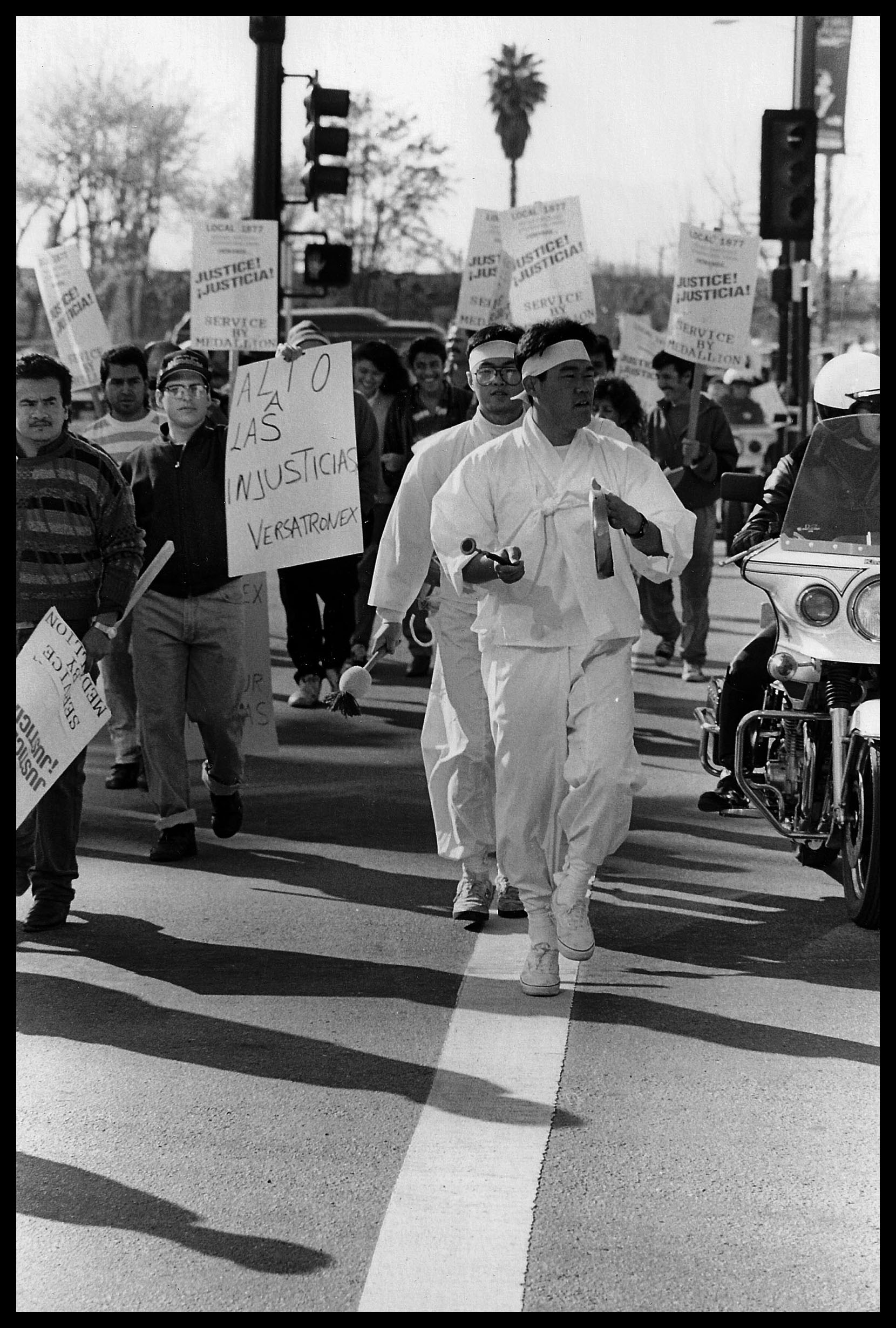
MOUNTAIN VIEW, CA (10/92) -- Strikers at Versatronex, a factory that assembled circuit boards for large electronics companies. Workers at the factory, mostly Mexican immigrants, went on strike over sweatshop conditions and the firing of a fellow worker, in the first strike by production workers in the history of Silicon Valley. Versatronex strikers marched through downtown San Jose with Korean workers cheated of their pay when their factory closed, and janitors fighting for a union contract, in a show of unity among immigrant workers.

How activism developed in Santa Clara Valley

by David Bacon

In the 1960s the upsurge of the civil rights and anti-war movements transformed the politics and social movements of the Santa Clara Valley. In part, this reflected growing population and changing demographics.

In 1950 Santa Clara County’s population was 290,000, and 12 percent were people with Spanish names. By 1970 the population had grown to over a million, and while Spanish-named people were still 12 percent, their numbers had swelled to 129,000. As significant, the 2,333 Filipinos in the county in 1960 had exploded to 28,000 in 1980, and 60,000 in 1990, as they became one of the most important parts of the workforce in the electronics industry of Silicon Valley. By 1990 the Hispanic category used by the Census that year included 307,000 people-now over 20 percent of the population.

Key among the organizers of the civil rights era was Sofia Mendoza. She and her husband Gil fought discrimination in San Jose from the time she was a student in college. In the 1960s she and other Chicano community activists in the East San Jose barrio began organizing against the Vietnam War. “I was extremely bothered because not only were they killing our young men in Vietnam, they were also killing them here in the streets of San Jose,” she later explained.

1960s Chicano movement mobilizes against police brutality

The first of the Chicano student blowouts, which helped launch the Chicano movement, took place at San Jose’s Roosevelt Junior High in 1968. Rosalio Muñoz came up from Los Angeles to support the students, and talked with Mendoza. He then went back to LA where he, Carlos Muñoz and other activists started the student walkouts there. Rosalio Muñoz later became a primary organizer of the huge Chicano Moratorium march against the Vietnam War up Whittier Boulevard, where Ruben Salazar was shot by Los Angeles police and killed.

In San Jose the movement began organizing marches on City Hall, and formed a committee to stop police brutality, the Community Alert Patrol. “We just had it,” Mendoza remembered. “We had reached our limit. The police had guns, mace and billy clubs. They were always ready to attack us. It seemed as if nobody could stop what the police were doing.”

But CAP did stop them. One march mobilized 2000 people. Its members monitored police activity, much as the Panthers were doing in Oakland, documenting police beatings and arrests. Students organizing for ethnic studies classes at San Jose State University became some of CAP’s most active members, at the same time fighting to get military recruiters off the campus. CAP had the participation of Communists, socialists, Chicano nationalists and other leftwing groups.

Mendoza, her comrade-in-arms Fred Hirsch, and others saw that the area needed a multi-issue organization to confront the many problems people faced in the barrios-discriminatory education, lack of medical services, poor housing, and of course the police. “We wanted an organization that was not limited to one ethnic group, that would organize our entire community,” she later recalled, “so we called ourselves United People Arriba-United People Upward. We liked the term ‘United People’ because it got the idea across that people from different ethnic backgrounds were coming together in San Jose to work for social change-Blacks, Mexicans, Puerto Ricans and whites working together in one organization.” Today organizations in Silicon Valley carry on the legacy of UP Arriba and the anti-deportation fights-from Silicon Valley De-Bug’s Albert Covarrubias Justice Project to the community organizing of Somos Mayfair to the Services, Immigrant Rights and Education Network.

Mendoza went to El Salvador, Nicaragua and Vietnam during the U.S. military interventions, and in 1973 she went to Moscow as a delegate to a congress of the World Peace Council. She was motivated, not just by the deaths of young Chicanos in Vietnam, but by the transformation of her valley by the Cold War. The Westinghouse plant in Sunnyvale was making nuclear missile tubes for Trident submarines. The plant where Gil worked started making farm equipment, but then switched to building tanks and armored personnel carriers.

Most of all, she saw food processing replaced by the growth of the huge electronics industry. Del Monte finally closed its Plant 3, at one time one of the largest and most modern in the world, in 1999-the end of the canning industry in San Jose. The last of the big canneries is today a condominium complex.

Defense contracts feed tech industry

One of the oldest myths about Silicon Valley is that its high tech innovations were the brainchildren of a few, brilliant white men, who started giant corporations in their garages. In fact, the basic inventions that form the foundation of the electronics industry, especially the solid-state transistor, were developed at Bell Laboratories, American Telephone and Telegraph, Fairchild Camera and Instrument, and General Electric.

These innovations were products of the Cold War-of the arms race after World War II. The Defense Advanced Research Projects Agency was founded in 1958 and provided basic research at taxpayer expense that enabled the electronics industry-especially chipmakers-to launch startups that were then fed by military contracts. Long before the appearance of the personal computer, high tech industry grew fat on defense contracts and rising military budgets. Its Cold War roots affected every aspect of the industry, from its attitude towards unions to the structure of its plants and workforce.

As the electronics industry began to grow in the 1950s, a fratricidal struggle within the U.S. labor movement led to the expulsion in 1949 of unions like UCAPAWA and the union founded to organize workers in the electrical industry-the United Electrical, Radio and Machine Workers of America (UE). Only the ILWU and the UE survived as independent unions, and the UE went from 650,000 at the end of World War II to about 60,000 at the beginning of the 1980s. As a result, while the new high-tech industry was growing in the Santa Clara Valley, support for workers organizing unions in the expanding plants virtually disappeared.


spot_img

Lawmakers introduce bill making it harder for police to take innocent Americans’ property

by Melissa Quinn

For the last few years, opponents of civil forfeiture have been calling on Congress to make it more difficult for law enforcement to take property, cash, and vehicles from innocent Americans through a process known as civil asset forfeiture.
Now, a bipartisan coalition of lawmakers on Capitol Hill is taking action.

Rep. Jim Sensenbrenner, R-Wis., is spearheading legislation reforming federal civil forfeiture laws. He, along with House Judiciary Committee Chairman Bob Goodlatte, R-Va., and Reps. John Conyers, D-Mich., and Sheila Jackson Lee, D-Texas, who are also Judiciary Committee members, introduced the Due Process Act on Thursday.

Reps. Tim Walberg, R-Mich., and Peter Roskam, R-Ill., also signed on to the legislation.

For the last few years, opponents of civil forfeiture have been calling on Congress to make it more difficult for law enforcement to take property, cash, and vehicles from innocent Americans through a process known as civil asset forfeiture.
Now, a bipartisan coalition of lawmakers on Capitol Hill is taking action.

Rep. Jim SensenbrennRep. Jim Sensenbrenner, R-Wis., is spearheading legislation reforming federal civil forfeiture laws.
He, along with House Judiciary Committee Chairman Bob Goodlatte, R-Va., and Reps. John Conyers, D-Mich., and Sheila Jackson Lee, D-Texas, who are also Judiciary Committee members, introduced the Due Process Act on Thursday.

Reps. Tim Walberg, R-Mich., and Peter Roskam, R-Ill., also signed on to the legislation.

“Forfeiture is a critical tool in the fight against crime, but it is also vulnerable to abuse. The Due Process Act, among other things, will increase transparency and add protections for innocent property owners, including the opportunity to contest seizures and regain illegally seized property immediately,” Sensenbrenner said in a statement.

“Reform to the current federal forfeiture laws is necessary to curb abuse, restore confidence in law enforcement, and help citizens protect their property rights.”

The legislation would raise the burden of proof from a “preponderance of evidence” to “clear and convincing,” which makes it more difficult for the government to forfeit property, especially from innocent people.

Under the Due Process Act, or the Deterring Undue Enforcement by Protecting Rights of Citizens from Excessive Searches and Seizures Act of 2016, the burden would also be shifted away from the property owner and on to the government to prove that there was a “substantial connection” between seized property and criminal activity.

Under current civil forfeiture law, property owners fighting a seizure must prove that their seized assets are not connected to criminal activity or that they didn’t know the property was being used in a crime.

Sensenbrenner’s bill would also increase transparency among federal agencies seizing property and calls for an annual audit of civil forfeitures. The Due Process Act further creates a publicly available database of all federal forfeitures.

In addition to making it more difficult for lawmen to forfeit property, particularly from innocent property owners, the bipartisan legislation creates a right to counsel for all property owners challenging a civil forfeiture and allows a property owner to recover lawyer’s fees if they successfully challenge a forfeiture against the government.

The Due Process Act also codifies policy changes implemented by the Justice Department and Internal Revenue Service regarding structuring.

Structuring involves making consistent cash deposits or withdrawals of just under $10,000 to avoid government reporting requirements.

Under a subset of civil forfeiture laws regulating cash deposits, the government can seize money from those accused of committing structuring violations.

However, many cases have arisen in recent years involving small business owners who had thousands of dollars seized by the IRS for committing structuring violations.

In many of those instances, property owners were unaware they were breaking the law and were ultimately never charged with a crime.

Both the IRS and Justice Department announced in 2014 and 2015, respectively, they would only pursue structuring cases if the property owner had been charged with a crime or if the money was used for criminal activity.

But experts encouraged Congress to codify those policy changes.

“Today’s introduction of the Due Process Act is a tremendous step forward for the rights of innocent property owners,” Jason Snead, a policy analyst at The Heritage Foundation, told The Daily Signal. “The act adopts many of the reforms advocated for by Heritage and a broad coalition of organizations.”

Though the Due Process Act addresses key issues opponents of civil forfeiture have with the tool, it doesn’t take aim at the Justice Department’s Equitable Sharing program or the profit incentive civil forfeiture creates for law enforcement agencies.

Under Equitable Sharing, law enforcement agencies can pursue forfeitures under federal law instead of state law, which experts say allows law enforcement to skirt stricter state civil forfeiture laws in favor of the looser federal standards. Additionally, under the Equitable Sharing program, law enforcement agencies can keep up to 80 percent of the proceeds from forfeited property.

Furthermore, at the federal level and in many states, law enforcement agencies can keep 100 percent of the proceeds from forfeitures if they’re not seized under Equitable Sharing.

“It is unfortunate that neither the Equitable Sharing program nor the broader financial incentives in forfeiture law have been addressed,” Snead said. “So long as agencies can retain and spend the proceeds they generate from the forcible seizure of property, there will be a temptation to abuse forfeiture laws to generate revenue.”

In speaking publicly about civil forfeiture, law enforcement officials have praised the tool for providing agencies with money outside of the normal budget process.

Civil asset forfeiture is a tool that gives law enforcement the power to seize property if they suspect it’s tied to a crime.
Law enforcement ramped up the use of civil forfeiture to combat the war on drugs in the 1980s. However, in recent years, many innocent Americans have been caught up in the forfeiture system after having cash, cars, and property seized.

Many of those people were ultimately never charged with a crime.

Congress first tackled civil asset forfeiture in 2000 through the Civil Asset Forfeiture Reform Act.

Walberg and Sen. Rand Paul, R-Ky., tried to reform civil asset forfeiture laws last year through the Fair Act, or the Fifth Amendment Integrity Restoration Act of 2015.

However, the legislation didn’t move through House or Senate committees.

spot_img

Latin America, the Caribbean have the world’s greatest biodiversity

by the El Reportero’s wire services

Politicians representative of different trends rejected President Enrique Peña Nieto’s statements and said Mexico has enough reasons for social anger.
Yesterday, La Jornada journal published a long interview with the President, who said there is no reason for what he called “social bad mood”.
Leader of the Democratic Revolution Party (PRD) Agustín Basave told the same journal that Peña Nieto “fails to understand that the issue of social mood is not a collective hormonal problem, but a discomfort due to corruption and authoritarianism.”
Federal deputy for the National Action Party Cecilia Romero, said the President lives in another reality. What he does not see is the anger generated by the persisting inequality in the country and essential issues like the fight against corruption are still pending, she said.
The same unrest, she said, is reflected in electoral processes, and especially in the states in which they use the government structure to benefit the ruling Institutional Revolutionary Party (PRI), she added.
Javier Oliva, a political scientist from the Faculty of Political and Social Sciences of the Autonomous National University of Mexico (UNAM), said there are reasons for social discontent. He agreed with Peña Nieto on the fact that the country has positive economic indicators in comparison to other Latin American nations, but he stressed that there are significant losses in salaries and the Mexican peso, as well as serious corruption and insecurity problems.
The President also told the journal he did not understand the reason why the federal government is being held responsible of the disappearance of the 43 Ayotzinapa students.
In this sense, Oliva said that the mere participation of municipal police officers make the State responsible, in addition, it took the federal administration 10 to look into the case and the official investigation has been deficient, slow and unsuccessful.

Politicians say there are reasons for social anger in Mexico
Latin America and the Caribbean is the region with the greatest biological diversity on the planet, holding 60 to 70 percent of all known life on Earth, according to a report issued by UN Environment Program (UNEP) today.
The document, entitled State of Biodiversity in Latin America and the Caribbean, is a mid-term evaluation of the region’s progress in the implementation of the Aichi Biodiversity Targets, to care and conserve the world’s flora and fauna.
Presented at the second session of the UN Environment Assembly (UNEA-2), the report explains that the region shows progress in 13 of the 20 Aichi Targets, while it shows no progress in six of them.
The report highlights that there are many examples of progress and innovation in the field of biodiversity conservation in the region.
However, the region also experiences high rates of urbanization, along with industrial and agricultural development, which represent huge challenges to achieve the conservation and the sustainable use of natural resources.

Honduran Millionaire Police Officers under Investigation
Honduran authorities are investigating the files of 27 millionaire police officers for supposed illegal enrichment, the newspaper La Prensa published today.
Amid that process, the Mission to Support the Fight against Corruption and Impunity in Honduras (MACCIH) requested that the Higher Court of Accounts (TSC) presented those documents for the Justice Ministry to look through them, the source said.
We are requesting that the court concludes the audits, because they are important for police purge and to end impunity in this country, said MACCIH spokesman Jimenez Mayor.
According to the Justice Ministry, of the total number of rich agents, 23 are police officers, one of them with a sum of money that exceeds 138 million Lempiras (the equivalent to more than $6 million USD).
Those under investigation by the TSC with the highest rankings include National Police ex-Director Ricardo Ramírez del Cid, who has more than eight million Lempiras (more than $362,000 USD), the source said.
Currently, the Commission for Police Purge and Reorganization in Honduras, approved by the Congress at the request of the Government, is carrying out a police purge process, including high-ranking officers.

spot_img

The lock and the key

by Jon Rappoport

It’s hard to know what a lock is unless you know what a key is, and how they fit together.

In this case, we can pile up many words to describe the lock: the mass of unceasing propaganda that bombards the population; global elites who fully intend to manage the planet as one integrated entity; the assault of toxic medical drugs and environmental chemicals on the human neurological system; the intentionally vapid and indoctrinating educational apparatus; the money-invention structure of banks; the hidden rules governing who, now and in the future, will eat and who will starve, who will have water and who will go without, who will have money who will not.

And this is just the beginning of the list.

But the key that fits into the lock and brings about a deep acceptance of things as they are…what is that?

It is the human mind. A mind not only conditioned by external factors but programmed by the person himself. A mind that provokes an onrush of emotions that hold a person in place, unable to break out. A mind that fosters false but convincing beliefs about what exists and what doesn’t exist. A mind unprepared to view potential and dormant human capabilities that exceed the physical laws of space and time.

A mind that wants to insert itself into the lock and form a durable partnership with what everyone else assumes reality is.

A mind that wants to function within certain boundaries. A mind that embraces limiting illusions about the so-called human condition.

A mind that, in a significant sense, obsessively copies reality, mirrors reality, becomes “a twin of the physical world.”

The mind seeks The Other, and believes The Other is the “world as it is.”

In order for this strange dynamic to operate, the mind has to believe it is lost and needs to find itself.

The key that fits into the lock is a mind that is waiting at a cosmic train station for the express to arrive. And when it does, the mind climbs on board, as if it has done the deed so many times before. And it has.

This is an old pattern. This is the mind mistaking a labyrinth for the familiar physical world. So the mind enters a maze and becomes wrapped up in a mystery that never ends, while thinking it is home.

This is a form of hypnosis that introduces the mind to increasing levels of complexity, until, exhausted, it gives up the ghost—and wonders why the world, which was so full of hope and warmth and comfort, turned into something else.

So a life is lived. And then another life. And another.

And the mind becomes unable to understand, as the old Tibetans did, that, in a very significant sense, the universe is a product of mind.

The mind becomes unable to understand that actions of both creation and destruction are more than myths depicting ancient gods. These stories are metaphors for how the mind can become brilliantly aware of the alive space(s) beyond mere acceptance and submission and surrender.

At the center of all this stands the archetype of The Artist. I mean that in the broadest sense. The Artist brings new realities into being and casts others away. He builds and he tears down. He, like the ancient figure of Hermes, can view the utterly insane joke of erecting and embroidering billions of trappings that define the one space of “things as they are (and must be).”

The overwhelming majority of human beings believe they want that space above all others. They believe that largeness represents a personal danger and smallness confers security.

They believe in the lock, and they struggle to discover a way to insert themselves into it. Permanently. Forever.

And in order to believe this, they exercise the majestic ability to put themselves into a trance state.

Below these issues I am discussing here, far below, is society/civilization and its attendant conflicts and madness. Civilizations come and go, come and go. They purport to be the only show on Earth. But they are just window dressing on Matrix.

Artists create worlds and universes. Therefore, the idea that “The Universe” is somehow our greatest guide and mentor and gift-giver is a joke of the highest magnitude.

Most people are not up to contemplating the idea of consciously creating, much less spontaneously improvising, which involves a kind of merging with what they would create.

But for those who can grasp such an idea, the world and the universe aren’t any longer arbiters and rule makers and guides. They are inventions that are already here.

Ensuing years of research resulted in my three recent Matrix collections, of which Exit From The Matrix is most focused on practical techniques of imagination — to make your deepest desires fact in the world.

spot_img

Latin America, the Caribbean have the world’s greatest biodiversity         

by the El Reportero’s wire services

Politicians representative of different trends rejected President Enrique Peña Nieto’s statements and said Mexico has enough reasons for social anger.

Yesterday, La Jornada journal published a long interview with the President, who said there is no reason for what he called “social bad mood”.

Leader of the Democratic Revolution Party (PRD) Agustín Basave told the same journal that Peña Nieto “fails to understand that the issue of social mood is not a collective hormonal problem, but a discomfort due to corruption and authoritarianism.”

Federal deputy for the National Action Party Cecilia Romero, said the President lives in another reality. What he does not see is the anger generated by the persisting inequality in the country and essential issues like the fight against corruption are still pending, she said.

The same unrest, she said, is reflected in electoral processes, and especially in the states in which they use the government structure to benefit the ruling Institutional Revolutionary Party (PRI), she added.

Javier Oliva, a political scientist from the Faculty of Political and Social Sciences of the Autonomous National University of Mexico (UNAM), said there are reasons for social discontent. He agreed with Peña Nieto on the fact that the country has positive economic indicators in comparison to other Latin American nations, but he stressed that there are significant losses in salaries and the Mexican peso, as well as serious corruption and insecurity problems.

The President also told the journal he did not understand the reason why the federal government is being held responsible of the disappearance of the 43 Ayotzinapa students.

In this sense, Oliva said that the mere participation of municipal police officers make the State responsible, in addition, it took the federal administration 10 to look into the case and the official investigation has been deficient, slow and unsuccessful.

Politicians say there are reasons for social anger in Mexico

Latin America and the Caribbean is the region with the greatest biological diversity on the planet, holding 60 to 70 percent of all known life on Earth, according to a report issued by UN Environment Program (UNEP) today.

The document, entitled State of Biodiversity in Latin America and the Caribbean, is a mid-term evaluation of the region’s progress in the implementation of the Aichi Biodiversity Targets, to care and conserve the world’s flora and fauna.

Presented at the second session of the UN Environment Assembly (UNEA-2), the report explains that the region shows progress in 13 of the 20 Aichi Targets, while it shows no progress in six of them.

The report highlights that there are many examples of progress and innovation in the field of biodiversity conservation in the region.

However, the region also experiences high rates of urbanization, along with industrial and agricultural development, which represent huge challenges to achieve the conservation and the sustainable use of natural resources.

Honduran Millionaire Police Officers under Investigation

Honduran authorities are investigating the files of 27 millionaire police officers for supposed illegal enrichment, the newspaper La Prensa published today.

Amid that process, the Mission to Support the Fight against Corruption and Impunity in Honduras (MACCIH) requested that the Higher Court of Accounts (TSC) presented those documents for the Justice Ministry to look through them, the source said.

We are requesting that the court concludes the audits, because they are important for police purge and to end impunity in this country, said MACCIH spokesman Jimenez Mayor.

According to the Justice Ministry, of the total number of rich agents, 23 are police officers, one of them with a sum of money that exceeds 138 million Lempiras (the equivalent to more than $6 million USD).

Those under investigation by the TSC with the highest rankings include National Police ex-Director Ricardo Ramírez del Cid, who has more than eight million Lempiras (more than $362,000 USD), the source said.

Currently, the Commission for Police Purge and Reorganization in Honduras, approved by the Congress at the request of the Government, is carrying out a police purge process , including high-ranking officers.

spot_img

Eliana López’s What’s the Scandal!

Compiled by the El Reportero’s staff

What is the scandal? of Ileana López. Is an autobiographical story that explores what it means to be an immigrant woman of color in the United States of America. Immigrants don´t just face the outside challenges of the legal system but also the internal challenge of adaptation and integration. A reflection of self-transformation and a journey of human growth.
At Fort Mason Center Chapel, Sunday, May 29, 2016 at 2 p.m., Sat., June 4, 2016 at 4 p.m., Sun, June 5, 2016 at 6 p.m. At 1100 Bay Street, San Francisco. Doors open at 5:45 p.m., starts at 6 p.m. Duration: 70 minutes, no intermission.


UFW convention spotlights recent union gains for farm workers

Hundreds of delegates, alternatives and guests will review progress improving farm worker lives through both proactive union work and exciting new global initiatives across state and national boundaries during the United Farm Workers’ 20th Constitutional Convention at Bakersfield’s Rabobank Convention Center. 

A fundraising dinner with Kerry Kennedy, Robert F. Kennedy’s daughter, kicks off events on Thursday, May 19, followed on Friday, May 20 by private delegate workshops, election of union officers and a dinner address by immigration reform champion U.S. Rep. Luis Gutiérrez.

The centerpiece of the convention is on Saturday and Sunday, May 21 and 22, focusing on important gains farm workers have scored through UFW organizing and negotiating.

May 21 and 22, at Rabobank Convention Center, 1001 Truxtun Ave., Bakersfield, California.

The hidden Indian life in Berkeley and the evidence surrounding it

Richard Schwartz, noted local author and scholar, will give an illustrated talk on the hidden Indian Life in Berkeley and the evidence surrounding it.

He will describe how the discovery and protection of artifacts and history combine as a powerful tool to begin to understand the extent Native Americans lived within what became the city of Berkeley, and more.

This event will be held on Saturday May 28, 2016 from 1 p.m. to 2:30 p.m. in the 3rd floor Community Meeting Room of the Central Library located at 2090 Kittredge Street in Berkeley, California.

For questions regarding this program, call 510-981-6148.

This free program is sponsored by the Friends of the Berkeley Public Library www.berkeleylibraryfriends.org.
The Central Library is located at 2090 Kittredge Street.

Roxie Theater brings Spanish films repertoire

The Roxie, San Francisco’s historic, nonprofit cinema in the heart of the Mission District, is pleased to announce the official launch of RoxCine, a new program offering year-round Spanish-language cinema and celebrating the vibrant Latino film culture and community in the city and beyond.

RoxCine will feature a comprehensive offering of new releases, repertory programming, and special series and retrospectives curated by Isabel Fondevila. “RoxCine will bring an exciting mix of films to San Francisco, from winners at major film festivals with US distribution, to special features not seen on any other screen outside of Latin America,” says Fondevila.

RoxCine’s inaugural offerings in May include a double feature of Alfonso Cuarón and Alejandro González Iñárritu’s breakthrough films Y Tu Mamá También & Amores Perros on May 12; an Early Almodovar Week (May 20-26) featuring the young, vital, and rarely revisited stage of Pedro Almodóvar’s storied career; and the Mexican thriller A Monster with a Thousand Heads by Rodrigo Plá, that with seven nominations to the Ariel Awards, including best film, will be opening at the Roxie on May 27. Also highly anticipated are the Venezuelan winner of the Golden Lion prize at the Venice Film Festival, From Afar, and the Mexican documentary All of Me, opening on July 8 and Aug. 5 respectively.

spot_img

Buena Vista Social Club says good-bye in Cuba too

by the El Reportero’s news services

Buena Vista Social Club, the orchestra that is considered an ambassador of traditional Cuban music in the world, will say goodbye on Saturday from stages in Cuba.

With two concerts this weekend at the Karl Marx Theater in Havana, the band will completes its “Adios Tour”, which took them to stages of all five continents for one and a half year.

Guitarist Eliades Ochoa, one of the founders, said that Buena Vista Social Club has become a myth and its legacy will remain over time, because the world does not want it to end.

“We should end the “Adios Tour” in Cuba, well, what better place to do it,” he said.

Singer Omara Portuondo stated that she had never wanted to end her work with the band, which has allowed her to take traditional music from Cuba to all five continents.

Although most of our performances were in other countries, we decided to end the tour in Havana, because we love to sing for the Cuban audience, she said.

During the concerts at the Karl Marx Theater, on May 14 and 15, images and videos to remember musicians such as Ibrahim Ferrer, who were founders of the project but they are no longer with us, will be screened.

Writes Rolling Stone’s Magazine:

“It’s been 20 years since Ry Cooder, British producer Nick Gold and Cuban musical director Juan de Marcos Gonzalez assembled a group of veteran Cuban musicians, christened them Buena Vista Social Club and recorded an album that would become a global phenomenon and sell more than 12 million copies worldwide. (And earn a spot on Rolling Stone’s 100 Greatest Albums of the Nineties.) Since then, the name – taken from a pre-revolution members-only club – has become as much brand as band, spawning an Oscar-nominated film, renewed interest in Cuban music and spinoff group Orquesta Buena Vista Social Club.”

Gabo’s ashes arrived in Cartagena, Colombia

The ashes of Colombian writer Gabriel García Márquez have arrived in Cartagena de Indias, where they will rest inside La Merced from Sunday, according to local media reports.

On the request of his family, the former religious building, built in 1619, has been dedicated to the author of ‘One Hundred Years of Solitude’, who died of cancer in Mexico, in 2014.

The ashes of the novelist, brought from Mexico, will remain in the hands of his relatives in Cartagena until May 22nd. The date has been chosen for the opening ceremony of the memorial erected in his honor.

“The building is ready to honor him, it will be an honor to have a permanent tribute to him on this earth,” Graciela Venecia, an official of the University of Cartagena – to which the old convent now belongs – she said in an interview.

Nearly a hundred journalists from around the world, directors of national media, Culture Minister Mariana Garcés and President Juan Manuel Santos appear on the guest list for the dedication ceremony, said the website El Heraldo.

Los Van Vam come back to U.S.

The mythical Cuban orchestra The Van Van returns with its music to United States, where during next month of June and part of July they will carry out presentations in more than 10 states, said the group.

Diverse scenarios of California, Arizona, Nevada, New Mexico, Texas, Lousiana, Florida, Georgia, North California, Pennsylvania, New Jersey, New York and Washington will open the doors to the Cuban musical ensemble known as “The Musical Train of Cuba”, as they announced in their official profile in the social

spot_img

U.S. deported 2 million Mexicans in 1930 claiming they were taking jobs

Then needed them back in WWII

by KJ MCelrath
The Ring of Fire Network
2015

Donald Trump seems to be enjoying some success at the moment by pandering to America’s lower-order primates with all his “tough talk” about deporting residents of Latino ancestry, regardless of citizenship or residency status. Well – news flash, Donny boy…America tried that once. It didn’t work out so well back then, either – and about ten years later, the US federal government was begging them to come back.

Like Donald Trump, President Herbert Hoover was a right-wing, corporatist, Republican hack. Most infamous for turning the US Army on the country’s own citizens during the “Bonus Army” incident in 1932, Hoover was clueless on how to handle the economic catastrophe that came in the wake of the Stock Market Crash of 1929. The Great Depression was a direct result of nearly a decade of Republican control and corporatist policies. However, instead of trying to address the underlying rot, Hoover’s Administration focused on treating the symptoms of the disease. The GOP didn’t hesitate to find scapegoats. Case in point: Americans of Mexican descent. Many of these families had been in this country since before the signing of the Treaty of Guadelupe-Hildago in 1848, when much of the western US was part of Mexico. Most were legal United States citizens, and many had property (the treaty allowed Mexican families to keep their lands after the US takeover).

None of this mattered in 1930. Wall Street and the banksters had put the world economy into the toilet. Unemployment was well on its way to double-digits (it would peak at nearly 24 percent by 1932). Most ordinary citizens didn’t understand why it had happened – they only knew that their incomes were shrinking and jobs were getting harder to find. It had to be somebody’s fault. At the same time, Hoover needed an issue to use in order to divert criticism of his Administration. Mexican-Americans were the perfect target.
Between 1930 and 1932, as many as 2 million people of Mexican ancestry – 60 percent of whom were citizens or legal residents – were summarily rounded up and “repatriated” to Mexico. Often, there was no hearing or due process. Many left the country under threats of violence. The “official” justifications for such action included reducing the number of people living on assistance (the figure was less than 10 percent) and “freeing up jobs” for “real Americans.” And what of children of immigrants who were born on American soil, and therefore entitled to citizenship under the 14th Amendment? According to California State University professor and author Francisco Balderrama, immigration officials claimed they didn’t want to “break up families.” Unfortunately, this is exactly what happened in too many cases.

It’s a dirty little secret of American history that Anglos have conveniently forgotten. However, the Mexican-American community continues to remember it in stories and songs.

The history of the Mexican Repatriation of the 1930s has an interesting epilogue. By 1942, the United States found itself fighting for its life on two fronts. For months after the attack on Pearl Harbor, the US suffered one defeat after another, and victory was far from being a foregone conclusion. As almost every able-bodied man between the ages of 18 and 35 was either drafted, enlisted in the Armed Services or went to work in war-related industries, the number of agricultural workers dwindled. The situation led to food shortages, threatening to bring chaos. With hat in hand, President Franklin Roosevelt went to his counterpart in Mexico, President Manuel Camacho, in order to discuss Mexico’s part in the war effort (Mexico had joined the conflict on the side of the Allies in May of 1942). In short, the US asked the Mexican laborers to return under the auspices of the “Bracero Program.”

Recently, Alabama tried its own version of the 1930s “Mexican Repatriation.” The results were similar: agricultural jobs went unfilled, and businesses that depended on their Mexican customers’ dollars began to suffer. Donald Trump, who continues to shoot off his mouth without any real facts to document his views, now has not one, but two examples from history, illustrating the abject failure of the policies he’s calling for.

But then, like most GOP politicians, Trump has never let petty details like “facts” stand in the way of his agenda.

spot_img

John F. Kennedy vs. the Federal Reserve – Part 3 of a series

NOTE FROM THE EDITOR:
My research on controversial topics continues to pay off. I found this excellent and interesting article, which, due to its length, it will be published in parts. In this piece you will learn about how is that President John Fitzgerald Kennedy’s Executive Order 11110, gave the Treasury Department Constitutional power to again create and issue currency -money – without going through the privately-owned Federal Reserve Bank, which is what is currently done now. It suggests that JFK was killed for that reason. THIRD PART OF A SERIES.

by John-F-Kennedy.net

Some people think the Federal Reserve Banks are United States Government institutions

THE FRBs are not Government institutions, departments, or agencies. They are private credit monopolies which prey upon the people of the United States for the benefit of themselves and their foreign customers. Those 12 private credit monopolies were deceitfully placed upon this country by bankers who came here from Europe and who repaid us for our hospitality by undermining our American institutions.
The FED basically works like this: The government granted its power to create money to the FED banks. They create money, then loan it back to the government charging interest. The government levies income taxes to pay the interest on the debt. On this point, it’s interesting to note that the Federal Reserve Act and the sixteenth amendment, which gave congress the power to collect income taxes, were both passed in 1913. The incredible power of the FED over the economy is universally admitted. Some people, especially in the banking and academic communities, even support it. On the other hand, there are those, such as President John Fitzgerald Kennedy, that have spoken out against it. His efforts were spoken about in Jim Marrs’ 1990 book Crossfire:”
Another overlooked aspect of Kennedy’s attempt to reform American society involves money. Kennedy apparently reasoned that by returning to the constitution, which states that only Congress shall coin and regulate money, the soaring national debt could be reduced by not paying interest to the bankers of the Federal Reserve System, who print paper money then loan it to the government at interest. He moved in this area on June 4, 1963, by signing Executive Order 11110 which called for the issuance of $4,292,893,815 in United States Notes through the U.S. Treasury rather than the traditional Federal Reserve System. That same day, Kennedy signed a bill changing the backing of one and two dollar bills from silver to gold, adding strength to the weakened U.S. currency.
Kennedy’s comptroller of the currency, James J. Saxon, had been at odds with the powerful Federal Reserve Board for some time, encouraging broader investment and lending powers for banks that were not part of the Federal Reserve system. Saxon also had decided that non-Reserve banks could underwrite state and local general obligation bonds, again weakening the dominant Federal Reserve banks”.
In a comment made to a Columbia University class on Nov. 12, 1963,
Ten days before his assassination, President John Fitzgerald Kennedy allegedly said:
“The high office of the President has been used to foment a plot to destroy the American’s freedom and before I leave office, I must inform the citizen of this plight.”
In this matter, John Fitzgerald Kennedy appears to be the subject of his own book… a true Profile of Courage.
This research report was compiled for Lawgiver.Org. by Anthony Wayne
What is the Federal Reserve Bank?
What is the Federal Reserve Bank (FED) and why do we have it?
by Greg Hobbs November 1, 1999
The FED is a central bank. Central banks are supposed to implement a country’s fiscal policies. They monitor commercial banks to ensure that they maintain sufficient assets, like cash, so as to remain solvent and stable. Central banks also do business, such as currency exchanges and gold transactions, with other central banks. In theory, a central bank should be good for a country, and they might be if it wasn’t for the fact that they are not owned or controlled by the government of the country they are serving. Private central banks, including our FED, operate not in the interest of the public good but for profit.
There have been three central banks in our nation’s history. The first two, while deceptive and fraudulent, pale in comparison to the scope and size of the fraud being perpetrated by our current FED. What they all have in common is an insidious practice known as “fractional banking.”
Fractional banking or fractional lending is the ability to create money from nothing, lend it to the government or someone else and charge interest to boot. The practice evolved before banks existed. Goldsmiths rented out space in their vaults to individuals and merchants for storage of their gold or silver. The goldsmiths gave these “depositors” a certificate that showed the amount of gold stored. These certificates were then used to conduct business.
In time the goldsmiths noticed that the gold in their vaults was rarely withdrawn. Small amounts would move in and out but the large majority never moved. Sensing a profit opportunity, the goldsmiths issued double receipts for the gold, in effect creating money (certificates) from nothing and then lending those certificates (creating debt) to depositors and charging them interest as well.
Since the certificates represented more gold than actually existed, the certificates were “fractionally” backed by gold. Eventually some of these vault operations were transformed into banks and the practice of fractional banking continued.
IT WILL CONTINUE ON THE WEEK EDITION.

spot_img

Mushrooms: a real superfood with multiple disease-fighting nutrients

by Ben Fuchs

Next to supplements, nothing contains more nourishment value per gram of edible material than “superfoods” which WebMD defines as “multitasking food substances that provide multiple disease-fighting nutrients”. Although a quick internet search will reveal dozens of various foods that claim “superfood” status, including eggs, yogurt, algae, various fruits and vegetables, none can boast more nutritional value than the humble, crepuscular and manure-munching mushroom.

Mushrooms and their uncouth and downright toxic cousins called toadstools (“tod” is the German word for death) are neither plant or animal or bacteria. They instead fall into a separate classification called fungi. They are botanically referred to as “fruiting bodies”, a plant structure that produces spores. Spores can be thought of as a type of seed specific to fungus and molds.

Mushrooms are members of one of the six great kingdoms of life, the Fungi (the others are the Plant, Animal, Archaeal, Protistal and the Bacterial). Like their fungal cousins, molds and yeasts, they have tremendous medicinal value. Although many are inedible and some deadly, the nutritional relevance of edible mushrooms, appreciated by culinary types as a delicacy since ancient times, is off the charts.

The most important of their nutrient elements is a type of non-sweet sugar called polysaccharides, which compose the bulk of the solid portion of typical mushrooms. Polysaccharides can be thought of as long chains of repeating and identical chemical chunks that from a cage-type network of molecules that allows them to effectively trap water. This ability to hydrate itself in what is essentially a sponge-like fashion, accounts for the characteristic gel like texture of the typical mushroom. One of these polysaccharides, a substance called chitin, which gives the mushroom cell a certain solidity and structure, is regarded as one of the most common organic molecules in the natural world. It is second in abundance only to its chemical cousin cellulose, which provides similar structural support for the cells of plants.

In a 2012 article published in the journal Food and Function, mushrooms were described as having evident clinical (anti-tumor) results and having the ability to activate numerous human immune cancer destroying cells of the human immune system including white blood cells and natural killer cells.

Mushrooms are also an important and rare source of vegan friendly Vitamin D. Typically only found in animal foods, Vitamin D has powerful immune strengthening properties of its own. As it turns out, Vitamin D from mushrooms, although not as long acting as the Vitamin D3 animal version, is absorbed just as effectively.

Mushrooms are also a source of other helpful nutrients including the B-vitamins and Vitamin C. Mushrooms also contain helpful non-nutrients, like nerve cell growth factors for improving brain health and anti-microbials to fight viruses and bacteria’s.
Four most common medicinal mushrooms:

1. Maitake Mushrooms – mineral rich mushroom, often found growing on the bottom of trees supports immune system health, used to treat cancer supports healthy blood sugar and provides cardiovascular health benefits.
2. Reishi Mushrooms – One of the oldest of the medicinal mushrooms, use recorded in Chinese medical texts as early as 200 BC. Handbooks on Reishi were the first illustrated publications in the history of Chinese mushroom medicine. High concentration of medicinal elements including blood thinning compounds and plant steroids give Reishi a bitter taste that makes them difficult to eat. However when sipped on as a pre-meal tea, the same bitter qualities can help improve secretion of bile, enzymes and stomach acid for digestive health benefits.
3. Shitake Mushrooms – One of the tastiest of medicinal mushrooms is considered to be the most popular gourmet mushroom in the world. Produces high amounts of Vitamin D3 when exposed to sunlight. Detoxification properties are being studied for removal of heavy metals and hydrocarbon (oil spill) contamination from soil.
4. Cordyceps – The athletes mushroom, Cordyceps supplements are used by Chinese Olympians for respiratory and oxygenation support properties. Loaded with anti-oxidants and prized for its anti-aging and adaptogenic (biochemistry stabilizing) properties, may stimulate libido and improve male sexual performance. Contains sedative properties that can be leveraged in a soothing, sleep promoting bedtime tea.

spot_img