Sunday, September 6, 2026
Home Blog Page 312

A different theory of cancer

by Jon Rappoport

“The scrambling of chromosomes is so massive that no two cancer cells are identical. This means there is no typical cancer cell for vaccines or drugs to target and drug resistance is inevitable. All this without gene mutations.” (David Rasnick, PhD, former mainstream researcher, who has now become an outsider.)

A theory to explain the failure of the war on cancer? A theory that indicates in simple terms why mainstream treatments fail? A door that could open up on new alternative treatments?

There is a fascinating book-in-progress by chemist David Rasnick, PhD. It proposes a quite different view of cancer.

Here is an excerpt from David’s bio: “The past 21 years I have studied cancer from a completely new perspective. Prior to that, I worked in the pharmaceutical/biotech industries developing drugs against cancer, emphysema, arthritis, and parasites.”

“I…synthesized the first peptidyl-fluoromethanes. These molecules are…used around the world in the development of therapies for the tissue-destroying diseases of arthritis, cancer, and parasites, among others.”

David presents an explanation of cancer by tracing the cause to CHROMOSOME MALFUNCTION—which is a major departure from the current GENE-MUTATION hypothesis.

Merriam-Webster: “[A gene is] a unit of DNA that is usually located on a chromosome and that controls the development of one or more traits and is the basic unit by which genetic information is passed from parent to offspring.”

Vocabulary.com: “A chromosome is a strand of DNA that is encoded with genes. In most cells, humans have 22 pairs of these chromosomes plus the two sex chromosomes…”

David writes: “Cancer is a disease of the chromosomes! This simple understanding changes everything—from prevention to diagnosis to treatment. It explains spontaneous remission, inevitable drug resistance, and strongly supports alternatives to radiation and chemotherapy. It can help you and your family make better informed choices.”

David is raising funds for the purpose of completing his book. You can go to his Indiego site and watch David explain his cancer research, and if so moved, make a contribution.

I asked David to make a few comments about his new work—now that he has moved from the scientific mainstream to an “outsider” position. Here are his remarks:

“The biggest mark against [gene] mutations causing cancer is that every attempt to experimentally, or any other way, to prove it has failed. Second, basing diagnosis and treatment on the gene theory have failed to reduce the incidence of cancer and mortality. Third, theoretical and experimental proof that unbalanced chromosomes cause cancer continues to amass. So far, the chromosomal imbalance theory has successfully explained everything we know about cancer: how it starts and progresses over years to decades, its physical and behavioral characteristics, inevitable drug resistance, the impossibility of a vaccine against cancer…”

“Anything that becomes entrenched is difficult to replace. The trillion dollars spent on the gene centric war on cancer has created a mighty citadel. Huge egg in the face of government, drug companies, academics and opinion leaders to say whoops folks, sorry, we got it wrong.”

“Unbalanced chromosomes completely disrupt the species specific and tissue specific location of chromosomes. The chromosomes still orchestrate the production of proteins but in bizarre and uncoordinated ways. Again, without mutation of genes.”

“…there is an overall gain in chromosomes as…unbalanced cells divide over a period of years to decades. The amount of protein in a cell is proportional to the number of chromosomes, which means that cancer cells have considerably more protein than normal cells. The extra protein leads to the secretion of very dangerous digestive enzymes and other proteins responsible for invasion of adjacent tissues and metastasis.”

“The scrambling of chromosomes is so massive that no two cancer cells are identical. This means there is no typical cancer cell for vaccines or drugs to target and drug resistance is inevitable. All this without gene mutations.”

“The chromosomal imbalance theory changes everything about cancer. It offers young researches a very powerful and productive alternative to the hopelessly failed gene mutation theory.”

(Jon Rappoport is he author of three explosive collections, The Matrix Revealed, Exit From The Matrix, and Power Outside The Matrix).

spot_img

The wonders of cinnamon

byBen Fuchs

I love easy-to-use remedies for common health issues. Vitamin C powder is super effective for colds, drinking lots of water can ease hunger pangs while encouraging weight loss and deep breathing can lower blood pressure almost immediately.

One of my favorite simple strategies for improving health involves using spices. Not only can they have medicinal value, but spicing strategically will make foods taste better and you’ll find that if you’re eating generously spiced foods you’ll feel fuller faster.

One of the most helpful of spices is cinnamon. It’s tasty and can help enhance the sweetening powers of sugar and honey. And, as it turns out, cinnamon can also help lower blood sugar too!

While there are dozens of types of cinnamon, the most readily available are Ceylon cinnamon (also known as “true” cinnamon), which is valued for its gentle sweet taste and Cassia (Chinese) cinnamon which has a spicier, stronger and more intense flavor. You can tell the difference between the two forms by their appearance; Cassia cinnamon is dark/reddish brown with a thick hard texture while the Ceylon type is light tan and tends to be thin and brittle.

No matter what form of cinnamon you chose to use, all have therapeutic properties. According to the Mayo Clinic, a 2012 review of scientific research found that using cinnamon had a “potentially beneficial effect” for sugar control. And another study from 2009 found that a 500 mg capsule of cinnamon taken twice a day for 90 days improved sugar levels, as measured by hemoglobin A1C levels, in people with poorly controlled type 2 diabetes.

Dr. Richard Anderson of the Human Nutrition Research Center, a division of the US Department of Agriculture, says that cinnamon contains a nutritional compound called MHCP which makes fat cells more sensitive to insulin, thus improving the body’s sugar handling capacity. In addition, cinnamon can slow down stomach emptying time reducing dramatic changes in blood sugar, which can again improve the effectiveness of insulin.

And that’s not the only health benefits cinnamon can provide. Cinnamon is packed with anti-oxidant compounds that slow down the aging process. It may act as an anti-inflammatory reducing the pain and stiffness associated with arthritis. For those prone to sticky prone-to-clot blood, cinnamon contains a natural blood thinner called “coumarin”, which can help improve blood flow and circulation. For those on anti-coagulant medication who want to avoid coumarin’s blood thinning effects, best to lay off the Cassia cinnamon, which contains lots more of the clot busting phyto-nutrient than the less popular Ceylon version.

If you’re a diabetic or don’t want to be one, try adding ½ a teaspoonful to your breakfast and or dinner time dessert and see what happens. It can be especially tasty on savory veggies like onions and shallots.

spot_img

Trump links NAFTA to steel, aluminum tariffs

No tariffs for Mexico and Canada if ‘fair’ NAFTA negotiated

by Mexico News Daily

United States President Donald Trump suggested today that Mexico and Canada could be exempt from new tariffs on aluminum and steel if the North American Free Trade Agreement (NAFTA) is renegotiated to better favor the U.S.

Trump flagged the possible exemption on Twitter this morning:

“We have large trade deficits with Mexico and Canada. NAFTA, which is under renegotiation right now, has been a bad deal for U.S.A. Massive relocation of companies & jobs. Tariffs on Steel and Aluminum will only come off if new & fair NAFTA agreement is signed.”

The president announced plans Thursday to introduce tariffs of 25 percent on imported steel and 10 percent on aluminum products, triggering fears of a trade war.

The proposal has been met with opposition, even from some senior figures in the president’s own party.

Congressman Kevin Brady and House of Representatives Speaker Paul Ryan are among those who have spoken out against it, with the former saying that Mexico and Canada should be exempt.

However, White House Trade Adviser Peter Navarro told CNN yesterday that there would be no exclusions, seemingly putting him at odds with Trump’s position today.

Commerce Secretary Wilbur Ross also said yesterday that there was no indication that Trump would consider exemptions for specific countries although he didn’t rule it out.

Today’s tweet was seen by some as a ploy to ramp up pressure on Mexico and Canada to cede ground to U.S. demands on contentious issues.

They include increasing U.S. content in the automotive sector and a proposed so-called sunset clause that would see the trilateral agreement automatically terminated if it is not updated every five years.

Trump followed his first post of the day on Twitter with another that said “Canada must treat our farmers much better” and “Mexico must do much more on stopping drugs pouring into the U.S.”

Foreign Affairs Secretary Luis Videgaray fired back shortly after, stating on Twitter that “dealing with drug trafficking is a shared responsibility between Mexico and the U.S.”

The online rhetoric came before the conclusion today of the seventh round of renegotiation talks in Mexico City.

Trump’s tariff announcement was unexpected but in response, Mexico’s deputy chief negotiator said yesterday that “Mexico will have to react in an equivalent way.”

Salvador Behar added that the tariff announcement “hasn’t contaminated the mood” of the current talks but said that it was “an irritation for Mexico and many other countries.”

The National Chamber of the Aluminum Industry (Calum) said that reciprocal measures should follow any decision to impose tariffs on Mexico, adding that it had full confidence in the Mexican government to respond adequately and quickly.

Thousands of jobs in the sector are at stake, it said in a statement.

Economy Secretary Ildefonso Guajardo also weighed in on Twitter, writing today that “Mexico shouldn’t be included in steel & aluminum tariffs. It’s the wrong way to incentivize the creation of a new & modern NAFTA.”

Kenneth Smith, the chief negotiator on the Mexican team, told reporters that Mexico would have to wait for an announcement next Tuesday to see if Mexico is excluded.

Because Mexico is a NAFTA and strategic partner of the U.S. it may choose to grant an exemption, he explained.

Alejandro Gómez, an international trade lawyer, said the proposed tariffs could actually be a violation of the 24-year-old trilateral trade agreement.

Progress on an updated NAFTA remains slow with just six of 30 chapters concluded so far.

At a joint press conference this afternoon to mark the end of the talks, U.S. Trade Representative Robert Lighthizer said that time was running “very short” and that the U.S. could instead negotiate separate bilateral deals with Mexico and Canada if needed.

All three countries previously agreed to expedite the renegotiation process as much as possible to avoid clashing with Mexico’s presidential election on July 1 and midterm elections in the U.S. in November.

Guajardo said the pace of talks should increase but made it clear that Mexico’s position is that “NAFTA is in the best interest of all three nations.”

Canadian Foreign Minister Chrystia Freeland described the week-long Mexico City round as “constructive” but added that “Canada would view any trade restrictions on Canadian steel and aluminum as absolutely unacceptable.”

News agency Reuters reported that no formal trilateral statement would be released.

Source: El Economista (sp), Milenio (sp), Expansión (sp), Reuters (en), Politico (en)

spot_img

Ayotzinapa arrests are imminents: prosecutor

New evidence will lead to arrest of 30 suspects and information regarding motive

by Mexico News Daily

Federal authorities are preparing to make arrests in connection with the disappearance and presumed murder of 43 teaching students in Guerrero in 2014, the prosecutor in charge of the case said yesterday.

Alfredo Higuera Bernal told a hearing of the Inter-American Commission on Human Rights (IACHR) in Bogotá, Colombia, that the federal Attorney General’s office (PGR) had obtained new information “in recent weeks” enabling it to file charges against 30 people, including municipal police officers.

Higuera explained that the information included evidence about the motive for the disappearance of the students in the city of Iguala on Sept. 26, 2014 but said that the information would not be made public at this stage.

However, a joint statement from the PGR and two federal secretariats said that the investigations would conclude this year.

The students’ disappearance triggered mass nationwide protests and an international outcry. It also damaged the reputation and popularity of President Enrique Peña Nieto more than any other single event.

The federal government has been heavily criticized for its handling of the case.

On the day of their disappearance, the 43 young men were among more than 100 students from the Ayotzinapa Rural Teachers’ College who commandeered buses in Iguala to travel to Mexico City to attend a protest march.

However, the students were intercepted by municipal police, leading to a confrontation that killed six people, injured 25 and left several vehicles destroyed.

According to the government’s official version of events, or “historical truth,” corrupt police subsequently handed over the 43 students to a local criminal gang which subsequently killed them before burning their bodies in a municipal dump and disposing of the ashes in a nearby river.

However, the official investigation was widely disputed and an international team backed by the IACHR uncovered several irregularities in the case.
Many people suspect that the Mexican military played a role in the students’ disappearance.

Higuera initiated a new probe in 2016 and said yesterday that it examined new lines of investigation.

In a radio interview following yesterday’s appearance before the IACHR, the prosecutor said that he had ruled out a theory suggesting that the students had taken control of a bus that contained a hidden heroin shipment.

The parents and other family members of the victims have led the criticism of the government’s investigation and continue to accuse authorities of evading their responsibility in relation to the case.

A lawyer for the victims’ families said yesterday that the government was continuing to drag its feet in its investigations and last year failed to comply with its own scheduled investigation timetable.

US bars personnel from using QR ferries
Explosion on one ferry and devices found on another trigger alert by embassy

An explosion aboard one ferry and at least one explosive device discovered on another triggered a security alert last night by the United States embassy, prohibiting government employees from using ferries operating between Cozumel and Playa del Carmen, Quintana Roo.

The explosion took place Feb. 21 on a passenger ferry in Playa del Carmen and injured 26 people, including U.S. citizens. The embassy alert said the blast was caused by an explosive device.

At least one other device was found yesterday on another ferry. Both vessels are owned by Barcos Caribe, whose regular service between Cozumel and Playa del Carmen was suspended by federal authorities after the explosion.

The alert prohibits U.S. government employees from using all tourist ferries on the route until further notice and said that Mexican and U.S. law enforcement continue to investigate. It also warns travelers to be aware of their surroundings and exercise caution.

The newspaper Reforma reported yesterday that the Federal Bureau of Investigation (FBI) is assisting Mexican authorities in its investigations.

After the February 21 explosion, the Quintana Roo state port authority said that preliminary indications suggested a mechanical failure may have been to blame. However, some media reported that a drug cartel had taken credit for the blast.

The vessel was left with a gaping hole in its starboard side next to a passenger seating area.

Guerrero, a large opium poppy producing state, is one of Mexico’s most violent.

At least five more forced disappearances occurred in state capital Chilpancingo in the last week of 2017 and the state’s main tourism drawcard, Acapulco, has been described as “Mexico’s murder capital.” 

Source: El Universal (sp), Reuters (en)

spot_img

Mexican cities among the most violent on the planet

Mexican cities among the most violent on the planet

by the El Reportero’s wire services

Twelve Mexican cities are included in a list of the 50 most violent cities on the planet, according to a report presented here today by a civil organization that places Los Cabos, Baja California, as the most dangerous.

This is the conclusion of the study Ranking of the 50 Most Violent Cities in the World 2017, prepared by the Citizen Council for Public and Criminal Security.

The president of such organization, Jose Antonio Ortega, said that Acapulco, Tijuana, La Paz, Ciudad Victoria, Culiacan, Juarez, Chihuahua, Obregon, Tepic, Reynosa and Mazatlan are also on the list.

According to the figures in the report, Los Cabos has 111,33 murders per 100,000 inhabitants.

Of the 50 cities on the list, 17 are located in Brazil, 12 in Mexico, five in Venezuela, four in the United States, three in Colombia, three in South Africa and two in Honduras; El Salvador, Guatemala, Puerto Rico and Jamaica, with one city, respectively.

‘The Mexican cities were very far from the rate of almost 300 homicides per 100,000 inhabitants that reached Juarez (Chihuahua) in 2010, but the increase in violence is undeniable,’ the text pointed out.

Mexico officially registered 25,339 murders in 2017, its most violent year in two decades.

Salvadorean Electoral Tribunal admits human error in vote processing

The Supreme Electoral Tribunal (TSE) has confirmed today a human error in vote processing for mayors and lawmakers in El Salvador, which will be resolved in the final counting.

‘Detecting the technical error in vote processing was possible thanks to the transparency with which we work’, TSE magistrate president, Julio Olivo, said when ratifying that the final results will be on Thursday.

The system contracted to the e-voting firm Smartmatic estimated at $3 million USD failed in the departments of San Salvador and La Libertad, where there are more seats at stake for the Legislative Assembly.

According to Francisco Campos, representative of the company, a ‘script’ (a programming code) failed on Monday morning when taking the names of the candidates in preferences, but the processing of minutes continued.

The system disordered the names, so that a rejected candidate could win a deputation, but Campos ruled out a possible alteration of the popular will.
Olivo stated that this is one of the most complex electoral systems in the world, but defended the transparency of the process.

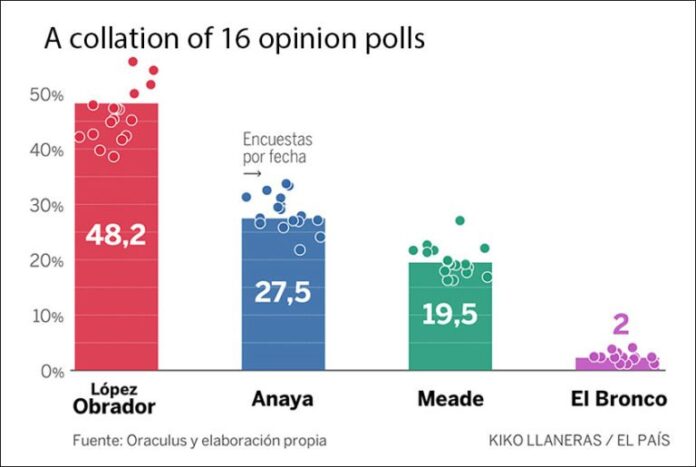
AMLO extends lead in latest opinion poll
Coalition’s Anaya and PRI’s Meade battling for second place

Leftist presidential candidate Andrés Manuel López Obrador has extended his lead over his nearest rival to 14 points, according to a new opinion survey conducted by the polling company Parametria.

But another poll conducted the same week, while giving López Obrador the lead, puts him just six points ahead of the Institutional Revolutionary Party candidate.

The leader of the National Regeneration Movement, or Morena party, garnered 35% support among the 800 voters who were surveyed last week.

The 24 horas poll is reflective of a recent statement from political risk analysts at Eurasia Group who said that the race will likely become more competitive between the two front runners.

Jockeying for that number-two position between Anaya and Meade, that would perhaps put either within striking distance of López Obrador, is well and truly under way.

The official campaign period starts on March 30, the first debate will be held in Mexico City on April 22 and voters will go to the polls on July 1.

spot_img

Boxing Schedule – The Sport of Gentlemen

FEBRUARY 28, 2018
Korakuen Hall, Tokyo, Japan
• Daniel Roman vs. Ryo Matsumoto
MARCH 3, 2018
MSG,, New York, NY, USA (HBO)
• Sergey Kovalev vs. Igor Mikhalkin
• Dmitry Bivol vs. Sullivan Barrera
Sheffield Arena, Yorkshire, UK (Sky)
• Kell Brook vs. Siarhei Rabchanka
• Gamal Yafai vs. Gavin McDonnell
• David Allen vs. TBA
MARCH 10, 2018
StubHub, Carson, CA, USA (ESPN / ESPN Deportes)
• Oscar Valdez vs. TBA
• Jessie Magdaleno vs. TBA
MARCH 17, 2018
MSG, NY, NY, USA (ESPN / ESPN Deportes)
• Jose Carlos Ramirez vs. Amir Imam
• Felix Verdejo vs. TBS
• Teofimo Lopez vs. TBS
• Michael Conlan vs. TBS
Star City, Pyrmont, Australia (Epicentre.tv)
• Darragh Foley vs. TBA

spot_img

The untold history of Mexico’s Afro-descendants

NOTE FROM THE EDITOR

Dear readers:

The nation is currently celebrating Black History Month, and to join such honoring of the people of African descend, El Reportero has the honor to bring to you the following article, written and researched by Alvaro Amador Muwhich highlights the contribution of those invisible communities of African descent – beyond the US border: the afromexicanos.

2015 census revealed nearly 1.4 million Mexicans of African descend

by Alvaro Amador Muniz

Until a few years ago, most Mexicans had no real idea about how many Afro-descendants existed, where they live or how they live.

Afro-descendants are part of who we are as a country, part of our history, our culture and ethnic background but most Mexicans do not know much about them. We do not know about our third root.

In 2015, for the first time in Mexican history, the Institute of Geography and Statistics (Inegi) included in the national census a question asking respondents whether they consider themselves to be afromexicano.

The results surprised many. NGOs and academics realized they had seriously underestimated their pre-census population estimates.

There are almost 1.4 million Mexicans who consider themselves to be afromexicanos. The majority of them live in the coastal areas of Oaxaca, Veracruz and Guerrero, but Mexico City and Baja California Sur also have important afromexicano settlements.

In 2015, the afromexicanos won an important victory: they went from an invisible and almost mythological status to a recognized ethnic group in Mexico.

But the importance of the afromexicano community in Mexico goes beyond numbers. What the census results don’t tell us is that without the cultural and historical contributions of the afromexicanos, Mexico would not be where it is today. So to celebrate Black History Month and as a humble attempt to keep alive this vital part of Mexican history, let’s do a quick dive into the untold history of the afromexicanos:

During the colonization

The first African slaves were brought to Mexico in 1519 by Hernán Cortés and some were granted their freedom and rewarded with land because of their loyalty and bravery during the colonization battles.

One of the most renowned cases was that of Juan Garrido, who was very close to Cortés and was compensated with the prestigious job of guardian of the aqueduct of Mexico City in Chapultepec.

The first slavery-free community of the new world

In 1570, before the first slaves were brought to the United States, Gaspar Yanga, an African slave from Gabon, rebelled against his Spanish master and escaped to the mountains of the state of Veracruz. There, he and a group of escaped slaves established, with the recognition of the Spanish crown, the first slavery-free town of the new world.

There is no exact number of the African and African descendant populations during the first years of the Spanish colony, but some historians believe that the number of Africans living in Mexico superseded that of the Europeans.

War of Independence

During the Mexican War of Independence in 1810 the leader of the independence movement, Miguel Hidalgo, released a decree that abolished any kind of slavery. This action was aimed at weakening the economic and political power of the Spanish slave owners that opposed Mexican independence and to add the freed slaves to the troops fighting for independence.

In 1813, after the death of Miguel Hidalgo, José María Morelos took over the leadership of the independence movement and again declared illegal all forms of slavery.
Independent Mexico and the first Afro-descendant president in North America

In 1821 Mexico declared its independence from Spain and the anti-slavery spirit of the draftsmen of independence made its way into the first Mexican constitution in 1824. The abolitionist laws were, unfortunately, a dead letter during the first years of independent Mexico.

The economy of the northern states, especially Texas, depended heavily on slave labor and those states refused to follow the abolitionist laws.

In 1829 President Vicente Guerrero, an Afromexicano himself, vigorously enforced anti-slavery laws.  Guerrero, in a conciliatory spirit, offered to pay the slave owners for the freedom of their slaves.

Black Seminoles or Mascogos in Coahuila

Not all the afromexicanos came to Mexico during colonial times. During the Seminole Wars in the United States some of the freed slaves settled with the Seminoles in what was then slavery-free Florida and fought against Andrew Jackson’s encroaching troops as he moved in to take the newly-purchased Florida back to a slavery state.

They fought for their freedom alongside the Seminole tribe in Florida but were eventually forced to abandon their land and relocate to Arkansas and Oklahoma. Some slaves took a small detour from the march to the west and escaped to northern Mexico where they had heard slavery was illegal.

In 1867, President Benito Juárez granted those refugees Mexican nationality and gave them the land that many still occupy in Múzquiz, Coahuila.

Maximiliano and the last attempt to reestablish slavery in Mexico

This might disappoint those of you who think Maximilian I was a kind-hearted “emperor” but it needs to be told. In 1865, in a desperate attempt to add allies to his fading cause, Maximilian attempted to reestablish slavery.

This was aimed at attracting the recently-defeated American confederates to northern Mexico as settlers in order to keep his “empire” afloat. Maximiliano met his end with Juárez’s firing squad, and the laws he signed never took effect.
Today
Some important victories have been won recently in favor of the afro-descendants in Mexico. The results of the census have triggered public awareness campaigns like #SoyAfro by the National Council to Prevent Discrimination (Conapred) and NGOs.

Also, places like Veracruz, Guerrero and Mexico City have included the afromexicanos as an ethic group in their local constitutions. But there is still a long road ahead. It is important that we learn, share and divulge this part of history so we can keep the ball of equality rolling forward.

“It is important for all of us to appreciate where we come from and how that history has really shaped us in ways that we might not understand.”  —United States Supreme Court Justice Sonia Sotomayor.

Alvaro Amador Muniz hails from Ciudad Juárez, Chihuahua, is an honorary Tennessean and an avid basketball player currently living in Mexico City. He can be contacted at alvaroamadormu@gmail.com.

CORRECTION: The original version of this pieces stated that Hernán Cortés was around in 1919, a mistake of four centuries in magnitude.

spot_img

The health benefits of beets

by Ben Fuchs

I’ve been hearing a lot of commercials about beets lately, the latest darling of the nutritional supplement industry. Supplements using beets, particularly beet juice and beet powder, look to exploit recent research findings focused on the nutrient-dense tap root’s ability to enhance athletic performance, strength and endurance.

The secret to the beet boost for athletes and workout warriors is in its nitrogen content, specifically in the form of nitrates and nitrites. Despite the conventional wisdom that these chemicals are best avoided, as it turns out the misunderstood molecules have been a valued medicinal asset for doctors and health care professionals for over a hundred years. They’re sources of nitrogen and, when transformed into the gas hormone nitric oxide (NO), they become a potent hormone-like biochemical that plays various important roles in keeping the body healthy. NO is especially important for heart health. It lowers blood pressure, supports the flow of fluid through the circulatory system, improves male sexual performance, fights cancer, destroys tumors and is anti-inflammatory. In addition to being a source of nitric oxide, nitrates may play an important role in eye health, particularly for patients dealing with glaucoma, a leading cause of blindness that affects 3 million Americans. A 1998 article published in the journal Vision concluded that the use of therapeutic nitrates in glaucoma patients may offer a protective effect. More recently, a study published in JAMA Ophthalmology found that American adults who ate the most nitrates were 21 percent less likely than those who ate the least nitrates to develop open-angle glaucoma by the time they were in their 60s and 70s.

But it’s not just nitrogen that makes the beet such a nutritionally significant vegetable. The red root is a source of many other important salubrious substances including betalins, the natural pigment that’s responsible for the vegetable’s rosy hue. Betalins, whose name is derived from the beets Latin name beta vulgaris, act as a type of molecular cleaning crew, speeding up the removal of toxins and dead cells. Betalins can help fight cancer and are, according to a September 2005 article in the journal Phytotherapy Research, particularly important for liver health.

The beet’s nutritional value doesn’t stop there. They’re rich in antioxidants, electrolytes like potassium and magnesium. They’re packed with B-vitamins, especially folic acid. They’ve got Vitamin C, and they’re loaded with fiber. They’re also important sources of carotenoids, particularly lycopene, which can protect the skin from the damaging effects of the sun.

You don’t have to ingest beets to enjoy their skin health benefits. You can apply their juice topically. Blend some up in a VitaMix with some juice or apple cider vinegar and you can make your own beet based skin care masks and toners. The alpha hydroxy acids from the vinegar and citrus will smooth and soften the skin, helping drive the beet’s vitamins, minerals and phytonutrients past the surface to the lower levels. This enhances their protective and detoxifying effects, helping prevent wrinkles, dark spots and other signs of age inducing sun damage.

Did You Know?

– You can use beets to test your digestive system. Stools should have a red hue 12-24 hours after eating the vegetable. If the rosy color doesn’t appear within a day or so you may be dealing with delayed transit time (constipation) and food stagnation.

– Beet juice makes a great hair dye. Cut up 1-2 beets into quarters, add water and mix in a food processor or blender. Use cheesecloth to filter out the juice and whip it into 2-4 cups of of melted coconut oil. Let cool and apply to hair as a mask. Let sit for 1-2 hours and rinse and wash hair as usual.

Even though they contain sugar, beets make a great diet friendly dessert. A cup only has 75 calories and can be used to sweeten pies, juices, or as a tasty low-cal sweet to finish off a meal.

– The surface of fresh, organic beets contains beneficial microorganisms. When you prepare them, rinse off the dirt, but don’t scrape off the skin and you’ll get the benefits of the good bacteria. If you juice your beets and add some bacterial starter culture (available on the internet), you can make your own probiotic rich beet beverage (it’s called “kvass”).

– The Romans used beets as a natural aphrodisiac, and for good reason. Although they didn’t know it at the time, the sweet root is a source of boron, an important mineral involved in the production of libido boosting testosterone.

spot_img

Top lawmakers call for investigation of DEA-led unit in Mexico

Democratic leaders in the House and the Senate cited ProPublica’s reporting into the DEA’s role in two operations in Mexico that resulted in dozens, perhaps hundreds, of deaths

by Ginger Thompson
ProPublica

Powerful Democrats in both the House and Senate called Tuesday for an investigation into Drug Enforcement Administration-led operations in Mexico that played a role in triggering violent drug cartel attacks. These attacks left dozens, possibly hundreds, of people dead or missing, including many who had nothing to do with the drug trade.

The call was issued in a letter signed by ranking members of the committees that oversee America’s foreign law enforcement operations and draws heavily on two stories last year by ProPublica and National Geographic that documented the attacks and the DEA’s role. One story reconstructed a 2011 massacre by the Zetas cartel in the Mexican state of Coahuila. It revealed that the wave of killings was unleashed after sensitive information obtained during a DEA operation wound up in the hands of cartel leaders, who ordered a wave of retaliation against suspected traitors.

A second story investigated a 2010 cartel attack on a Holiday Inn in Monterrey, Mexico, and found that it, too, was linked to a DEA surveillance operation. Four hotel guests and a hotel clerk, none of whom were involved with the drug trade, were kidnapped and never seen again.

In both cases, the DEA never revealed its involvement or helped in the investigation of the slaughter of Mexican citizens. Until contacted by ProPublica, the family members of the victims never knew why their loved ones had been targeted.

Both operations involved a Mexican federal police unit that is specially trained and vetted by the DEA to work with U.S. law enforcement. ProPublica’s reporting found that despite that scrutiny, the Sensitive Investigative Unit had a record of leaking information to violent and powerful drug traffickers. The DEA, ProPublica found, had long been aware of this corruption and failed to address it, even when innocent lives were lost. The agency has similar units in 12 other countries.

“These operations raise serious questions about the practices of DEA-trained and funded SIU’s,” the congressional letter said, “and point to the need for greater accountability for these vetted units.”

The letter was signed by Sen. Patrick Leahy of Vermont, vice chairman of the Senate Appropriations Committee, who has long pursued accountability for the DEA’s operations abroad, as well as Sen. Dianne Feinstein of California, the ranking member of the Senate Judiciary Committee and one of the country’s leading authorities on national security matters, Rep. Eliot L. Engel, the ranking member of the House Foreign Affairs Committee, and Rep. Jerrold Nadler, the leading Democrat on the House Judiciary Committee. The two representatives are from New York, and their committees oversee the State and Justice departments.

The legislators asked the inspectors general at the Justice and State departments to investigate the attacks in Monterrey and Coahuila, as well as the DEA’s overall work with vetted units. They asked eight detailed questions about the two deadly incidents, including how information about the operations was leaked to the cartels and whether the DEA attempted to provide assistance to the families of those kidnapped or killed and whether the United States Ambassador to Mexico had been fully informed.

“In light of these incidents,” the letter said, “we believe that a thorough investigation into the practices of the DEA’s vetted units is essential.”

For two decades, the “Sensitive Investigative Unit Program” has been the DEA’s workaround method of battling drugs with foreign partners it doesn’t always trust. The agency sets up a unit under its supervision, choosing members from the host country’s police forces. Then it trains these foreign officers — often in the U.S. — polygraphs them, and, in some cases, works alongside them in the field.

Administrators at the agency have hailed them as the “bread and butter” of the DEA’s activities abroad.

In Mexico, however, the SIU has been plagued by corruption from the start. Since 2000, at least two supervisors have been assassinated after their identities and locations were leaked to drug traffickers by SIU members, according to allegations by current and former DEA agents who worked in Mexico. Earlier this year, another SIU supervisor, Ivan Reyes Arzate, flew to Chicago and surrendered to U.S. authorities, who charged him with collaborating with drug traffickers.

In interviews, current and former DEA agents who worked with the unit didn’t dispute the corruption within the Mexican unit’s ranks. Several agents said that part of “the game” of working in Mexico involves understanding that the vetted unit — and every other Mexican law enforcement agency — might leak to a specific cartel and reliably help pursue another. The trick, they said, was figuring out which cartel the vetted unit was helping, and then using the unit to pursue that cartel’s rivals.

When it works, the agents said, they bring down a cartel kingpin and garner headlines. But the investigations by ProPublica made clear that the game sometimes has tragic consequences, about which the DEA has remained largely silent.

Both Engel and Leahy have been seeking accountability for U.S. foreign law enforcement operations for years. Engel was among more than a dozen legislators who signed a letter to the Justice and State departments last year, expressing concern about the DEA’s role in the massacre in Coahuila. And Leahy was a driving force behind government efforts to investigate a botched DEA operation in Honduras in 2012 that left four unarmed people dead, and another four injured.

Earlier this year, Leahy sent a letter directly to the DEA’s Acting Administrator, Robert W. Patterson, to convey his concerns about ProPublica’s reports. The letter contained 22 questions about the DEA’s work with SIUs; questions that Leahy said warranted response, “given the reported history of corruption and misconduct by some members of the SIU.”
(Ginger Thompson is a senior reporter at ProPublica who writes about the drug war).

spot_img

Almost 1,000 immigrants intercepted in México

by the El Reportero’s wire services

The Mexican Federal Police intercepted 137 Central American migrants on the Tampico-Victoria Highway in the north of the country, adding up to a thousand undocumented migrants registered by the authorities so far this year.

The migrants traveled in the box of a trailer in total overcrowding and in the group there were also minors.

Mexican authorities expressed their concern over the increase in undocumented persons from Central America who use Mexican territory to enter the United States illegally.
The groups are each time more numerous, as well as the number of children, said sources from the Ministry of Interior.

US ambassador to Mexico unexpectedly resigns amid increased tensions under Trump

Roberta Jacobson, the US ambassador to Mexico, announced her resignation on Thursday, saying on Twitter she would be leaving her post at the beginning of May “in search of other opportunities.”

CABEI Board of Directors Meets in Nicaragua

The board of directors of the Central American Bank for Economic Integration (CABEI) is holding a meeting today in this capital, to address several strategies for the current year, among other institutional issues.

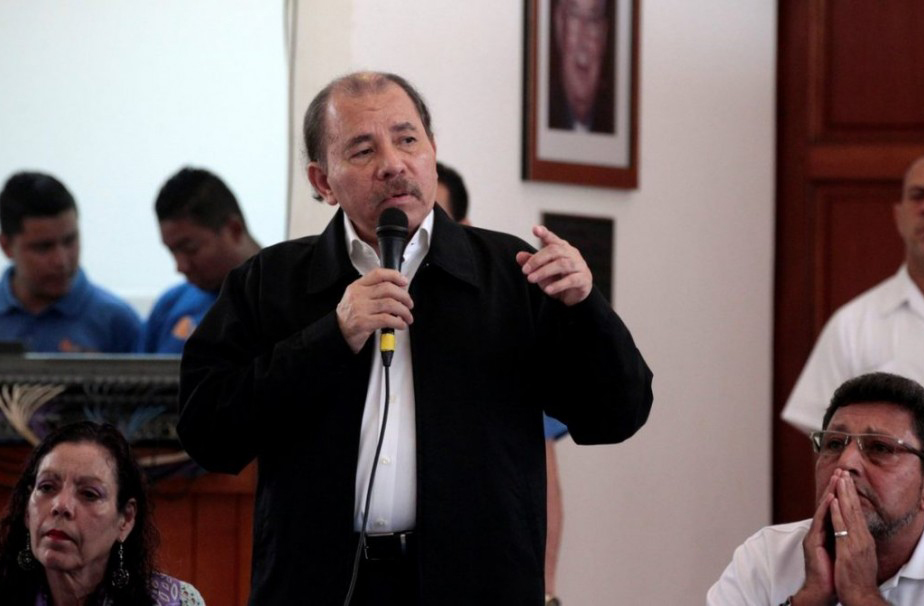
Vice President Rosario Murillo said she will address some operational issues related to the approval of loans for Honduras, El Salvador and Nicaragua.

Murillo also said that President, Daniel Ortega, will receive today and tomorrow the CABEI board of directors, who will also pay posthumous tribute during a solemn session to Silvio Conrado. Conrado was the Nicaraguan director of this regional organization until his death.

The Central American Bank for Economic Integration, founded in 1960, aims to promote integration and development of Central America, being one of its main suppliers of resources.

Its founding members are Guatemala, El Salvador, Honduras, Nicaragua and Costa Rica, while Panama, the Dominican Republic and Belize joined as non-founding regional countries; and Mexico, Taiwan, Argentina, Colombia, Spain are non-regional members.

Federal judge whom Trump called ‘Mexican’ clears way for border wall

The federal judge once slammed by President Donald Trump as being a “Mexican” who was incapable of being impartial has sided with Trump in his bid to move ahead with construction of a wall on the U.S.-Mexico border.

Judge Gonzalo P. Curiel on Tuesday rejected arguments by the state of California and a coalition of environmental groups, who said the Trump administration had improperly ignored environmental laws in its push to build the wall.

Curiel said in his 101-page ruling that such decisions should be left to other branches of government, not the judiciary. He quoted U.S. Supreme Court Chief Justice John Roberts in saying political matters “are entrusted to our Nation’s elected leaders, who can be thrown out of office if the people disagree with them. It is not our job to protect the people from the consequences of their political choices.” (by James Rainey).

Measure passes the Assembly Floor to urge trump to reverse decision ending TPS for Salvadorans

(Sacramento) – Today, Assemblymember Wendy Carrillo (D-Los Angeles) presented her first legislative measure, House Resolution (HR) 69, on the Assembly Floor. As the only member of the state legislature of Salvadoran background it is a personal issue she is uniquely qualified to lead on. The resolution urges the President to reverse his decision to terminate the Temporary Protected Status (TPS) designation of Salvadorans and to work with Congress to find a path to legal status for these valuable members of our community. HR 69 was adopted on a bipartisan vote.

An estimated 200,000 Salvadorans protected by TPS found refuge in the United States, and 49,000 found a home in California. They are a key part of the workforce, with labor participation rates of 88 percent, and of our communities, with over 190,000 U.S.-born children living here. Tearing hundreds of thousands of immigrants from their families exemplifies just how callous and out of touch the Trump administration is.

Scotus breathes new life to DACA program, at least temporarily
High Court’s decision means DACA renewals can continue

Los Angeles — The California Dream Network (CDN), the youth organizing arm for the Coalition for Humane Immigrant Rights (CHIRLA), celebrated the Supreme Court’s decision not to rule on the DACA injunction Monday, Feb. 26, until the 9th District Court of Appeals rules on the case.

The following is a statement for Angelica Salas, CHIRLA Executive Director:

“This is great news for the 800,000 DACA recipients who are eyeing President Trump’s self-imposed March 5th deadline with great concern and trepidation.   The court’s decision not to stop the injunction for now allows many more young immigrants to renew their DACA work permits.

President Trump can ameliorate the anxiety, fears, and distrust many young immigrants and their families are feeling by extending DACA indefinitely and by working with Congress to pass a reasonable, fair, and permanent solution.

CHIRLA encourages young immigrants whose DACA work permits have expired or are set to expire within the next few months to renew them at a community organization or with an immigration attorney of trust.”

spot_img