Wednesday, August 5, 2026
Home Blog Page 283

‘Super successful’ program registers 10,000 migrants in six days: Immigration

Mexico is providing them with one-year humanitarian visas

by Mexico News Daily

Immigration authorities have now registered more than 10,000 migrants at the southern border as part of a new government program that has been described by an official as “super successful.”

The National Immigration Institute (INM) announced on Twitter today that it registered 8,446 requests for humanitarian visas from adult migrants currently in Chiapas and 1,897 requests from minors in just six days.

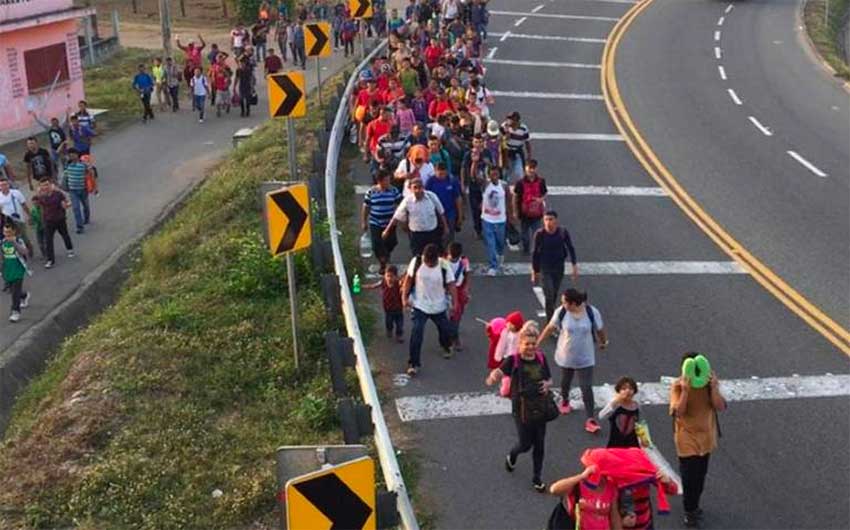
Many of the migrants crossed into Mexico last week as part of a new caravan that left San Pedro Sula, Honduras, on Jan. 14.

Some of them entered Mexico illegally and continued walking to Tapachula but later returned to the border crossing to regularize their immigration status. Some returned in buses provided today by the federal government.

Of 10,343 migrants, 75 percent are from Honduras while most of the remainder are from Guatemala and El Salvador, although the total also includes a small number of Nicaraguans, Haitians, Brazilians and Cubans.

INM chief Tonatiuh Guillén told the newspaper La Jornada that the initiative to offer humanitarian visas to the migrants has been successful and will continue, explaining that it is part of the federal government’s new immigration policy.

“I understand that for Donald Trump it’s not his ideal scenario and that he prefers another vision but this is Mexico’s sovereign decision and we hope that it also has an impact on reducing human trafficking,” he said.

“It’s been a super successful program, it’s really establishing a new paradigm in Mexico’s immigration policy that is based on Mexico’s laws and the country’s international commitments,” Guillén added.

The humanitarian visas, which allow migrants to work in Mexico and access services for a period of 12 months, are issued five days after the INM receives the requests.

Once in possession of the visa, the migrants are able to move legally throughout the country, meaning that if their goal is to apply for asylum in the United States, they can travel to the northern border.

“The objective on our part is for their entry to be regular, for all of them to have their legal situation in order and for them to consider Mexico as an alternative for employment,” Guillén said while in Chiapas to oversee the issuing of visas.

An added benefit of the visa scheme, he said, was that it allows authorities to know who is in the country.

“… For the first time, we’re going to know who has crossed into Mexico . . . and obviously we’ll have the possibility of identifying those who have a legal problem in Mexico or in another country,” Guillén said.

Thousands of Central American migrants are already in cities on Mexico’s northern border, especially Tijuana, where they face long waits for the opportunity to request asylum with United States authorities.

It is unclear how many of the cohort currently in Chiapas will also attempt to reach the Mexico-U.S. border and how many will choose to remain in Mexico.

Salvadoran migrant Aura Guinea, who is traveling with her five-month-old daughter, told CBS News today that she saw the humanitarian visa as a means to get to the United States and that she remained determined to do so.

However, a Honduran woman said that she would stay in Mexico because Trump doesn’t want people like her in the United States.

She said she hoped to be able to find a better paying job in Mexico than in Honduras, where she earned just US $2 a day washing dishes.

Trump, who has accused Mexico of doing nothing to stop migrants from reaching the United States’ southern border, is currently locked in a bitter battle in the United States over funding for his long-promised border wall.

“Build a wall and crime will fall,” he tweeted today.

Source: La Jornada (sp), CBS News (en).

In other related caravan news:

Government is monitoring new migrant caravan from Honduras
Senior official says they won’t be allowed to ‘bang down the door’

The federal government is determined to avoid any repeat of violence on the southern border, a high-ranking official said yesterday as a new migrant caravan set out from Honduras bound for the United States.

Alejandro Encinas, undersecretary for human rights, migration and population in the Secretariat of the Interior, said the government has a clear strategy with which to receive the next migrant caravan and warned that its members will not be permitted to “bang down the door.”

A clash between Central American migrants and Mexican police on the Mexico-Guatemala border near Tapachula, Chiapas, in October resulted in the death of one Honduran man.
Thousands of migrants reached Mexico’s southern border in the final months of last year as part of several migrant caravans.

Many of them entered Mexico illegally, some by wading or floating across the Suchiate River, which separates Chiapas from Guatemala.

Large numbers of migrants are now stranded on Mexico’s northern border, especially in Tijuana, where they face a long wait for the opportunity to request asylum in the United States.

Interior Secretary Olga Sánchez Cordero said earlier this month that the government is reinforcing the southern border to guarantee that migrants’ entry into Mexico is safe, orderly and regulated, a strategy reiterated by Encinas yesterday.

“Everybody has the right to human mobility, to orderly, safe and regulated migration, and he who enters in a regular manner… will have no impediment…” he said.

Source: El Sol de México (sp), Associated Press (sp).

spot_img

Vitamin D deficiency during pregnancy linked to autism in children

by Zoey Sky

Vitamin D, also called the “sunshine vitamin,” does more than keep your bones and teeth healthy. According to a study, taking enough vitamin D when you’re pregnant can help lower your unborn child’s risk of developing autism.

The study, which was published in the journal Molecular Psychiatry, is part of “Generation R,” a large research project on youth in the Netherlands.

Vitamin D deficiency and autism in children

For the study, researchers analyzed the levels of vitamin D of more than 4,200 blood samples taken from both pregnant women and their children. The blood samples examined in the study were taken twice: once when the mother was 21 weeks pregnant, and once at birth.

After the children turned six years old, the parents taking part in the study were instructed to fill out a questionnaire called the “Social Responsiveness Scale.” The parents used the questionnaire to determine if their children were exhibiting “autism-related traits.”

The team of researchers noticed a crucial link after they compared the mothers’ vitamin D levels with the self-reported signs of autism in their children. The mothers with low vitamin D levels in their blood, or at least 36 percent of the female volunteers by the time they gave birth, had a higher chance of delivering a baby who showed autism-related traits once they turned six years old, compared to the women who had regular levels of vitamin D in their blood. (Related: BREAKTHROUGH: Vitamin D supplements taken during pregnancy found to prevent autism in children).

The researchers believe that this isn’t new information, especially since earlier studies suggest that vitamin D is crucial for proper brain development. Previous research has also implied that a deficiency during pregnancy is linked to other conditions in children, like asthma and schizophrenia.

Keep in mind that this study determined a link between D deficiency and autism instead of proving that one caused the other. Another factor to remember is that the “autism-related traits” monitored in the study were self-reported by the parents and that the child did not receive an official diagnosis from a healthcare professional.

Despite these factors concerning the study, pregnant women need to get enough vitamin D to ensure their overall health and the well-being of their unborn children.

Tips for increasing your vitamin D intake while pregnant

If you’re with child, follow the tips below to increase your vitamin D intake:

– Bask in the sunshine vitamin. Sunbathe and expose your arms and face for at least 15 to 20 minutes every day before you apply sunscreen. Take note that women with darker skin will need to sunbathe for longer than 20 minutes.

– Be more conscious of your weight. Expectant mothers who are overweight or obese at the start of their pregnancy may have lower levels of vitamin D in their blood. Try to lose weight before you give birth, and do your best to avoid putting on too much weight during your pregnancy. About six kilograms (kg) of weight gain is normal for pregnant women. Consult a midwife to learn more.

– Eat fatty fish. Oily fish is the best natural source of vitamin D. Consume one portion of at least 140 grams a week. Sources include fresh tuna, mackerel, pilchards, salmon, and sardines.
– Eat other foods that are also rich in vitamin D. Other foods that contain vitamin D include fresh eggs and red meat. You can also eat vitamin D-fortified breakfast cereals.

– Take a vitamin D supplement. Pregnant women need to take a supplement with about 10 micrograms (mcg) of vitamin D every day.

You can read more articles about vitamin D-rich foods and the benefits of increasing your intake of the vitamin while pregnant at VitaminD.news.

Sources include:
GoodHousekeeping.com
DietInPregnancy.co.uk

spot_img

10 Oscar nominations for Roma, including best film, director and actress

Filmmaker Alfonso Cuarón was himself nominated in four categories

by the El Reportero’ news services

The accolades for Roma, the award-winning film by Alfonso Cuarón, continued today with the announcement of the Oscar nominations — fully 10 of them, including best picture, best director and best actress.

The filmmaker himself became the third person ever to be nominated in four categories in a single year, joining a short roster that includes Orson Welles and Warren Beatty. Cuarón was nominated for direction, cinematography, original screenplay and best picture.

Yalitza Aparicio’s debut acting performance earned her a nomination as best actress, a singular list that also includes another first-timer, Lady Gaga, along with Glenn Close, Olivia Colman and Melissa McCarthy.

The nominations earned by Roma, described by the newspaper SFGate as a “deeply personal exhumation of [Cuarón’s] Mexico City childhood,” also included best supporting actress, best foreign language film, best production design, best sound editing and best sound mixing.

Roma also gave the film’s distributor, Netflix, its first best-picture nomination, a prize that has until now eluded the streaming giant.
Only one other film was nominated in as many categories as Roma this year— Yorgos Lanthimos’ The Favourite.

Best-actress nominee Aparicio, 25, who plays a domestic worker in the home of a family living in Mexico City’s Roma district in the 1970s, is the second Mexican actress to earn the nomination. The first was Salma Hayek for her role in Frida in 2002.

Roma had already made history earlier this month when it became the first foreign language film to win the award for best picture at the Critics’ Choice Movie Awards, where it won three other awards as well.

Other awards won by the film include two Golden Globes for best director and best foreign film.

The other best-film nominees this year are Black Panther, BlacKkKlansman, Bohemian Rhapsody, The Favourite, Green Book, A Star Is Born and Vice.

The Academy Awards will be broadcast February 24 at 7 p.m.

Source: Milenio (sp), El Economista (sp), SFGate (en).

The Oscar nominee has reason to feel proud

Yalitza Aparicio has captivated audiences with her first-ever acting role in Alfonso Cuaron’s masterpiece Roma. Her nominatioan is a momentous occasion for a multitude of reasons: she’s only the 4th Latin American actress to achieve this honor and the only one to be indigenous, reported Vanessa Erazo.

Especially after facing racist attacks online, Aparicio knew that landing an Oscar nomination would have a tremendous impact on her community.

Thankfully, a friend woke up her up early in the morning armed with a laptop to stream the nominations while they were announced live and a camera to catch Yalitza’s reaction. It’s impossible to watch without crying.

No Manches Frida releases on March 15

In this over-the-top sequel to the smash hit No Manches Frida, the all-star cast of the original (Omar Chaparro and Martha Higareda) and some fresh new faces (Itatí Cantoral and Aaron Díaz) leave the school yard and hit the beach in No Manches Frida 2! But there’s trouble in paradise… literally.

When the seemingly reformed ex-con Zequi is about to marry the love of his life, the lovably nerdy Lucy, wedding day jitters turn into a full blown fiasco and Lucy calls the wedding off. Meanwhile, the school finds itself in deep trouble and the gang heads to the water to compete in the tournament of their lives.

Once they’re all seaside, Lucy runs into her high school sweetheart Mario, whom since she last saw him has transformed into a smoking hot hunk. He’s coach of the opposing squad and Zequi finds himself a rival in more than one competition. Now he has to pull out all the stops to wrangle in his rowdy kids, win Lucy back, and in case that wasn’t enough, save the school from shutting down by leading Frida High to victory!

spot_img

Russia and key allies vow to stand by Maduro in Venezuela crisis

Vladimir Putin offers support to Venezuelan leader in crisis ‘provoked by abroad’

by Andrew Roth, Lily Kuo, David Agren, Ed Augustin, Peter Walker and agencies

Key allies of Venezuela’s embattled president, Nicolás Maduro, led by Russia and China, have warned the US not to intervene in support of the opposition leader Juan Guaidó’s attempt to lead the country.

Russia’s Vladimir Putin spoke by telephone with Maduro and offered him strong support in a political crisis he said had been “provoked from abroad”, a Kremlin statement said. “Destructive interference from abroad blatantly violates basic norms of international law,” Putin was quoted as saying.

The Kremlin press release did not mention the US by name but matched earlier rhetoric by other senior Russian officials targeted at Washington.

Russia’s prime minister, Dmitry Medvedev, described the US support for Guaidó as a “quasi-coup” and accused the US of hypocrisy, asking rhetorically how Americans would react if the House speaker, Nancy Pelosi, declared herself president.

Sergei Ryabkov, Russia’s deputy foreign minister, said a US military intervention in Venezuela would be catastrophic.

Russia is an important source of financial support to the Venezuelan government, providing billions of dollars in loans, some as pre-payment for future deliveries of oil. Last month Russia dispatched two nuclear-capable Tu-160 bombers to the country in a further show of support.

Russia has said it is ready to facilitate talks among political forces in Venezuela. “We will stand, if you’d like, together with this country in defence of sovereignty, in defence of the inadmissibility of encroaching on the principle of nonintervention in internal affairs,” Ryabkov said.

Franz Klintsevich, a Russian senator and retired colonel, said Moscow could wind up its military cooperation with Venezuela if Maduro, who he said was the legitimately elected president, was ousted.

Other MPs criticised US actions. “The US is trying to carry out an operation to organise the next ‘colour revolution’ in Venezuela,” said Andrei Klimov, the deputy chair of the foreign affairs committee of the upper house of parliament, using a term for the popular uprisings that unseated leaders in Georgia, Ukraine and Kyrgyzstan.

China said it supported the Venezuelan government’s efforts in preserving the country’s sovereignty, independence and stability. “I want to emphasise that outside sanctions or interference usually make the situation more complicated and are not helpful to resolving the actual problems,” a foreign affairs spokeswoman said.

Venezuela has been one of Beijing’s closest allies in Latin America, and the largest recipient of Chinese financing, taking as much as £38bn in loans by 2017. China is Venezuela’s largest creditor, prompting concerns that as Venezuela’s economy spirals, state assets could fall into Chinese hands, as was the case with Sri Lanka’s Hambantota port.

It is in Beijing’s interest to support Maduro, given that a new government could refuse to honour Venezuela’s debt obligations to China. Maduro met China’s president, Xi Jinping, last year and toured Mao Zedong’s mausoleum in Beijing, and the countries agreed on £3.8bn in loans and more than 20 bilateral agreements.

Turkey’s president, Recep Tayyip Erdoğan, phoned Maduro to offer his support on Thursday, later telling a press conference he was shocked that the US had backed Guaidó.

“You will respect the results of elections. Trump’s remarks shocked me, as someone who believes in democracy,” he said. “I called Maduro on the way back from Russia. I told [him] very clearly: ‘Never allow anti-democratic developments. Stand tall,’” he said.

Turkey’s foreign minister issued a warning about Guaidó’s declaration. “There is an elected president and another person declares himself president, and some countries recognise this. This may cause chaos,” Mevlüt Çavuşoğlu told the A Haber news channel. “We are against the isolation of countries. I hope the situation will be solved peacefully.”

Mexico, part of the 14-member Lima Group, departed from the regional bloc’s call for democratic transition and said it would stick to its “constitutional principles of non-intervention”.

It joined Uruguay, the only other prominent Latin American country still recognising Maduro, in calling for additional talks between the government and opposition to find a peaceful solution.
Previous talks brokered by the Vatican on the Venezuelan situation broke down.

Mexico had previously criticised Venezuela but its new president, Andrés Manuel López Obrador, has returned the country to its traditional foreign policy of not weighing in on the internal affairs of other countries and expecting the same silence in return.

Iran denounced events in Venezuela, saying the opposition’s claim there that it held the presidency was a “coup” and an attempt to take power unlawfully.

The foreign ministry spokesman Bahram Ghasemi said: “Islamic Republic of Iran supports the government and people of Venezuela against any sort of foreign intervention and any illegitimate and illegal action such as attempt to make a coup d’état.”

Cuba expressed its support for Maduro, with the state newspaper Granma saying that by recognising Guaidó as interim president, Donald Trump was “directing a coup d’état”. Cuba is hugely dependent on Venezuelan petroleum paid for with doctors.

The UK broke European ranks on Thursday and sided with the US. “This regime has done untold damage to the people of Venezuela, 10% of the population have left Venezuela such is the misery they are suffering,” the foreign secretary Jeremy Huny said in a statement issued in Washington. “So the United Kingdom believes Juan Guaidó is the right person to take Venezuela forward. We are supporting the US, Canada, Brazil and Argentina to make that happen.”

The UN secretary general, António Guterres, said talks in Venezuela were needed to avoid the political crisis spiralling out of control.

“What we hope is that dialogue can be possible, and that we avoid an escalation that would lead to the kind of conflict that would be a disaster for the people of Venezuela and for the region,” he said at the World Economic Forum in Davos.

“Sovereign governments have the possibility to decide whatever they want. What we are worried [about] with the situation in Venezuela is the suffering of the people of Venezuela.”

Maduro has presided over a deepening economic crisis that has left millions of people in poverty as the oil-rich country faces shortages of basic necessities such as food and medicine. An estimated 2.3 million people have fled the country since 2015, according to the UN, and the International Monetary Fund says inflation will hit 10 million per cent this year. (The Guardian).

spot_img

A new day for Mexican workers

by David Bacon

NAFTA had been in effect for just a few months when Ruben Ruíz got a job at the Itapsa factory in Mexico City in the summer of 1994. Itapsa made auto brakes for Echlin, a U.S. manufacturer later bought out by the huge Dana Aftermarket Group. In the factory, asbestos dust from brake parts coated machines and people alike. Ruiz had hardly begun his first shift when a machine malfunctioned, cutting four fingers from the hand of the man operating it.

It seemed clear to Ruiz that things were very wrong, so he went to a meeting to talk about organizing a union. When Itapsa managers got wind of the effort, they began firing the organizers. Nevertheless, many of the workers joined STIMAHCS, an independent democratic union of metalworkers.

Itapsa workers filed a petition for an election, but then discovered that they already a “union” – a unit of the Confederation of Mexican Workers (CTM). They’d never seen the union contract – in essence, a “protection contract,” which insulates the company from labor unrest.

The plant’s HR manager told Ruiz that Echlin management in the U.S. said any worker organizing an independent union should be immediately fired. “He told me my name was on a list of those people,” Ruiz recounted, “and I was discharged right there.”

Nevertheless, there was a vote, in September 1997, to decide which union workers wanted. But before the election, a state police agent drove a car filled with rifles into the plant. Two busloads of strangers arrived, armed with clubs and copper rods. During the voting, workers were escorted by CTM functionaries past the club and rifle-wielding strangers. Some workers were forcibly kept in a part of the factory to keep them from voting. At the polling station, employees were asked aloud which union they favored, in front of management and CTM representatives.

STIMAHCS tried to get the election canceled. But the government body administering it, the Conciliation and Arbitration Board (JCA), went ahead, even after thugs roughed up one of the independent union’s organizers. Predictably, STIMAHCS lost.

For 20 years the Itapsa election has been a symbol of all that’s gone wrong with Mexico’s labor law, which provides protection on paper for workers seeking to organize but which has been routinely undermined by a succession of governments bent on using a low-wage workforce to attract foreign investment. Dana Corporation was just one beneficiary – Itapsa has been the norm, not the exception.

In 2015 thousands of farm workers struck U.S. growers in Baja California. Instead of recognizing their new independent union, however, growers signed protection contracts with the CTM, which were certified by the local JCA. Strikers were blacklisted. Later that year workers tried to register an independent union in four Juarez factories. Some 120 workers making ink cartridges for Lexmark were fired, as were another 170 at ADC Commscope, and many more at Foxconn and Eaton.

The labor board declined to reinstate the fired workers in Juarez and Baja – following the pattern it had set at Itapsa two decades earlier. Indeed, the JNCs have been key to the defeat of workers’ attempts to form democratic unions, invariably protecting employers and corporate-friendly unions.

The new Mexican government, headed by President Andres Manuel Lopez Obrador (AMLO), says that’s all over. Deputy Secretary of Labor in the new administration, Alfredo Dominguez Marrufo, promises that, “after all these struggles, we can finally get rid of the protection contract system. We can make our unions democratic, choose our own leaders and negotiate our own contracts. This government will defend the freedom of workers to organize.
That right has existed in theory, but we’ve had a structure making it impossible. This will change.”

That could have a big impact on political life in Mexico, where corporate union leaders have had an inside track to political power and corruption. It could change the dominating role U.S. corporations have played in the Mexican economy, and affect relations between workers in both countries. Most of all, it would raise a standard of living for workers that Lopez Obrador has called “among the lowest on the planet.” In his speech to the Mexican Congress during his December 1 inauguration, the new president charged that 36 years of neoliberal economic reforms had lowered the purchasing power of Mexico’s minimum wage by 60 percent. Today, on the border, that wage comes to a little above $4 per day. (President López Obrador announced that salaries in border states with the US would increase the minimum wage twice as much).

According to University of California Professor Harley Shaiken, “The Mexican government created an investment climate that depends on a vast number of low wage-earners. This climate gets all the government’s attention, while the consumer climate – the ability of people to buy what they produce – is sacrificed.”

Protecting corporations from demands for higher wages has made Mexico a profitable place to do business. Big auto companies, the world’s major garment manufacturers, the global high tech electronic assemblers – all built huge plants to take advantage of Mexico’s neoliberal economic policies, starting more than two decades before the negotiation of the North American Free Trade Agreement.

That wild-west climate for investors produced more than low wages, however. Between 1988 and 1992, 163 Juarez children were born with anencephaly – without brains – an extremely rare disorder. Health critics charged that the defects were due to exposure to toxic chemicals in the factories or their toxic discharges. The Chilpancingo colonia below the mesa in Tijuana where the battery plant of Metales y Derivados was located experienced the same plague.

(Due to the length of this article, it has been cut to fit space. You can read the full piece at: https://prospect.org/article/new-day-mexican-workers).

spot_img

Bolivia to receive archaeological pieces belonging to it

by the El Reportero’s news services

Some 100 archaeological pieces are currently waiting in various countries to be returned to Bolivia during 2019, after several actions for the protection of heritage were undertaken by the Ministry of Cultures of this country.

Among the ancient relics are a keru or sacred vessel found in Argentina and another one in England, belonging to the Mollo culture – a pre-Inca people from 700 A.D. to 1400 A.D. – who inhabited the western part of the Royal mountain range, in the current La Paz department.

As part of the lot of objects to return to Bolivia is also a pot from the post-Tiwanaku era, culture developed in part of South America and after 1187 A.D.

The casserole is from the Netherlands, while another piece in the process of recovery from the United States is an eight-year-old mummy from the Inca culture.

Out of all these archaic components, 50 were recovered and 20 are expected to be in La Paz in January or February 2019, according to Laura Chambi, head of the International Relations Unit of Bolivia’s Ministry of Culture.

Chambi explained the repatriation process is neither simple nor low-budget.

If there is willingness to return an asset, the process can take up to six months, she said.

The return has two stages, one, delivery to the diplomatic representation of the embassy or consulate, which delays the analysis of the piece, while the second phase includes the return process, with departure permit, diplomatic bag and piece insurance, she added. The Protection and Defense Committee for Bolivia’s Cultural Heritage was reactivated this year, made up of several state agencies and security forces.

The Red List of Property Vulnerable to Illicit Trafficking, Theft and Disappearances of International Groups and Networks was created to prevent pieces trade, Chambi pointed out.

El “L.A. Art Show,” la feria de arte más importante de la costa oeste de EE.UU.
Apuesta por el arte latinoamericano en 2019

La Feria de Arte de Los Ángeles desembarcará en el Centro de Convenciones de Los Ángeles del 23 al 27 de enero de 2019 afianzando su posición como punta de lanza del arte contemporáneo y latinoamericano en la costa oeste de Estados Unidos. En su vigesimocuarta edición, la feria contará con la presencia de 120 galerías procedentes de 18 países – entre ellos México, Argentina, Chile, China y Japón.

La propuesta latinoamericana e iberoamericana se engloba bajo “DIVERSEartLA”, una sección que regresa a la feria por tercer año consecutivo bajo la dirección curatorial de la latina Marisa Caichiolo. “DIVERSEartLA” agrupa las iniciativas artísticas de carácter cívico de instituciones, museos y organizaciones internacionales y locales sin fines lucrativos, como el Museo de Arte Latinoamericano de Long Beach (MOLAA), la prestigiosa Colección Arte Al Límite de Chile, LACMA, el CCK de Buenos Aires (con la presencia de la conocida artista argentina Marta Minujín & Andrés Paredes), Launch, Art Share LA o el performance del artista de origen costarricense Dorian Wood.

Noche de estreno Miércoles, 23 de enero de 2019, from 7 p.m. – 11 p.m. En el Centro De Convenciones De Los Ángeles (L.A. Convention Center) – West Hall, 1201 South Figueroa Street Los Angeles. Para entradas visite: https://tinyurl.com/LAArtShow2019. Visita DIVERSEartLA en: https://www.laartshow.com/diverseartla/. Video: https://youtu.be/Tox12Ik22zw.

spot_img

Cheese from hormone-treated cows found to raise the risk of breast cancer by over 50 percent

by Russel Davis

That gooey mozzarella on your pizza may be the best thing next to chocolate, but little do people know that cheese is quite literally “to die for.” Previous studies have established a link between dairy products and obesity, which in turn increases the risk of developing up to 13 types of cancer.

Now, a recent study supports that claim. Researchers at the Roswell Park Cancer Institute in New York examined more than 3,000 women and found that those who had the highest consumption of cheddar cheese, cream cheese, and other American varieties had a 53 percent increased risk of developing breast cancer. However, eating yogurt was associated with a 30 percent reduced risk of cancer.

“Dairy foods are complex mixtures of nutrients and non-nutrient substances that could be negatively as well as positively associated with breast cancer risk,” said lead author and professor of oncology Dr Susan McCann.

Hormone treatment in milk-producing cows may be to blame

Hormones such as Insulin-like Growth Factor -1 (IGF-1) and estrogen were two of the most notoriously hazardous hormones found in milk. IGF-1 was shown to to promote cancer cell growth by turning otherwise health cells into the malignant kind. According to a study published in the Iranian Journal of Public Health, the IGF-1 hormone found in milk may expedite tumor growth through cell stimulation and by anti-apoptosis effect. The results indicate that high levels of IGF-1, insulin, or both were associated with the increased risk of colon, pancreas, endometrium, breast, and prostate tumors. Estrogen has also been associated with higher incidence rates of prostate cancer in Japanese males who had increased consumption of milk and dairy products.

Two more studies revealed that high levels of IGF-1 may raise the risk of colorectal, breast, and prostate cancer. A study published in the Journal of the National Cancer Institute showed that men with the highest levels of IGF-1 hormone were up to four times as likely to develop colorectal cancer.

Data from another study revealed that women with high IGF-1 levels were two and a half times as likely to suffer colorectal cancer. “The fact that these two large studies give the same results for both men and women increases our confidence in the findings,” said lead researcher Edward Giovannucci. Previous studies have also linked IGF-1 hormone with increased odds of breast cancer and prostate tumor by up to two-folds and four-folds, respectively.

Synthetic treatments for cows may endanger public safety

Ever wonder how cancer-laden cheese gets on our plates? The answer lies in the questionable practices imposed in cattle farms. U.S. farmers raise about 35 million cattle per year. These cows are given recombinant bovine growth hormone (rBGH) — a synthetic hormone designed to help them grow bigger and bulkier. According to Think Before You Pink, a breast cancer awareness organization, rBGH treatment had been in use in the United States since 1993. However, the treatment was used without labeling, which makes it difficult for customers to make informed purchases. However, countries including Australia, Canada, Japan, and all 27 nations in the European Union have imposed a total ban against the treatment, the group reported.

The premise, according to the American Cancer Society, is that administering recombinant bovine growth hormone to cattle results in higher levels of IGF-1 in their milk. It doesn’t take rocket science to do the equation. High IGF-1 in milk means increased odds of cancer for people who consume cheese and other dairy products.

Steroids injected in cattle might also be a primary factor in this conundrum. Data showed that 99 percent of cattle entering feedlots were given steroids to expedite their growth. Steroid, the same compound used by athletes, is carcinogenic. Therefore, consuming dairy products from treated cows may raise the odds of cancer. (Natural News).

spot_img

It’s like 1984′: Venezuela targets human rights defenders

Amid Venezuela’s collapse, Nicolás Maduro has locked up those accused of criticizing his regime – often without due process

by Joe Parkin Daniels in Bogotá

Geraldine Chacón, a 24-year-old lawyer from Caracas, went four months without seeing the sun while a prisoner in the Helicoide, the feared hillside prison complex administered by Venezuela’s secret police, where she was denied access to sunlight, water and food.

“The guards told me I was a political prisoner, and for that I don’t get anything,” said Chacón, speaking by phone from Caracas, where she is on conditional release. “Without seeing the sun, you lose a sense of time, you don’t know if it’s day or night – it’s horrible.”

Chacón’s crime was to be a human rights defender in Venezuela.

Her role as the director of Community Ambassadors – a foundation which provides legal training for disadvantaged youth – put her in the crosshairs of the security forces, who have been systematic in weeding out perceived dissent. She had previously founded Amnesty International’s youth movement in Venezuela while at university.

One of her colleagues, Gregory Hinds, was also arrested and held in the Helicoide compound for months at the same time. Others from Community Ambassadors have fled the country.

Venezuela’s president, Nicolás Maduro, presides over the economic and social collapse of a country that was once the envy of Latin America. Hyperinflation is expected to reach 1 million per cent by the end of the year,
rendering cash worthless.

Shelves in supermarkets are often bare, while basic medicines are in short supply. About 3 million Venezuelans have fled, putting strain on neighbouring countries.

In response, Maduro has denied the humanitarian crisis exists and stamped out dissent, locking up those accused of criticizing his regime – often without due process.

In last year’s bout of nationwide protests, 165 people were killed and 15,000 were injured. More than 4,500 were arrested.

“It’s a dangerous time for human rights defenders in Venezuela,” Chacón said. “It isn’t just opposition leaders that are targeted – I’ve never been attached to a political party.”

Chacón’s nightmare began one night in February, when uniformed officers from the Bolivarian national intelligence service, Sebin, showed up at the house she shares with her mother. “It was 2am and I was in my pyjamas,” she said. “They said they only wanted to ask me a few questions, so I went with them.”

Chacón didn’t see her mother again for four months. She was driven to the Helicoide, a sprawling pyramid of concrete and glass sitting atop a hill, where she was booked into the system.

Eventually, she was brought before a judge who read a list of charges – including conspiracy and public incitement to commit crimes – before sentencing her. She was then moved to a cell she shared with 26 women, who slept on camping mattresses on the floor.

In the sweltering Caracas heat, one of the worst things to endure was the lack of water, she said. “There was no drinking water, no running water of any kind. You can imagine how difficult that can be for 27 women sharing a cell.” Chacón’s mother would send 15 litres a week to her in prison – her only source of water.

Two months into her sentence, a judge ordered Chacón and Hinds’ release but the ruling was ignored.

A protest broke out inside the jail: detainees barricaded a section of cellblocks, calling on the Catholic church to mediate negotiations, and demanding freedom for political prisoners with release orders.

Chacón was eventually given a conditional release in June but is forbidden to leave Venezuela, and could be rearrested at any time. Every month she reports to the same Caracas courtroom where she was first tried. “It’s a trauma every time I walk in there,” she said. “I’m still a prisoner.”

Her case is hardly unique. Official statistics do not exist but watchdogs say that thousands of activists have been arbitrarily detained in conditions similar to those Chacón endured.

Another activist, José Gregorio Hernández, said he was beaten with metal pipes during interrogations inside the Helicoide.

“It’s like 1984 in there,” he said. “They do what they want and the answer to no one.”

Hernández has applied for asylum in Colombia, where he now lives having been released last year.

Chacón’s case received support from Amnesty International and Human Rights Watch. Amnesty is currently campaigning for the Venezuelan government to lift all the conditions of her release, so that she can freely travel and continue her work unimpeded.

“She’s an amazing role model for young women in her country,” the campaign statement reads. “But instead of supporting her work, the Venezuelan authorities have persecuted her for years.” (The Guardian).

spot_img

Court hears of El Chapo’s 3-day escape from the army in the mountains

El Chapo was calm throughout but witness recalls he was ‘very afraid’

by the El Reportero‘s wire services

A former technology guru for the Sinaloa Cartel told jurors this week at the New York trial of Joaquín “El Chapo” Guzmán that he spent three days with the former drug lord in the Sinaloa mountains while on the run from the Mexican army.

Cristian Rodríguez, a Colombian info-tech expert who set up an encrypted communications system for Guzmán, told the court that in 2009, the military raided the kingpin’s secret hideout in the northern state.

Rodríguez said that he, Guzmán, other cartel leaders and a band of heavily armed bodyguards fled into the mountainous terrain to evade capture.

The witness said the gunmen carried both large weapons and one enormous weapon “capable of shooting down a helicopter.”

After their first day on the lam, the men slept in a small house, Rodríguez said. The second night was spent exposed to the elements.

“Chapo was very calm,” the I.T. specialist told jurors. “He was always very sure, calm, tranquil.”

Asked by a prosecutor how he felt during the ordeal, Rodríguez responded: “Very afraid.”

On their third day on the run, the 32-year-old witness said, they reached another house where they were given a meal, after which they got a lift to Culiacán, the Sinaloa state capital.

After that experience, Rodríguez said, he worked for the cartel remotely from Colombia.

However, according to court testimony Tuesday by Federal Bureau of Investigation special agent Stephen Marston, Rodríguez started cooperating with the FBI in 2011 by helping it to infiltrate the encrypted communications system he developed.

He sent recordings of Guzmán’s calls to the FBI and also installed an automatic recording system that allowed United States authorities to listen in to the kingpin’s conversations almost in real time.

This week, jurors heard excerpts of self-incriminating telephone calls the suspected former Sinaloa Cartel chief made to business partners, criminal associates, hired guns and corrupt officials.

Marston said Tuesday that undercover FBI agents had posed as Russian mobsters at a meeting with Rodríguez in a New York hotel in 2010, where one agent told him that he was interested in acquiring an encrypted communications system so that he could speak to criminal associates without law enforcement listening in.

Rodríguez said yesterday that he agreed to work for the FBI after two federal agents approached him in Bogotá, Colombia, the following year, saying that they knew he worked for Guzmán and that he was “in serious trouble.”

Rodríguez also installed a GPS system on the cell phone of Jorge Cifuentes, a criminal associate of Guzmán’s who had recommended him for the IT job. Cifuentes was arrested shortly after. He has also testified against Guzmán.
The tech guru told jurors that after the Sinaloa Cartel became aware that he was cooperating with the FBI, he panicked and fled to the United States, where he had a “nervous breakdown.”

Rodríguez has not faced any criminal charges and, according to a report by the Associated Press, has received US $480,000 from the United States government in exchange for his cooperation.

Guzmán, who was extradited to the United States in January 2017, is facing multiple charges of drug trafficking, conspiracy, money laundering and weapons offenses.

Since his trial started in mid-November, several cartel witnesses have testified against him, giving testimony about bribes the kingpin paid to corrupt officials, the life of luxury he led, his first prison break inside a laundry cart, multi-tonne drug shipments and bitter cartel wars, among other tales.

If convicted, Guzmán faces probable life imprisonment. The trial resumes Monday.

Source: The Associated Press (sp), The New York Times (en).

spot_img

Wed Salsa at Shbooms Feat DJ Super Chino

Compiled by the El Reportero’s staff

Make new friends and make long-lasting relationships while learning the hottest dance around!

If you are hot for dancing for a night to have fun, come and join us every Wednesday night at Shboom Nightclub to dance salsa with Beto and Noelani. Delicious dinner buffet. 7:30 p.m. Beginner Friendly Salsa Class 8:15 p.m. Intermediate Salsa at 6-8 p.m. Class 9 p.m. open dancing with DJ Super Chino. Only $10.

Every Wednesday, Jan 16 – Jan 30. Shboom Nightclub 2410 San Ramon Valley Blvd, San Ramon.

https://www.facebook.com/events/393198637918865/

An icon of Latin percussion Poncho Sanchez in SF

Legendary percussionist Poncho Sánchez will bring his Latin-Jazz conga beat to the Bay Area in a few days. He will bring the musical power muscle that he got back when he performed with some of the best, such as Cal Tjader, Mongo Santamaría, Hugh Masekela, Clare Fischer, and Tower of Power and more.
At Yoshi’s, 510 Embarcadero West, Oakland, CA 94607 510-238-9200. On Friday Jan. 25. Doors open at 7:30 p.m. Show starts at 8:00 p.m.

Live Latin Jazz @ Bird and Beckett
Hosted by Adrian Areas Latin Jazz Ensemble

Latin jazz and original compositions for your dancing and intellectual stimulation. New Music, new Energy, the new generation of Latin Jazz!!

The Adrian Areas Latin Jazz Ensemble will Be Performing Live. Cover Charge $5 Donation for Students/Musicians:$10-20 Donation for the Artists/Musicians.

Musicians Line up: Adrián Aréas on the Moperc Tumbadoras, Dan Neville On Vibes, Jordan Brysk On Baby Bass, Brian Andres On Drums.

Sunday February 3rd 2019, Show Time 4:30 p.m. -6:30 p.m., at Bird and Beckett Books in San Francisco.

The Inaugural COVEN Film Festival brings world-class short films made by women to San Francisco

Announcing the first-ever COVEN Film Festival, San Francisco’s new world-class short film festival featuring films made by women, for everyone. A full day of curated short film screenings, complete with filmmaker Q&A’s will take place Saturday, Feb. 9th, 2019 at the New People Cinema in San Francisco’s historic Japantown neighborhood. A private networking event will take place the evening before on Friday, Feb. 8 for filmmakers and sponsors.

More than 200 films were submitted from 19 countries. COVEN is dedicated to showcasing short films by underrepresented emerging women filmmakers with a lineup that includes work from creators of all ages and genres while spotlighting Bay Area artists.

On Feb. 9, at New People Cinema in San Francisco’s historic Japantown neighborhood, 1746 Post St, San Francisco. Tickets are limited and on sale now at covenfilmfest.com.

Dying in Vein, the Opiate Generation

Dying in Vein is an intimate and deeply personal exploration of opiate and heroin addiction. The film follows two young women trying to get clean, a 22-year-old in recovery, a family grieving the loss of their son, and a team of ER doctors trying to save their patients. Through these four stories, the film explores the pill to heroin pipeline and the shame and blame that surrounds the disease of addiction.

The film looks at the aftermath of death on loved ones, the daily commitment of sobriety, the reality of considering treatment after multiple relapses, and the culpability of our medical communities in the opiate crisis.

At the Tiburon Library located at 1501 Tiburon Boulevard in Tiburon, on Thursday, Feb. 14, 2019 at 6:30 p.m.

spot_img