Thursday, August 6, 2026
Home Blog Page 266

In México economy: For executives, AMLO fear factor has created investment paralysis  

They’re watching the president closely amid uncertainty about what he might do next


by Mexico News Daily


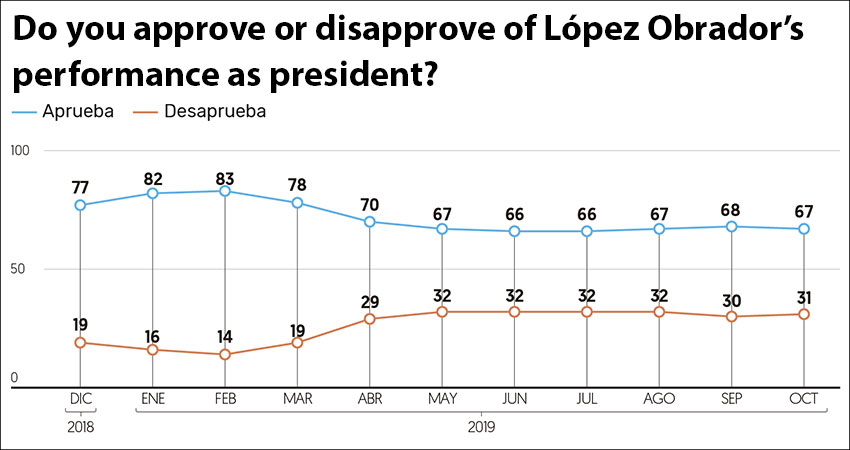
Fear and uncertainty about the policy agenda of President López Obrador are paralyzing investment, according to high-ranking business executives who spoke to the news agency Bloomberg.

A report published today said that about half a dozen executives who met with Bloomberg in Mexico City last week described navigating the president’s policies and abrupt pronouncements as a struggle.

The most common word that the executives used to describe López Obrador’s decision-making process on issues that affect them was “erratic,” Bloomberg said.

Speaking on the condition of anonymity, most expressed support for the government’s implementation of austerity measures and its crusade against corruption – many said that the scourge spiraled out of control during Enrique Peña Nieto’s presidency – but rejected the decisions to cancel the Texcoco airport project, freeze new energy auctions and take legal action that seeks to annul clauses in natural gas pipelines.

Amid uncertainty about what the president might do next, the executives said they closely watch López Obrador’s daily press conferences for clues.

In that context, no one is investing, they said. Many of the executives said they see the beginning of a downward economic trend for Mexico although their views differed about how steep the slope will be.

In any case, the situation raises a range of questions, Bloomberg said: “Invest now? Wait to invest? Simply keep the business on autopilot or consider selling assets? Put resources toward other countries?”

Gross fixed investment in Mexico fell 7.4 percent in May, the worst monthly performance in more than two years, while the economy only narrowly avoided entering a technical recession by recording 0.1 percent growth between April and June after a 0.2 percent contraction in the first quarter.

Although López Obrador has clung to his forecast of 2 percent growth in 2019, his own government predicts an expansion of just 1.1 percent.

The International Monetary Fund slashed its growth outlook for the Mexican economy to 0.9 percent from 1.6 percent last month while the Bank of America and Citibanamex cut their forecasts to just 0.5 percent and 0.2 percent, respectively.

Bloomberg said that the “mix of AMLO’s austerity drive and the uncertainty among business leaders” is taking a heavy toll on the economy.

The news agency noted that while the president is curtailing government spending in many areas, he has allocated significant funding to Pemex, the beleaguered state oil company.

It questioned the logic of building a new oil refinery on the Tabasco coast when existing refineries are operating at or below 30 percent capacity.

Considering the president’s track record on canceling and challenging investment projects, Bloomberg said the business community is waiting for “a sign – any sign” that López Obrador can generate an economic and legal environment in which investors have the confidence they need to make decisions.

The news agency noted that the president told its editor-in-chief John Micklethwait in an interview last week that he respects contracts and the need for foreign investment but added that “for the executives, actions speak louder than words.”

Source: Bloomberg (en).


Mexico considers legal action against US after 8 Mexicans die in El Paso

Mexico could obtain access to evidence revealed by the investigation and prosecute the shooter


Mexico is looking into taking legal action against the United States over the murder of eight Mexican citizens in a mass shooting in El Paso, Texas, on Saturday.

Foreign Affairs Secretary Marcelo Ebrard told a press conference Sunday that Mexico is considering the mass shooting an act of terrorism against the Mexican-American community and against Mexicans in the United States, and that the attorney general is exploring legal action that would rule the shooting as such.

Designating the attack as an act of anti-Mexican terrorism would give Mexico access to all the evidence that comes out of the investigation into Saturday’s shooting. Ebrard said that such a designation would be the first of its kind.

“There will be legal action against whoever ends up being responsible for the sale of the assault weapons to the person responsible, and whoever pulled the trigger,” said Ebrard. “We are going to request access to the investigation to find out how the weapon was sold and how it got into his hands.”

A total of 22 people were killed in the shooting, which took place at a Walmart in the Cielo Vista shopping center in El Paso. The shooter has been identified as 21-year-old Patrick Crusius, of Allen, Texas.

Authorities say Crusius is the author of a 2,300-word “manifesto” posted to the message board 8chan before the attack, which speaks of an “invasion” of Mexican and Latino immigrants into the United States.

Ebrard added that Mexico will send a diplomatic note to the United States asking it to “take a clear position against hate crimes,” and that Mexico will consider requesting that Crusius be extradited to Mexico to face charges for the murders of Mexican citizens.

“Mexico considers this individual to be a terrorist,” he said.

Ebrard was scheduled to travel to El Paso on Monday where he was to meet with Mexican consuls from around the United States.

Source: El Universal (sp), CNN (en).

spot_img

Farmworkers rise up against labor exploitation

BELLINGHAM, WA - 4AUGUST19 - Farm workers and their supporters march to protest the H2-A guestworker program and the death of Honesto Silva, on the anniversary of his death twho years earlier. They also protested recent federal regulations making it more difficult to protect the rights of H-2A and resident farm workers. The march was organized by Community2Community and the new union for Washington farm workers, Familias Unidas por la Justicia. Copyright David Bacon

by David Bacon


Washington State today is ground zero in the effort to hold back the massive use of agricultural guest workers by U.S. growers, and to ensure that farmworkers, both those living here and those coming under the H-2A visa program, have their rights respected. For a second year, on Aug. 4 workers and their supporters marched 14 miles in 90-degree heat through berry fields just below the Canadian border, protesting what they charge is widespread abuse of agricultural labor.

“Farmworker families have been living and working in local fields since the early 1950s,” according to Rosalinda Guillén, director of Community to Community, a farm worker organizing and advocacy group in Whatcom County. “But we’ve seen a big increase in growers’ use of the H-2A guest worker program in the last few years, and it’s had a huge impact on working conditions in the fields. We’ve had to feed guest workers who come to us hungry, fight to get them paid their wages, and help them deal with extreme work requirements. At the same time, our local workers find they’re not being hired for jobs they’ve done for many seasons.”

At dawn on Aug. 4, 200 marchers gathered in front of the immigration detention center in Ferndale, about three hours north of Seattle. Before starting the 14-mile peregrination, Guillen told the crowd that most of the immigrants detained there, and later deported, are farmworkers. “The Trump administration is targeting our local community, deporting people who have been living here for years,” she charged. “Then growers complain there aren’t enough workers, and begin using the H-2A program to bring in guest workers. It is a vicious revolving door of exploitation.”

According to the U.S. Department of Labor’s National Agricultural Workers Survey, there are about 2.5 million farmworkers in the U.S., about three quarters of whom were born outside the country. Half are undocumented and the rest are visa holders or people born in the U.S.

Last year growers were certified to bring in 242,762 H-2A workers – a tenth of the total workforce and a number that in just four years has increased from 139,832.

In 2017, Washington State growers were given H-2A visas for 18,796 workers, about 12,000 of whom were recruited by WAFLA (formerly the Washington Farm Labor Association, a H-2A labor contractor). “We predict growers will request more than 30,000 H-2A workers during 2019,” according to Washington Employment Security Department Commissioner Suzi LeVine.

The department estimated that 97,068 farm workers were employed in Washington State in 2016, so the projected number of H-2A workers would be a third of the entire workforce.

At the same time as H-2A employment is rising, deportations are increasing. The Trump administration deported 256,000 people in 2018, just slightly more than the number of people brought to the U.S. under H-2A visas. Local deportations are increasing as well in Washington. In August last year 16 people were arrested and held at the Ferndale center. Half were deported immediately, and others were charged bail as high as $18,000 to be released pending hearings. A month earlier 19 others had also been arrested for deportation.

Stories are common, according to C2C, of people stopped for traffic violations, and then held for detention by immigration authorities. In 2017, Gov. Jay Inslee signed an executive order barring state agents from helping to enforce federal immigration laws in most cases, ordering them not to ask about immigration status. Nevertheless, immigration detention centers are scattered around the state, including one of the nation’s largest in Tacoma, three hours south of Whatcom County, where the GEO Group holds around 1,500 people.

Protesting Exploitation at Crystal View Raspberry Farm

After leaving the Ferndale detention center, people walked north for four hours, arriving at the Crystal View Raspberry Farm. There they stopped to hold an informal hearing to highlight the decision by the farm’s owners to bring in 80 guest workers for this year’s blueberry harvest.

Growers recruit H-2A workers every year from other countries, mainly Mexico. Companies using the H-2A program must apply to the U.S. Department of Labor, listing the work, living conditions and wages workers will receive. The company must provide transportation and housing. Workers are given contracts for less than one year, and must leave the country when their work is done. They can only work for the company that contracts them, and if they lose that job they must leave immediately.

The H-2A program has its roots in the notorious “bracero” program, which brought workers from Mexico in extremely exploitative conditions starting in 1942. At its height in 1954 about 450,000 workers were brought in by growers, and in the same year over a million people were deported – the same “vicious revolving door” described by Guillen. Although the program was abolished in 1964, the H-2 visa on which it was based was never eliminated. In 1986 an organized farm labor importation program began again, and the H-2A visa was created. It has been growing ever since.

In August last year, about 60 Crystal View workers, brought from Mexico and Guatemala under H-2A visas, went on strike to protest the non-payment of their wages. They reached out to Community to Community (C2C) and Washington’s new farm worker union, Familias Unidas por la Justicia, looking for help. Workers told C2C organizer Edgar Franks they’d been threatened that if they didn’t work fast enough they’d be fired and sent back home. “They didn’t feel safe reaching out to anyone because of the threats,” he said. Workers were isolated because they lived on the farm property, miles from the nearest town, and had no cars or transportation of their own.

spot_img

The media have ignored pedophilia in the elite

It took a billionaire pedophile to die in jail for the mainstream media to finally report on elite child sex trafficking

by Matt Agoris

Adult and child sex trafficking is an unfortunate and horrifying reality that plagues countries around the world—including the United States. As TFTP has reported, people have been arrested attempting to purchase children as young as three-months-old to abuse them, including police officers. Even former child sex slaves have come forward to tell their stories and provide insight into the elite sickos who have the money and resources to deal in the lives of children. This has been ongoing for decades, yet the media and Americans alike, have largely ignored it, until now.

The arrest of Jeffery Epstein and his subsequent demise in the Metropolitan Correctional Center in New York has catapulted the massive problem of elite child sex trafficking into the limelight. Naturally, politicians on both sides — including the president — are attempting to use Epstein’s death for political advantage which has skewed the discourse. However, for the first time, Americans are actually talking about the problem of child sexual abuse among the elite, and this is healthy.

While some Americans are hearing Epstein’s name for the first time, TFTP has been reporting on his special treatment and ties to the elite for years. The child trafficking scandal doesn’t stop at the White House either, it crosses the pond and implicates the royal family too. Last year, a photo of the Queen’s son, Prince Andrew, surfaced as evidence during legal proceedings, showing him with his arm around one of the underage victims.

Epstein is a convicted child molester and sexually abused no less than 40 underage girls. Despite this fact, Alexander Acosta protected him while serving as a U.S. Attorney in Florida. After letting an admitted pedophile off with a wrist slap, instead of being fired, Acosta was then appointed to Trump’s labor secretary in 2017 before resigning last month amid the Epstein controversy.

Instead of going to prison for life, as he should’ve considering the evidence against him, Epstein only got 13 months and was allowed to stay in the Palm Beach County Jail in his own private cell where he was allowed to leave the prison six days a week for “work release”. Epstein was forced to register as a sex offender for life, but with his money and his connections he wasn’t too bothered—until last month.

Despite the left and the right pitting Epstein against their political foes, this pedophile was tied to all sides of the political spectrum.

Just in case you thought sex abuse was a partisan thing, here’s a picture of @POTUS with convicted child rapist and @BillClinton Lolita Express chauffer, Jeffrey Epstein. #ItsABigFuckingClubAndYouAreNotInIt pic.twitter.com/qpNxcdzT6W

— Matt Agorist (@MattAgorist) November 29, 2017

As a report in the Miami Herald noted:

The eccentric hedge fund manager, whose friends included former President Bill Clinton, Donald Trump and Prince Andrew, was also suspected of trafficking minor girls, often from overseas, for sex parties at his other homes in Manhattan, New Mexico and the Caribbean, FBI and court records show.

However, he was never held accountable until last month — only after his victims and dedicated reporters pushed for justice for nearly a decade.

Now, as a tornado of conspiracy theories over Epstein’s death continues to travel across the internet like wildfire, the media can no longer ignore the problem, nor Epstein’s connections.

Maybe now, as the DOJ investigates, the media may start to actually report on this massive problem. This is not the first time high profile figures have been arrested for sick crimes against children and let off with a wrist slap, but it is the first time the media is giving it so much attention—because this sicko is now dead.

As TFTP reported, in April of 2016, Dennis Hastert, former Speaker of the House under Clinton and Bush — and admitted child rapist — was sentenced to 15 months in prison after he was caught paying his victims to keep quiet. However, he was released in 2017 — two months before finishing his already insultingly lenient sentence.

Hastert was sentenced, not for raping children, but for illegally structuring bank transactions in an effort to cover up his sexual abuse of young boys.

Just like Epstein, Hastert was an admitted serial child rapist, yet because he is a well-connected politician and former Speaker of the House, this vile man’s victims received no justice. In fact, Hastert attempted to sue his victims for speaking out after he paid them to stay silent about their abuse.

As TFTP has reported, Washington D.C. not only protects sex abusers but they use your tax dollars to silence their victims. Sadly, most people ignore at least half of all the abuse because blowhards in the media try to turn sex abuse into a partisan issue. Those on the left ignore the crimes of their party, just like those on the right claim sex abuse is a liberal issue. But as we’ve shown, there is no difference between a blue child rapist and a red one.

As the Free Thought Project has previously reported, the problem of child sex trafficking goes all the way to the top in the UK as well. Sir Edward Heath, the former Prime Minister of the United Kingdom was found by the police chief to be a pedophile. Just like what happens in the US, his vile crimes against children were allegedly ‘covered up by the establishment.’

Unfortunately, pedophilia and human trafficking is all too common among those in power. Sadly, however, those who attempt to draw attention to this problem are labeled as conspiracy nuts or perpetrators of fake news. Hopefully, as the truth comes out in regard to Jeffrey Epstein, the establishment will have a harder time protecting society’s worst.

spot_img

Learn to improvise with different styles of music!

Free music instruction at City College of San Francisco

Compiled by the El Reportero’s staff

All Instruments & Vocalists Are Welcome!!

Free tuition for students who are S.F. Residents. Register Now!! http://www.ccsf.edu.

Register Now! Jazz Band / Stage Band!

MUSIC 46, CRN# 76947, Section 501. Tuesdays 7-10 P.M. (3 units). Instructor David Hardiman, Jr. 1st Class Meets Tuesday, Sept. 3, 2019. CCSF Creative Arts Building, Room A132, (510) 407-6915. Instructor David Hardiman Jr. Off, (415) 239-3640. http://www.ccsf.edu.

Salsa in the Mission with Emilio Pérez and his New Caní band

Come and celebrate summer time with salsa, Latin jazz and tropical music for the soul on the dance floor, with Grupo New Caní. In the congas Emilio Pérez, in timbales Tito Thumas and his aunt Patricia Thumas on the piano.

At Cavas-22 Restaurant. Full bar and Mexican and International food, 22nd Street @ Bartlett – across the street from Café Revolution. Fridays and Saturdays, from 8 to 11:30 p.m.

Sounds of the Shores 2019

Redwood City takes its summer music out to Redwood Shores for 3 Sundays throughout the summer. Marlin Park is located on the lagoons of Redwood Shores and provides a picturesque setting for live music. There will also be food concessions available.

The Cocktail Monkeys will perform their unique blend of rock, pop and R&B live during the event, which takes place 5 p.m. to 7 p.m. Come hear and dance to some of your favorite songs by your favorite bands, paired with treats from this month’s food truck, Casablanca.

Sunday, Aug. 18, 2019, from 5 -7 p.m., at Marlin Park (corner of Neptune & Cringle), Redwood City.

Cuban Timba Pioneer! ¡Fiesta Cubana! Issac Delgado: Album Release Party

Replacing ¡CUBANISMO!

This album release celebration will be an explosive salsa dance event that Miner Auditorium will barely be able to contain.

One of Cuba’s most famous stars and a respected musical innovator, GRAMMY-nominated vocalist Issac Delgado returns to SFJAZZ for the first time in nearly a decade with the U.S. premiere of material from his new Tropix Music release.

Lluvia Y Fuego (Rain and Fire) brilliantly showcases the effect of his return to his homeland and a re-investment in traditional song forms. The recording features lushly arranged original compositions and tributes to timeless Cuban sonero Benny Moré and Puerto Rican salsa king Cheo Feliciano.

A dazzling live performer who was mentored by legendary Cuban jazz pianist Gonzalo Rubalcaba, Delgado helped pioneer the timba style (Havana’s tough, funky take on salsa) as lead singer of the wildly influential group NG La Banda in the late 1980s. Restlessly inventive, he has continually rewritten the rules of Caribbean dance music, constantly playing with time and tempo, employing jazz-inspired passages and mixing in cutting edge rhythms and avant-garde electronics. He defected to the U.S. for over a decade in the late 2000s, but recently returned to Havana where his fame has only grown more fervent over the years.

Through Aug 18th, 2019, at Miner Auditorium, SF Jazz center, SF.

Please note: Dance floor is General Admission standing room only. If you would prefer seats, please select a different level for this show.

Détente – Oakland Premiere

Détente investigates displacement, the words meaning, and impact. Through dance, video, and story, performers experiment with the act or process of displacing, and what it means to be removed from home.

The Oakland premiere includes a special film screening of the documentary, Alice Street, and a post-show discussion on gentrification and housing rights with organization Causa Justa: Just Cause.

Dance Show Alert!! Premiere in Oakland! Choreography by Cherie Hill. Featuring Rose Rothfeder and Andreina Maldonado

On Thursday, Aug. 22 & Saturday Aug. 24, 8 p.m., at Temescal Arts Center, 511 48th St., Oakland. Cover $10-20 Sliding Scale (no one turned away for lack of funds)

Tickets: https://detente-oakland.brownpapertickets.com/ More info: http://www.iriedance.com/deacutetente.html


spot_img

UnidosUS awards MEDA as member of the year for its work in the Latino community

by Aracely M. Ortega

The Economic Development Agency of the Mission (MEDA), based in the Mission District neighborhood in San Francisco, was awarded the “Affiliate of the Year” award granted by the national organization UnidosUS, formerly called National Council of La Raza ( NCLR) for its work to give Latinos tools and information to achieve the American dream and obtain financial stability.

The award was presented to MEDA on Aug. 5 during the 2019 Annual Conference held in San Diego for its commitment to achieve a significant change for the Latino community. The “Affiliate of the Year” award is the greatest honor given to a UnitedUS affiliate.

“UnidosUS has been very fortunate to have MEDA as part of our network of talented affiliates who face critical issues and improve lives,” UnitedUS President Janet Murguía said.

“We are honoring MEDA for its strong passion to help working Latino families gain greater financial security and achieve the American dream,” he said.

Because many families face economic challenges and displacements, MEDA’s approach is through building resistance and prosperity in one of the most expensive cities in the nation.

MEDA works to strengthen the financial well-being of Latino families of moderate and low income by promoting economic equity and social justice through the creation of assets and economic development in the San Francisco Bay area.

It offers almost all its services at no cost, and its strategies focus on accessible housing, small businesses, access to capital and education. It serves 7,300 people every year.

“MEDA is honored to be selected as a United States affiliate of the year 2019,” said Luis Granados, executive director of MEDA.

He said his diligent work team works daily to strengthen immigrant and low-income families. In addition they are now sharing their model nationwide.

“This work is inspired by the power of the collective and individual experience of our Latino community,” he said.

He added that MEDA is very proud to be part of the 269 organizations that make up the UnidosUS affiliate network by working collaboratively towards a common goal of building equity through the power, name and wealth of Latinos.

MEDA works with UnidosUS as a digital innovation program fellow to scale the impact of MEDA’s Viva! a financial capacity toolkit for an online platform.

This will offer an interactive tool for instructors, clients and communities that allows them to work together on family development and wealth building plans.

MEDA works with five UnitedUS affiliates to build financial capacity programs using the MEDA’s Viva! for community development.

Meda was born in 1973 to serve small businesses. According to Luis Granados, they are also currently working on the development of accessible housing, access to capital and political commitment for immigrant families or children of immigrants. The goal for 2020 is to prevent and reverse the displacement of families. In recent years, 8,000 Latinos have been forced to leave their homes in the Mission neighborhood, 25 percent of the community.

The Affiliate of the Year award was made possible by the generous collaboration of the Ford Motor Company Fund, a longtime ally of UnitedUS in its commitment to advance the interests of the Latino community.

The Ford Motor Company Fund is the philanthropic arm of the Ford Automotive Company.

“The Ford Fund congratulates MEDA’s impressive work to empower Latino families in their excellent economic development programs,” said Joel Avila, community development manager in the United States and Latin America of the Ford Automotive Company Fund.

“It is very stimulating to continue our collaboration of more than 25 years with UnidosUS to strengthen communities throughout the country,” he said.

In addition to rewarding MEDA with $25,000 in cash, UnidosUS also recognized regional beneficiaries of its affiliate network. Each of the winners was given $5,000 in cash at the lunch of the National Conference for Affiliates.

Other organizations that were awarded are: Esperanza, Inc. of Cleveland, Ohio as the Midwest affiliate; Affiliate of the Far West Latino Network of Portland, Oregon; Northeast affiliate: Puerto Rican Association in March, Inc. (APM) of Philadelphia; Southeast affiliate: East Coast Migrant Head Start Project of Raleigh of Northern California; The Texas Affiliate, Your Family Clinic.

The UnitedUS affiliate network consists of almost 300 community organizations that provide a variety of key services and resources to millions of Latinos throughout the country.

The Annual Conference of UnidosUS is a central meeting place for affiliates, and that includes thousands of people representing community organizations, non-profit organizations, government, corporations and academic institutions.

UnidosUS, formerly NCLR, is the largest Hispanic defense and civil rights organization in the nation. With the joint work of researchers, leaders, programs and its network of affiliates throughout the United States and Puerto Rico, for more than 50 years, UnitedUS has challenged the social, economic and social barriers that affect Latinos at national and local levels.

spot_img

México necesita 123 mil médicos; las escuelas no están entrenando lo suficiente: AMLO

El presidente dijo que el nuevo servicio de salud trabajará con las universidades para capacitar más

por Mexico News Daily

El presidente López Obrador dice que México necesita 123,000 médicos más para cubrir las necesidades del país.
“Hay 270,600 médicos generales en el país, y de acuerdo con las normas internacionales, deberíamos tener 393,600 médicos”, dijo durante una visita a un hospital rural en Michoacán el sábado. “Eso significa que somos 123,000 médicos cortos”.
Según la Organización para la Cooperación y el Desarrollo Económicos (OCDE), un país debe tener un médico por cada 333 residentes. Según una estimación del Banco Mundial para 2017, México cuenta con un solo médico por cada 477 personas.
El presidente agregó que la escasez de médicos está relacionada con las bajas tasas de ingreso en las universidades para los programas de medicina.
“Es por eso que hay una escasez”, dijo. “Necesitamos más médicos generales, necesitamos más especialistas”.
Dijo que 13,000 personas solicitaron su admisión en la facultad de medicina de la Universidad Nacional Autónoma, pero solo 216 fueron aceptadas. La elección de carrera más popular entre los futuros estudiantes es la de un cirujano. En febrero, dijo López Obrador, había 11,198 solicitantes para 140 lugares.
Dijo que el nuevo Instituto Nacional de Salud para el Bienestar trabajará con las universidades para capacitar a más médicos.
El instituto, que aún no ha sido aprobado por el Congreso, operará con un presupuesto de 80 mil millones de pesos (US $4.2 mil millones) y reemplazará al Seguro Popular, que ofrece servicios médicos a personas que no están cubiertas por la seguridad social.
Fuente: Notimex (sp), W Radio (sp).

Algunos inversores extranjeros nerviosos se están retirando, ven mayor riesgo en México
Han estado vendiendo títulos públicos desde febrero

Los tenedores extranjeros de valores gubernamentales han comenzado a retirar sus inversiones debido a la disminución de la confianza en el gobierno federal y la economía mexicana, y la expectativa de que el Banco de México recortará las tasas de interés.
Las estadísticas del banco central muestran que el valor de los bonos del gobierno y los certificados del tesoro federal en manos de los inversionistas extranjeros fue de 2.11 billones de pesos (US $111 mil millones) el 9 de julio, la cantidad más baja desde el 14 de diciembre.
Desde el 8 de febrero, cuando el valor de la deuda pública en manos extranjeras alcanzó un nivel récord, los inversionistas descargaron valores por un valor de 162 mil millones de pesos (US $ 8.5 mil millones), informó el periódico El Universal.
La inversión extranjera en certificados de tesorería, que son más fáciles de cobrar, ha disminuido a su nivel más bajo desde marzo de 2018.
“Los inversores ya están empezando a ponerse nerviosos y, si bien perciben un mayor riesgo, es posible que veamos más ventas de valores del gobierno y que la tasa de interés de los bonos suba”, dijo Ernesto O’Farrill, gerente general de Bursamétrica, una firma de corretaje de la Ciudad de México.
A pesar de decisiones como la cancelación del nuevo aeropuerto de la Ciudad de México, el gobierno federal generó confianza entre los inversionistas durante sus primeros meses en el cargo luego de presentar un presupuesto para 2019 que fue descrito como fiscalmente prudente y realista por muchos analistas.
La primera venta masiva de valores emitidos por el gobierno por parte de la administración de López Obrador a mediados de enero generó un fuerte interés de los inversores.
Más de 300 inversionistas institucionales de las Américas, Europa, Asia y Medio Oriente participaron en la subasta y la demanda para comprar valores excedió la oferta por cuatro.
Pero la confianza de los inversionistas ha disminuido debido a las bajas en la calificación soberana de México y la de Pemex, y la posibilidad de que haya más recortes en las calificaciones.
“Los inversionistas anticipan los ajustes de las agencias calificadoras y deducen que Moody’s eliminará el grado de inversión de Pemex en los próximos meses como lo hizo Fitch a principios del mes pasado”, dijo O’Farrill.
Predijo que las agencias también rebajarán la calificación soberana de México pero no por debajo del grado de inversión. Fitch redujo su calificación soberana para México a una muesca por encima del estado de chatarra el mes pasado, pero si él y otras agencias de calificación bajaran, se produciría una enorme venta masiva de bonos del gobierno.
“El noventa y cinco por ciento de los inversionistas están en valores del gobierno porque México tiene un grado de inversión”, dijo Oarrill.
Otros factores que han puesto nerviosos a los inversionistas son los recortes generalizados a los pronósticos de crecimiento para la economía mexicana y la renuncia de Carlos Urzúa la semana pasada como secretario de finanzas.
El Universal informó que los inversionistas ahora ven inestabilidad en la implementación de políticas públicas y han respondido retirando sus inversiones en valores gubernamentales. El retroceso podría acelerarse a medida que el Banco de México se acerque más al recorte de las tasas de interés, que muchos analistas creen que ocurrirá en agosto o septiembre.
Otro factor que pesa en la mente de algunos inversionistas es la decisión de la Comisión Federal de Electricidad (CFE, por sus siglas en inglés) de buscar un arbitraje internacional destinado a anular cláusulas en siete contratos de ductos.
Uno de los contratos que el servicio público está tratando de renegociar es el del gasoducto Texas-Tuxpan, que fue construido conjuntamente por la compañía canadiense TC Energy (anteriormente TransCanada).
El embajador de Canadá, Pierre Alarie, se pronunció en contra de la decisión de la CFE, mientras que el jefe de misión adjunto de la embajada dijo que la acción legal ha generado preocupación entre los inversionistas canadienses.
“La verdad es que desde las acciones de la CFE, recibo llamadas todos los días con respecto a la señal que México está enviando a los inversionistas canadienses. Piden nuestro consejo para saber si México aún quiere más inversión y qué hacer con su inversión actual y futura. Sí, son acciones que causan preocupación “, dijo Jean-Dominique Leraci.
Fuente: El Universal (sp), Milenio (sp).

spot_img

Mexico short 123,000 doctors; schools not training enough: AMLO

The president said new health service will work with universities to train more

by Mexico News Daily

<p>President López Obrador says Mexico needs 123,000 more doctors to cover the country’s needs.
“There are 270,600 general practitioners in the country, and according to international norms, we should have 393,600 doctors,” he said during a visit to a rural hospital in Michoacán on Saturday. “That means we’re 123,000 doctors short.”
According to the Organization for Economic Co-operation and Development (OECD), a country should have one doctor for every 333 residents. Based on a 2017 World Bank estimate, Mexico has only one doctor for every 477 people.
The president added that the shortage of doctors is related to low admission rates at universities for medicine programs.
“That’s why there’s a shortage,” he said. “We need more general practitioners, we need more specialists.”
He said 13,000 people applied for admission to the faculty of medicine at the National Autonomous University, but only 216 were accepted. The most popular career choice among prospective students is that of a surgeon. In February, López Obrador said, there were 11,198 applicants for 140 places.
He said the new National Institute of Health for Well-Being will work with universities to train more doctors.
The institute, which has not yet been approved by Congress, will operate with a budget of 80 billion pesos (US $4.2 billion) and replace the Seguro Popular, offering medical services to people who are not covered by social security.
Source: Notimex (sp), W Radio (sp)

Nervous foreign investors are pulling back, see higher risk in Mexico
They have been selling off government securities since February

Foreign holders of government securities have begun withdrawing their investments due to declining confidence in the federal government and the Mexican economy, and the expectation that the Bank of México will cut interest rates.
Statistics from the central bank show that the value of government bonds and federal treasury certificates in the hands of foreign investors was 2.11 trillion pesos (US $111 billion) on July 9, the lowest amount since December 14.
Since February 8 – when the value of government debt in foreign hands hit a record high – investors have offloaded securities worth 162 billion pesos (US $8.5 billion), the newspaper El Universal reported.
Foreign investment in treasury certificates, which are easier to cash in, has declined to its lowest level since March 2018.
“Investors are already starting to get nervous and while they perceive greater risk, we may see more sales of government securities and the interest rate for bonds may go up,” said Ernesto O’Farrill, general manager of Bursamétrica, a Mexico City brokerage firm.
Despite decisions such as the cancelation of the new Mexico City airport, the federal government generated confidence among investors during its first months in office after presenting a 2019 budget that was described as fiscally prudent and realistic by many analysts.
The first sell-off of government issued securities by the López Obrador administration in the middle of January garnered strong interest from investors.
More than 300 institutional investors from the Americas, Europe, Asia and the Middle East participated in the auction and demand to purchase securities exceeded supply fourfold.
But investor confidence has waned on the back of downgrades to Mexico’s sovereign rating and that of Pemex, and the possibility that more ratings cuts are still to come.
“Investors are anticipating rating agencies’ adjustments and they deduce that Moody’s will strip Pemex’s investment grade in coming months like Fitch did at the start of last month,” O’Farrill said.
He predicted that agencies will also downgrade Mexico’s sovereign rating but not below investment grade. Fitch cut its sovereign rating for Mexico to one notch above junk status last month but if it, and other rating agencies went lower, a huge sell-off of government bonds would occur.
“Ninety-five per cent of investors are in government securities because Mexico has investment grade,” O’Farrill said.
Other factors that have made investors nervous are the widespread cuts to growth forecasts for the Mexican economy and Carlos Urzúa’s resignation last week as finance secretary.
El Universal reported that investors now see instability in the implementation of public policy and have responded by withdrawing their investments in government securities. The pullback could hasten as the Bank of México draws closer to cutting interest rates, which many analysts believe will happen in August or September.
Yet another factor weighing on some investors’ minds is the decision by the Federal Electricity Commission (CFE) to seek international arbitration aimed at annulling clauses in seven pipeline contracts.
One of the contracts the utility is seeking to renegotiate is for the Texas-Tuxpan gas pipeline, which was jointly built by the Canadian company TC Energy (formerly TransCanada).
Canadian ambassador Pierre Alarie spoke out against the CFE’s move, while the embassy’s deputy head of mission said that the legal action has triggered concern among Canadian investors.
“The truth is that since the actions of the CFE, I receive calls every day with regard to the signal that Mexico is sending to Canadian investors. They ask for our advice in order to know if Mexico still wants more investment and what to do with their current and upcoming investment. Yes, they’re actions that cause concern,” Jean-Dominique Leraci said.
Source: El Universal (sp), Milenio (sp).</p>

spot_img

They reward MEDA as a member of the year of UnidosUS for their work in the community

by Aracely M. Ortega

The Economic Development Agency of the Mission (MEDA), based in the Mission District neighborhood in San Francisco, was awarded the “Affiliate of the Year” award granted by the national organization UnidosUS, formerly called National Council of La Raza ( NCLR) for its work to give Latinos tools and information to achieve the American dream and obtain financial stability.

The award was presented to MEDA on Aug. 5 during the 2019 Annual Conference held in San Diego for its commitment to achieve a significant change for the Latino community. The “Affiliate of the Year” award is the greatest honor given to a UnitedUS affiliate.

“UnidosUS has been very fortunate to have MEDA as part of our network of talented affiliates who face critical issues and improve lives,” UnitedUS President Janet Murguía said.

“We are honoring MEDA for its strong passion to help working Latino families gain greater financial security and achieve the American dream,” he said.

Because many families face economic challenges and displacements, MEDA’s approach is through building resistance and prosperity in one of the most expensive cities in the nation.

MEDA works to strengthen the financial well-being of Latino families of moderate and low income by promoting economic equity and social justice through the creation of assets and economic development in the San Francisco Bay area.

It offers almost all its services at no cost, and its strategies focus on accessible housing, small businesses, access to capital and education. It serves 7,300 people every year.

“MEDA is honored to be selected as a United States affiliate of the year 2019,” said Luis Granados, executive director of MEDA.

He said his diligent work team works daily to strengthen immigrant and low-income families. In addition they are now sharing their model nationwide.

“This work is inspired by the power of the collective and individual experience of our Latino community,” he said.

He added that MEDA is very proud to be part of the 269 organizations that make up the UnidosUS affiliate network by working collaboratively towards a common goal of building equity through the power, name and wealth of Latinos.

MEDA works with UnidosUS as a digital innovation program fellow to scale the impact of MEDA’s Viva! a financial capacity toolkit for an online platform.

This will offer an interactive tool for instructors, clients and communities that allows them to work together on family development and wealth building plans.

MEDA works with five UnitedUS affiliates to build financial capacity programs using the MEDA’s Viva! for community development.

Meda was born in 1973 to serve small businesses. According to Luis Granados, they are also currently working on the development of accessible housing, access to capital and political commitment for immigrant families or children of immigrants. The goal for 2020 is to prevent and reverse the displacement of families. In recent years, 8,000 Latinos have been forced to leave their homes in the Mission neighborhood, 25 percent of the community.

The Affiliate of the Year award was made possible by the generous collaboration of the Ford Motor Company Fund, a longtime ally of UnitedUS in its commitment to advance the interests of the Latino community.

The Ford Motor Company Fund is the philanthropic arm of the Ford Automotive Company.

“The Ford Fund congratulates MEDA’s impressive work to empower Latino families in their excellent economic development programs,” said Joel Avila, community development manager in the United States and Latin America of the Ford Automotive Company Fund.

“It is very stimulating to continue our collaboration of more than 25 years with UnidosUS to strengthen communities throughout the country,” he said.

In addition to rewarding MEDA with $25,000 in cash, UnidosUS also recognized regional beneficiaries of its affiliate network. Each of the winners was given $5,000 in cash at the lunch of the National Conference for Affiliates.

Other organizations that were awarded are: Esperanza, Inc. of Cleveland, Ohio as the Midwest affiliate; Affiliate of the Far West Latino Network of Portland, Oregon; Northeast affiliate: Puerto Rican Association in March, Inc. (APM) of Philadelphia; Southeast affiliate: East Coast Migrant Head Start Project of Raleigh of Northern California; The Texas Affiliate, Your Family Clinic.

The UnitedUS affiliate network consists of almost 300 community organizations that provide a variety of key services and resources to millions of Latinos throughout the country.

The Annual Conference of UnidosUS is a central meeting place for affiliates, and that includes thousands of people representing community organizations, non-profit organizations, government, corporations and academic institutions.

UnidosUS, formerly NCLR, is the largest Hispanic defense and civil rights organization in the nation. With the joint work of researchers, leaders, programs and its network of affiliates throughout the United States and Puerto Rico, for more than 50 years, UnitedUS has challenged the social, economic and social barriers that affect Latinos at national and local levels.

spot_img

Information overload is a weapon of control

by James Corbett

Do you feel confused? Listless? Overwhelmed? Have you ever found yourself scrolling through news feeds and flicking mindlessly through social media posts with a strange mixture of outrage, dread, and boredom? Is your disgust at the thought of going online consistently overwhelmed by your compulsion to pick up your fondleslab?

Don’t worry. You’re not alone. More and more people are finding it harder and harder to put their devices down even though it leaves them feeling restless, angry or empty. As a result, some are seeking ways to disconnect and unplug from the 24/7 siren song of never-ending news feeds, instant messaging and social media distractions, whether by ditching their smartphone in favor of a “dumb” phone or taking device-free holidays.

Yes, we all succumb to information overload, and yes, we all need a break from the online maelstrom every now and then.

But what if this state of information overload—the malaise we experience when we find ourselves paralyzed by a ceaseless stream of noise and nonsense—is not a mere byproduct of this vaunted “Information Age” but the actual point of it? Has it ever occurred to you that these devices have been weaponized against us? Or that the confusion and exhaustion we feel after spending an hour mindlessly scrolling on our smartphone is the effect that this weaponized technology has on our psyche?

And, more to the point, what can we do to protect ourselves from these daggers of digital distraction?

First, let’s examine the problem.

Suppose you start your day by checking your friends’ social media profiles. The stream of dream vacation pictures and posts about happy relationships and fun parties leaves you feeling miserable as you head out the door for work.

Later that morning you take a break from your desk job (entering information on a computer, of course) to check the news. Clickbait nonsense battles with atrocity porn for your attention in the news feed. You finally find something interesting and informative only to scroll down to the comment section and find it populated by trolls bent on starting flame wars and disinformation operatives deploying every trick in the book to derail thoughtful conversation.

Closing the browser window you get back to work and discover an angry email from your boss in your inbox reminding you that your latest report was due yesterday and several messages from your coworkers asking for your help with their own projects.

Running to the one place you know you can get away from it all—the washroom—you lock the stall door . . . only to feel a buzzing in your pocket. You got a new message on Facebook! You pull your phone out of your pocket and start the whole process over again.

The worst part is that you know that this constant flow of information is making you miserable, but you can’t help yourself. It’s harder and harder to leave the phone at home when you go out to the store or turn the TV off when you’re eating dinner. You’ve become a slave to the technology that once promised to free you.

Now this may not be a description of your average day, but we all know people to whom this description applies. And if you use electronic devices on a daily basis, it’s getting harder and harder to deny that you’ve experienced the strange mixture of compulsion and depression that those devices bring.

This is not even controversial at this point. We hardly need a scientific study to tell us that social media is making us dumb, angry and addicted, but in case you missed it here’s a scientific study telling us that social media is making us dumb, angry and addicted. As you might expect, people who compare their mundane, humdrum existence to the idealized lives that people present online—fun parties, great food, perfect vacations, happy families—are more likely to develop depressive symptoms.

But it’s important to note that this state of affairs has not come about by accident. This technology has been weaponized against you. This is not conspiracy theory or conjecture; as I pointed out in my podcast on The Weaponization of Social Media, many of the founders of the social media giants don’t even use social media themselves and they actively keep it away from their children. If you haven’t seen it yet, watch Facebook co-founder Sean Parker admitting that they designed their product to keep you addicted by exploiting vulnerabilities in human psychology.

When you realize that all aspects of our online experience—like the red badges and phone buzzers that alert us to new social media notifications—have been precisely fine-tuned to keep you clicking indefinitely, you can at least appreciate that it is not merely a matter of weak will that has led you to this spot.

It is also important to realize that this is not merely a ploy to earn more advertising revenue for the big internet companies. It does do that, of course, but this addiction to (and, ultimately, enslavement to) the very source of our unhappiness if part of a much more insidious agenda. We are being groomed by the hucksters and charlatans of our era to accept the coming integration of man and machine. Or, worse yet, to embrace it.

Never mind that the Borg-like vision of the future propounded by these transhumanists is a nightmare beyond comprehension. Never mind that free will will be rendered meaningless in a world where we are nudged by devices along pre-determined paths. Never mind that privacy will be unthinkable when our every thought will be monitored and analyzed in real time. Never mind that dissent will be impossible when our ability to access the networks upon which our lives are built can be turned off at the flip of the switch. We’ll be able to surf the internet in our head! Where do I sign up?

If you think information overload is bad now, wait until you’re interacting with avatars of your friends in augmented reality while listening to music that only you can hear and ordering your Alexa to adjust the thermostat and order you a pizza for dinner.

So what do we do about this?

If this were just another clickbait listicle designed to give you some trite pieces of warm and fuzzy advice and keep you coming back for more, this is the point where I’d give you a few bullet points about setting a screen time limit on your phone or practicing mindful browsing (searching for something specific instead of scrolling and clicking aimlessly). These things are all well and good, as far as they go . . . but they don’t go far enough, do they?

Because if we really face up to the fact that these devices have been weaponized against us, and that they are leading us into a transhuman future, then we arrive pretty quickly at a conclusion that might put you into a cold sweat: Every time you pick up your device, every time you check that news feed, every time you scroll through your social media notifications, you are putting a loaded gun to your head.

Or, even worse, you are ingesting a little bit of poison. One or two doses won’t hurt. A thousand doses might make you sick, but you can probably handle it. The fatal dose might be the millionth. And if the poison is sweet enough, then, like any addict, you’ll convince yourself that it’s OK to keep taking it; after all, we’ll be able to quit before we get to that millionth hit, won’t we?

And what’s the alternative, anyway? Giving up on this tech altogether? Is that even possible?

These are not rhetorical questions. They are very real questions with answers that have very real consequences for our lives. And I’m not posing these questions from up in the clouds. I make my living online. My life right now revolves around the very information overload that I’m writing about. Will I know where to draw that line in the sand and stop using the tech before it becomes an implantable brain chip? Will you?

Feel free to tell me that I’m being overly dramatic and that there’s nothing to worry about here. But the next time you feel yourself reaching for your phone in a moment of silence or scrolling aimlessly through a news feed with a gnawing sense of emptiness in the pit of your stomach, take a moment to reflect on that sensation. And then see if you can put the phone down.

spot_img

CDMX, state authorities won’t comply with court order that tightens air quality standands

Meeting the standard won by Greenpeace would generate ‘economic and social stress’

by Mexico News Daily

Authorities in Mexico City and México state have announced that they won’t comply with a court order to issue an environmental warning when pollution exceeds 100 points on the air quality index because it would cause “economic and social stress.”
Greenpeace was granted a definitive injunction on Monday dictating that contingency measures must be activated when the Imeca index, which measures the quantity of fine particulate contaminants in the air, hits 101.
Under the Mexico City government’s environmental contingency program, a contingency is declared when the Imeca index reaches 150.
While Greenpeace’s stricter pollution standard was endorsed by a judge, the non-governmental organization explained that the ruling allows authorities not to declare a contingency at the lower pollution threshold if doing so would adversely affect the economy, education, public and private transportation and the public in general.
But Greenpeace said that prioritizing the economy over people’s health would be irresponsible, highlighting that 17,000 people per year die in the Mexico City metropolitan area from illnesses related to air pollution.
However, the Environmental Commission of the Megalopolis (CAMe) and the environment secretariats in both Mexico City and México state say that is exactly what they will do.
Had the stricter standard applied since January 1, an environmental contingency would have been declared on all but 19 days so far this year, said CAMe chief Víctor Hugo Páramo.
He explained that around 200 gas stations and 11 LP gas plants would be forced to close on any given day when a warning is in effect.
In addition, more than 2,000 factories would have to reduce their production by 40%, Páramo said.
The CAMe chief also said that declaring a contingency at a lower pollution threshold doesn’t reduce air contamination, adding that people’s health is already protected by the dissemination of information about the risks of exposure to smog.
Mexico City Environment Secretary Marina Robles pointed out that a lot of the measures in Greenpeace’s more stringent standards, such as recommendations not to smoke on high-pollution days and for certain segments of the population to avoid going outdoors, are also set out in the government’s contingency program.
Source: El Universal (sp), La Jornada (sp) 

Over 200 migrants found traveling in truck bearing Pepsi logos
The driver tried unsuccessful to bribe police to let them go

State and Federal Police officers detained 228 Central American migrants while they traveled through Chiapas hidden in a truck disguised with Pepsi logos.
Police gave chase on Highway 190 after the truck driver ignored officers’ requests to pull over. When authorities finally forced the truck to stop near Cintalapa, Chiapas, the driver and another man in the truck attempted to pay police an 80,000-peso bribe (US $4,176) to let them continue on their way.
Instead, police officers arrested the two and turned them over to the public prosecutor’s office.
Inside the truck authorities discovered 228 migrants, including many women and children and all from Central American countries. Police accompanied the migrants to the Cupapé migratory station in the city of Tuxtla Gutiérrez, where they received medical attention, food and water.
Both PepsiCo and Grupo GEPP, the corporation’s distributor in Mexico, firmly denied any involvement in the incident. They said that the truck’s prominent Pepsi logos were false.
“The unit detained by authorities does not belong to our distribution fleet, nor is it the property of any company belonging to the group, which means that [the logos] were falsified.”
The corporation added that neither the driver nor the passenger are Pepsi employees and that the company did not authorize the use of its logo.
Source: Infobae (sp)

Puerto Morelos residents worry that burning is precursor to development
One resident got up at four in the morning and the whole area was full of smoke

Residents of Puerto Morelos, Quintana Roo, have spoken out against the burning of forest land, which they believe is a precursor to a new real estate development.
Complaints about the fires on social media caught the attention of Sebastián Torres Perdigón, a researcher in the Faculty of Science at the National Autonomous University.
After traveling to Puerto Morelos to investigate, he told the newspaper Reforma that jungle located near the El Faro residential estate is being set on fire at night.
Firefighters arrive to battle the blazes but fires are set again the very next night, Torres said.
“For two weeks, residents have been complaining that smoke is coming out of the jungle . . . In that area, they’re building new real estate developments in the El Faro, Quinta Mareta and La Palma residential estates,” he said.
“The fires start at about eight at night and continue until two or three in the morning, which is when the smoke begins to be noticed in the residential areas,” Torres added.
He said that trees extending across approximately three kilometers of land have been cleared, a process that residents fear is designed to bring about a land-use change to permit further residential development.
The presence of boundary markers was further evidence, Perdigón said.
During a June 29 visit to the site, the researcher said he noticed that two species of protected trees – the chechem or black poisonwood and zapote or Mexican apple – have also been cut down.
Juan Pedro García Trujillo, a resident of the El Faro estate, told Reforma that the fires have very nearly encroached on his home.
“My house is right next to the jungle, it’s only separated by a wire fence so for us it’s very evident. At night, you notice the smell of smoke. One night I got up at four in the morning and the whole place was full of smoke. We went outside and the jungle was on fire,” he said.
“The next day we walked around the site and saw several hectares had already been cleared. There is a federal road [next to the jungle] where high-voltage electricity lines run and some parts [of the lines] were still burning.”
Karen Daniela Hernández said the constant fires are not only clearing trees but also causing the displacement of fauna.
She and other Puerto Morelos residents have called on the National Forestry Commission and the Secretariat of Agrarian and Urban Planning to take action to stop the fires and to implement an orderly urban expansion strategy.
Source: Reforma (sp).

spot_img