Sunday, October 11, 2026
spot_img
Home Blog Page 168

Will Governor Newsom sign two bills Will Governor Newsom sign two bills strengthening “guest worker” rights?

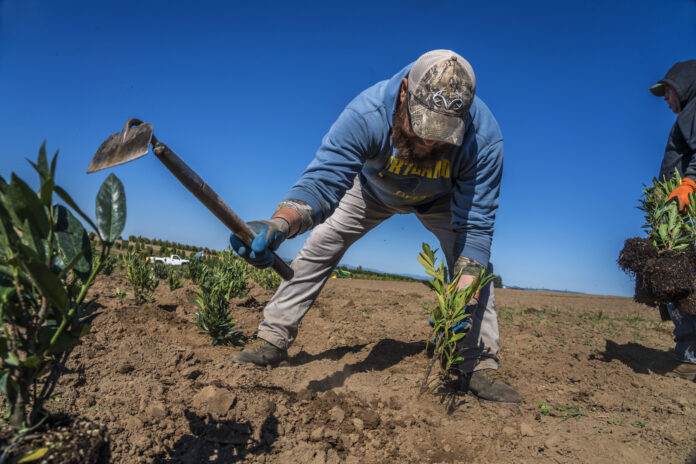
WOODBURN, OR - 1SEPTEMBER21 - Farmworkers brought to the U.S. in the H-2A visa program plant and weed ornamental shrubs early in the morning in a field near Woodburn, Oregon. They work for the nursery Advanced Ornamentals. Members of this crew include Alfonso Guevara. He works with a short-handled hoe, the "cortito," that has been banned in California because repeated use causes damage to the spine. Copyright David Bacon

by David Bacon

Alfonso Guevara, an H-2A worker, uses a short-handled hoe, the “cortito,” that has been banned in California because repeated use causes damage to the spine.  California’s agricultural wage order says:  “Weeding or thinning with short-handled hoes is prohibited when the hoe is used in a stooping, kneeling or squatting position.”  This photograph was taken in Oregon.  In California AB 857 would require his crew boss to give him a list of his rights, including the prohibition of this kind of work that can cause damage to the spine.

Two bills awaiting Gov. Gavin Newsom’s signature – or veto – would broaden protections for an estimated 300,000 foreign contract workers laboring in California on work visas. While the documented abusive conditions in “guest worker” visa programs have led to calls for their termination, these bills would offer some improvements to the workers involved.

AB 364, authored by Assemblymember Freddie Rodriguez (D-Pomona), seeks to regulate the recruitment of many workers brought to the U.S. under contract labor visas. AB 857, coauthored by State Assemblymember Ash Kalra (D-San Jose) and State Senator María Elena Durazo (D-Los Angeles), would give guest workers on H-2A visas (contract workers in agriculture) notification of their rights under state law, making it easier for them to go to the Labor Commissioner if those rights are violated.

“Congress has failed to act to protect workers who are recruited abroad through temporary work visa programs,” explains Daniel Costa, director of Immigration Law and Policy Research at the Economic Policy Institute. “The abuses of labor recruiters have included requiring the payment of illegal fees to obtain jobs, which can result in debt bondage, as well as cases of wage theft, discrimination, human trafficking and other abuses. But since these U.S. work arrangements are being set up abroad, it is difficult to regulate the behavior of recruiters.”

Protections that AB 364 would provide include a prohibition of recruitment fees by labor recruiters operating outside the U.S., and a requirement that they give workers a written contract specifying their wages and working conditions when they’re recruited. Because it’s difficult for workers to get paid for violations by a recruiter operating abroad, the recruiters would have to have a California address and post a bond.

Rodriguez’s legislation was written to expand state protection to work visa holders omitted in a previous bill, SB 477, signed by Gov. Jerry Brown in 2014. That law only applies to workers in one of the smallest visa categories, the H-2B visa program. They make up less than 1 percent of temporary work visa holders in California. H-2B workers are employed in jobs often called “low-skilled,” but not agriculture – primarily hotel and hospitality, meatpacking, domestic and home care, and landscaping jobs. ?Assemblymember Rodriguez’s AB 364 would cover all work visa holders – those on A-3, B-1, H-1B, H-1C, H-2A, H-2B, L-1, O-1, 1, P-3 and TN visas – except for students on J-1 visas who also work.

Nationally, the U.S. Department of Homeland Security estimates the number of temporary work visa holders is 1.6 million, while Costa believes it’s closer to 2 million. The DHS says about 300,000 work in California, a number they admit is not a direct count but an estimate. Costa estimates that AB 364 would cover at least 310,500 workers.

Farmworkers brought to the U.S. in the H-2A visa program harvest melons in July 2021 in a field near Firebaugh, California. At 9 in the morning, it was more than 95 degrees, and would soon surpass 110. It was the second day of work in the U.S. for the indigenous Cora workers from Nayarit, Mexico; they were not yet accustomed to the high temperatures. One worker fainted and got a nosebleed from the heat. They worked for the labor contractor Rancho Nuevo Harvesting in a field that belongs to the Fisher family, a large California grower.

Workers come to California to work in several basic industries or job categories. The H-2A visa program covers farmworkers. They can only stay for less than a year, and if they are fired by the contractor or grower who brought them, they must leave the country. Growers were certified to bring more than 317,000 H-2A workers to the U.S. in 2021, three times the number eight years earlier. Of these, 32,333 were brought to California. Three large California-based companies, Fresh Harvest, Foothill Packing and Rancho Nuevo Harvesting, accounted for 12,974 workers. One company alone, CSI Visa Processing (formerly Manpower of the Americas), says it recruits more than 25,000 workers from 12 offices in Mexico every year.

Some of the most egregious examples of recruitment abuse involve farmworkers on H-2A visas. One Texas grower, Larsen Farms, charged 100 Mexican workers as much as $1,500 each for a visa, and workers couldn’t leave the job until they’d paid their debt. In November 2021, the U.S. Attorney in Georgia filed a case against 24 growers and labor contractors for abusing H-2A workers. The complaint included two deaths, rape, kidnapping, threatening workers with guns, and growers selling workers to one another as though they were property.

While the federal government sets regulations and is responsible for enforcement, effective oversight hardly exists. According to the Cato Institute, the Department of Labor fined, on average, 2 percent of all employers from 2008 to 2018. Most fines averaged $237 for minor infractions, and the maximum fine was only $115,624. On average, fewer than 20 employers a year were suspended or banned from the program, an annual rate of 0.27 percent.

The annual cap for the recruitment of H-1B workers is set at 85,000 per year, and because these visa holders can stay in the country for multiple years, the total number of H-1B workers in the U.S. was 583,420 in 2019. Those workers are considered “high skilled,” some holding advanced degrees, and work in the technology industry, health care, and even as teachers in the school system. There is no annual cap on the L-1 visa, supposedly intended for transfers of people within a corporation into the U.S. from outside the country, and there are no education or skill requirements.

The record of abuse of people with these work visas is as extensive. According to a 2021 report from the Economic Policy Institute, “Thousands of skilled migrants with H-1B visas working as subcontractors at well-known corporations like Disney, FedEx, Google and others appear to have been underpaid by at least $95 million. Victims include not only the H-1B workers but also the U.S. workers who are either displaced or whose wages and working conditions degrade when employers are allowed to underpay skilled migrant workers with impunity.” The recruiters are large corporations. One, HCL Technologies, made $11 billion in revenue in 2020.

A federal bill, the H-1B and L-1 Visa Reform Act of 2022, would go after recruitment abuse in this category, especially the use of H-1B workers to replace workers in the U.S. It was introduced in March but has not passed either house. Terry FitzPatrick?, co-chair? of the Alliance to End Slavery and Trafficking, urged California legislators, “Despite ATEST advocacy at the federal level for more than 10 years on these issues, a lack of comprehensive and consistent federal oversight and regulation means temporary workers continue to be exploited and trafficked.”

AB 857 is directed specifically at farmworkers coming to the U.S. under the H-2A visa program, responding to a long history of false and misleading claims by recruiters denying farmworkers’ rights under state law. California’s workplace standards and minimum wages and benefits are governed by a series of wage orders, part of the state labor code. In recent years, farmworkers have won coverage in those orders for overtime pay and sick leave, as well as break times and other protections. State law does not exclude workers from the protection of those regulations, regardless of whether they have legal immigration status, or if they are laboring under work visas like H-2A.

Nevertheless, according to a California Rural Legal Assistance Foundation fact sheet, in a review of 280 job offers used to recruit more than 22,000 H-2A workers, 172 falsely claimed employers didn’t have to pay travel time, 144 denied workers tenants’ rights and 131 claimed that H-2A workers couldn’t receive outside visitors in company housing. Although workers are covered by sick-leave benefits, many came into legal-aid offices complaining that their employers wouldn’t pay them, even when they got the COVID-19 virus during the pandemic.

Federal H-2A program regulations require recruiters to give workers a copy of their job offer, or contract. But they’re not required to notify workers of their protections under California state law, which are much broader. AB 857 would require recruiters and employers to notify workers, in Spanish and in writing, about those protections. It also specifically requires that workers be notified about emergency disasters – critical information for farm laborers who toil in the smoke and heat during the heat dome and fire seasons, and in emergencies stemming from the pandemic. The bill, according to CRLAF, would cover 110 employers and recruiters, and more than 25,000 workers.

One right enumerated by the bill states, “An employer shall not retaliate against an employee for complaining about working conditions or for organizing collectively.” When an H-2A worker is fired for protesting, not meeting production quotas, or for no reason at all, he or she loses their visa status and must leave the country. According to the Southern Poverty Law Center, recruiters then can, and do, blacklist them. The bill would prohibit this, although it is not clear how this right might be enforced.

Ultimately, however, given the abuses that can and do happen to people on work visas, both bills simply try to impose a degree of regulation and protect at least some rights. Neither bill addresses the impact of the work visa programs on the surrounding workforce. “The power that visa programs give employers, and the individuals and companies that they contract with to recruit workers, is then used to undercut wages and labor standards,” warns Costa.

Contract work visas have been controversial since the bracero program, which brought millions of Mexican workers into U.S. fields from 1942 to 1964. Farm labor advocates, including Cesar Chavez and Bert Corona, accused growers of using braceros to replace farmworkers already living in the U.S., and keeping the braceros isolated in camps where they were vulnerable to exploitation. Congress finally ended that program during the civil rights era.

One worker advocate, who for legal reasons didn’t want to be identified, concludes, “When you look at where our agricultural system is headed today, what’s growing is the worst possible alternative. We’re creating a permanent underclass of workers with fewer rights, isolated from the communities around them. While we’re trying to limit some of the worst abuses, these programs should really be abolished.”


spot_img

Future of tomatoes in CA drought: hydroponic farming?

Suzanne Potter

by Caleigh Wells for KCRW.

When Scott Beylik’s grandfather started the now four-acre Beylik Family Farms in Fillmore in the 1970s, it was a radical idea to grow tomatoes indoors without soil. Back then, they were pioneers of what has since become a growing trend in the agriculture industry: hydroponic farming.

The technology involves lacing water with all the nutrients a plant needs, which eliminates the reliance on soil. That means no water is wasted in keeping dirt moist. This type of farming uses  percent of the water needed to grow tomatoes in the field, according to the National Park Service.

Since Beylik mostly grows tomatoes, it made more sense to grow them in a place where they’d thrive year-round. In the fall when his outdoor competitors sell the last of their summer tomato crop, Beylik keeps making money.

“In a way, it balances out. We’re able to grow 365 days. With … crops in the field, you’re only going to do maybe one a year because it’s seasonal,” he says.

On a typical day, Scott Beylik walks between rows of tomato vines that climb wires strung in a greenhouse. He reaches down and checks on a water dropper that drips some life into the plants’ stunted roots every second.

As the drought drags on, the future of water-loving crops like tomatoes hangs in the balance. And as water in drought-ridden California gets more scarce and more expensive, that option isn’t just good news for the planet – hydroponics seem more affordable for some farmers than ever.

But the cost of growing a tomato is more complicated than it seems.

About a third of fresh tomatoes in the U.S. are grown hydroponically. But that doesn’t account for the bulk of the tomatoes grown nationwide. Most tomatoes are “processing” crops – meaning they get canned, bottled and jarred into soups, ketchups and salsas. And hydroponic technology isn’t catching on at all in that sector. That’s because the cost of water – used sparingly with hydroponics – pales in comparison to the cost of labor – which hydroponics relies on heavily to function.

Companies that provide processing tomatoes have machines that can pick for them outside – so they have lower labor costs. Moving the tomatoes inside and using hydroponics would require paying people to pick them. And people are more expensive than machines.

“If the water price doubles, that raises the cost of production by 5 percent. Not because the water is cheap for them, but because the labor and the capital of a greenhouse, for example, is so much more than the water cost,” says agricultural economist Dan Sumner.

He says processing tomatoes still make money in California for now, but if their profitability is ever threatened, they likely won’t move to greenhouses. They’ll move to somewhere like Mexico, where labor is cheaper.

“I haven’t heard anyone talk about a period of time in which we’d grow indoor tomatoes in California for processing. It’s much more likely that they might be grown somewhere else, some other part of the world,” he says.

Hydroponics has the best chance of catching on with the small, local farms, where big machines and international relocation aren’t really an option.

Because yes, hydroponics are catching on, but they don’t make financial sense for all growers yet. Samantha Watson with Sunrise Organics in Santa Barbara says greenhouses are a big investment.

“At the size that we are, they’re very expensive,” she says. “We deal with a lot of wind in our community as well. So you could spend days building them, pay your whole crew, and then you get a bad wind and you’re like, ‘There goes the greenhouses.'”

For now, Sunrise Organics makes more money selling tomatoes seasonally, and other crops the rest of the year.


spot_img

Secretary General of the OAS, will be distinguished with the “Key to the City of Miraflores,” Peru

Ceremony will take place in the Huaca Pucllana

by the El Reportero’s wire services

Distinction will be held within the framework of the activities for the 52nd Regular Session of the Assembly of the Organization of American States, to be held in Lima from October 5 to 7.

On Oct. 5, Ambassador Luis Almagro, Secretary General of the Organization of American States (OAS), will be distinguished by the Mayor of Miraflores Luis Molina, who will present him with the Key to the City of Miraflores, in a special act that will have as scene of the pre-Inca ancestral precinct Huaca Pucllana.

In a letter sent to Mayor Molina, Ambassador Almagro confirms the honor of accepting the award from the Municipality of Miraflores.

The distinction ceremony will take place within the framework of the activities for the 52nd Regular Period of Sessions of the OAS Assembly, to be held from Oct. 5 to 7 in the city of Lima.

Mayor Molina thanked Ambassador Almagro for his deference and recalled that on a recent visit to the OAS headquarters in Washington he spoke with him and told him about the Municipality’s decision to give him the Key to the City of Miraflores.

Mexican student to participate in NASA’s next mission to explore Titan

He’ll contribute scientific experience as well as inherited knowledge from his Mayan astronomer ancestors, he said

A Campeche man will contribute to NASA’s mission to explore Titan, the largest moon of Saturn.

Guillermo Adrián Chin Canché, a Mayan man currently studying in Ensenada, Baja California, will assist the U.S. space agency in its mission to deliver an eight-bladed rotorcraft dubbed “Dragonfly” to Titan.

“Slated for launch in 2027 and arrival in 2034, Dragonfly will sample and examine dozens of promising sites around Saturn’s icy moon and advance our search for the building blocks of life,” NASA says on its website.

Chin Canché, a physical oceanography student at Ensenada’s Center for Scientific Research and Higher Education, told the EFE news agency that his research in the fields of planetary science and astrobiology allowed him to collaborate on the Dragonfly project. He will be the only Mexican to contribute to the mission.

Chin Canché said he will work with NASA to study the atmosphere of Titan, which is larger than the planet Mercury and the second largest moon in the solar system. He said the aim of his work is to “predict meteorological phenomenons,” including turbulence that could affect Dragonfly’s flight.

“During its 2.7-year (32-month) baseline mission, Dragonfly will explore Titan’s diverse environments and take advantage of its dense nitrogen-based atmosphere – four times denser than Earth’s – to fly like a drone.”


spot_img

8 Questions on the Life + Work of Diego Rivera

Compiled by the El Reportero‘s staff

Diego Rivera’s America – Experience the richest years of Rivera’s prolific career through 150 artworks from the 1920s to mid-1940s

James Oles discusses curating the most in-depth examination of Rivera’s work in over two decades.

Diego Rivera’s America, on view through Jan. 2, 2023, revisits one of the most aesthetically, socially, and politically ambitious artists of the twentieth century. The exhibition opens with Rivera’s return to Mexico in 1921, then covers his rise to international fame for social realist paintings focused on Mexican traditional culture and the working class, his trips to San Francisco in 1930–31 and 1940, and concludes with works done at the beginning of the Cold War.

Organized thematically, the exhibition includes galleries dedicated to places like Tehuantepec and Manhattan that captured his imagination, and to his favorite subjects, such as street markets, popular celebrations, and images of labor and industry. In this interview, guest curator James Oles shares insights into Rivera’s bold vision, and themes and works on view. “In each gallery you’ll be surrounded by related paintings and drawings that are like mini-exhibitions that show Rivera’s mind at work,” Oles says.

At SFMOMA, 151 Third St, Floor 4, San Francisco. Closing Jan. 3, 2023.

Queen of Ranchera Music! Aida Cuevas

A multi GRAMMY nominee and 2x GRAMMY winner is widely as the “Queen of Ranchera Music,” and “La Voz de México” (the Voice of Mexico) in her native country, she celebrates her 47th year as performer with this special show, “Yo Creo Que Es Tiempo” (“I Think It’s Time”), named for her 1983 hit written by her late mentor and producer, pop icon Juan Gabriel.

Much like Ella Fitzgerald’s classic releases for Verve, her “songbook” albums have played a central role in defining Mexican popular music. Over her career, she’s recorded an impressive 41 full-length albums that have sold internationally in excess of 11 million copies. In 2017 released her studio album “Arrieros Somos” (Versiones Acústicas), and became the first female mariachi vocalist to win a GRAMMY (for Best Regional Mexican Music Album).

Her two latest albums (2020 & 2021), Antología de la Musica Ranchera Vol. 1 and Vol. 2, feature her interpretations of the timeless songs made famous by the iconic 1930s ranchera singer Lucha Reyes and both made a GRAMMY nomination.

On Oct. 9, at 7 p.m., at the Miner Auditorium, SFJAZZ Center, 201 Franklin Street
San Francisco. $25 – $55.


spot_img

Oscars: Dominican Republic Picks ‘Bantú Mama’ as International Feature Submission

Screenshot

Focusing on a French-Cameroonian woman who manages to escape after being arrested, director and co-writer Ivan Herrera’s drama stars Clarisse Albrecht and bowed at SXSW

by Etan Vlessing

The indie drama Bantú Mama has been selected as Dominican Republic’s best international feature film entry for the upcoming 95th Academy Awards.

Ivan Herrera’s film follows Emma, a French-Cameroonian woman played by Clarisse Albrecht. After being arrested in the Dominican Republic, she escapes and is sheltered by three semi-orphaned kids in Santo Domingo, according to the film’s synopsis.

By becoming their maternal figure as a fugitive in a dangerous section of the city, Emma will see her destiny change as she finds redemption, the film’s logline continues. Herrera and Albrecht co-wrote the script for Bantú Mama, which also stars Euris Javiet, Johnny Morales Jr., Arturo Perez, Scarlet Reyes and Donis Taveras.

Actress, screenwriter, producer and songwriter Albrecht was born to a French father and a Cameroonian mother and grew up in France, Guinea-Bissau and Mozambique. She lives in the Dominican Republic, where she co-founded the production companies Too Caribbean and Point Barre.

Bantú Mama, which had its world premiere at SXSW, is produced by Point Barre, with production having taken place in the Dominican Republic, France and Senegal.

The film has had a wide run on the film festival circuit, including at the BFI London Film Festival, the Pan African Film Festival, the Philadelphia Latino Film Festival and the Chicago Latino Film Festival.

“We enjoy the sensory, almost textural images of the film: the sky, the water, the graffitied walls of the shantytown, the bodies dancing, and motorbikes circling,” said film critic, Fernando G. Herrero, of the film.

To Rob Aldam, “Bantú Mama is a whimsical and compelling portrait of a women whose life has taken an unexpected turn for the worse. An expression telling a thousand words. Bantú Mama is a all about second chances. It’s pacing and minimalism will not be for some, but it’s a finely crafted character study.”


spot_img

In Mexico struggling with learning Spanish? Try being a baby for a while

Sarah DeVries’ quick tips includes giving yourself permission to simply observe Spanish in use, like infants do


by Sarah DeVries


The first year I was in Mexico, I took Spanish classes at the School for Foreign Students at the Universidad Veracruzana. My classmates were mostly college students like me, and they came from all over the world.

The European students always made me feel a little bit jealous. As I struggled through verb conjugations and new vocabulary, they’d say things like, “Oh, I just keep getting Spanish confused with Italian!”

When it comes to those of us from (north-er) North America, we’ve really only got the one language, unless you happen to be French Canadian. And when your native language is the lingua franca of the day, it means that not much effort is made to take advantage of kids’ spongey brains language-wise. What for, we think? You already speak the language that everyone else in the world must adapt to.

This means, of course, that most of us learn second languages as adults, when it’s decidedly harder. Learning a language as a child happens naturally, and as long as we are around the language and are forced to use it, we’ll learn it.

So unlike, say, the Danish, who learn English and perhaps a few other languages as children, we English speakers are both privileged in that most people attempt to speak our language and at a disadvantage because for the most part, we get to adulthood not knowing how to learn another language; the experience simply hasn’t been necessary.

Even so, we all know the joke: “What do you call someone who speaks two languages? Bilingual. What do you call someone who speaks one language? American.”

While this is fair, I can’t help but feel a little offended. I mean, all emotions aside, we’ve got one giant ocean on one side of us, one giant ocean on the other side of us, and a world full of people who already speak our language. What do you expect?

If you’re reading this article, chances are you’re interested in either learning Spanish or continuing to learn Spanish. Maybe you’re already fluent! (If that’s the case, feel free to add on in the comments to what I’ve written.)

As someone who went through the humiliating yet very rewarding experience of learning Spanish as an adult, I’ve got some general tips. Read on if you need some encouragement!

  1. Just listen for a while. Think about how we all learn our first languages: we don’t even attempt to start saying anything coherent until we’re at least a year old, and I personally know plenty of four-year-olds that can still only barely be understood. So give yourself a break, and remember that it’s okay to just sit there and absorb the sounds around you without worrying about what they mean. Try to do so as often as possible. Pay attention to the sounds people make when they’re speaking, the tone of their voices in certain situations, the cadence of their speech. It’s also a nice way to calm down your anxiety about not understanding: “It’s alright, I’m just a baby.”
  2. Listen to music and watch TV and movies in Spanish. This is an even more stress-free way to simply listen, as there’s no expectation that you’ll need to answer the other people. Keeping subtitles on might help as well. There are plenty of phrases, words, and common exclamations that I know today because I read English subtitles while they were said on TV and thought, “Oh, so that’s how you say that!” It’s also a great way to get yourself out of the habit of trying to translate something from English, because it widens your repertoire naturally, introducing aspects of the language without first passing through your native language filter.
  3. Now that I’m on my third tip, it occurs to me that most of these are still about listening. No matter! Again, so much of learning is simply paying attention. What do people say when they greet each other and when they leave? What do they say when they want to get someone’s attention? What do they say when they’re surprised, and what are the filler words and phrases they say without thinking (“ahorita”, anyone?)? Learning these will get you far on your quest of speaking like a native.
  4. Don’t get too hung up about your accent. We all have accents; even “native speakers” have regional accents. I won’t lie: the English-speaker’s accent in Spanish is not very sexy. It’s not like a French accent in English or even a German accent in English. But you know what? That’s okay. And the more you listen to others, the more you’ll be able to imitate them. Learning to roll your r’s, for example, is a big step and really does come with practice.
  5. Some further tips on pronunciation: remember that all the letters in Spanish are pronounced (for the most part) individually and that they are pronounced the same way every time, in every word. So an “o” will always sound the same, as will a “g”, as will a “u”… you get the idea. In English we’re able to be a bit lazy with our vowels in that we let our mouths keep moving once we’ve started saying them (think about how we say the letter “a” for example: “aee.”) In Spanish, the vowels don’t move around as the milliseconds go by, and making sure you don’t let them will do wonders for your accent. Nail the vowels – they are all sounds we also have in English – and you’re golden. Consonants are mostly the same, though the “d” is a bit more forceful in Spanish – almost halfway to a “th” sound — and the “b” and “v” are pronounced so similarly (each one about halfway between the two) that even when Mexicans spell out a word aloud for someone else, they will usually say B-grande to mean “B” or B-chica or V-chica to mean “V” so that the person writing down the word can be sure which they intend. (There is some conflict among Mexicans about which to use. Some will insist that the chica version is said with a “B” and others say it’s with a “V,” but they both sound the same when said aloud, so…)

So remember, be like a baby: listen closely and don’t stress. And even if your Spanish remains subpar for life – hey, not everyone’s got a knack for languages – remember that at least in Mexico, you’re surrounded by tolerant and friendly people who will do their best to communicate.

Sarah DeVries is a writer and translator based in Xalapa, Veracruz. She can be reached through her website, http://sdevrieswritingandtranslating.com/

spot_img

Federal judge stops Biden from imposing limits to ICE enforcement

by Chief Editor

ConsFighters


President Joe Biden’s administration has been blocked by a federal court from imposing limitations on arrests, detentions, and removals by Immigration and Customs Enforcement.

Southern District of Ohio Judge Michael Newman made the decision after a lawsuit was filed by Republican Attorneys General of Arizona, Montana, and Ohio.

He issued a preliminary injunction stopping Biden from imposing the new guidelines on punishments for illegal immigration.

“The States sue because they believe DHS skirted Congress’s immigration enforcement mandates when it issued a policy that prioritizes certain high-risk noncitizens for apprehension and removal,” the judge said. “DHS contends that seemingly mandatory statutes must be read flexibly to permit efficient law enforcement.”

“At bottom, that is what this dispute is about: can the Executive displace clear congressional command in the name of resource allocation and enforcement goals? Here, the answer is no,” he added.

Arizona Attorney General Mark Brnovich, Montana Attorney General Austin Knudsen, and Ohio Attorney General Dave Yost sued the Biden administration in November 2021 over the policy revision, which they said: “dramatically ties the hands of immigration officers, halting nearly all deportations.”

That month, the Department of Homeland Security, which oversees ICE, issued permanent guidance to limit whom ICE could arrest and thus remove from the country.

The guidance established that ICE officers had to obtain permission to arrest illegal immigrants who had not been convicted of an aggravated felony, were not affiliated with a gang or terrorist network or had illegally entered the U.S. before November 2020.

However, liberals are not backing down in the fight.

Liberal groups and some former government officials are calling on the U.S. Supreme Court to reinstate the Biden administration’s policy that narrowed which immigrants should be targeted for removal.

On Monday, the groups “told the high court in eight friend-of-the-court briefs filed Monday that they each had strong interests in the policy staying intact,” Law360 reported.

“As former DHS and [Immigration and Naturalization Service] officials, amici know well the importance of these policies,” a group of former DHS and INS officials said. “Policies setting enforcement goals and priorities allow immigration officials to concentrate resources on noncitizens whose removal would best serve government interests….”

“The policy notably put in place a case-by-case analysis in determining whether an individual should be removed, and notably emphasized that officials should dive into the circumstances of someone’s criminal convictions rather than rely only on the fact that the individual was convicted,” Law360 noted in its report.

“The Biden administration petitioned for a writ of certiorari in July, asking the high court to take up its case for review. The former DHS and INS officials said that while they differed in their views of the guidelines as a matter of policy, they all have observed first-hand the critical role guidelines play in immigration law enforcement. Administrations of both parties have for decades used their enforcement discretion to meet the “unique and variable” challenges in immigration, the officials added, pointing to how administrations have used their discretion in addressing limited enforcement resources as an example,” the report added.

“But even if the policy did prohibit DHS officers from making certain arrests, the lower Texas court’s decision to toss the case still couldn’t stand since the relevant immigration statutes concerning the detention and removal of noncitizens didn’t deprive DHS of its “prosecutorial discretion” to decide whether to go forward with removal proceedings. A group of 21 local governments and local government organizations said their interest in keeping removal discretion with the federal government lies in the fact that millions of their residents are immigrants,” the report continued.

“Without such discretion, the health and safety of amici’s communities will suffer,” their brief reads. “Immigrants will increasingly fear deportation, leading many to avoid contact with local law enforcement or healthcare services — a result that would harm all of amici’s residents.

spot_img

Texas governor designates Mexican drug cartels as terrorist organizations

Greg Abbott also ordered state public safety officials to create a division to gather intelligence on Mexican cartels

by the El Reportero‘s wire services

Texas Governor Greg Abbott on Wednesday designated Mexican drug cartels as terrorist organizations and ordered the Texas Department of Public Safety (DPS) to establish a Mexican cartel division.

In an executive order, Abbott said that Mexican cartels are responsible for trafficking hundreds of millions of lethal doses of fentanyl into Texas and the United States and that 1,600 Texans were fatally poisoned by drugs containing fentanyl in 2021, “an increase of more than 680 percent since 2018.”

The governor also said that Mexican cartels smuggle humans across the Texas-Mexico border and generate “deadly violence.”

Citing powers vested in him by the U.S. constitution and laws of the state of Texas, Abbott designated the Sinaloa Cartel, the Jalisco New Generation Cartel (CJNG) and “any similarly situated Mexican drug cartels who may be identified in subsequent proclamations” as “foreign terrorist organizations.”

He said that the designation would “target [cartels] for enhanced apprehension, prosecution, and disruption, while heightening awareness of their deadly activities for our citizens and the international community.”

Abbott ordered the DPS to “establish a Mexican Cartel Division within the Texas Fusion Center to collect and analyze intelligence that will enable further apprehension, prosecution, and disruption of these foreign terrorist organizations.”

Among six other orders, he directed the DPS to “identify, arrest, and impede the gangs in Texas that support the drug and human smuggling operations of these foreign terrorist organizations.”

The Texas Tribune described the governor’s designation as “largely symbolic” because Texas doesn’t have terrorism-related statutes.

Abbott also wrote to U.S. President Joe Biden and Vice President Kamala Harris to urge them to designate Mexican cartels as terrorist organizations.

“Mexican drug cartels terrorize the United States and its citizens every day, leaving thousands of dead bodies in their wake. Their latest weapons of choice are the millions of tiny pills laced with fentanyl that they pour across our southern border. As a result, it is necessary, now more than ever, for you to designate the Sinaloa Cartel, the Jalisco New Generation Cartel, and any similarly situated Mexican drug cartels as foreign terrorist organizations under Section 219 of the Immigration and Nationality Act,” he wrote.

spot_img

NOTICE OF CANDIDATES FOR PUBLIC OFFICE

NOTICE IS HEREBY GIVEN that the following persons have been nominated for the offices appointed to be filled at the General Municipal Election in the City of Newark on Tuesday, November 8, 2022:

For Mayor Vote for One
Jason Michael
Michael Hannon

For Member of the City Council Vote for Two
Soraya Ahmadjar
Mike Bucci
Barry Taimani
Matthew Jorgens
Terrence Grindall
Tarinjit Singh Gujral

All candidates have voluntarily agreed to spending limits.
SHEILA HARRINGTON, City Clerk

spot_img

Secretary General of the OAS, will be distinguished with the “Key to the City of Miraflores”, Peru

Ceremony will take place in the Huaca Pucllana

by the El Reportero‘s wire services

Distinction will be held within the framework of the activities for the 52nd Regular Session of the Assembly of the Organization of American States, to be held in Lima from October 5 to 7.
On October 5, Ambassador Luis Almagro, Secretary General of the Organization of American States (OAS), will be distinguished by the Mayor of Miraflores Luis Molina, who will present him with the Key to the City of Miraflores, in a special act that will have as scene of the pre-Inca ancestral precinct Huaca Pucllana.
In a letter sent to Mayor Molina, Ambassador Almagro confirms the honor of accepting the award from the Municipality of Miraflores.
The distinction ceremony will take place within the framework of the activities for the 52nd Regular Period of Sessions of the OAS Assembly, to be held from Oct. to 7 in the city of Lima.
Mayor Molina thanked Ambassador Almagro for his deference and recalled that on a recent visit to the OAS headquarters in Washington he spoke with him and told him about the Municipality’s decision to give him the Key to the City of Miraflores.

spot_img