by Kate Wolffe
CalMatters
In the San Joaquin Valley, a 28 year-old Democrat with a thin campaign resume unseated the Republican Party Assembly leader.
In the Palm Springs area, a Democrat making her first run at elected office won decisively over a well-financed, two-term Republican incumbent.
This month’s blue tsunami swept away at least nine of the Republican Party’s 30 seats in the 120-member state Legislature. The magnitude of the upset surprised statehouse leaders, but most agree that divisions within the GOP didn’t help.
Democrats won every statewide office, right down to the Board of Equalization, continuing a trend that began in 2010, when Gov. Jerry Brown replaced the termed-out Arnold Schwarzenegger.
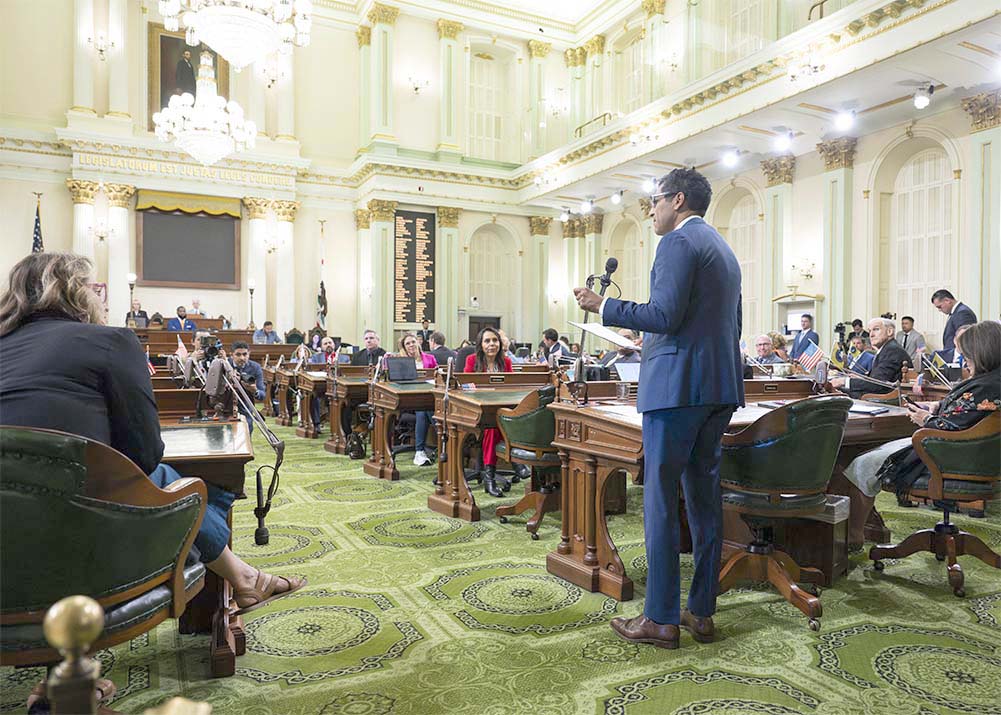
For the next two years at least, Republicans will have to represent their constituents while facing the largest Democratic supermajority in 150 years. And Californians, meanwhile, will have to contend with a Democratic body that has fewer checks on its power.
Why so many GOP losses?
Experts told CalMatters they believe most of the losses stemmed from the “nationalization” of the down-ballot races.
“It was about voters sending Republicans a message,” said GOP strategist Duane Dichiara, whose candidates had mixed results in the election.
In competitive districts, Democrats won resoundingly. Republicans survived mostly in traditional strongholds.
Hard for a fractured party to win
And although nationalization was a factor, legislative leaders agreed that the fracturing of the state Republican Party in recent years contributed to their woes.
A few months after California GOP chair Corrin Rankin took the helm in March 2025, Republican leaders in the Assembly and Senate signaled their displeasure with her leadership and broke a longstanding joint fundraising agreement with the party.
Further dividing the conservatives is San Diego Assemblymember Carl DeMaio’s organization, Reform California, which also courted tens of thousands of small-donor dollars that might otherwise have contributed to the party.
Rankin announced last week that she would not seek reelection after her term is up in February.
How will fewer Republicans affect lawmaking?
Most Republicans agree they have little or no power in the Capitol.
The new delegation would need 15 more members in the Assembly and six more in the Senate to be able to block certain tax and urgency measures, dozens more to reach the majority needed to pass policy unpopular with Democrats.
It’s unclear how the 12 Republicans in the Assembly will be distributed across its 32 standing committees, which have all traditionally had a Republican vice chair.

Less incentive to get things done?
Several political scientists say the increasing Democratic supermajority means there may be less incentive for Democrats to fix pressing issues.
“Competition keeps politicians honest,” said Eric Schickler, co-director of UC Berkeley’s Institute for Governmental Studies. “It pressures them to deliver.”
“To the extent that you don’t face a viable opposition party in California, the pressure on politicians to actually solve big, complicated problems is reduced somewhat.”
While he agrees it would be good to have more of an opposition party, Napa state Sen. Christopher Cabaldon said Republicans’ refusal to acknowledge the impact of ICE raids and federal healthcare cuts means they are naturally left out of conversations around governing.
Some California Republicans have pushed back against ICE tactics – last year six Republican legislators wrote to President Trump asking him to focus on targeting violent criminals, not everyday people.
Republicans plot their path forward
Still, DeMaio has a plan. Unwind the alternative fundraising efforts, restructure party leadership, and create a “shadow caucus” of Republican candidates who get to know constituents and weigh in on state policy long before they’re voted on at the polls.
Roger Niello, who became Senate Republican leader on Nov. 5, is more circumspect.
When the session reconvenes, he said, “the first thing is looking at 2028.” He added the focus will be on quality candidates and positioning their image in contrast with Democrats.
However, with the nationalization of party politics, it might be an uphill battle.
Editor’s note: This article has been edited for length to fit available space.