Saturday, August 29, 2026
Home Blog Page 56

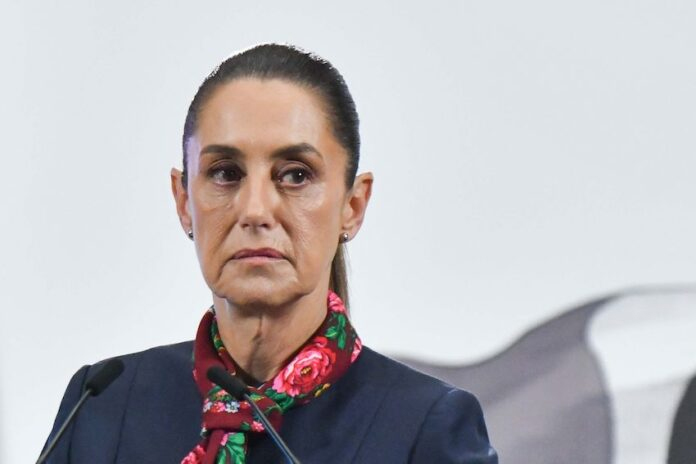
‘There won’t be an invasion’: Sheinbaum de-escalates after Trump orders US military to target cartels

Sheinbaum pushed back against reports that Trump's order authorized the U.S. military to target criminal organizations abroad. (Cuartoscuro, Shutterstock)

by Mexico News Daily

President Claudia Sheinbaum on Friday told reporters that an executive order signed by U.S. President Donald Trump directing the Pentagon to target foreign drug cartels does not pose a risk of invasion to Mexico.

Citing anonymous sources, a New York Times report published on Friday said that Trump has “secretly signed a directive to the Pentagon to begin using military force against certain Latin American drug cartels that his administration has deemed terrorist organizations.”
During her daily press conference, Sheinbaum said the directive does not imply that the U.S. military will cross the border into Mexico. She also told reporters that her administration had been advised of the details of the executive order.

“We were informed that this executive order was coming and that it had nothing to do with the participation of any military personnel or any institution in our territory,” she said, adding that the directive referred exclusively to actions within U.S. territory.

When asked about the Times’ reporting that the directive authorized military use abroad, on land and sea, Sheinbaum dismissed that claim, too.

“No,” she said, “absolutely not. The United States is not going to send its military into Mexico. We cooperate, we collaborate, but there will be no invasion. That’s ruled out … because, in addition to what we’ve stated in all our conversations, it’s not allowed, nor is it part of any agreement.

“Each time they’ve raised the issue, we’ve said no. We can collaborate in other ways, but if [entry of the U.S. military is the suggestion], then no.”
When pressed to explain if the reporting was inaccurate, Sheinbaum demurred, suggesting she had not seen the directive.

“Well, we’ll have to see how the executive order is [written],” she said, “but there’s no risk that they’ll invade our territory.”

The Times reported the U.S. Defense Department declined to comment on the directive. When AFP contacted the Pentagon with regard to the executive order, its questions were referred to the White House.
Still, the Times said Trump’s directive provides an official basis for U.S. military operations at sea or on foreign soil against the cartels.

Mexican cartels in the crosshairs
In February, the Trump administration designated six Mexican drug trafficking groups as terrorist organizations. When the U.S. government announced this classification, Sheinbaum warned that her administration would never tolerate a U.S. invasion.
In a Thursday television interview, U.S. Secretary of State Marco Rubio said the U.S. government could use the designations to “target” cartels, without further specifying what range of actions could be used to do so.

“It allows us to now target what they’re operating and to use other elements of American power, intelligence agencies, the Department of Defense … to target these groups if we have an opportunity to do it,” Rubio said. “We have to start treating them as armed terrorist organizations, not simply drug dealing organizations.”

The Trump administration has already deployed thousands of active-duty combat troops to the U.S. border with Mexico in order to staunch the northward flow of drugs, particularly fentanyl, as well as limit the flow of immigrants.

The U.S. also has sent two warships to patrol the coasts of Mexico — one in the Pacific Ocean, the other in the Gulf of Mexico — a use of naval force without precedent in U.S. border security operations.

The U.S. has also been using drones and spy planes to surveil Mexican drug cartels, an action that Sheinbaum said was “part of a coordinated operation between the U.S. and Mexican governments.”

At the same time, the news agency Reuters reported on Friday that the U.S. Federal Bureau of Investigation (FBI) is looking to add drug cartel suspects to its terror watch list.
In an exclusive report filed after reviewing law enforcement documents, Reuters reported that the FBI has asked local police to submit the names of people they believe are linked to the eight criminal groups designated as terrorist organizations in February. It also asked for information about family members and associates of the groups’ members.
These names would be added to the U.S. government’s terrorist watch list which contained roughly 1.1 million names as of a year ago.

Civil rights groups have complained that designating suspected cartel and gang members, as well as their relatives, as terrorists will drastically expand the number of people on the watch list, which can subject people to surveillance on airplanes, travel restrictions and secondary screenings at airports and other ports of entry into the United States.
With reports from The New York Times, El Universal, Reforma, Reuters and CBS News

spot_img

Child care crisis in San Mateo: Families caught between income limits and high costs

by the El Reportero team

In San Mateo County, hundreds of families face a painful paradox: they earn too much to qualify for financial assistance for child care, but not enough to cover its real cost. This situation, which impacts both parents and providers, will be the main focus of a series of public meetings starting this Thursday.

Blanca Ventura knows this dilemma all too well. A Sequoia High School graduate with a university degree and a stable career, the single mother found herself shut out of subsidized programs and unable to afford private rates. “It was like, ‘I might as well stay home and take care of my child.’ And obviously, I couldn’t do that because I have a mortgage to pay,” she said.

According to official figures, the county meets only 73% percent of the demand for licensed child care, leaving nearly 9,000 children without access to this essential service. The problem doesn’t just affect families—providers face rising costs, difficulty hiring qualified staff, and in some cases, the threat of closure.

Economic pressures are also driving some residents to consider moving to areas with a lower cost of living, which authorities warn could threaten the region’s long-term economic stability.

To seek solutions, County Supervisors Jackie Speier and Lisa Gauthier have organized community meetings open to parents, caregivers, and providers. The first will take place on Thursday, August 14, at 6 p.m. at the South San Francisco Library/Parks and Recreation Center (901 Civic Campus Way). There will be a supervised space for children 2.5 years and older who are toilet-trained, subject to availability. Families bringing children must RSVP and provide the child’s age.

“We want to hear directly from the community,” the organizers have said, emphasizing that the sessions will be active listening forums where every voice will count toward building proposals.

Ventura resolved her own situation thanks to a chance encounter at the library, where she connected with an affordable local provider. “I was finally able to pay without feeling like I had to lie about my income,” she recalled. Her three-year-old son now attends a program close to home.

The second meeting is scheduled for Wednesday, August 27, at EPACENTER in East Palo Alto. County leaders hope that, as happened with Ventura, the conversations sparked in these forums will help build networks and find solutions for those still searching for quality, affordable child care.


spot_img

Eddie Palmieri: A Titan of Latin Jazz leaves an eternal legacy

Eddie Palmieri Latin Jazz Network

by the El Reportero‘s staff

The music world is mourning the loss of Eddie Palmieri, the revolutionary pianist, composer, and bandleader whose fearless innovation redefined Latin music and forever changed the course of jazz and salsa. Palmieri, who passed away this week at the age of 88, leaves behind a towering legacy that spans more than six decades, nine Grammy Awards, and an immeasurable impact on the sound and soul of the Americas.

Palmieri died on August 6, 2025, at his home in New Jersey after an extended illness, according to a statement confirmed by his daughter, Gabriela. While public reports have not specified who was present during his final moments, it is clear that his passing marks the end of an era in Latin music.

Born in Spanish Harlem, New York City, on December 15, 1936, to Puerto Rican parents, Palmieri grew up immersed in a musical landscape that was bursting with Afro-Caribbean rhythms, jazz, and the emerging voices of Latino musicians shaping new identities through sound. He studied classical piano as a child but was soon drawn to the vibrant energy of Latin dance music and jazz. By his teens, he was playing in local bands, absorbing everything from Cuban son and mambo to bebop and blues.

In 1961, Palmieri formed his first major group, La Perfecta, with a bold vision: to replace traditional trumpets with trombones, creating a more aggressive and gritty sound that would become one of his trademarks. The effect was revolutionary. Fusing the driving rhythms of Afro-Caribbean percussion with the improvisational complexity of jazz, Palmieri crafted an explosive sound that captivated dancers and musicians alike. La Perfecta set the stage for a new era of salsa and Latin jazz, blending tradition with innovation.

Palmieri’s music was always more than entertainment—it was an act of cultural affirmation, a celebration of Afro-Latin identity, and at times a form of protest. In songs like “Justicia” and “Puerto Rico,” he called attention to issues of social injustice and colonialism, channeling his art into a deeper expression of community and resistance. His compositions were layered, complex, and deeply rooted in the rhythms of the African diaspora, while also borrowing from classical fugues, jazz harmonies, and modern improvisation.

In 1975, Palmieri became the first Latin artist to win a Grammy Award for Best Latin Recording, for his groundbreaking album The Sun of Latin Music. That milestone marked the beginning of a long list of accolades, including multiple Grammy wins, a National Endowment for the Arts Jazz Master Award, and honors from cultural institutions across the United States and Latin America. Yet Palmieri never slowed down. Well into his 80s, he continued to perform, record, and mentor young musicians, his energy on stage undiminished and his passion as fierce as ever.

Palmieri’s influence extended far beyond the Latin music scene. Jazz legends like Herbie Hancock and McCoy Tyner admired his harmonic daring, while salsa giants such as Willie Colón and Rubén Blades credited him with expanding the possibilities of the genre. To many fans, he was not just a musician but a philosopher of rhythm, a master who spoke through polyrhythms and piano lines with equal eloquence.

For the Latino community in the United States, Palmieri was a cultural pillar. His music was the soundtrack of family gatherings, street festivals, political rallies, and late-night dance floors. He gave a voice to generations of immigrants, Afro-Caribbeans, and urban youth who found in his work a sense of belonging and pride. In cities like San Francisco, New York, and Miami, his passing is being mourned with concerts, tributes, and spontaneous gatherings of musicians and fans celebrating his legacy.

Palmieri is survived by five children and four grandchildren, who carry forward his personal and musical legacy. While the Maestro has left the stage, his rhythms still pulse through turntables, dance clubs, and concert halls around the world. His legacy is not just in the notes he played but in the doors he opened for those who followed.

He was, and will always be, El Maestro.

– With reports by various sources.

spot_img

PG&E Supports Local Restaurants: 188 Restaurants Will Receive $5,000 in Resiliency Grants Funded by the PG&E Corporation Foundation

Grants Help Restaurants and Commercial Caterers in Our Cities Achieve Long-Term Success

Oakland, California — This year, a record number of restaurants and commercial caterers in Northern and Central California will receive grants from the California Restaurant Foundation (CRF) and the PG&E Corporation Foundation (PG&E Foundation). Grant money can be used for equipment upgrades, staff training, and more. The grants reflect the commitment to strengthening local restaurants so they can achieve long-term business success and continue to contribute to local economies and community development.

The PG&E Foundation’s $1.1 million charitable contribution this year will fund $5,000 grants for 188 local restaurants. Recipients are located in 29 counties across the Pacific Gas and Electric Company (PG&E) service area. The contribution also provides operating support to CRF, which administers the grant program. Funding comes from PG&E shareholders, not customers.

This increased number of grant recipients this year exceeds last year’s 154. This means that CRF’s Restaurants Care Resiliency Fund will assist more restaurants. Grant funds can help pay for equipment and technology upgrades, unexpected hardships, training, and employee retention bonuses. The goal is to help restaurant owners invest in their businesses and staff.

The grants were available to California-based restaurant owners with fewer than five locations and revenues under $3 million.

“This grant is a huge blessing. I opened my restaurant with no savings or formal training; I relied only on my passion for feeding people and a lot of support from my family. Today, we are a full-service restaurant with a loyal team and community. With rising costs, it’s harder than ever to invest in the equipment and upgrades we need to grow. This assistance will help us become more efficient and expand our menu with homemade desserts. That gives us the boost we need to stay strong and continue doing what we’re passionate about,” said Dawn Borst, owner of Bayside Café in Morro Bay.

Since 2021, PG&E and the PG&E Foundation have contributed $4.3 million in funding to the CRF’s Restaurants Care Resiliency Fund, offering grants of $3,000 to $5,000. (Watch our “From Kitchen to Community” videos featuring previous grant recipients in the PG&E service area.)

With this year’s funding, PG&E has helped provide grants to a total of 863 restaurants and caterers in Northern and Central California.

“These restaurants, which are often family-run businesses, are the lifeblood of our communities. They are gathering places where friends and families gather to celebrate birthdays and graduations and create cherished memories. Partnering with the California Restaurant Foundation helps these restaurants thrive and strengthens our local economies and communities,” said Carla Peterman, executive vice president of Corporate Affairs for PG&E Corporation and chair of the PG&E Corporation Foundation board of directors.

CRF created the Resiliency Fund to support restaurants recovering from the economic impacts of the COVID-19 pandemic. The pandemic caused many restaurants to close their doors temporarily or permanently. PG&E and the PG&E Corporation Foundation have supported the program since its inception. The company has maintained its support as restaurants continue to weather economic fluctuations.

“We are incredibly grateful to PG&E for five years of unwavering support for the Resilience Fund,” said Alycia Harshfield, president of the California Restaurant Foundation. “This assistance is critical because when local restaurants thrive, so do the people and neighborhoods around them. Partnering with PG&E helps independent restaurant owners recover from hardships, strengthen their operations, and continue to create jobs and gathering spaces in the communities they serve.”

We Help Restaurants and Small and Medium-Sized Businesses

PG&E remains committed to offering its small and medium-sized business customers ways to save energy and money, especially during tough economic times. Here are some of the ways PG&E is helping its customers:

Bill Financing. PG&E offers 0% interest loans to replace old, worn-out equipment with more energy-efficient models. Watch this video to learn how energy savings are reinvested in your business to help improve your bottom line.

Foodservice Equipment Rebates. PG&E offers several rebate programs to help you save money and improve productivity when you upgrade your foodservice equipment.

Foodservice Technology Center. Access key training programs, design consultants, and test kitchen plans to improve your operations and energy efficiency.

Budget Billing. If you’re a small business owner, you can have a predictable bill each month by enrolling in the Budget Billing program. The program averages your monthly bill to determine your monthly payment, rather than having unpredictable summer bills.

Energy Efficiency Programs. PG&E hires third-party companies to provide a customized solution for different business sectors.

Find Your Best Rate Plan. Customers can use this online tool to perform a rate analysis to see if they are on the best rate plan for their operations. Last year, we were able to save customers $5.4 million.

Economic Development Rate. This offers eligible business customers the opportunity to reduce costs through one of three reduced electric rate options. PG&E developed this rate to help businesses grow or maintain jobs in California. The standard 12% rate is available throughout our service territory.


For more information about PG&E’s support for small and medium-sized business customers, visit pge.com/smbsupport.

spot_img

Nicaragua to Host 2026 WBSC U-23 Baseball World Cup: A Historic Milestone for National Baseball

Screenshot

por Marvin Ramírez

Baseball, Nicaragua’s national sport, is once again placing the country on the international stage. The World Baseball Softball Confederation (WBSC) has officially announced that Nicaragua will host the 2026 U-23 Baseball World Cup. The decision was made by the WBSC Executive Committee, which awarded the hosting rights to the Nicaraguan Baseball and Softball Association (ANBS), the newly unified national federation.

This will be the first WBSC U-23 event held in Nicaragua, although the country has previously hosted the Baseball World Cup in 1948, 1950, 1972, 1973, and 1994. The selection represents a major achievement for national sports and a chance to showcase Nicaragua’s rich baseball legacy to the world.

A national passion

Baseball in Nicaragua is more than a sport—it’s a deeply rooted national passion. Introduced in the late 19th century, it spread quickly and became widely popular. The first professional league emerged in the 1950s, and in 2004, the Nicaraguan Professional Baseball League (LBPN) was founded, elevating the level of competition.

The country has produced legendary players who’ve made their mark both locally and internationally. Among them are MLB pitcher Dennis Martínez—whose name adorns the national stadium in Managua—as well as Marvin Bernard and David Green, who helped establish Nicaragua’s reputation as a land of baseball talent.

A rising national team

The announcement comes at a moment of momentum for Nicaraguan baseball. In the 2024 U-23 Baseball World Cup, held in Shaoxing, China, the national team won a historic bronze medal after defeating the host nation. It was Nicaragua’s first medal in the U-23 category since the tournament’s creation in 2014.

In that edition, Japan took gold and Puerto Rico silver. Nicaragua completed the podium, confirming the nation’s growing prominence in youth international baseball.

Venues and organizational readiness

The bid presented by the ANBS to the WBSC included three stadiums ready to host international competition: the National Stadium “Soberanía” in Managua (15,000 seats), the new Roberto Clemente Stadium in Masaya (4,000 seats), and the Rigoberto López Pérez Stadium in León (6,300 seats). These venues will allow games to be spread across cities, ensuring high-quality facilities and broader national engagement.

Honoring a rich baseball history

Evelio Evaristo Gómez, a Nicaraguan baseball scout based in San Francisco, welcomed the news with pride and historical perspective:
“This is something epic and a source of great pride for Nicaragua to host such an important event. The country has high-quality stadiums where teams will feel safe and comfortable,” he said.

Gómez added, “Let’s go back before the 1940s and remember legendary center fielder Stanley Cayasso. Then came the powerful utility hitter Duncan Campbell, who signed with the Pittsburgh Pirates and—had he not died—would’ve been the first Nicaraguan in the Major Leagues. In the 1960s, we had the great pitcher René ‘El Ñato’ Paredes, who won the Triple Crown in 1965. Then in the 1970s, we saw a generation of stars who famously defeated Cuba in the Baseball World Cup—players like Julio Juárez, Vicente López, Calixto Vargas, and César ‘La Maravilla’ Jarquín.”
He emphasized that this new opportunity is “a recognition of a forgotten history now brought back into the spotlight.”

A tournament of global prestige

The WBSC U-23 Baseball World Cup has become one of the premier global tournaments for rising professional talent. Since transitioning from U-21 to U-23 in 2016, it has grown in prestige and is held every two years. The 2026 edition will be the seventh overall and the fourth hosted in the Americas, following Mexico (2016 and 2020) and Colombia (2018).

The tournament serves as a launchpad for young players aiming to reach professional leagues. Hosting such a competition in Nicaragua presents a unique chance for local talent to shine on a global platform.

Unified federation: A key factor

The recent establishment of the Nicaraguan Baseball and Softball Association (ANBS) was crucial to securing the WBSC’s approval. This new unified governing body replaces older entities and provides a more stable foundation for the sport’s development.

The ANBS demonstrated effective planning and long-term vision. Its strong technical proposal, institutional support, and public enthusiasm played a major role in the WBSC’s decision.

Economic and social impact

Beyond the playing field, the U-23 World Cup is expected to boost the local economy, particularly in tourism, hospitality, commerce, and transportation. The arrival of international delegations, media, and fans will provide economic stimulus to the host cities.

Socially, the tournament will inspire a new generation of Nicaraguan athletes. Seeing world-class baseball up close may encourage hundreds of young people to take up the sport and foster healthier lifestyles.

A future-forward vision

This announcement confirms Nicaragua’s rising status in the international baseball community. With a bronze medal in 2024, upgraded stadiums, and a unified federation, the country is poised for greater achievements.

The 2026 WBSC U-23 Baseball World Cup will be more than just a tournament—it will be a celebration of national talent and pride. Baseball, once again, becomes a symbol of hope and greatness for the entire nation.

– With reports provided by independent sources.

spot_img

Latin Party in Berkeley

by Magdy Zara

The band Combo Chimbita was formed as a result of the Colombian diaspora in New York when a group of friends and family came together to make music. Since then, they have forged a path in the city’s music scene.

Since 2017, the band has toured nonstop, developing an unparalleled live show, both for its musicianship and its intricate and evolving instrumental interplay, which manages to be precise, expansive, and psychedelic, often within the space of a single song.

During this performance, they will share the stage with Turbo Sonidero, pioneers of electronic cumbia based in San José, with roots in Puebla and Mexico City. He began his work as a music producer in 2008, developing a unique style that combines cumbia sonidera and rap, thus creating a new cumbiambero sound.

Both groups will perform on August 6th, starting at 7 p.m., at Cornerstone, located at 2367 Shattuck Avenue in Berkeley. Tickets are $32 and can be purchased by calling (510) 214-8600 or by emailing cornerstoneberkeley@gmail.com.

13th Bay Area International Dance Festival for the Deaf

The Bay Area International Dance Festival for the Deaf (BAIDDF) is an annual event produced by Urban Jazz Dance. It features performances and workshops highlighting the important contributions that deaf and hard-of-hearing (HoH) artists make to the community.

During the Festival, you’ll find a variety of sign languages, including Spanish, American Sign Language, and International Sign Language (ISL), English interpretation at each show, live captioning, wheelchair access, and self-description.

The festival will take place from August 8th to 10th, on Fridays and Saturdays, starting at 7:30 p.m. and on Sundays at 3 p.m.

Tickets start at $15 and will be held at the Mission Dance Theater, located at 3316 24th Street in San Francisco.

CHCC’s 46th Annual Convention

The California Hispanic Chamber of Commerce (CHCC) Annual State Convention is now in its 46th year and this year brings together more than 1,250 executives, entrepreneurs, corporate leaders, leaders of diverse chambers, community leaders, and elected officials from across the country.

Participants establish strategic and lasting alliances through direct personal engagement, the sharing of best practices, interactive dialogues, networking workshops, and more.

To register to participate, you can do so through their website https://cahcc.com/.

This year’s agenda includes an annual business matchmaking program, dynamic panels and speakers, an exhibit hall, awards ceremonies, and food events highlighting the notable achievements of Hispanic and diverse businesses and communities.

The event will take place from the 20th to the 22nd of this year at the Sheraton Fairplex Suites & Conference Center, located at 601 West McKinley Avenue, Pomona.

spot_img

August: Art and Culture in Nicaragua and Latin America

Parishioners carry the patron saint of Managua, Santo Domingo de Guzmán -- Agosto: Arte y Cultura en Nicaragua y LatinoaméricaAgosto: Arte y Cultura en Nicaragua y Latinoamérica

A look at the month’s festivals and cultural expressions

by El Reportero news services

  • August bursts with vibrant artistic, cultural, and spiritual expressions across Nicaragua and Latin America. From religious traditions and culinary fairs to Afro-descendant celebrations and contemporary art, the month reflects the region’s diversity and creativity.

Nicaragua: Faith, flavor, and alternative sounds

  • The Santo Domingo de Guzmán Festival (August 1–10) transforms Managua with music, fireworks, and rituals blending Catholic and Indigenous traditions. Thousands accompany the saint’s image through the capital in one of the country’s largest religious processions.
  • In recent years, the Festival of Arts, Culture, and Gastronomy of Our Peoples (around August 5–6) has gathered representatives from 40+ countries, celebrating culinary and musical traditions. While 2025 dates remain unconfirmed, a new edition is anticipated.
  • On the Caribbean Coast, the Crab Soup Festival in the Corn Islands (late August) commemorates the abolition of slavery with parades, music, and traditional crab soup prepared with coconut milk and spices.
  • Alternative music thrives at the Tenebrario Tour (August 26) at El Mamut in Managua, a key event in Nicaragua’s growing rock and metal scene.

Latin America: Afro-heritage, youth, and creativity

  • In Cali, Colombia, the Petronio Álvarez Festival (August 12) celebrates Afro-Pacific rhythms. In Santo Domingo, the Dominican Republic Youth Forum (August 10–12) features workshops and cultural events for International Youth Day.
  • Argentina’s ArteBA (August 29) brings artists and galleries to Buenos Aires in a major international art fair. Puerto Rico hosts the Ponce Cuna de la Salsa Fest (August 2–3), celebrating salsa with concerts and dance classes.
  • Curaçao’s Mid-Year Jump In Concert (August 6–8) highlights music and community. In Brazil, the Festa da Iemanjá (August 15) fills Rio’s beaches with offerings to the sea goddess, while the Tiradentes Gastronomic Festival (August 22–31) blends cuisine, wine, and music.
  • In Honduras, SUNJAM (August 1) gathers youth and DJs from across Central America for an electronic music festival on Tela’s beaches.

Memory and identity

  • August 4 marks two historic dates: the U.S. military occupation of Nicaragua (1912) and U.S. recognition of the Central American Federation (1824)—reminders of the region’s resilience and sovereignty.

A living celebration

  • From Managua’s processions to Buenos Aires’ art fairs, August showcases Latin America’s enduring and evolving cultural heritage.

With reports from Managua, Buenos Aires, and Rio de Janeiro.


spot_img

DACA recipients to lose CoveredCA health coverage Aug. 31

Jessica Altman, executive director of Covered California, participates in the statewide "Let's Talk About Health" campaign in Los Angeles on November 13, 2024. Altman is promoting a new expansion of the Affordable Care Act that benefits immigrants covered by DACA. Photo by Zaydee Sanchez for CalMatters. -- Jessica Altman, directora ejecutiva de Covered California, participa en la campaña estatal "Hablemos de Salud" en Los Ángeles el 13 de noviembre de 2024. Altman promueve una nueva ampliación de la Ley de Cuidado de Salud Asequible que beneficia a los inmigrantes amparados por DACA. Foto de Zaydee Sanchez para CalMatters.

by Suzanne Potter

People who are part of the Deferred Action for Childhood Arrivals program, known as DACA, will be dropped from their CoveredCA health plans at the end of August.

The move comes after the Trump administration changed a Biden-era definition of “lawfully present” to revoke health care eligibility for thousands of immigrants.

Christine Smith, policy and legislative advocate for the nonprofit Health Access California, said people only have a few weeks to get medical appointments in before their coverage ends.

“If you’re enrolled in Covered California and you’re a DACA recipient, the Trump administration just ended your coverage,” Smith emphasized. “People should use as much of your health care as you can before the Aug. 31st deadline.”

The Centers for Medicare and Medicaid Services defended the move, saying it will save taxpayers money. CoveredCA estimated the change affects about 2,400 DACA recipients in the state who make too much to qualify for Medi-Cal and have jobs not providing health insurance. They can still buy private insurance but it is much more expensive. People who prepaid for their coverage can seek a refund.

Smith predicted it will be a blow not just to those who lose coverage but to the state’s health care system as a whole.

“The lines in the ERs are going to be longer because people are not going to be able to get affordable preventive care,” Smith projected. “They’re just going to get sicker and then end up in the ERs. People will overall incur more medical debt. Hospitals will have more uncompensated care.”

The change is nationwide. As of mid-July, about 538,000 people in the DACA program across the U.S. are ineligible to enroll in any state-based insurance marketplace and are unable to access premium subsidies or cost-sharing assistance.

In other unrelated news:

Free online therapy now available for California undocumented students

Therapists are stepping up to help undocumented students deal with the pervasive fear created by the Trump administration’s ongoing ICE raids.

The group Immigrants Rising offers free online counseling to undocumented students in California, ages 18 to 45.

Mayra Barragan-O’Brien is a licensed marriage and family therapist, and the mental health senior manager with the nonprofit Immigrants Rising.

“They struggle with the fear of family separation, with anxiety, financial struggles, relationship struggles, discrimination,” said Barragan-O’Brien. “And so these mental health providers help them find ways to cope with those stressors.”

The program started during the first Trump administration and has provided about 24,000 hours of therapy to almost 800 undocumented immigrant students to date.

People can learn more online at ImmigrantsRising.org/mental-health-connector. The deadline to apply is Aug. 11.

Barragan-O’Brien said all counselors are licensed therapists who have lived experience or work with the undocumented community.

“They will be connected with a therapist who understands their experience,” said Barragan-O’Brien, “who will not judge, who will meet them where they are, who are culturally sensitive.”

Most of the therapy is conducted in English, but some therapists also speak Spanish, Mandarin, or Tagalog.
Support for this reporting was provided by Lumina Foundation.


spot_img

France must not legislate death: Cardinal Sarah’s wake-up call to a nation losing its soul

Cardinal Sarah, at an event in Rome: Oct 2023. -- Cardenal Sarah, en un evento en Roma: octubre de 2023.

by Michael Haynes | Senior Vatican Correspondent

In a time when Western nations increasingly define compassion as the legal facilitation of death, Cardinal Robert Sarah has sounded an unflinching alarm — one that France, and indeed the world, must heed.

Preaching to some 30,000 faithful at the Shrine of Sainte-Anne-d’Auray in Brittany, the former prefect of the Congregation for Divine Worship denounced the French government’s push to legalize assisted suicide. In no uncertain terms, he called it what it is: “barbaric and inhuman.”

This wasn’t merely a political commentary disguised as a homily. It was a prophetic rebuke delivered at a sacred celebration — the 400th anniversary of Saint Anne’s apparitions to Breton farmer Yvon Nicolazic. And it was a rebuke meant to stir the soul of a nation with Catholic roots now drying out under the sun of secularism.

“In our Western societies, God has been relegated,” lamented Sarah. “Religion is presented as emotional well-being, a philanthropy for migrants or homeless people, a spirituality of personal development. But that is not faith.”

France is on the verge of making legal what ought to remain unthinkable: the state-sanctioned ending of human life under the guise of mercy. On May 27, its National Assembly voted 305 to 199 in favor of a bill that would enshrine a “right to assisted dying.” The legislation is still winding its way through the Senate, but the momentum — and the president’s endorsement — make its passage likely.

Under the bill, adults with an “incurable condition” that causes “unbearable” physical or psychological suffering could choose to die with medical assistance. It sounds clean, even humane. But as Cardinal Sarah implied, it cloaks a moral abdication — a betrayal of human dignity under the guise of compassion.

“Do not desecrate France with laws that promote death where God wants life,” Sarah declared. “This nation is a holy land, reserved for God.”

His words were not just theological sentiment. They were a challenge: to remember who we are, to see the divine image in every suffering person, and to resist the seductive call to eliminate pain by eliminating the person.

Even Pope Leo XIV, though more reserved, made his concerns known. Addressing French pilgrims in June, he called on the Spirit to “enlighten our minds, so that we know how to defend the intrinsic dignity of every human person.” The message was clear: the Church will not be silent as France contemplates legislating away life.

But Sarah didn’t stop at life issues. He reminded the faithful of what it means to worship — and what the Church must look like if she is to lead in this time of moral confusion. Liturgy, for him, is not a matter of taste but of truth. It must be reverent, centered on God, and guarded from secular dilution.

“Our churches are not performance halls, nor concert halls or cultural or entertainment activities,” he said. “The church is the house of God… We enter with respect and reverence, properly dressed because we tremble before the greatness of God.”

This insistence on sacredness — in worship and in life — is no accident. It reflects a coherent worldview, one in which beauty, suffering, sacrifice, and redemption are all intertwined. A worldview where even suffering has meaning and life is always worth living.

At 80, Cardinal Sarah may no longer vote in future conclaves, but he is far from retreating into silence. On social media, he shared the Vatican’s coverage of the Pope’s remarks — amplifying Leo XIV’s subtle but unmistakable resistance to the euthanasia agenda.

More than a homily, Sarah’s message was a call to conversion. He urged the pilgrims to “rebuild the church of our soul… confess the sins you have committed in word or deed, night or day… and receive the heavenly treasure.”

This is the kind of conversion that must happen not only in individuals but in cultures — especially those like France that once lit the flame of Catholic civilization. France was not made for death, but for life. And unless her leaders remember that, they risk leading their people down a path of no return.

The time to speak is now. The time to act is now. France — and the world — must choose between the Gospel of life or the counterfeit gospel of death. Cardinal Sarah has made his choice unmistakably clear.

Will France listen?

With some edition by the El Reportero‘s staff.


spot_img

The unfinished justice of Epstein’s crimes — Let Ghislaine Maxwell speak freely

The unfinished justice of Epstein’s crimes — Let Ghislaine Maxwell speak freely -- Ghislaine Maxwell asiste a una conferencia de prensa sobre la cuestión de los océanos en los Objetivos de Desarrollo Sostenible, en la sede de las Naciones Unidas, el 25 de junio de 2013. Rick Bajornas / Archivo AP
Marvin Ramírez, editor

by Marvin Ramírez

The saga of Jeffrey Epstein is not just about a disgraced financier or a sex trafficking ring — it is about a justice system that stopped short of true accountability. Years after Epstein’s mysterious death in a New York jail cell, the only person serving time for his vast web of exploitation is not one of the many powerful men who participated in his crimes, but a woman: Ghislaine Maxwell.

That’s not justice. That’s a cover-up.

Maxwell, sentenced to 20 years in federal prison for aiding Epstein in the grooming and trafficking of underage girls, certainly bears responsibility for her actions. But it defies all logic — and all notions of fairness — that none of the wealthy and influential men who allegedly took part in abusing young victims on Epstein’s private island and elsewhere have faced the same fate. Not one has stood trial. Not one has gone to prison.

The message this sends is as chilling as it is clear: if you are rich, male, and powerful, you are untouchable — even when children are the victims.

Now, members of Congress are beginning to challenge this silence. There is growing pressure to allow Maxwell to testify publicly, under oath, before congressional committees. But here’s the catch: without immunity from further prosecution, she cannot speak freely. If she testifies without legal protection, any self-incriminating detail could extend her sentence or lead to new charges. Her silence would be understandable — even expected — under such threat.

That is why granting Maxwell limited immunity is not about excusing her crimes. It’s about exposing the full network behind Epstein’s operation. It’s about giving the public the truth — not just a scapegoat.

If Maxwell is the only one who pays the price, the system has not only failed the victims — it has also shielded the abusers. Many of those victims, now adults, are still waiting to see the men who violated them held accountable. They deserve to know who these men were, what they did, and why they’ve been protected for so long.

Some members of Congress are pushing for transparency. Others appear frightened by what a full testimony might reveal — especially if it names names. But no political discomfort can outweigh the moral necessity of bringing these abusers into the light. That process must begin with giving Maxwell a chance to tell the full story.

Critics may say she doesn’t deserve any leniency. That’s a fair point — she played a critical role in one of the most grotesque sex trafficking scandals in modern history. But withholding immunity from her testimony ensures one thing: the silence continues, and the real power players walk free.

What kind of system punishes the accomplice while shielding the perpetrators? What kind of country allows wealth and connections to bury truth and protect predators?

This is not about Ghislaine Maxwell’s redemption. It’s about justice. And justice, in its true form, demands full disclosure. It demands that all guilty parties — not just one — be exposed and held to account.

If Congress truly wishes to restore faith in our institutions, it must give Maxwell the immunity she needs to testify without fear. Not to protect her, but to finally expose the men who believed they were beyond the reach of the law.

The victims deserve closure. The public deserves the truth. And those responsible — no matter how powerful — must face justice.

– With reports contributed by independent sources.


spot_img