Wednesday, October 14, 2026
spot_img
Home Blog Page 48

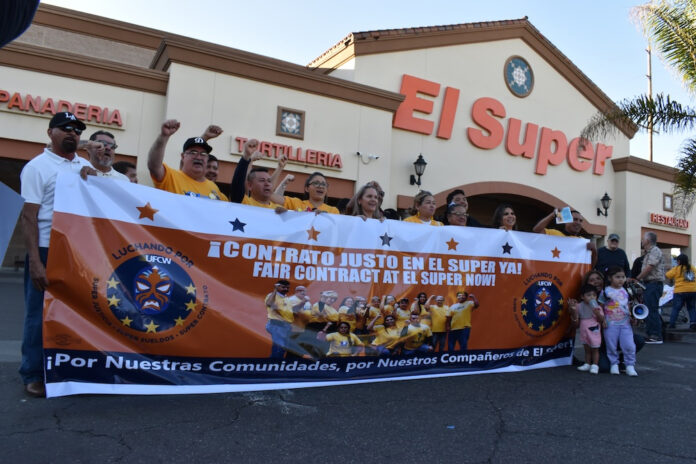
El Super workers demand fair contract and immigration safeguards ahead of Thanksgiving rush

por el equipo de El Reportero

As one of the busiest grocery shopping weeks of the year approached, El Super workers across Southern California intensified their call for a fair contract, holding a large rally on Tuesday, November 25, outside an El Super store in Los Angeles. The demonstration came amid rising concerns over immigration raids in public spaces and ongoing labor negotiations that workers say have stalled for months.

Employees, supported by community leaders and immigrant-rights advocates, urged Chedraui USA—the parent company of El Super—to agree to a contract that includes living wages, safer working conditions, and clear immigration protections for workers and customers. With Thanksgiving sales surging, workers said the need for economic stability and safety inside stores has never been more urgent.

Negotiations between the company and approximately 700 unionized employees represented by United Food and Commercial Workers (UFCW) locals have been ongoing since April, when the previous collective bargaining agreement expired. Since then, workers say the company has rejected almost every major proposal, including requests for guaranteed protocols in the event of an immigration enforcement operation. Workers note that similar protections were included in recent agreements between other large grocery chains and their unionized workforces.

“With the wages El Super pays us, my coworkers and I struggle to put food on our own tables. Especially at Thanksgiving,” said Araceli Pinedo, a cashier at a South Los Angeles store. Pinedo explained she supports a family of four and was forced to take a second job after her hours were cut. “I stretch every dollar, use coupons, and even go to the park for free vegetables just to supplement what I can buy.”

Other workers echoed the sentiment, saying the company’s wage proposals fall far short of what is needed to survive in today’s Southern California economy. El Super’s most recent offer, union representatives say, includes hourly raises ranging from just 1 to 22 cents. Workers argue that this structure would allow wages to stagnate even as California’s minimum wage continues to increase—leaving long-time employees earning barely above the legal minimum.

“For seven months, we have been fighting for a contract that pays a living wage and protects our community,” said employee Fermin Rodríguez. He emphasized that the absence of immigration protections leaves both workers and customers vulnerable. “We want the company to establish clear security protocols for how to proceed during an immigration raid, so families feel safe to shop in the store; restrict immigration agents’ access to non-public areas; and put these protocols in our contract so they are guaranteed rights, not just empty promises.”

Concerns over immigration enforcement were shared by local leaders who joined the rally. Giovanni García, chair of the Voices Neighborhood Council, urged the company to recognize the needs of its predominantly Latino workforce. “I ask El Super to respect your workers and give them the family-sustaining wages that they deserve, and commit to including immigration protections as part of their contract agreement,” Garcia said.

Jose Ugarte, deputy chief of staff for Los Angeles City Councilmember Curren Price, said the company’s refusal to adopt basic protections threatens the wellbeing of the entire community. “Our Latino community’s economic power is immense,” Ugarte noted, adding that residents and elected leaders would continue supporting workers in their push for a contract that guarantees dignity, stability, and safety.

Workers are also seeking improvements to staffing levels, injury prevention measures, and more predictable schedules—issues they say affect both employee wellbeing and customer service. Many stores, the union argues, operate with inadequate staffing, leading to longer lines and heavier burdens on employees.

El Super is part of Chedraui USA, a subsidiary of Grupo Comercial Chedraui, Mexico’s third-largest supermarket operator. The company runs 383 stores across the United States under various brands, including Fiesta Mart, Smart & Final, and El Super, serving predominantly Latino communities in five states.

As negotiations continue, workers say they will maintain pressure through public actions and community outreach. With the holiday season underway, they hope the company will reconsider its position and work toward an agreement that reflects the economic realities faced by thousands of working families. – With reports.


 

spot_img

Did Mexico grant FIFA a full tax break for the World Cup?

Un balón gigante del Mundial de 2026 da la bienvenida a los viajeros que llegan a la entrada de la Terminal 2 del Aeropuerto Internacional de la Ciudad de México (AICM). (Andrea Murcia/Cuartoscuro)

by Mexico News Daily

Alone among the three co-hosts of the 2026 World Cup, Mexico has granted soccer’s global governing body FIFA a full tax exemption for the 40-day tournament involving 48 national teams.

The U.S. and Canada, the other co-hosts, only agreed to specified tax benefits at the national, state and local levels.

Still nearly seven months out from the inaugural match, which will be held in Mexico City’s Estadio Azteca on June 11, the concession has caused consternation.

As a result of the agreement confirmed by Mexico’s Finance Ministry (SHCP) on Monday, FIFA and any companies it designates will be exempted from paying taxes during the 2026 World Cup matches held in Mexico City, Monterrey and Guadalajara.

The stipulation has its origin in FIFA’s 2026 Revenue Law, which features transitional articles declaring that companies “participating in the organization, development and execution of activities related” to the tournament are exempt from paying taxes.

The SHCP’s proposal “releases all individuals and legal entities” covered by the Revenue Law from tax and administrative burdens.

The loss of potential tax revenue has caused a mild fuss in some corners, but politicians and tax experts have defended the accord as a good business decision.

The criticism comes from the fact that World Cup tourists buying merchandise, drinks or anything else from FIFA partner brands will not be contributing to Mexico’s tax revenues.

Additionally host countries typically suffer a financial deficit since they spend more money — investing billions in infrastructure, stadiums and preparation — than they earn, because the direct profits from ticket and marketing rights go to FIFA.

However, Mexican President Claudia Sheinbaum has brushed aside the negative comments, pointing out that her government has worked with FIFA to limit the terms of the 10-year-deal deal that was signed in 2018 during the Enrique Peña Nieto administration.

Sheinbaum said talks with FIFA have sought to avoid a disproportionate fiscal impact and ensure that the benefits are applied only to the activities essential for the organization and celebration of the event.

“The talks with FIFA aim to establish clear limits on the tax benefits originally agreed upon, ensuring that these are applied responsibly and under the direct supervision of the Mexican State,” an SHCP official told ESPN.

Whereas Canada granted customs and tax benefits primarily on the importation of goods and the U.S. forced FIFA to negotiate with each of the 11 venues to obtain tax benefits, Mexico was at a comparative disadvantage, tax attorney Miguel Ángel Rosas told ESPN.

Rosas cited Mexico’s lack of modern infrastructure, saying: “The best way for Mexico to respond in order to host these types of events is to offer tax incentives.”

This approach could benefit Mexico over time, he said, because “this could open doors for other international events to take notice.”

Deputy Claudia Anaya concurred, saying that “connectivity between cities, highway infrastructure, logistics and maintenance of stadiums, airports, all of that” gives Canada and the U.S. a distinct advantage.

“So, yes, sometimes the one who has the least must offer the most in order to [participate],” she said.

In the end, the original agreement — which the SHCP insists will not compromise tax collection or fiscal equity between national and foreign taxpayers — resulted in Mexico being granted the right to host 13 games instead of 10.

It is estimated that 1.5 million people will visit Mexico during the World Cup, with a projected economic impact of approximately US $3 billion.

With reports from ESPN, El País, Debate and El Economista

spot_img

Venezuelan sweet Tricolor Foundation Holds Fundraiser

Dulce Tricolor Venezolano works to maintain Venezuelan cultural traditions in the Bay Area. (Courtesy: https://dulcetricolor.com/)-- Dulce Tricolor Venezolano trabaja para mantener las tradiciones culturales de Venezuela en el Área de la Bahía.

By Magdy Zara

To raise funds for the Venezuelan Sweet Tricolor Foundation, a live dance and music show will be held.

This will be an afternoon full of joy and family fun where vibrant dances, music, and traditional Venezuelan food will take center stage, all in true Venezuelan holiday style.

This colorful event is being held to raise funds and support the Venezuelan Sweet Tricolor Foundation, a non-profit organization dedicated to teaching and preserving Venezuelan folk dance for youth and families throughout the Bay Area.

Attendees will have the opportunity to sample a Venezuelan Christmas feast, which includes: hallaca, chicken salad, ham bread, and a beverage of their choice. Tickets range from $10 to $40 and are available at https://www.zeffy.com/…/a-latin-american-holiday

The event takes place this Saturday, November 15, starting at 11:30 AM, at 655 Magdalena Ave, Los Altos.

SFMOMA Opens Alejandro Cartagena Exhibition

The San Francisco Museum of Modern Art opens its doors to present Ground Rules, an exhibition by Alejandro Cartagena that explores themes from more than 20 series of work, including documentary images, collages, vernacular photographs, and AI-generated videos.

Cartagena is a Dominican artist who lives and works in Monterrey, Mexico, and for more than twenty years has explored social, urban, and environmental issues through portraiture and landscape photography.

The exhibition explores for the first time the themes that have been constants throughout his career, such as land use, the border between Mexico and the United States, climate change, growing economic inequality, and the effects of accelerated suburban sprawl.

The exhibition will be open to the public from November 22 of this year, starting at 2:00 PM, until April 9, 2026. The SFMOMA is located at 151 Third Street in San Francisco.

John Santos celebrates his 70th birthday with a concert. With a concert featuring a long list of renowned guest artists and his sextet, John Santos celebrates his 70th birthday.

Also known as the man of the Latin music renaissance, percussionist and composer John Santos celebrates his birthday with a magical night of Latin jazz with his telepathic sextet. Some of his special guests include vocalists Destani Wolf and Zoe Ellis, percussionist Orestes Vilató, trumpeter Skylar Tang, vibraphonist Kyle Athayde, and more.

This concert will serve as the closing event for what he describes as a challenging year. It will take place on Thanksgiving weekend, Friday, November 28, at the Miner Auditorium, located at the corner of Franklin & Fell in San Francisco, starting at 7:00 PM. Tickets can be purchased at:

https://www.sfjazz.org/…/prod…/25-26/john-santos-sextet/

spot_img

Painting stolen from Teotihuacán church returns a quarter of a century later

Los habitantes de Mazapa, pueblo situado en la zona que rodea las pirámides de Teotihuacán, celebraron la recuperación de una pintura del siglo XVIII de San Francisco de Asís, que había sido perdida durante mucho tiempo, y que volvió a su lugar en la iglesia. (Registro de Arte Perdido)

by the El Reportero‘s news services

A treasured 18th-century painting of Saint Francis of Assisi — taken in a nighttime heist from a church in México state nearly 25 years ago — has returned after years of investigation and faith-fueled waiting.

Dated Dec. 3, 1747, the oil painting was stolen from the Church of San Francisco Mazapa on Jan. 6, 2001. Eighteen works disappeared that night, but only this one has resurfaced.

The parish is in a town of 3,300 adjacent to the Teotihuacán archaeological zone, a massive UNESCO World Heritage Site that includes the Pyramid of the Sun. It’s about an hour’s drive northwest of Mexico City.

The painting stands out for many reasons, including its large, church-display size of 159 centimeters high by 101 centimeters wide (5.2 feet by 3.3 feet) — making it comparable to some of the world’s most famous single-panel gallery paintings.

Its recovery began roughly eight years ago, when the alleged owner took it to the Morton Auctions house in Mexico City and left it on consignment, said historian David Collepardo.

The piece was flagged as stolen, and reported to Interpol, after a database check with the Art Loss Register, which tracks missing art and antiques worldwide.

“We stopped the auction process,” said Collepardo, Morton’s manager of antiques and books. “The Art Loss Register filed the corresponding reports with the prosecutor’s office.”

And why did a resolution take so long? Collepardo said it was due to legal red tape.

Published reports indicate that the person who brought the stolen painting to the auction house was never reprimanded or criminally charged. Authorities attempted to contact that person, but no response was received.

The outcome is typical of sacred art thefts in Mexico, where stolen items are sold or transferred through intermediaries, but legal actions focus on recovering the artwork rather than on prosecution.

The Mexican government has an international campaign to recover Mexican artifacts that uses the slogan #MiPatrimonioNoSeVende (“My Heritage is Not for Sale”).

The returned painting shows Saint Francis of Assisi holding a skull and a crucifix, stigmata on his hands and feet, and bears a dedication to Don Gregorio Juan, an Indigenous mayor of Mazapa.

Community members said its arrival restores a lost part of their identity.

“The recovery of our painting is of inexplicable significance to the faith of local people,” said parish priest Teodoro García Romero.

The Art Loss Register confirmed on Instagram that it worked pro bono with Morton Auctions to secure the return.

Photos posted show more than 1,000 residents celebrating on Sunday as the artwork was rehung in the parish.

“It’s a reminder that stolen cultural heritage, feared lost forever, can be returned to its rightful home,” the registry wrote.

With reports from El País, Milenio and ARTnews

spot_img

CalKIDS expands opportunity for over 5 million children during National Scholarship Month

by El Reportero’s staff and reports

California is marking National Scholarship Month by celebrating the expanding reach of CalKIDS, the state’s pioneering scholarship and savings program now supporting more than five million children. Officials say the initiative is reshaping how families prepare for higher education by offering early financial support and fostering a college-going culture statewide. Launched in 2022, the California Kids Investment and Development Savings Program—CalKIDS—provides up to $1,500 in scholarships for eligible public school students and $175 for every child born in California on or after July 1, 2022. The program is administered by the ScholarShare Investment Board and chaired by State Treasurer Fiona Ma, CPA, with the goal of making higher education more accessible for families regardless of income. State figures show that more than 750,000 students have already claimed their scholarships, using the funds for tuition, books, housing, and other educational expenses at accredited colleges, universities, and vocational schools across the country. Treasurer Ma called CalKIDS a powerful tool for equity. “CalKIDS is a catalyst for building family assets and expands access to education,” she said. “For older students, it offers real financial support to meet immediate education needs. For younger families, it plants the seeds of lifelong financial literacy.” For many students, the benefits are immediate. Abigail Lopez of CSU San Bernardino said her CalKIDS scholarship reduced the stress of paying for essential school costs. “I found out about it my first year of college and wanted to use it to pay my tuition, books, and housing,” she said. “It relieved some stress I had about paying for things for school.” Parents of newborns say the program brings peace of mind. Lindsay Ferguson of Orange County described her son’s automatic scholarship as a meaningful early step toward future planning. Educators also see significant impact. Cindy Duran, a CalWORKs counselor at Saddleback College, said the automatic account creation is critical. “Most students aren’t aware of it,” she noted, adding that funds can be claimed easily online. About 60 percent of public-school students in grades 2–12 qualify for CalKIDS, along with all children born in California since mid-2022. Families can confirm eligibility by visiting CalKIDS.org and entering a student’s Statewide Student Identifier or the 13-digit number on a newborn’s birth certificate. State leaders say CalKIDS supports California’s cradle-to-career vision by encouraging savings habits and expanding access to higher education, helping ensure every child has a path toward a brighter future.

spot_img

Mainstream media continues to downplay attacks against Christians in Nigeria

After US President Donald Trump called attention to the genocide in Nigeria, the press claimed there are no mass killings there

by Jonathon Van Maren

On Saturday, the Nigerian government was caught off guard by a post on Truth Social from U.S. President Donald Trump.

“If the Nigerian Government continues to allow the killing of Christians, the U.S.A. will immediately stop all aid and assistance to Nigeria, and may very well go into that now disgraced country, ‘guns-a-blazing,’ to completely wipe out the Islamic Terrorists who are committing these horrible atrocities,” he wrote. “I am hereby instructing our Department of War to prepare for possible action.”

Trump added, in his signature style, “I am hereby instructing our Department of War to prepare for possible action. If we attack, it will be fast, vicious, and sweet, just like the terrorist thugs attack our CHERISHED Christians! WARNING: THE NIGERIAN GOVERNMENT BETTER MOVE FAST!”

Secretary of War Pete Hegseth responded beneath the post: “Yes sir.” Trump elaborated on his post Sunday, stating, “They’re killing record numbers of Christians in Nigeria. They’re killing the Christians and killing them in very large numbers. We’re not going to allow that to happen.”

Predictably, the mainstream press pivoted immediately to trotting out a claim they have been making for years: That there is no targeted mass killing of Christians in Nigeria, and that there is certainly no genocide underway. The BBC led their coverage by stating that “claims of a genocide against Nigeria’s Christians have been circulating in recent weeks and months in some right-wing U.S. circles.”

This is manifestly deceptive. Many journalists and Christian organizations have been trying to draw the world’s attention to the slaughter of Christians in Nigeria for years; I wrote a long report titled “The Slow-Motion Genocide of Nigeria’s Christians” for The European Conservative in 2021 after conducting eyewitness interviews. Some readers might also recall the mass kidnapping of Christian schoolgirls by Boko Haram, and the horrors they endured from the Islamist captors. Some are still missing.

The BBC, however, reported in their coverage of Trump’s remarks that “Groups monitoring violence say there is no evidence to suggest that Christians are being killed more than Muslims in Nigeria, which is roughly evenly divided between followers of the two religions.” This slant is unsurprising considering the fact that the BBC actually profiled one of the primary groups butchering Christians, the Fulani, in 2021 with the title: “Nigeria’s hipster herders — the funky Fulanis.” The profile only made one vague mention of the Fulani’s penchant for attacking Christians and burning churches.

In fact, a surface perusal of the reports coming out of Nigeria in the last year make it clear that, contrary to the BBC’s coverage, Christians are being systematically targeted, kidnapped, and killed. A total of 7,800 Christians were abducted as of August.

“More than 7,000 Christians had been killed in Nigeria during the first 220 days of 2025, a civil-society watchdog said,” Newsweek reported recently. “This is an average of 35 killings a day, according to the recent report published by the Nigeria-based human-rights NGO International Society for Civil Liberties and the Rule of Law (Intersociety) … The violence has displaced at least 12 million Christians since 2009, according to Intersociety. That year marked the start of Boko Haram’s insurgency to establish a caliphate in Nigeria and the broader Sahel.”

Since 2009, the group estimates that 125,000 Christians and 60,000 liberal Muslims have been killed. The claim that Christians and Muslims are being killed in “roughly even” numbers is not even remotely true — and the reason that media outlets are making the claim to begin with is to obscure the truth of what is happening on the ground. In fact, many outlets have repeatedly attributed Islamist attacks on Christians to climate change, insisting that the slaughters are primarily pastoral disputes over grazing grounds rather than religiously or ideologically motivated.

Despite that, the BBC went so far as to claim that “Trump earlier announced that he had declared Nigeria a ‘Country of Particular Concern; because of the ‘existential threat’ posed to its Christian population. He said ‘thousands’ had been killed, without providing any evidence.” The BBC could have uncovered such evidence with a very cursory online search, and I suspect they also have the capacity to conduct on-the-ground interviews. I could connect them with sources without any difficulty.

Whether or not the Trump administration decides to follow through on his threat of concrete action, his words in defense of Nigeria’s Christians have had an immediate effect. “Trump’s threat triggered alarm across Nigeria,” the BBC noted. “Many on social media urged the government to step up its fight against Islamist groups to avert a situation where foreign troops are sent into the country.” Government spokespeople hastened to assure the global press that stopping Islamist violence was of utmost concern.

“While Christians used to be vulnerable only in the Muslim-majority northern states, this violence continues to spread into the Middle Belt and even further south,” Open Doors, which monitors the persecution of Christians worldwide, observed recently. “The attacks are shockingly brutal. Many believers are killed, particularly men, while women are often kidnapped and targeted for sexual violence. More believers are killed for their faith in Nigeria than anywhere else in the world.”

“These militants also destroy homes, churches and livelihoods. More than 16.2 million Christians in sub-Saharan Africa, including high numbers from Nigeria, have been driven from their homes by violence and conflict. Millions now live in displacement camps.”

No doubt Nigerian Christians are heartened to hear that the president of the United States sees their plight, even while much of the world deliberately turns a blind eye.


spot_img

San Mateo breaks its own vote: The appointed sheriff and the cost to democracy

Marvin Ramírez, editor

Undersheriff Dan Perea, who by law and custom should have been the natural interim leader, was dismissed from serious consideration

by Marvin Ramírez –

November 14, 2025 – San Mateo County has crossed a line it cannot uncross. With the appointment of Ken Binder as sheriff — installed through a process controlled entirely by the Board of Supervisors — the county has replaced the will of the voters with the will of five elected officials. The Board may call the process “transparent” and “participatory,” but no amount of community forums or multilingual outreach can erase the reality: the public was invited to speak, not to choose.

This appointment does more than fill a vacancy. It rewrites the meaning of the sheriff’s office itself. In California, the sheriff is intentionally not a political appointee. The office exists outside the control of boards and mayors so that no law-enforcement chief becomes an extension of political power. That safeguard has now been breached.

Binder — a seasoned law-enforcement leader from Santa Clara County — may very well bring order, but he arrives without the mandate that gives a sheriff legitimacy: the people’s vote. The Board’s decision ensures that the county will go nearly five years without a sheriff chosen by its own residents. That is not stability. It is disenfranchisement dressed up as reform.

Supervisors congratulated themselves as they appointed Binder. They spoke of “a new spring,” “a new beginning,” and “a moment of unity.” They applauded the public forums, the questions submitted, the meetings held in multiple languages. But one truth remains unspoken: the community was never given the power to decide.

Public comment is not democracy. A multilingual website is not democracy. A forum streamed on Zoom is not democracy.

Democracy is the ballot box — and the ballot box was bypassed.

The Board emphasizes that Binder’s qualifications justify their decision. But qualifications are not the issue. Legitimacy is. Even the most qualified sheriff must derive authority from the governed, not from political appointment.

Equally concerning is the unmistakable effort to wipe clean any continuity with the prior administration. Undersheriff Dan Perea, who by law and custom should have been the natural interim leader, was dismissed from serious consideration. Now, under Binder, his future is uncertain. That exclusion reveals something deeper: a deliberate clearing of the deck, a reshuffling of power, and a restoration of the same internal alliances that Sheriff Corpus once challenged.

Independence — the cornerstone of the sheriff’s office — has been replaced with dependency. Binder begins his term tied not to the electorate but to the Board that appointed him, the same Board he will one day be expected to scrutinize or resist when circumstances demand it. That structural tension is exactly what the Constitution sought to avoid. Now, it has been locked into place.

Supporters of the process insist that the public was engaged at every step: 7,600 website visits, hundreds of questions, dozens of speakers. Yet none of it was binding. None of it replaced the power of the vote. And none of it restores the principle the Board has now severed — that the sheriff belongs to the people, not to politicians.

San Mateo County now faces a sobering reality: the shield of constitutional independence around the sheriff’s office has been pierced. A precedent has been set that future boards may use whenever an elected sheriff becomes inconvenient or politically undesirable.

This editorial is not about Ken Binder the man. It is about the method that installed him. The county’s democratic order has been weakened, not strengthened, by a process that may have been open to the eye but closed to the will of the people.

And so we pose a question that every resident of San Mateo County must confront:
If the people cannot choose their own sheriff, what other offices will soon be declared too important, too urgent, or too “crisis-ridden” to trust to voters?

This is not the restoration of faith that the Board promises. It is the quiet erosion of electoral power — the beginning of a new political norm in which democratic inconvenience justifies democratic override.

Let us be clear: The sheriff is not an administrative hire. The sheriff is the people’s guardian of justice. And when the people are denied the right to choose that guardian, something far more important than a single office is lost.

What has been wounded is not simply a process.
What has been violated is not only a tradition.
What has been ignored is not merely a vote.

What has been broken is the very foundation of local democracy.

If San Mateo County is to repair that foundation, the path is unmistakable: return the sheriff’s office to the ballot and restore the people’s authority. Public comment cannot replace public consent. And no amount of applause in the Board chambers will drown out this truth:

Democracy begins with the voter — and it dies when the voter is replaced.


spot_img

US Senators push bill to block water deliveries to Mexico

by El Reportero’s wire services

With reports from Berenice García, The Texas Tribune

U.S. Senators Ted Cruz and John Cornyn have introduced legislation aimed at pressuring Mexico to comply with the 1944 Water Treaty after the country failed to deliver required water to Texas during the most recent five-year cycle. The bill would limit U.S. water deliveries to Mexico and allow the president to restrict Mexican economic sectors that benefit from U.S. water.

Under the treaty, the United States must deliver 1.5 million acre-feet of Colorado River water to Mexico annually, while Mexico must provide 1.75 million acre-feet every five years from six tributaries that feed the Rio Grande. When the latest cycle ended on Oct. 24, Mexico still owed 865,136 acre-feet. Prolonged drought, limited rainfall and record-low reservoir levels have intensified the strain on Rio Grande Valley farmers who rely on these deliveries for irrigation. The lack of water has already contributed to the closure of Texas’ last sugar mill, though investors plan to revive it.

Cruz accused the Mexican government of exploiting loopholes in the treaty to delay yearly deliveries until meeting obligations becomes impossible. The new bill would compel Mexico to make minimum annual deliveries of 350,000 acre-feet instead of accumulating them at the end of each cycle. It also requires the U.S. State Department to report to Congress on Mexico’s compliance and identify economic sectors that benefit from U.S. water.

If Mexico fails to meet the annual minimum, the president would be required to deny any emergency water requests under treaty amendments, except in ecological, humanitarian or national-interest circumstances. The president could also limit or end engagement with Mexican sectors that rely on U.S. water, except when cooperation is tied to combating fentanyl and other synthetic drugs.

Members of the Rio Grande Valley congressional delegation support tying enforcement of the water treaty to the 2026 review of the U.S.-Mexico-Canada Agreement. Cornyn said the proposed legislation would add necessary consequences to ensure Texas receives the water it is owed.

spot_img

Your daily soda habit is a ticking time bomb for your liver, groundbreaking study reveals

by Cassie B.

  • Daily diet soda intake is linked to a 60 percent higher risk of a serious fatty liver disease.
  • Even sugary drinks raise the risk of this liver condition by 50 percent.
  • This liver disease is a silent epidemic with no early symptoms but severe consequences.
  • Artificial sweeteners harm the liver by altering gut bacteria and disrupting metabolism.
  • Replacing sweetened drinks with water can reduce the risk of liver disease by up to 15 percent.

If you think having a daily can of diet soda is a harmless treat, think again. A bombshell new study is shattering the long-held myth that artificially sweetened beverages are a safe alternative, revealing that both regular and diet drinks are aggressively linked to a potentially fatal liver condition. The research, which tracked nearly 124,000 people for over a decade, delivers a much-needed warning about the true cost of our beverage choices.

This isn’t just about a few extra calories. The study found that consuming more than one cup (about three-quarters of a standard can) of a sugar-sweetened beverage daily increases the risk of developing metabolic dysfunction-associated steatotic liver disease (MASLD) by 50 percent. This condition, formerly known as non-alcoholic fatty liver disease, involves dangerous fat buildup in the liver and is now the most common chronic liver disease worldwide.

The real shocker, however, was for those who have switched to “diet” options believing they made a healthier choice. The same research found that low- or artificially sweetened drinks were associated with an even higher risk—a staggering 60 percent increased chance of developing MASLD.

A silent epidemic

MASLD is a silent epidemic often with no symptoms in its early stages, but it can progress to severe liver scarring, cancer, and heart problems. The study, presented at United European Gastroenterology Week 2025, followed UK Biobank participants who had no initial liver issues. Over the study period, 1,178 developed liver disease.

Lead author Lihe Liu acknowledged the counterintuitive nature of the findings. “SSBs [sugar-sweetened beverages] have long been under scrutiny, while their ‘diet’ alternatives are often seen as the healthier choice. Both, however, are widely consumed and their effects on liver health have not been well understood,” she said in a press statement.

Why your “diet” drink is not a safe harbor

The mechanisms of damage differ between the two beverage types, but the destination is the same: a stressed and fatty liver. Sugar-sweetened beverages cause rapid spikes in blood glucose and insulin, promote weight gain, and increase uric acid levels. This metabolic chaos directly contributes to liver fat accumulation.

Artificially sweetened beverages, however, attack the body through more insidious pathways. They can alter the gut microbiome, disrupt feelings of fullness, drive sweet cravings, and even stimulate insulin secretion despite containing no sugar. This can lead to inflammatory gut conditions and metabolic disturbances that ultimately burden the liver.

The study’s findings challenge the corporate narrative that these chemical concoctions are benign. It provides direct evidence that dietary behaviors heavily influence liver health, contradicting prior analyses that suggested diet drinks could be substituted for water.

The simple, pure solution

In a world of complex and often corrupted food science, the solution presented by the data is beautifully simple. The researchers found that replacing these sweetened drinks with water reduced the risk of MASLD by up to 15 percent.

“Water, however, hydrates the body without affecting metabolism, helps with satiety and supports overall metabolic function,” Liu noted. She emphasized that water is the healthiest default beverage, a natural choice that avoids the metabolic burden imposed by both sugar and artificial sweeteners.

This research underscores a fundamental truth that natural health advocates have long championed: you cannot outsmart nature with laboratory-created chemicals. The pursuit of “guilt-free” sweetness through artificial means is a dangerous illusion sold to the public by profit-driven corporations.

For the sake of your liver and your long-term health, it is time to ditch the deceptive diet drinks and the sugar-laden sodas. The most powerful and liberating choice you can make is to return to the pure, life-sustaining essence of water. Your body, freed from the burden of processing these toxic sweeteners, will thank you for years to come.

spot_img

California’s DUI crisis: Weak laws and rising death toll

by the El Reportero‘s staff

A CalMatters investigation reveals that California’s system for DUI enforcement is broken. The state’s laws are now among the weakest in the country, contributing to a sharp increase in alcohol-related roadway deaths.

The system routinely allows repeat drunk and drugged drivers to remain on the road with minimal punishment until they cause fatal crashes.

The human toll and fatal leniency

Alcohol-related roadway deaths in California have shot up by more than 50% in the past decade, an increase twice as steep as the rest of the country. Over 1,300 people die each year in drunken collisions.

The stories of repeat offenders escaping justice are tragic and common. Sylvester Conway, despite two prior DUI convictions, was repeatedly arrested for drunk driving between 2019 and 2021. He accumulated three open cases and multiple warrants for skipping court.

In February 2022, Conway sped while drunk, lost control, and killed his passenger, Khayriyyah Jones. He is now facing murder charges.

Another victim, Sarah Villar, was killed in 2021 by a driver who had three prior misdemeanor DUI convictions in consecutive years. That driver had served only a couple of weeks behind bars for the prior offenses.

Villar’s father, Dave Villar, publicly condemned the lack of consequences, stating in her eulogy: “To the broken justice system that allowed this to happen — shame on you… Our system says it’s after the last [shot].”

The case of Masako Saenz and her son, Manuel, highlights the decades-long failure. Manuel, five, was killed in 2000 by a driver who had his fourth DUI conviction just two months earlier. The driver was out of jail at the time, finishing a rehab program.

At the arraignment, Saenz broke down, screaming: “Murderer! Murderer! You killed my son!” She later reflected on her grief, saying: “They have no idea. They have no idea. Sometimes even now I wonder if I can go on.”

Tragically, in 2022, Masako Saenz herself was killed by a different drunk driver, Puentis Currie Jr., whose license was suspended. The driver who killed her received only three months in jail and was later caught driving on a suspended license again, receiving just a ticket.

Currie, now 25, reflected on the ubiquity of drinking and driving, stating: “I think it’s accepted in society until the worst happens.”

David Alvarado, another repeat offender, had three prior DUIs that did not count toward a felony charge because California’s 10-year look-back period had expired. He was arrested for DUI three more times between 2019 and 2021, yet received only probation and a 129-day alcohol monitoring bracelet.

Less than a year later, while driving drunk, he killed Mary and Paul Hardin. Their son, Benjamin Hardin, stunned by the driver’s history, said: “It really does feel like it is literally just a matter of time before they kill someone — or in my family’s case, two someones.”

Similarly, William Curtis, after a DUI in 2012, received a second DUI and accumulated numerous tickets and collisions—all while his license was suspended. He continued to drive until November 2020, when his crash killed Dominique Howard.

Law enforcement later heard Curtis tell his mother on the phone: “I killed someone. I’m going away. I’m sorry, mom. Tell my kids I love them.”

Weak laws and political inertia

The investigation points to several critical flaws in state law. California maintains a high felony bar: drivers generally cannot be charged with a felony until their fourth DUI within 10 years, unless they injure someone.

The short ten-year look-back period is a major loophole, ensuring DUIs drop off a driver’s record after a decade. This allows drivers with numerous old convictions to be charged only with a minor misdemeanor.

The state’s classification system also creates sentencing gaps. Drunk vehicular manslaughter is not considered a “violent felony.” Prosecutors noted this twisted state law means a drunk driver who causes “great bodily injury” (such as a broken leg) can potentially face more time behind bars than a driver who kills someone.

California is also lenient with license revocation, typically suspending a license for only three years after a third DUI. This is significantly shorter than in other states like New Jersey (eight years) or Connecticut (permanent revocation). Drivers with up to six DUIs have been able to get their licenses reinstated.

Despite the mounting death toll, state leaders have shown little willingness to adopt effective countermeasures. A bill proposed this year to expand the use of mandatory in-car breathalyzers (Ignition Interlock Devices, or IIDs)—which research proves can significantly reduce drunk driving—was killed. The California Department of Motor Vehicles (DMV) opposed the provision, citing a lack of time and resources.

Adding to the problem, law enforcement efforts are decreasing. DUI arrests statewide have dropped from nearly 200,000 in 2010 to 100,000 in 2020.

A past success

California has a historical precedent for success. In the 1980s, the tragic death of Candace Lightner’s daughter led to the founding of Mothers Against Drunk Driving (MADD).

This movement galvanized state leaders to enact tough new laws, which then resulted in California cutting alcohol-related roadway fatalities by more than half in the following decades.

Now, the state is reversing course. The lack of consequences over time makes fatal crashes often seem like a “tragedy foretold.”

– With reports by Robert Lewis and Lauren Hepler. This is a shorten version of the original.

– To read the complete piece visit: https://calmatters.org/investigation/2025/10/california-dui-failure/

spot_img