Thursday, July 30, 2026
Home Blog Page 414

Mexico is facing its greates human rights abuse case with missing students

[Author]by the El Reportero’s wire services
[/Author]
Mexico is experiencing its worst human rights crisis since the October 1968 massacre of student protesters in this capital’s Tlatelolco square, the Americas director of Human Rights Watch said in an interview published here Monday.

“The crisis that is sweeping Mexico since the (2000-2006) term of (President Felipe) Calderon is, I would say, the most serious … since the times of Tlatelolco,” HRW’s Jose Miguel Vivanco told El Universal newspaper.

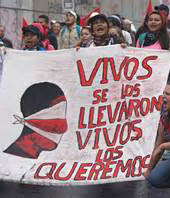
He cited the case of 43 young people who have been missing since Sept. 26 after police attacked students from Ayotzinapa Rural Normal School, a teachers college in the southern state of Guerrero, leaving six dead and 25 wounded.

“There have been many people disappeared in the history of Mexico, but I don’t know of a single case of this magnitude in real time (in all of) Latin America in the last 30 years,” he said.

“Impunity is the only explanation” for why such events continue to happen, Vivanco said.

President Enrique Peña Nieto’s first reaction to the mass abduction was “to wash his hands” of the matter by saying that the federal government could not do the job of state authorities, as if Guerrero “were Guatemala,” the head of HRW’s Americas desk said.

The current administration thinks that public discussion of crime and human rights projects “an image of an unsafe country,” Vivanco said.

Peña Nieto’s strategy is to sweep such problems under the rug, resorting to damage control “only if there is a scandal of gigantic and international proportions,” according to Vivanco.

But thanks to the missing students and to the still-unfolding scandal of Tlatlaya, which involved soldiers summarily killing at least eight civilians and then altering the scene to make it appear the fatalities died in a gunfight, the Mexican government’s image is now “in the dirt,” Vivanco said.

“Like the previous administration, it seems the current one is not inclined to do anything to change the existing impunity,” he said.

“Public servants, police and military personnel have the certainty that they will not be held accountable,” Vivanco said.

spot_img

Faith leaders unite to support Prop. 47

[Author]by Julian Do

New America Media
[/Author]
 

LOS ANGELES — The real-life story of José Osuna — like the character Jean Valjean in Victor Hugo’s novel Les Misérables — gives credence to the idea that a second chance is sometimes all you need to turn your life around.

A second chance is essentially what California’s Proposition 47, if approved by voters, would provide. The law would reduce prison terms for offenders like Osuna who were given long sentences for minor and non-violent offenses. The law would also reclassify many non-violent felonies, such as drug possession, as misdemeanors.

According to the most recent California Department of Corrections report, there are roughly 133,000 inmates incarcerated in California state prisons on any given day. If Proposition 47 passes, about one in five of those inmates could have their prison sentences reduced retroactively, resulting in early releases.

“At 17, I was arrested for a drug offense,” said Osuna, 45, who was a drug user and gang member before he reached 13. “When I was convicted, the judge sentenced me to a California state prison for five years.” Those years, he said, transformed him into something he never set out to be: a criminal. When he was released in his early 20s, he rejoined a gang and spent 13 of the next 17 years in and out of 12 different state prisons.

Stories like Osuna’s are commonplace in California, where the prison population has grown in recent decades to accommodate non-violent offenders swept up in the net of the federal War on Drugs and the state’s Three Strikes Law. Passed in 1994, that law imposed mandatory life sentences on anyone convicted of a third felony, regardless of whether that felony was violent or deemed serious in nature – something as minor as possession of an ounce of marijuana or stealing a hubcap would result in time served.

Osuna views the state prison system as a machine that feeds on people like him, only pretending to provide safety to the public. Recent trends suggest that the general public may be starting to see things similarly: in 2012 voters approved Proposition 36, a law that weakened the Three Strikes Law considerably, and seemed to signal a shift in public opinion in California about the role of prisons.

Faith leaders at the forefront

Today, alarmed by mass incarceration that has been separating families and damaging young people in their communities, religious leaders around the state are using Proposition 47 as a lightening rod to mobilize their constituents. Religious leaders gathered at a recent faith summit in Los Angeles, to map out a grassroots campaign to educate their congregations and get them out to vote for Prop. 47 on the November ballot.

Billed as The Safe Neighborhood and Schools Act, Prop. 47 would reclassify most of the “non-serious and nonviolent property and drug crimes” from a felony to a misdemeanor and permit re-sentencing for people who are serving sentences for misdemeanors and especially infractions.

The summit attracted nearly 150 religious and civic leaders from faiths such as Judaism, Catholicism, Islam, diverse Christian denominations, and ethnic communities such as African Americans, Jews, Latinos, Arabs, Filipinos, Japanese, Vietnamese, and Hmong.

Referring to the prison system – in which African-American and Latino populations are overrepresented — as racist and injustice, Rabbi Sharon Brous of IKAR, an independent congregation in Los Angeles, and Imam Shakeel Syed of the Islamic Shura Council of Southern California, joined in their call for community groups, regardless of ethnic makeup or religious affiliation, to unite in support of Prop. 47.

Other leaders, such as Father Wm. Tom Davis of Our Mother Of Good Counsel Catholic Community and Minister Alvin Tunstill of the Trinity Baptist Church, said the issue affects everyone.

“We should spend money on education, finding jobs for people, rather than keeping people in jails. Not only that, [but] socially, every time a person is jailed, his or her family is wrecked,” said Rev. Tunstill.

spot_img

Scientists: Ebola can go airborne but hasn’t in West Africa

[Author]Ebola can go airborne but hasn’t in West Africa because it’s too warm, researchers conclude


by Kit Daniels[/Author]


Ebola can spread by air in cold, dry weather common to the U.S. but not West Africa, presenting a “possible, serious threat” to the public, according to two studies by U.S. Army scientists.

After successfully exposing monkeys to airborne Ebola, which “caused a rapidly fatal disease in 4-5 days,” scientists with the U.S. Army Medical Research Institute of Infectious Diseases (USAMRIID) concluded Ebola can spread through air but likely hasn’t in Equatorial Africa because the region is too warm, with temperatures rarely dropping below 65°F.

“We… demonstrated aerosol transmission of Ebola virus at lower temperature and humidity than that normally present in sub-Saharan Africa,” the 1995 study entitled Lethal Experimental Infections of Rhesus Monkeys by Aerosolized Ebola Virus reported. “Ebola virus sensitivity to the high temperatures and humidity in the thatched, mud, and wattle huts shared by infected family members in southern Sudan and northern Zaire may have been a factor limiting aerosol transmission of Ebola virus in the African epidemics.”

“Both elevated temperature and relative humidity have been shown to reduce the aerosol stability of viruses.”

The study also referred to the 1989 Ebola outbreak at a primate quarantine facility in Reston, Va., in which the virus rapidly spread between unconnected rooms.

“While infections in adjacent cages may have occurred by droplet contact, infections in distant cages suggests aerosol transmission, as evidence of direct physical contact with an infected source could not be established,” the study added.

It is interesting to note this outbreak occurred in December 1989, when temperatures in Reston were usually below freezing, and it’s unlikely the indoor temperature in the vast quarantine facility was much higher.

A 2012 study also by the USAMRIID, which exposed monkeys to an airborne filovirus similar to Ebola, reached a similar conclusion to the 1995 study.

“There is no strong evidence of secondary transmission by the aerosol route in African filovirus outbreaks; however, aerosol transmission is thought to be possible and may occur in conditions of lower temperature and humidity which may not have been factors in outbreaks in warmer climates,” the study entitled A Characterization of Aerosolized Sudan Virus Infection in African Green Monkeys, Cynomologus Macaques and Rhesus Macaques stated.

The study pointed out that filoviruses, which include Ebola and the Sudan virus used in this particular study, have stability in aerosol form comparable to influenza.

“Filoviruses in aerosol form are therefore considered a possible, serious threat to the health and safety of the public,” it added.

And the Pentagon took this threat of airborne filoviruses so seriously that it organized a Filovirus Medical Countermeasures Workshop with the Department of Health and Human Services in 2013.

“The DoD seeks a trivalent filovirus vaccine that is effective against aerosol exposure and protective against filovirus disease for at least one year,” the executive summary of the workshop stated.

The Pentagon’s concern with airborne Ebola runs contrary to health officials who claim the disease can’t spread through coughing and sneezing, but according to the Army studies, that may only be true in tropical climates.

“How much airborne transmission will occur will be a function of how well Ebola induces coughing and sneezing in its victims in cold weather climates,” the web site potrblog.com suggested. “Coughing and nasal bleeding are both reported symptoms in Africa, so the worst should be expected.” infowars.com


In other Ebola’s news:


House testimony: sweat on bus surfaces can spread Ebola

HHS boss admits Ebola can survive in perspiration on inert surfaces


by Kurt Nimmo


Rep. Thomas Massie, a Republican from Kentucky, asked Rabih Torbay, the Vice President of International Operations for International Medical Corps., if somebody on a bus could catch Ebola from an infected passenger.

The exchange occurred on Friday during a House hearing on the federal government’s response to the disease. Massie also asked Health and Human Services Assistant Secretary Dr. Nicole Lurie about the transmissibility of Ebola.

Torbay said he is not a medical professional and tried to skirt the issue. Dr. Lurie said Ebola is present in perspiration but did not concede it may be spread on a bus. She also conceded that Ebola can live outside the body on inert surfaces.

Rep. Massie’s questions and the answers by Torbay, Lurie and Maj. Gen. James Lariviere indicate Ebola can be passed on in a bus or other public transport – for instance, the subway car used by a Doctors Without Borders physician hours before checking into a hospital where he was diagnosed with Ebola.

The question is, then: Is the government simply inept and incapable of handling a national health care issue, or are they hiding the truth from the American people for other, more nefarious reasons?

If Torbay and Lurie know Ebola can be passed on to others through sweat – and who in a crowded bus has not touched a pole or straphanger where sweat from an ill person may be present? – and they are hiding or avoiding telling people about the dangers, they should not only be fired, but brought up on charges of endangering public health. infowars.com

spot_img

UC Davis student establishes on-campus undocumented center

[Author]by Julia Ann Easley
[/Author]
UC Newsroom


A harsh reality once stood between Ana Maciel of Soledad, California, and her dream of a college education: She is an undocumented immigrant.

Now, just a few years later, the junior is living that dream at the University of California, Davis, and has played a role in establishing a center to help others like herself through their obstacles to a university education.

The new AB540 and Undocumented Student Center is opening in the heart of the campus. It will be part of the Student Community Center open house from 1 to 3 p.m. on Oct. 1, and hold a grand opening from 5 to 6:30 p.m. on Oct. 21.

“It means so much,” said Maciel, a junior majoring in Chicana/o studies and political science. “It means a central location where students can see they’re represented on campus and there are other people like them.”

AB540 refers to a California state law, passed in 2001, that exempts students from paying nonresident college tuition (which is costlier than resident tuition) if they have attended a California high school for at least three years, graduated from a California high school and met other requirements.

Empowering students

AB540 and undocumented students should have the support services they need to realize their dreams, said Adela de la Torre, vice chancellor for Student Affairs at UC Davis.

“I have seen the undue stress these students have faced working multiple jobs because of their limited access to financial aid and the isolation they have experienced not fitting into the more traditional student path,” she said. ”Now we can create an environment where they are no longer navigating these issues alone and have campus support to reach their full potential.”

The center will offer undocumented students community, coordinate resources for them and support their success. Andrea Gaytan, formerly assistant director of the Cross Cultural Center on campus, is the new center’s director.

Building on the efforts of students over the years, Maciel and other members of SPEAK (Scholars Promoting Education Awareness and Knowledge), a student-run organization that supports undocumented students, last year were drafting a proposal for a center and in discussions with campus leaders.

It was timely when in fall 2013, UC President Janet Napolitano announced a $5 million initiative to enhance student services and financial aid available to undocumented UC students. UC Davis is receiving $500,000 to serve its estimated 200 undocumented students.

Challenges for undocumented students

Predominantly Asian and Latino, most undocumented students at UC Davis graduate from underperforming high schools, are from low-income families, and are in the first generation of their family to go to college.

Gaytan said undocumented students face significant challenges. They must adapt to the campus culture, including both academic and administrative systems that can be difficult to navigate. They can often experience discrimination based on their lack of legal status, ethnic background and economic disadvantage. And they may fear the deportation of themselves or their family.

Services for undocumented students

The new center will offer academic and financial advising, and access to counseling services. It will also advocate for undocumented students and raise campus awareness about their concerns.

Through a partnership with the School of Law’s Immigration Law Clinic, the center will offer free immigration-related legal services including representation in immigration court or before immigration agencies; and workshops for preparing applications for Deferred Action for Childhood Arrivals, naturalization and other forms or immigration relief.

Gaytan, who started in August, has also served as program coordinator for an English-as-a-second-language program at Santa Fe Community College in New Mexico, taught English at two Mexican universities and English immersion at a California intermediate school. She is outgoing chair of the Latino Staff and Faculty Association at UC Davis.

Maciel will serve as the academic coordinator for the center. Three other undergraduates will help with outreach, retention and marketing. And two graduate researchers will assist with advocacy, policy, and education and training of staff.

The route to university

For Maciel, studying at a world-class university and helping others do the same is a long way from her native Irapuato, a city in the Mexican state of Guanajuato. She was told an uncle brought her across the border in 1997, and her mother crossed through the desert. Her childhood memories include long drives to her mother’s deportation hearings.

Maciel said she always loved school and wanted to go to a university. But when her high school teacher asked his class to bring in their parents’ documents so they could apply for federal student aid, she knew her family didn’t have the documents.

Paying for her daughter’s college seemed daunting to a single mother of four who worked in the fields and cared for other people’s children. Maciel’s mother could help her through the first quarter. Private scholarships would help, too.

Just about the time spring quarter fees were due that first year, Maciel learned she was among the first cohort of students to benefit from the new California Dream Act, which allows AB540 undocumented students to qualify for state and UC-funded aid.

“It was a huge relief,” Maciel said. “I knew I wouldn’t have to focus on money at finals. I was just so happy to be here.”

In 2013, Maciel was granted deferred action on removal from the United States and permission to work under the Deferred Action for Childhood Arrivals program. Since then, she’s worked at a clothing store in Salinas and as a research assistant. This year, in addition to her job at the center, she’ll also serve as an academic peer adviser in the Department of Chicana and Chicano Studies.

Maciel is enthusiastic about the year ahead. She’s eager to watch the AB540 and Undocumented Student Center come to life. And as co-chair of SPEAK, she wants to continue to advocate for affordable housing, grants and scholarships to provide more help for undocumented students.

spot_img

Boxing

The Sport of Gentlemen
OCTOBER 24
Moscow
Carlos Takam vs. Alexander Povetkin
12 rounds, heavyweights
Melbourne, Australia
Alex Leapai vs. Malik Scott
10 rounds, heavyweights

OCTOBER 25
Monte Carlo
Martin Murray vs. Domenico Spada
12 rounds, middleweights

NOVEMBER 1
SHOWTIME
New York, NY
Peter Quillin vs. Matt Korobov
12 rounds, for Quillin’s WBO middleweight title
NOVEMBER 8
HBO / BOXNATION
Atlantic City
Bernard Hopkins vs. Sergey Kovalev
12 rounds, IBF/WBA/WBO light heavyweight unificationNOVEMBER 12
Melbourne, Australia
Anthony Mundine vs. Sergey Rabchenko
12 rounds, junior middleweights


NOVEMBER 15
Hamburg
Wladimir Klitschko vs. Kubrat Pulev
12 rounds, for Klitschko’s lineal/IBF/WBO/WBA heavyweight title

NOVEMBER 22
HBO PPV
Macau
Manny Pacquiao vs. Chris Algieri
12 rounds for Pacquiao’s WBO welterweight title
Zou Shiming vs. TBA
12 rounds, WBO flyweight eliminator


spot_img

Macondo in San Francisco: A tribute to Colombian novelist Gabriel García Márquez

Compiled by the El Reportero staff

Believed by many to be one of the world’s greatest writers, Gabriel García Márquez was a Colombian-born writer and journalist, winner of the 1982 Nobel Prize for literature, and author of the international bestseller One Hundred Years of Solitude. He passed away in April 2014, at the age of 87. This evening’s tribute is co-hosted by KPOO announcer Chelis López and San Francisco Poet Laureate Alejandro Murguía.

On October 15 at 7 p.m., at Mission Branch of the San Francisco Public Library, at Bartlett and 24th

MEX Collects: The Mexican Museum to showcase recent Gifts and Acquisitions

The Mexican Museum, the premier West Coast museum of Mexican, Mexican-American, Chicano, Latin American and Latino art, culture and heritage, announces an exhibition entitled MEX Collects: Recent Gifts & Acquisitions, which will feature a dramatic selection of over 30 recent pieces recently gifted to The Mexican Museum. Visuals are available upon request.

The exhibition will run from Oct. 10, 2104 – Jan. 18, 2015. A special members’ preview reception will take place on Thursday, Oct. 9 at The Mexican Museum from 6pm to 8 p.m. The Museum is located at Fort Mason Center, Building D in San Francisco. It is open Wednesday through Sunday, from noon to 4 p.m. Admission is free.

For more information, please visit: http://www.mexicanmuseum.org or call (415) 202-9700.

Acting classes in Spanish and to participate in Theater Nahual Classes of performance in Spanish are offered by Verónica Meza of the Theater

Nahual. The classes are given at he National Hispanic University in San Jose, California.

To sign up and get more information, please visit us at: http://www.teatronahual.org/classes.html

The 15th Annual Brower Youth Awards

Be a part of our milestone celebration! The premier event honoring bold young environmental leaders from North America is right around the corner – and we want you to celebrate with us!

Meet our honorees before the Awards Ceremony and mingle with the Earth Island community.

Free Awards Ceremony: Nourse Theatre, 275 Hayes Street, between Van Ness and Franklin, SF, at 7:30 p.m. (doors at 7) – 9 p.m. The ceremony is open to the public, but RSVPs are necessary.

Tuesday, Oct. 21, San Francisco. RSVP for the Awards Ceremony, or Purchase Opening Reception tickets. Opening Reception at 5:30 p.m. – 7:15 p.m., at Wattis Room, Davies Symphony Hall, Grove Street between Van Ness and Franklin.

Bilingual podcast Radio Ambulante and Yerba Buena Center for the arts present Outsiders, a live radio performance streets, San Francisco.

Radio Ambulante returns to its hometown with a brand-new show called Outsiders, to be performed for one night only at the Yerba Buena Center for the Arts. Like previous live events, Outsiders will feature the kind of stories that Radio Ambulante listeners have come to expect — moving, surprising, funny audio stories from everywhere Spanish is spoken — re-imagined for the stage. Outsiders will be completely subtitled, and therefore accessible for both monolingual English and Spanish speakers to enjoy.

Radio Ambulante is a program of San Francisco’s KALW and Public Radio International and is hosted by the award-winning novelist Daniel Alarcón.

For Outsiders, Radio Ambulante will feature stories about people who skirt around the edges, taking the audience to visit an embattled town deep in the Peruvian jungle; to meet Cuban metalheads in the dark corners of Havana; to recall the grim early days of the AIDS epidemic; and hear the story of an accidental witness to a Mexico City wedding.

The show will feature music from the Bay Area DJ crew La Pelanga and a short film from the Colombian animator Malalegría based on a text from the Chilean novelist Álvaro Bisama.

At Yerba Buena Center for the Arts, 701 Mission Street, San Francisco, Sunday, Nov. 2, 2014. Doors at 4:30 p.m., show starts at 5 p.m.

spot_img

Destroying the right to be left alone: government agencies exploit technology to make privacy obsolete

FROM THE EDITOR:

Dear readers:

Privacy is an item in our liberties that has been clearly established from the Constitution from the very beginning of the nation, but which many have probably forgotten its meaning. In the following article, Matthew Harwood, from the Tom Dispatch, takes pretty inside about how the government has violated this principal in so many way, so undermining our freedom to be left alone. Due to its length, El Reportero will publish it in several parts. This is Part 1.

Destroying the right to be left alone: government agencies exploit technology to make privacy obsolete

by Matthew Harwood,
Tom Dispatch
News Analysis

For at least the last six years, government agents have been exploiting an AT&T database filled with the records of billions of American phone calls from as far back as 1987. The rationale behind this dragnet intrusion, codenamed Hemisphere, is to find suspicious links between people with “burner” phones (prepaid mobile phones easy to buy, use, and quickly dispose of), which are popular with drug dealers. The secret information gleaned from this relationship with the telecommunications giant has been used to convict Americans of various crimes, all without the defendants or the courts having any idea how the feds stumbled upon them in the first place. The program is so secret, so powerful, and so alarming that agents “are instructed to never refer to Hemisphere in any official document,” according to a recently released government PowerPoint slide.

You’re probably assuming that we’re talking about another blanket National Security Agency (NSA) surveillance program focused on the communications of innocent Americans, as revealed by the whistleblower Edward Snowden. We could be, but we’re not. We’re talking about a program of the Drug Enforcement Administration (DEA), a domestic law enforcement agency.

While in these last months the NSA has cast a long, dark shadow over American privacy, don’t for a second imagine that it’s the only government agency systematically and often secretly intruding on our lives. In fact, a remarkable traffic jam of local, state, and federal government authorities turn out to be exploiting technology to wriggle into the most intimate crevices of our lives, take notes, use them for their own purposes, or simply file them away for years on end.

“Technology in this world is moving faster than government or law can keep up,” the CIA’s Chief Technology Officer Gus Hunt told a tech conference in March. “It’s moving faster I would argue than you can keep up: You should be asking the question of what are your rights and who owns your data.”

Hunt’s right. The American public and the legal system have been left in the dust when it comes to infringements and intrusions on privacy. In one way, however, he was undoubtedly being coy. After all, the government is an active, eager, and early adopter of intrusive technologies that make citizens’ lives transparent on demand.

Increasingly, the relationship between Americans and their government has come to resemble a one-way mirror dividing an interrogation room. Its operatives and agents can see us whenever they want, while we can never quite be sure if there’s someone on the other side of the glass watching and recording what we say or what we do — and many within local, state, and federal government want to ensure that no one ever flicks on the light on their side of the glass.

So here’s a beginner’s guide to some of what’s happening on the other side of that mirror.

You won’t need a warrant for that Have no doubt:

the Fourth Amendment is fast becoming an artifact of a paper-based world.

The core idea behind that amendment, which prohibits the government from “unreasonable searches and seizures,” is that its representatives only get to invade people’s private space — their “persons, houses, papers, and effects” — after it convinces a judge that they’re up to no good. The technological advances of the last few decades have, however, seriously undermined this core constitutional protection against overzealous government agents, because more and more people don’t store their private information in their homes or offices, but on company servers.

Consider email.

In a series of rulings from the 1970’s, the Supreme Court created “the third-party doctrine.” Simply stated, information shared with third parties like banks and doctors no longer enjoys protection under the Fourth Amendment. After all, the court reasoned, if you shared that information with someone else, you must not have meant to keep it private, right? But online almost everything is shared with third parties, particularly your private e-mail.

Back in 1986, Congress recognized that this was going to be a problem. In response, it passed the Electronic Communications Privacy Act (ECPA). That law was forward-looking for its day, protecting the privacy of electronic communications transmitted by computer. Unfortunately, it hasn’t aged well.

Nearly three decades ago, Congress couldn’t decide if email was more like a letter or a phone call (that is, permanent or transitory), so it split the baby and decreed that communications which remain on a third party’s server — think Google — for longer than 180 days are considered abandoned and lose any expectation of privacy. After six months are up, all the police have to do is issue an administrative subpoena — a legal request a judge never sees — demanding the emails it wants from the service provider, because under ECPA they’re considered junk.

This made some sense back when people downloaded important emails to their home or office computers and deleted the rest since storage was expensive. If, at the time, the police had wanted to look at someone’s email, a judge would have had to give them the okay to search the computer where the emails were stored.

Email doesn’t work like that anymore. People’s emails containing their most personal information now reside on company computers forever or, in geek speak, “in the cloud.” As a result, the ECPA has become a dangerous anachronism. For instance, Google’s email service, Gmail, is nearly a decade old. Under that law, without a judge’s stamp of approval or the user ever knowing, the government can now demand from Google access to years of a Gmail user’s correspondence, containing political rants, love letters, embarrassing personal details, sensitive financial and health records, and more.

And that shouldn’t be acceptable now that email has become an intimate repository of information detailing who we are, what we believe, who we associate with, who we make love to, where we work, and where we pray. That’s why commonsense legislative reforms to the ECPA, such as treating email like a piece of mail, are so necessary. Then the police would be held to the same standard electronically as in the paper-based world: prove to a judge that a suspect’s email probably contains evidence of a crime or hands off.

Law enforcement, of course, remains opposed to any such changes for a reason as understandable as it is undemocratic: it makes investigators’ jobs easier. There’s no good reason why a letter sitting in a desk and an email stored on Google’s servers don’t deserve the same privacy protections, and law enforcement knows it, which is why fear-mongering is regularly called upon to stall such an easy fix to antiquated privacy laws.

As Department of Justice Associate Deputy Attorney General James Baker put it in April 2011, “Congress should also recognize that raising the standard for obtaining information under ECPA may substantially slow criminal and national security investigations.” In other words, ECPA reform would do exactly what the Fourth Amendment intended: prevent police from unnecessarily intruding into our lives.

spot_img

Border Patrol agent accused of assaulting migrant teen

by the El Reportero‘s wire services

A U.S. Border Patrol agent has been formally accused of assaulting a 15-year-old migrant detained in southern Arizona, authorities said Friday.

“The Border Patrol agent was sent by the court to our offices yesterday for us to take his photo and fingerprints,” Tony Estrada, sheriff of Santa Cruz County, told Efe Friday, adding that he hadn’t heard of a case of an immigrant being attacked like this for “a long time.”

The agent, identified as Aldo Arteaga, 35, must appear in court on charges of aggravated assault as a result of the Jan. 30 incident at the Border Patrol facility in Nogales, Arizona.

The investigation and accusation of Arteaga have been handled by the Border Patrol’s Office of Internal Affairs, for which reason Estrada said he had no knowledge of exactly what had happened.

Local media have said that the teen is a Mexican citizen, though Efe tried unsuccessfully to confirm his nationality with several consulates of that nation in Arizona.

The charges brought against the federal agent come at a time when the Border Patrol faces a series of accusations of turning a blind eye to the reported deaths and abuses of undocumented immigrants at the hands of its agents on the Mexican border.

spot_img

8 Soldiers Taken Into Custody Over Killings in Central Mexico

Eight soldiers have been taken into military custody over their alleged involvement in the deaths of 22 civilians on June 30, Mexico’s Defense Secretariat said Friday.

In a statement, the secretariat said one officer and seven enlisted men were turned over to military authorities in connection with the events that occurred in the central municipality of Tlatlaya, Mexico state.

spot_img

Catalonia Calls Independence Referendum in Spain

The head of Spain’s northeastern autonomous community of Catalonia, Artur Mas, on Saturday signed a decree calling an independence referendum for Nov. 9, although the national government in Madrid vowed to challenge the planned vote before the Constitutional Court.

The nationalist CiU coalition, which governs Catalonia, had promised during regional elections in 2012 to formally call an independence referendum. It is supported in that push by other pro-secession parties and grassroots organizations.

Mas said Saturday in signing the decree in a solemn ceremony at the regional government’s headquarters in Barcelona that it marks a “before and after” for Catalonia, but at the same time he said he is willing to negotiate the conditions of the plebiscite with Prime Minister Mariano Rajoy’s administration.

Minutes afterward, however, Deputy Prime Minister Soraya Saenz de Santamaria said in a public appearance that she “deeply” regretted the decree calling for the independence vote and said it “won’t be held because it’s unconstitutional.”

spot_img