


NATO General warns, Putin is a “dangerous gambler… willing to use nuclear weapons”
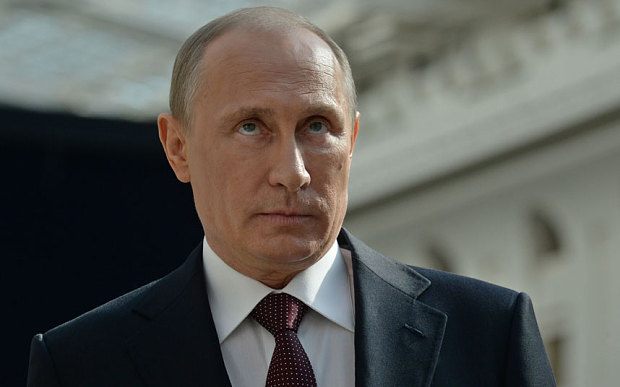
“There is a real danger China will align itself with Russia politically and militarily”
by Tyler Durden
Hot on the heels of George Soros’ warnings that we stand on the verge of World War 3, demanding Washington back off its anti-Yuan pressure, it appears “the good guys” are fighting back with their own good-cop, bad-cop propaganda. As Sputnik News reports, General hans-Lothar Domrose, NATO Commander of the Brunssum Allied Joint Force Command, said in an interview with German magazine Focus Online that Russian President Vladimir Putin is a tough-minded, forward-thinking politician who is capable of foreseeing situations, but also regards him as a dangerous “gambler,” who “is willing to use nuclear weapons against NATO troops.”
Soros previously noted, …unless the U.S. makes ‘major concessions’ and allows China’s currency to join the IMF’s basket of currencies, “there is a real danger China will align itself with Russia politically and militarily, and then the threat of world war becomes real.”
And so NATO has decided to make it clear just who the bad gyuys are in any equation of global thermonuclear war (as Sputnik News reports), General Hans-Lothar Domröse, Commander of Allied Joint Force Command Brunssum (The Netherlands) has revealed what NATO thinks of Russian President Putin.
In his interview with the German magazine Focus Online, Domröse called the Russian leader a tough-minded, forward-thinking politician who is capable of foreseeing the situation.
The general, however, added that Putin is a “gambler”, which might be dangerous. Unfortunately the general did not elaborate any further.
General Domröse also emphasized that neither NATO nor he personally consider Russia an enemy; at the worse, the country is seen as a potential threat. He stressed that no one in the alliance is interested in waging war; their purpose, rather, is to defend. He said that President Putin is aware of that, and that allows the general to sleep well.
The general is however concerned that President Putin might be willing to use nuclear weapons against NATO troops.
The full interview (via Focus Online – Google Translate) – NATO General Hans-Lothar Domröse on the new rapid reaction force, and the threat of Russia General, we are not already at war with Russia – in a propaganda war?
The Russian propaganda machine is running and acts. We will reply to the west on the truth quickly, and we gloss over anything. It may there be exceptions, but it is the principle. However, it is an old Russian tradition, matters only not admit it then to comment in a different light, and finally to make a U-turn. Let’s take the example of the Crimea. It was said at the beginning: We are not. Then it was: Yes, there are also Russian soldiers. But they’re on vacation . Soldier on vacation with equipment so. The summit was then entering into argument of President Putin: I had to intervene there.
Should the West respond with counter-propaganda?
He must not be primarily be lulled. I can understand the concern of our Baltic friends who warn repeatedly: Warning, not fall for the Russian scam. We have to be straight and honest go our way. Let the differences quietly made: We stick to the truth.
How is the Russian military presence in and around the Ukrainian troubled region?
The Russian armed forces are permanently very active since the beginning of Ukraine crisis in the air. We have over 300 airspace violations or fast-injury. On Russian territory at a location nearby Ukraine regiments, classic combat units. We also have time with Special Forces dealing with jeans and sunglasses, the seep.
They currently rely on a highly mobile task force, which is to make the eastern flank of NATO safer. How far are you with it?
We are nearing the realization of our plans, including the necessary infrastructure. We know from the Russian military exercises that Russia can move 100 000. soldiers very quickly. We have responded and the NATO Response Force, so to speak, our firefighters, reinforced, 13 000 to 30 000 men. NATO has also decided to make these forces available more quickly, thus reducing the alarms. And we need a spearhead, a sort of scouts who can start immediately. This is on the order of a brigade, good 5,000 men, supported by ships and aircraft, which can be moved within a week to counter a possible attack. First, they should put off, in the hope that there will be no further.
How credible deterrence may in such outnumbered ever be?
That’s a relatively small troupe 5000-7000 man, so much is true. But its essential value is that it represents more than half of all NATO members. So there are around 20 different countries always on site. And just in case, each nation would be affected. But let me emphasize that: No one in NATO wants to wage a war. But we will protect the population. I believe that President Putin knows it. That’s why I still sleep well.
NATO has Putin challenged by being moved up to close to the Russian borders?
That, sir, is nonsense. NATO is a values-based defense alliance. It is in principle open to like-minded people. Nations seek its own initiative to take charge. The Alliance itself will not do so on fishing expeditions to get more members into the basket.
Former members of the Warsaw Pact now belong to NATO and are still equipped with Russian military technique. Delivering the Russians still spare parts?
Currently, they do not. I hear you supplied on the open market.
Putin would be willing to use nuclear weapons against NATO troops?
We consider this issue with great concern. The Russians maintain the tactical use of nuclear weapons in the battle for a possible form of warfare.
I think President Putin is a forward-thinker. But also a gambler. That can also be dangerous. You have to make the cost of the use of [nuclear weapons] so high that it seems too expensive to him for him. Since we are on track. But I want to emphasize that neither NATO nor Domröse consider Russia as an enemy. Very well, but as a threat.
Mexican daily warns of US military presence in Central America
by the El Reportero’s wire services
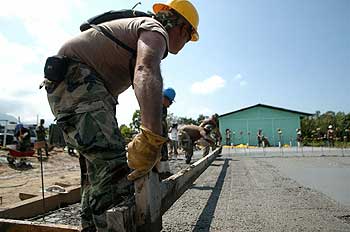
The new deployment of U.S. troops in Central America will open another cycle of mass violations of human rights and atrocities in the region, Mexican daily newspaper La Jornada warned today.
In an article, La Jornada says that in previous years, the deployment of U.S. soldiers in the area has meant an increase in violations committed by the military forces led, trained and funded by the Pentagon and the CIA.
“The presence of the U.S. military contingents have been translated into massacres, mass human rights violations, backing of unpresentable tyrants and the loss of sovereignty in the affected nations,” said the journal.
La Jornada recalled that many military incursions ended up in occupations or in the formation of “puppet regimes” in Nicaragua, Guatemala and Honduras.
It also warned that the authorities in Washington continue with their colonialist, pro-interference leaning, disrespecting human rights and sovereignty.
La Jornada cited police abuse in the streets of U.S. cities, the torture of prisoners in Guantanamo (Cuba) and Abu Ghraib (Iraq) and the military interventions in Libya and Syria.
The Mexican daily published these reflections after the announcement yesterday that in the next few days, the U.S. Southern Command would be deploying 280 marines in Honduras and in other Central American countries to take part in drills with local security forces under the alleged purpose for the Pantagon to have units available in the area to help face eventual disaster during the hurricane season 2015, on June 1st- Nov. 30.
According to a communique, 200 troops will be deployed in the U.S. base in Palmerola, some 75 km north of Tegucigalpa, and the rest will be deployed in Belize, El Salvador and Guatemala to accomplish cooperation missions as needed by each country.
However, in the past few months, political activists and social leaders have denounced the maneuvers, describing them as U.S. interference in the internal affairs of those countries and a threat to progressive movements and governments in the area.
Fine-art artist América Jiménez’s exhibit opens with amazing paintings in SF

Compiled by the El Reportero’s staff
Want to be a witness of a quality, high definition art exhibition? Then do not miss this incredible event of fine art in the City.
America Jiménez a countryside Mexico-born, Bay Area artist, has been preparing day and night for several months specifically for this presentation. Nearly 40 paintings of her own will be exhibited with grand splendor.
She describes her work as eclectic, using oil, acrylic, watercolor, charcoal, pastels and mixed media.
A graduate from UC Berkeley with a BA in Arts with emphasis in mixed media (oils, watercolors, acrylics, sculpture, photography) as well as creative writing and ceramics, America decided to leave the corporate world in 2012, to pursue her passion as an artist and become an advocate for Culture and Education.
She launched and is CEO of Global America which promotes a “Cultural Renaissance”.Recently merging Global America with CandleLight to create a Gallery and Studio that will allow for a stronger growth and impact in the arts.
At Payne Mansion Hotel, 1409 Sutter St, at Franklin Street, San Francisco, on Thursday, May 21, 2015 from 6 p.m. to 9 p.m.
Carnaval SF 2015 to Sizzle with participation by Grand Marshal Sheila E.
The Mission district will sizzle with the sights and sounds of samba, salsa, soca, cumbia and the participation of parade grand marshal, Bay Area native and musical icon Sheila E., when the 37th Annual Carnaval San Francisco makes its way through the neighborhood, showcasing the very best of Latin American and Caribbean cultures.
Carnaval San Francisco offers a dazzling array of food, music, dance and artistry from Bolivia, Brazil, Cuba, El Salvador, Jamaica, Mexico, New Orleans, Puerto Rico, Trinidad and more. Works created by the talented community of Mission District residents and Bay Area artists are also showcased.
Event organizers chose this year’s theme, “Agua Sacrada! Cada Gota Cuenta! – Sacred Water! Every Drop Counts” to celebrate water as precious and sacred.
Poet Jorge Argueta will perform a poem at the festival written in direct co-relation with the theme.
The Carnaval San Francisco Festival will be held Saturday and Sunday, May 23 and 24 from 10 a.m. – 6 p.m. Located on Harrison Street between 16th and 24th Streets, the Festival will feature a rich assortment of food, music, dance, arts, crafts and other fun activities and entertainment on several stages for people of all ages to enjoy. A special live tribute performance for Bay Area native and musical icon Pete Escovedo will take place Saturday, May 23 at 4:30 p.m. at the Harrison and 22nd streets stage in honor of his 60 years in the music business and his 80th birthday. The complete list of festival participates can be found at http://www.carnavalsanfrancisco.org/festival.
Eliana López debuts Original Bilingual Monologue, ¿Cual es el Escándalo?
Eliana López in her bilingual monologue ¿Cual es el Escándalo? for a three-weekend-long series.
Award-winning film, theater, and television actress, Eliana López, presents an original piece created by her and her brother Alfonso López and produced by Ivette Carolina Agudelo, celebrating Latina women’s values through a comedic one-woman show. Through her various characterizations, López covers themes such as immigration, discrimination, and racism, demonstrating the power of one woman daring enough to speak her truth.
Eliana López born in Caracas, Venezuela, made her debut at 16 as the main actress in the prestigious National Theatre Company of Venezuela. She has since worked in Mexico and Venezuela, and her most recent work includes Spanish theatrical performances of The Vagina Monologues.
General admission for this event costs $18 Advance until May 3, and $20 after May 4. Admission to week one and week two performances are guaranteed, and admission to week three performances will be by popular demand only.
At the Mission Cultural Center for Latino Arts (MCCLA), beginning Friday, May 29 from 8-9:15 p.m. through Sunday June 14 from 6–7:15 p.m.
Colombia recovers stolen book of García Márquez
by the El Reportero’s news services
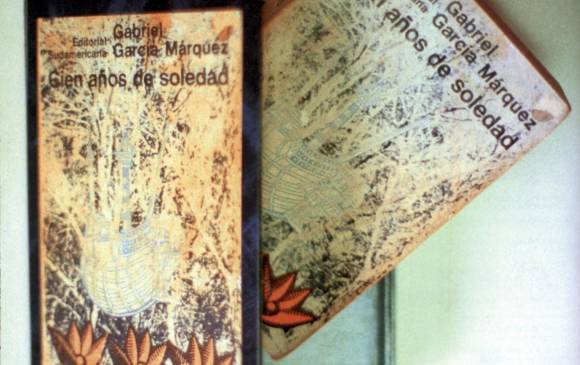
After an intensive search the volume of One Hundred Years of Solitude stolen during the Book Fair of Bogota, returned to the hands of its owner, who announced that he will donate it to the National Library of Colombia, today confirmed the press.
The text dedicated and signed by its author, Gabriel García Márquez, belongs to the private collection of Alvaro Castillo.
This bookseller treasures recognized the first editions of the works of the Nobel Prize for Literature.
According to reports from investigators in the case, the book was recovered in the La Perseverancia, located in downtown Bogota, in a sector where functions a market of pieces of great literary and cultural value, regardless of the law.
The book published in 1967 was to be sold on the black market worth 120 million pesos (about $ 60,000), said the police chief Rodolfo Palomino after providing details of the operation on the trail of this literary gem.
According to Castillo, there is a treasure that belongs to the country so you should be in the National Library.
This text disappeared the week before the Corferias exhibition complex, specifically the Macondo Pavilion, dedicated to revere the narrator and journalist who died last year in Mexico, victim of cancer.
The novel One Hundred Years of Solitude is considered the best example of its kind written in Castilian after Quixote by Miguel de Cervantes.
Gabo left for posterity other prominent creations, among which Love in the Time of Cholera, which he defined as the most human of his writings, Of Love and Other Demons, Chronicle of a Death announced and a series of stories.
Mexican Cuarón to chair jury at Venice International Film Festival
Mexican filmmaker Alfonso Cuarón will chair the jury that will deliver the Golden Lion at the next Venice International Film Festival, according to organizers of the famous film festival.
Cuarón, who won a screenplay award in Venice with his classic Y Tu Mama También and then opened the event with Gravity will rule along with eight more members what is the best movie of the event.
The 72 edition of the contest will run from September 2nd to 12th, coinciding with the end of the busy Arts Biennial of the City of Canals.
The decision to entrust the presidency of the jury to Cuarón was taken by the board of the ‘Biennale’, whose cinema chapter is directed by Alberto Barbera.
Corporate gods: “Obama, remember why we hired you; ram the TPP through

by Jon Rappoport
NoMoreFakeNews.com
“Current TPP negotiation member states are the United States, Japan, Mexico, Canada, Australia, Malaysia, Chile, Singapore, Peru, Vietnam, New Zealand and Brunei. The TPP is the largest economic treaty in history, including countries that represent more than 40 per cent of the world´s GDP.” (Wikileaks)
“Since 1945, no American President has escaped vetting by elite Globalists. Partisan politics plays no role in this process. The one overriding issue of every Presidency has been: make sure Globalist legislation and treaties pass through to completion. Do not obstruct them. A little crooked President named Nixon got it in his head to erect anti-Globalist tariffs. He found himself on the floor looking up, with Henry Kissinger, David Rockefeller’s man, staring down at him, assuring him his days in the White House were over.” (The Underground, Jon Rappoport).
Obama is under the gun. Not since he pressured Congress, on behalf of the pharmaceutical companies, to pass Obamacare, has he worked so hard and sweated so much.
The latest Globalist treaty, the TPP (Trans-Pacific Partnership), is on the table.
Elite mega-corporations all over the world, the Council on Foreign Relations (Rockefeller), the Bilderberg Group, the Trilateral Commission (Rockefeller) want the TPP to be ratified by the 12 member nations. They really want it. They insist on it.
Obama has run into Congressional roadblocks. They appear to be temporary, but make no mistake about it, he was put into office to bring this treaty to fruition. Failure is not an option.
Whatever Obama has to promise, to whomever he has to promise it, he’s making deals. Side deals, back room deals, upside down deals.
His masters don’t care that he’s a lame duck President at this point. Lame duck, waddling duck, it makes no difference. He’s got to come through.
And he knows it.
He also knows, because the TPP is another Globalist treaty, that more jobs will flee the US, more cheap imported goods will flood the US market from countries where slave wages prevail, where environmental laws aren’t worth the paper they’re printed on. He knows those cheap goods will sink more American businesses.
He knows no private citizen anywhere in the world who doesn’t run a big corporation has read the contents of the TPP—and won’t read them before its passage.
Obama has had his marching orders for 10 years. He realized going in who his bosses were.
The Globalists don’t play games when it comes to a treaty like this. The TPP is their baby.
Remember Pelosi? She blew the whistle during the midnight negotiations on Obamacare. She said to her Congressional colleagues: “If you want to know what’s in the bill, you have to vote for it. Then you can read it.”
People began to wake up to the fact that, when thousand-page bills are on the table, legislators either can’t read them or choose not to. They just vote the way they’re told to.
So here is another one: the TPP. Congressional representatives have to go into a sealed room and read it. They can’t make copies. They can’t tell the public what’s in it.
Senator Rand Paul just went into the room. When he came out, he said he didn’t even know whether he’d read a draft or the final version.
He said he couldn’t disclose what was in the treaty. Why not? Who made that decision? Under what illegal authority are legislators prohibited from revealing the details of a treaty that will, when passed, bind all Americans and citizens of 11 other countries?
Leaks indicate that the TPP will set up private courts to rule on disputes between corporations and governments. For example, a foreign corporation tries to export a product to the US. They’re blocked. They appeal to this court. Relevant US law and US courts are ignored. Questions pertaining to environmental harm or toxicity of the product are decided in secret.
As Wikileaks notes, “Similar mechanisms have already been used. For example, US tobacco company Phillip Morris used one such tribunal to sue Australia (June 2011 – ongoing) for mandating plain packaging of tobacco products on public health grounds; and by the oil giant Chevron against Ecuador in an attempt to evade a multi-billion-dollar compensation ruling for polluting the environment. The threat of future lawsuits chilled environmental and other legislation in Canada after it was sued by pesticide companies in 2008/9. ISDS [Investor-State Dispute Settlement] tribunals are often held in secret, have no appeal mechanism, do not subordinate themselves to human rights laws or the public interest, and have few means by which other affected parties can make representations.”
Like GATT, NAFTA, and CAFTA, the TPP is a Globalist treaty that expands the power of mega-corporations around the world. At will, they move their manufacturing operations to places where workers are virtual slaves. They sell goods across borders, without paying billions in tariffs, regardless of the effects on smaller competitors, who are torpedoed and forced out of business.
All treaties under consideration should be published in full, at least two years before member nations vote on them. Then we would have time to see and understand what’s in them.
The secret shroud surrounding the TPP is a criminal farce.
Mainstream media dupes are fond of saying that those who warn against global dictatorship are crazy conspiracy theorists.
Well, what do you call it when a secret treaty expanding the international power of mega-corporations is passed into law, when that law supersedes every other law and court of the member nations?
Would you call it “a good business decision?” “Employment enhancement?” “Smarter people helping the rest of us?”
In the US, Congressional legislators are prancing and dancing and fencing. They aren’t at all sure they know what’s in the TPP. But their debates are taken seriously, as if they actually mean something.
It’s the blind leading the blind leading the blind. But behind it all, the architects of the TPP are fully aware of the meaning and consequences of what they’re doing.
They plucked Barack Obama out of obscurity to carry out a job. This job. Passage of the treaty.
So much for “the leader representing the people.”
Ditto for the other 11 members of the TPP.
Puppet show. Shadow play.
Organized crime.
The TPP treaty is a kind of religious document. We have to take it on faith. We have to accept what the priests are telling us.
They’re our pipeline to the corporate gods.
I’ve quoted the following interview in previous articles. It reveals the kind of Globalist power I’m talking about.
Here is a close-up snap shot of a remarkable moment from out of the past. It’s through-the-looking-glass—a conversation between reporter, Jeremiah Novak, and two (Globalist/Rockefeller) Trilateral Commission members, Karl Kaiser and Richard Cooper. The interview took place in 1978. It concerned the issue of exactly who was formulating US economic and political policy, which would include trade treaties like the TPP.
The careless and off-hand attitude of Trilateralists Kaiser and Cooper is astonishing. It’s as if they’re saying, “What we’re revealing is already out in the open, it’s too late to do anything about it, why are you so worked up, we’ve already won…”
NOVAK (the reporter): Is it true that a private [Trilateral committee] led by Henry Owen of the US and made up of [Trilateral] representatives of the US, UK, West Germany, Japan, France and the EEC is coordinating the economic and political policies of the Trilateral countries [which would include the US]?
COOPER: Yes, they have met three times.
NOVAK: Yet, in your recent paper you state that this committee should remain informal because to formalize ‘this function might well prove offensive to some of the Trilateral and other countries which do not take part.’ Who are you afraid of?
KAISER: Many countries in Europe would resent the dominant role that West Germany plays at these [Trilateral] meetings.
COOPER: Many people still live in a world of separate nations, and they would resent such coordination [of policy].
NOVAK: But this [Trilateral] committee is essential to your whole policy. How can you keep it a secret or fail to try to get popular support [for its decisions on how Trilateral member nations will conduct their economic and political policies]?
COOPER: Well, I guess it’s the press’ job to publicize it.
NOVAK: Yes, but why doesn’t President Carter come out with it and tell the American people that [US] economic and political power is being coordinated by a [Trilateral] committee made up of Henry Owen and six others? After all, if [US] policy is being made on a multinational level, the people should know.
COOPER: President Carter and Secretary of State Vance have constantly alluded to this in their speeches. [untrue]
KAISER: It just hasn’t become an issue.
Source: “Trilateralism: The Trilateral Commission and Elite Planning for World Management,” edited by Holly Sklar, 1980. South End Press, Boston. Pages 192-3.
This interview “slipped under the mainstream media radar,” which is to say, it was ignored, buried, sat on, censored.
US economic and political policy run by a committee of the Trilateral Commission—the Commission had been created in 1973 as an “informal discussion group” by David Rockefeller and his sidekick, Zbigniew Brzezinski, who, much later, was Obama’s mentor in the months before he was sworn in for his first term as President.
To inhale the scent of Obama’s approach to TPP negotiations, here is a quote from his first appointed US Trade Representative, Ron Kirk. Replying to his critics, Kirk wrote: “I am strongly offended by the assertion that our [TPP negotiating] process has been non-transparent and lacked public participation.”
This comment, in the face of the fact that the exact terms of the TPP are still secret.
(Jon Rappoport is the author of three explosive collections, The Matrix Revealed, Exit From The Matrix, and Power Outside The Matrix).
Meet the secretive group that runs the world – Part 3
NOTE FROM THE EDITOR:
Dear readers, I found this great article, previously published by Zero Hedge, on one of the most secretive banks: the Bank of the International Settlements. This is the bank that is above all banks, top of the top of the world controllers. Higher than all world Central Banks. Super interesting! THIS IS PART THREE OF A SERIES.
Nothing comes closer to the stereotypical, secretive group determining the fate of over 7 billion people, than the Bank of International Settlements
by zero hedge
Over the centuries there have been many stories, some based on loose facts, others based on hearsay, conjecture, speculation and outright lies, about groups of people who “control the world.” Some of these are partially accurate, others are wildly hyperbolic, but when it comes to the historic record, nothing comes closer to the stereotypical, secretive group determining the fate of over 7 billion people, than the Bank of International Settlements, which hides in such plain sight, that few have ever paid much attention.
WHEN I EXPLAINED to friends and acquaintances that I was writing a book about the Bank for International Settlements, the usual response was a puzzled look, followed by a question: “The bank for what?” My interlocutors were intelligent people, who follow current affairs. Many had some interest in and understanding of the global economy and financial crisis. Yet only a handful had heard of the BIS. This was strange, as the BIS is the most important bank in the world and predates both the IMF and the World Bank. For decades it has stood at the center of a global network of money, power, and covert global influence.
The BIS was founded in 1930. It was ostensibly set up as part of the Young Plan to administer German reparations payments for the First World War. The bank’s key architects were Montagu Norman, who was the governor of the Bank of England, and Hjalmar Schacht, the president of the Reichsbank who described the BIS as “my” bank. The BIS’s founding members were the central banks of Britain, France, Germany, Italy, Belgium, and a consortium of Japanese banks. Shares were also offered to the Federal Reserve, but the United States, suspicious of anything that might infringe on its national sovereignty, refused its allocation. Instead a consortium of commercial banks took up the shares: J. P. Morgan, the First National Bank of New York, and the First National Bank of Chicago.
The real purpose of the BIS was detailed in its statutes: to “promote the cooperation of central banks and to provide additional facilities for international financial operations.” It was the culmination of the central bankers’ decades-old dream, to have their own bank—powerful, independent, and free from interfering politicians and nosy reporters. Most felicitous of all, the BIS was self-financing and would be in perpetuity. Its clients were its own founders and shareholders— the central banks. During the 1930s, the BIS was the central meeting place for a cabal of central bankers, dominated by Norman and Schacht. This group helped rebuild Germany. The New York Times described Schacht, widely acknowledged as the genius behind the resurgent German economy, as “The Iron-Willed Pilot of Nazi Finance.” During the war, the BIS became a de-facto arm of the Reichsbank, accepting looted Nazi gold and carrying out foreign exchange deals for Nazi Germany.
The bank’s alliance with Berlin was known in Washington, DC, and London. But the need for the BIS to keep functioning, to keep the new channels of transnational finance open, was about the only thing all sides agreed on. Basel was the perfect location, as it is perched on the northern edge of Switzerland and sits al- most on the French and German borders. A few miles away, Nazi and Allied soldiers were fighting and dying. None of that mattered at the BIS. Board meetings were suspended, but relations between the BIS staff of the belligerent nations remained cordial, professional, and productive. Nationalities were irrelevant. The overriding loyalty was to international finance. The president, Thomas McKittrick, was an American. Roger Auboin, the general manager, was French. Paul Hechler, the assistant general manager, was a member of the Nazi party and signed his correspondence “Heil Hitler.” Rafaelle Pilotti, the secretary general, was Italian. Per Jacobssen, the bank’s influential economic adviser, was Swedish. His and Pilotti’s deputies were British.
After 1945, five BIS directors, including Hjalmar Schacht, were charged with war crimes. Germany lost the war but won the economic peace, in large part thanks to the BIS. The international stage, contacts, banking networks, and legitimacy the BIS provided, first to the Reichsbank and then to its successor banks, has helped ensure the continuity of immensely powerful financial and economic interests from the Nazi era to the present day.
* * *
FOR THE FIRST forty-seven years of its existence, from 1930 to 1977, the BIS was based in a former hotel, near the Basel central railway station. The bank’s entrance was tucked away by a chocolate shop, and only a small notice confirmed that the narrow doorway opened into the BIS. The bank’s managers believed that those who needed to know where the BIS was would find it, and the rest of the world certainly did not need to know. The inside of the building changed little over the decades, recalled Charles Coombs. The BIS provided the “the spartan accommodations of a former Victorian-style hotel whose single and double bedrooms had been transformed into offices simply by removing the beds and installing desks.”
The bank moved into its current headquarters, at 2, Centralbahnplatz, in 1977. It did not go far and now overlooks the Basel central station. Nowadays the BIS’s main mission, in its own words, is threefold: “to serve central banks in their pursuit of monetary and financial stability, to foster international cooperation in these areas, and to act as a bank for central banks.” The BIS also hosts much of the practical and technical infrastructure that the global network of central banks and their commercial counterparts need to function smoothly. It has two linked trading rooms: at the Basel headquarters and Hong Kong regional office. The BIS buys and sells gold and foreign exchange for its clients. It provides asset management and arranges short-term credit to central banks when needed.
Five items you see that every day that contain animal ingredients
by Jeanette Padilla
When you start to read the fine print, it becomes very clear that avoiding animal products in non-food items is nearly impossible. It’s hard enough trying to navigate through food items to avoid eating something containing animal byproducts; avoiding animal products in non-food items is an entirely different challenge. A growing number of individuals are becoming part-time vegetarians and opting for meatless meals one or more days a week. This growing trend is a welcomed one since it will help lead to healthier lifestyles, less livestock-produced methane and happier animals. However, many individuals are not aware of the many animal-derived ingredients used in common everyday products, some of which you’d never guess contain animal ingredients.
Toothpaste
Glycerine, also known as glycerin or glycerol, is a common ingredient in toothpaste. It’s present in nearly every brand of toothpaste as well as in many beauty products. Glycerin can be sourced from animals or vegetables, which makes it tricky when trying to avoid animal products. Animal-derived glycerine comes from the fatty tissue of animals. The fat contains triglyceride molecules, each of which contains three fatty acid chains all connected to a glycerol base. When processed, the bonds between the fatty acids and the glycerol are broken and glycerine results as a byproduct.
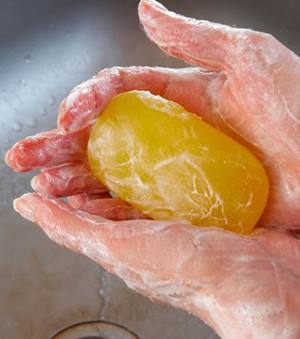
Soap
The majority of all bar soaps contain animal-derived tallow. This is what gives them the ability to moisturize. Some individuals choose to use tallow soap because of specific allergies. However, most people using bar soap won’t ever realize that they’re washing with animal fat. If you’re using a large brand of bar soap, chances are, your soap has tallow in it. Current Dove soap bars list the ingredient as “sodium tallowate.”
Shampoo
Glycerin may not be the only animal-derived ingredient in your personal care products. According to information from PETA, there may be over 20 animal-derived ingredients in your shampoo. Ingredients may include “panthenol,” “vitamin B” and “amino acids,” all of which can be derived from animals.
Fabric softener
Tallow or tallowate is the fat derived from animals such as cows, sheep, pigs and horses. The fat is rendered down and after a few chemical alterations is added to fabric softeners like Downey. On the bottle, it’s labeled as “dihydrogenated tallow dimethyl ammonium chloride.” What it really is: fat coating your clothing.
Plastic bags
Animal ingredients in cosmetics, beauty products, and similar products isn’t too far-fetched, but how about in plastic bags? Yes, even plastic bags have animal-derived ingredients. Animal fat is added to plastic bags, such as those you get at the grocery store, pharmacy, retail stores and just about everywhere really. The fat serves as a “slip-agent” and is added to a large array of other plastics as well. Yet another reason to forego plastic bags and switch to reusable bags made from animal-friendly materials.
Animal fat is used in a large variety of products, from cosmetics and personal care products to plastics and even some electronics. The fat typically comes from cows, pigs, sheep or horses. Additionally, some products are processed using animal components even though they may not be a part of the final product. Food items such as sugar are processed using cow and horse bones, and beer and wine are clarified using fish bladders, also known as isinglass. Vegetable-sourced substitutions are available to be used in place of all of these animal-derived components; however, using animal-derived components is far cheaper. Natural News.
Hard labor in the organic patato field
by David Bacon
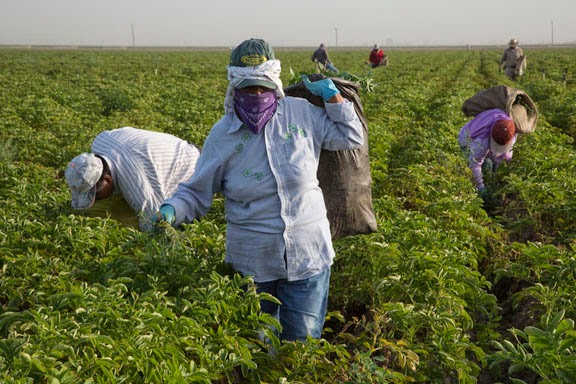
By 7:30 in the morning it is already 80 degrees in a potato field in Lamont, in the southern San Joaquin Valley. By mid-afternoon here it will reach 107. The workers moving up and down the rows are not dressed in shorts and tank tops, though. They wear multiple layers of clothing, including long sleeves and, in the case of women, bandannas that cover their faces, leaving only their eyes visible.
Farmworkers know how to handle heat. They work in these intense conditions every day. ‘’Clothing is like insulation,’’ says Evelina Arellano. ‘’It actually protects you. And if I didn’t wear my bandanna, by the end of the day it would be hard to breathe because of the dust.’’ [The names of the workers in the field have been changed-Ed.]
The rows are as long as two football fields, each a deep furrow next to a mound bearing the potato plants. Between the potatoes grow weeds, some spreading out next to the dirt and others growing as tall as the workers themselves. On this day in mid-June the farm labor crew is pulling the weeds.
Men and women walk from weed to weed, bending down low, pulling each out by the roots. You can hear the breath expelled by each effort to tear a big one from the ground.
Everyone carries a bag on his or her back, and stuffs the weeds into it. As workers move down the rows, the bags expand and get heavy. The weeds are scratchy, even with gloves, and as the morning wears on, the sun gets hotter. There is a lot of dust everywhere in the air in the southern San Joaquin Valley, which has some of California’s worst air quality.
Soon you are unable see to the far edge of the field next to this one.
If this were a potato field like most in the valley, the dust would contain pesticide and herbicide residue. Here the dust may be unpleasant, but it is not toxic, because the field is growing organic potatoes for one of California’s largest producers of organic vegetables, Cal Organic Farms.
Potato plants take from three to four months to grow to maturity, and this field contains anywhere from 17,000 to 22,000 plants. Probably back in late February or early March, it was seeded with potatoes or pieces of potatoes that contain the eye, from which the new sprout grows. Cal Organic Farms says it can get two crops a year in the San Joaquin Valley.
This field is almost ready to be harvested, and weeds can interfere with the operation of the mechanical harvester. Weeds also compete for water, not a minor factor given California’s drought, and can provide an environment for pests that can damage the tubers.
So a healthy attractive organic potato-ready for au gratin, potato salad, or your grandmother’s adobo – is much more a product of workers’ labor than the non-organic kind. Organic produce not only has created somewhat healthier conditions for these farmworkers, it has also meant more work. Since the grower cannot use herbicides, weed removal is accomplished by hand. That means workers are hired to remove them, instead of spraying the field with chemicals.
Cal Organic Farms grows a variety of vegetables, and other operations also require human labor instead of chemical inputs. As a result, the work season for a Cal Organic crew lasts longer than for many other farmworkers.
‘’I started on January 27th,’’ explains Josefina Reyes, ‘’and I’ll work until November 1st.’’
Hernandez and her husband, Alfredo, are the oldest workers in the crew. They are no longer able or willing to do what others do to get nine months of work a year: hit the road to northern California or even Oregon and Washington. Organic farming gives them enough work so that they can live in Lamont year-round. If they save their money, they will be able to make it through the three months of winter when growers are not hiring.
At lunch break the couple talk to each other quietly in Mixteco, an indigenous language that was spoken in their hometown of Tlaxiaco, in the Mexican state of Oaxaca, long before Columbus arrived in the Americas.
For lunch small groups of friends sit together at the side of the field, and some build small fires to heat their tacos. One popular taco filling is chorizo, the spicy Mexican sausage, mixed with papas, or potatoes. Organic potatoes are expensive in the market, but these workers are surrounded by fields of them. Many like the idea of eating food with no pesticides as much as anyone. Farmworkers are exposed to much greater pesticide levels than what is contained in food. Many here in this crew worked in sprayed fields earlier in their work lives, and pesticide residue is omnipresent in small farmworker towns like Lamont.
From the late 1960s to the early 1980s, Lamont and the southern San Joaquin Valley were strongholds of the United Farm Workers of America (UFW), the union founded by Cesar Chavez, Larry Itliong, and Dolores Huerta. At the height of the UFW’s strength, the base wage for farm labor in this area was two to three times the minimum wage. Translated into today’s terms, this would be $16-24 per hour. One method the union used to get wages up was to ban labor contractors, and instead to operate union hiring halls. In the 1980s the union lost most of its contracts here, the hiring halls disappeared, growers went back to using contractors, and wages fell. Worker abuse increased as well.
Low wages and abuse are as prevalent in organic agriculture as they are in the non-organic sector. Case records at the California Occupational Safety and Health Agency (Cal OSHA) show that organic growers and contractors have engaged in practices that were prohibited forty years ago.
The organic potatoes from the Lamont field by now have been harvested, and are sitting in the bins at stores, and in the potato drawer in kitchens across the country. The weeding crew has moved on to some other field, getting the next vegetable ready for its journey to the plate. Despite their hard work, however, it often seems as though these workers live in a different dimension. We may eat the food they produce, but most people do not know what it is like to labor out in the heat and dust, or what it takes to get food onto the dinner table.
Those broccoli florettes sauteed in cheese and wine, the green onions chopped onto that fish steamed with soy sauce and sesame oil, the carrots in that chilled potato salad-they all came from somewhere. That somewhere is likely a field like the one in Lamont. And the hands that pulled the weeds, so those vegetables would flourish, belong to Josefina and Alfredo Reyes, Natalia Arevalo, Evelina Arellano and others like them.
They are connected to us. We all eat the product of their labor.
The Orwellian re-branding of “mass surveillance” as merely “bulk collection”
by Glenn Greenwald
The Intercept
Just as the Bush administration and the U.S. media re-labelled “torture” with the Orwellian euphemism “enhanced interrogation techniques” to make it more palatable, the governments and media of the Five Eyes surveillance alliance are now attempting to re-brand “mass surveillance” as “bulk collection” in order to make it less menacing (and less illegal). In the past several weeks, this is the clearly coordinated theme that has arisen in the U.S., U.K., Canada, Australia and New Zealand as the last defense against the Snowden revelations, as those governments seek to further enhance their surveillance and detention powers under the guise of terrorism.
This manipulative language distortion can be seen perfectly in yesterday’s white-washing report of GCHQ mass surveillance from the servile rubber-stamp calling itself “The Intelligence and Security Committee of the UK Parliament (ISC)”(see this great Guardian editorial this morning on what a “slumbering” joke that “oversight” body is). As Committee Member MP Hazel Blears explained yesterday (photo above), the Parliamentary Committee officially invoked this euphemism to justify the collection of billions of electronic communications events every day.
The Committee actually acknowledged for the first time (which Snowden documents long ago proved) that GCHQ maintains what it calls “Bulk Personal Datasets” that contain “millions of records,” and even said about pro-privacy witnesses who testified before it: “we recognise their concerns as to the intrusive nature of bulk collection.” That is the very definition of “mass surveillance,” yet the Committee simply re-labelled it “bulk collection,” purported to distinguish it from “mass surveillance,” and thus insist that it was all perfectly legal.
This re-definition game goes as follows: yes, we vacuum up and store literally as much of the internet as we possibly can. Then we analyze all the data about what you’re doing, with whom you’re speaking, and who your network of associates is. Based on that analysis of all of you and your activities, we then read the communications that we want (with virtually no checks and concealing from you what percentage of it we’re reading), and store as much of the rest of it as technology permits for future trolling. But don’t worry: we’re only reading the Bad People’s emails. So run along then: no mass surveillance here. Just bulk collection! It’s not mass surveillance, but “enhanced collection techniques.”
One of the many facts that made the re-defining of “torture” so corrupt and indisputably invalid was that there was long-standing law making clear that exactly these interrogation techniques used by the U.S. government were torture and thus illegal. The same is true of this obscene attempt to re-define “mass surveillance” as nothing more than mere innocent “bulk collection.”
As Caspar Bowden points out, EU law is crystal clear that exactly what these agencies are doing constitutes illegal mass surveillance. From the 2000 decision of the European Court of Human Rights in Amann v. Switzerland, which found a violation of the right to privacy guaranteed by Article 8 of the European Convention on Human Rights and rejected the defense from the government that no privacy violation occurs if the data is not reviewed or exploited:
The Court reiterates that the storing of data relating to the “private life” of an individual falls within the application of Article 8 § 1 …. The Court reiterates that the storing by a public authority of information relating to an individual’s private life amounts to an interference within the meaning of Article 8. The subsequent use of the stored information has no bearing on that finding (emphasis added).
A separate 2000 ruling found a violation of privacy rights even when the government is merely storing records regarding one’s activities undertaken in public (such as attending demonstrations), because “public information can fall within the scope of private life where it is systematically collected and stored in files held by the authorities.”
That’s why an EU Parliamentary Inquiry into the Snowden revelations condemned NSA and GCHQ spying in the “strongest possible terms,” pointing out that it was classic “mass surveillance” and thus illegal. That’s the same rationale that led a U.S. federal court to conclude that mass metatdata collection was very likely an unconstitutional violation of the privacy rights in the Fourth Amendment.
By itself, common sense should prevent any of these governments from claiming that sweeping up, storing and analyzing much of the Internet — literally examining billions of communications activities every week of entire populations — is something other than “mass surveillance.” Yet this has now become the coordinated defense from the governments in the U.S., the U.K., Canada, New Zealand and Australia. It’s nothing short of astonishing to watch them try to get away with this kind of propagnadistic sophistry. (In the wake of our reports with journalist Nicky Hager on GCSB, watch the leader of New Zealand’s Green Party interrogate the country’s flailing Prime Minister this week in Parliament about this completely artificial distinction.)
But — just as it was stunning to watch media outlets refuse to use the term “torture” because the U.S. government demanded that it be called something else — this Orwellian switch in surveillance language is now predictably (and mindlessly) being adopted by those nations’ most state-loyal media outlets.
The other night, I was on the BBC program Newsnight to discuss the new report. As usual, they decided to interview me first, and then interview a security services official after me, so that I could not respond to what the official said. In this case, the interviewee after me was former GCHQ director David Omand (last seen refusing to answer a difficult question about surveillance from the U.K.’s often-excellent Channel 4 by literally walking away from the interview, insisting he had to catch a train).
The somewhat contentious BBC interview from last night is worth watching, in part because Omand literally demands that there be no more surveillance disclosures or debate because The Committee Has Spoken (also a clearly coordinated message). But it’s worthwhile even more so because this interview illustrates the “bulk collection” language fraud that is now being perpetrated with the eager help of the largest media outlets in these countries: