Sunday, October 18, 2026
spot_img
Home Blog Page 403

Here’s what happens in the 60 minutes after you drink a can of Coca-Cola

by L.J. Devon

Cleaning a toilet is cheap and easy with a can of Coca-Cola. After the Coke sits in the toilet for an hour, the carbonic and phosphoric acid gets the job done, leaving behind a scum-free toilet bowl!
When that same can of Coke is poured into the mouth and down the esophagus of a human being, a much more complex chain of events occurs. After burning its way down the throat and leaving behind a film of caramel coloring on the teeth, the Coca-Cola begins its nutritional destruction on the inside of the body.
In 60 minutes, a can of Coke takes the body on a roller coaster ride, taxing the liver, spiking the blood sugar, accelerating the production of bad fat and robbing the body of beneficial nutrients.
With 1.6 billion servings of Coke sold worldwide every day, it’s no wonder why heart disease, malnutrition, dehydration, diabetes and obesity are slowly killing people.
Doctors often advise obese patients to stop eating fats, but many fats are good for the heart and the brain, like Omega-3 fatty acids. To top it off, simply avoiding fats disregards one of the most silent perpetrators of weight gain and disease – high fructose corn syrup.
Instead of drinking poisonous soda, drink a hydrating glass of WATER.
Soda robs the body of nutrients and burdens the liver
High fructose corn syrup (HFCS) is found in all sorts of processed foods, condiments and sweet drinks. It’s even in the “low fat” alternative foods that people are conned into buying for losing weight.
The thing is this: HFCS is NOT like glucose. Glucose is recognized by the body, metabolized by the cells, and more readily used for energy, whereas HFCS breaks down into glucose and fructose, making it harder for the body to use.
The fructose that is broken down is nothing like the fructose in fruits, either. Fruits naturally have fiber to prevent the body from absorbing too much of the fructose. HFCS does not contain fiber. It floods the body with no accountability or balance, taxing the liver. HFCS is often consumed with other artificial sweetening agents that are only there to enhance a product’s flavor. This flood of toxins is hard on the blood, skin and detoxifying organs.
HFCS is ultimately metabolized by the liver in similar fashion to ethanol found in an alcoholic drink. As fructose floods the liver, the liver becomes confused and ends up producing a bunch of bad fats. As the body is “intoxicated” by HFCS, the brain never receives the signal that it is full either. This may lead to a person to eating and drinking more, adding to weight gain woes.
Read other interesting articles on both toxic sweeteners like aspartame and natural sweeteners like coconut sugar at sweeteners.news
60 minutes of abuse
In the first 10 minutes of drinking a Coke, 10 teaspoons of sugar enter the body
That’s 100 percent of a person’s recommended daily intake. A person can only tolerate the extreme sweetness because the teeth-rotting phosphoric acid offsets the sweetness.
After 20 minutes has gone by, the blood sugar spikes, causing a burst of insulin. As the fructose runs rampant and goes unabsorbed, the liver goes into overtime, drawing in the sugar molecules and turning them into bad fats.
By the time 40 minutes hits, caffeine absorption maxes out. A person’s blood pressure spikes and their pupils dilate. This spurs the liver to dump more sugar into the bloodstream. Consequentially, the brain’s adenosine receptors are blocked, making the person feel awake.
Five minutes later, dopamine production goes up in the brain, giving the person feelings of pleasure that addict them into wanting more.
After an hour, the phosphoric acid that has made its way through the system has pulled out vital nutrients from the body. Calcium, magnesium and zinc bind with phosphoric acid in the lower intestine.
Calcium, magnesium, zinc, electrolytes and water are then urinated out the body and wasted. The Coke has not only addicted the brain to its curse but it has also caused the formation of bad fats, blood sugar spikes, blood pressure changes, dehydration and the loss of bone building nutrients!
As the hour climaxes, a person begins to have a sugar crash. Irritability and fatigue sets in. The bones are robbed of vital nutrients and the system is left dehydrated.
It’s 60 minutes of abuse and it happens with every can of soda. (Natural News).


spot_img

Mexico City murder deepens threatened journalist’s fears

by Yemeli Orteg

Reported AFP – Mexico City was once seen as an island of refuge in one of the world’s most dangerous countries for reporters, but the brutal killing of a prominent photojournalist has shattered that image. The death of news photographer Rubén Espinosa in a gory five-victim homicide has unleashed new fears for other journalists who, like him, have fled to the capital after receiving threats in their hometowns.
There are currently at least a dozen journalists from around the country sheltering in Mexico City because they fear for their safety in a nation where, according to Reporters Without Borders, at least 88 of their colleagues have been murdered in the last 15 years.
Once seen as a sort of ceasefire zone — or at least a place to hide out anonymously amid nine million people — Mexico City suddenly seems a lot less safe since Espinosa was found Friday with a bullet through his head, his hands bound and his body showing signs of torture.
Four women killed alongside Espinosa were found in similar condition. They included human rights activist Nadia Vera.
Judicial authorities released surveillance footage of the alleged killers Tuesday night.
“This was the armored city, and now it’s broken,” said a colleague at Espinosa’s funeral Monday who, like the slain photojournalist, hails from Veracruz.
The eastern state has been described as the deadliest in Mexico for journalists by rights group Article 19, which says 17 journalists have been killed there in the last 15 years — 13 of them since current Governor Javier Duarte came to power in 2010.
– ‘No kind of life’ –
Espinosa, a photographer for the prestigious investigative magazine Proceso, had moved to Mexico City two months ago after receiving threats in Veracruz.
He had also been beaten by state police in 2013.
Another Veracruz colleague sheltering in the capital said Espinosa’s killing had brought his old hometown fears back to his doorstep.
“After what happened to Ruben, your fear returns. We exiles don’t feel so safe among the multitude anymore,” said the political cartoonist, who spoke on condition of anonymity.
The cartoonist fled the state in 2012 after finding a threatening note in his car. “Calladito,” it said — “Quiet.”
That one word chilled his blood and convinced him to flee the country, he said. But he later returned to Mexico, counting on the sheer size of the sprawling capital to keep him safe.
Living in self-exile is “no kind of life,” he told AFP.
“It’s a life of constant anguish, nightmares, crying. It’s a life of not telling people where you are, not arriving where you say you will, changing your phone number, mistrusting everyone, even your friends,” he said.
Currently around 15 Mexican journalists are reported to be living in self-exile abroad.
The number of colleagues seeking to join them has increased substantially in recent years, said Philippe Olle-Laprune, the head of the Citlaltepetl House of Refuge in Mexico City, which shelters persecuted journalists and artists from around the world.
He called Espinosa’s killing “a horrible wake-up call,” adding that “the violence hits closer to
– ‘Flimsy’ protection –
The Committee to Protect Journalists ranks Mexico the eighth deadliest country in the world for reporters.
Seeking to combat the violence, the government has launched a protection program for threatened journalists and rights activists, plus a special prosecutors’ office for crimes against free speech.
But one former journalist enrolled in the so-called “protective mechanism,” Balbina Flores, said the program “has a lot of problems,” particularly its slow registration procedures.
The Inter American Press Association agreed, criticizing the program’s “flimsy, inefficient performance.”
Espinosa had opted not to register with the program, saying he did not trust the authorities.
His death has left journalists in the capital living in a climate of “fear, uncertainty and defenselessness,” said Flores, who now heads the free speech program at the city’s human rights commission.

spot_img

In Greece, reliance on public funds is the problem

Someone has to pay for all the “free” stuff

by Justin Murray
mises.org
Analysis

Greece is a hot topic at the moment, mostly with the continued negotiations over bailouts from the European Union and, through institutions like the IMF, the world at large.
Much of the discussion paints the image that Greece is only a debt-restructuring away from a stable economic situation. However, without understanding how Greece got into this problem in the first place and identifying the root cause of an over-indebted society, any plan or solution has a high probability of failure. To crack into this root cause, I had to develop an entirely new metric called “implied public reliance.”
Employment data doesn’t tell the whole story
The main puzzle behind Greece is simple from a praxeological standpoint — you get more of what you subsidize and less of what you tax. Greece, being a nation with a high tax rate on production and a high subsidy rate on public assistance, will generate a population that finds greater preference toward public assistance and away from productive labor.
The problem with this is that the data doesn’t, on the surface, support the statement. Calculating the average annual hours worked, Greece actually ranks far ahead of nations with lower public sector subsidies and lower taxes:
If it were true that higher taxes dissuaded labor, then Greece shouldn’t report higher worker hours than much lower tax burden nations like the United States and Canada. This indicator would also identify Germany as the European Union’s economic basket case, not its economic powerhouse. Even nations like Spain and Portugal, which have a negative stereotype for sloth, both come ahead of Germany, but are suffering economically.
The problem is these numbers only applied to those who were actively employed and did not provide us a picture of the overall employment situation. Even other indicators, like workforce participation rates, don’t fully paint the picture. What is needed is a new metric that effectively identifies the core of a nation’s potential growth and prosperity.
Someone has to pay for all the “free” stuff
This is where a look at “implied public reliance” comes in. Ultimately, in a modern nation, all citizenry is provided with the necessities of life in some form or another. Mass starvation, homelessness and sickness is not generally present in modern nations, so virtually every citizen receives food, medicine, and housing from somewhere.
So, we must look to find the source of those resources, and it is, by and large, the active employees of any given nation that are tapped to provide the resources for all other individuals not engaged in overt economically productive activities. In every modern country, these resources are primarily delivered through the public bureaucracy and funded with taxation on existing workers.
How to find who’s paying
First, we must identify a nation’s currently employed population. Next, all public sector employees are removed to obtain an adjusted productive workforce. It may be objectionable that certain professions, like teaching, nurses in single payer systems and fire fighters, are classified as an unproductive workforce, but as our system is currently designed, the salaries of these individuals are not covered by the immediate beneficiaries like any other business but are paid through dispersed taxation methods.
Finally, this productive population is divided into the nation’s total population to identify the total number of individuals a worker is expected to support in his country. To remove bias toward non-working spouses and children, the average household size is subtracted from this result to get the final number of individuals that an individual must support that are not part of their own voluntary household.

In other words, how many total strangers is this individual providing for?
The Implied Public Reliance metric does a far better job of predicting economic performance:
Greece, the nation with the debt problem, is currently expecting each employed person to support 6.1 other people above and beyond their own families. This explains much of the pressure to work long hours and also explains the unstable debt loads. Since a single Greek worker can’t possibly hope to support what amounts to a complete baseball team on a single salary, the difference is covered by Greek public debt, debt that the underlying social system cannot hope to repay as the incentives are to maintain the current system of subsidies.

To demonstrate how difficult it is to change these systems within a democratic society, we just have to look at the percentage of the population that is reliant on public subsidy.
The numbers imply that 67 percent of the population of Greece is wholly reliant on the Greek government to provide their incomes. With such a commanding supermajority, changing this system with the democratic process is impossible as the 67 percent have strong incentives to continue to vote for the other 33 percent — and also foreign entities — to cover their living expenses.
How does this equate to GDP growth? While GDP is not a perfect metric, it is still the best available to identify economic health. Each nation that has breached the 50 percent barrier in public reliance is also showing poor growth with numerous nations coming dangerously close to the majority in some form of reliance on redistribution for earnings.
What does this tell us? A nation that allows its citizenry to remain idle and expect the support of a productive worker will eventually undermine its ability to maintain the economy that those recipients of public funds rely on. Nations that do not have a structure to dissuade usage of public assistance or hire too many public sector workers will find their economic growth impeded and, if it becomes too large, recessive.
However, public institutions are not capable of creating these safeguards to ensure as few people as possible engage in safety net programs. Government institutions are, in fact, designed to grow public sector employment rolls. So as long as this social structure is in place, the odds that a Greek default and restructuring will lead to a sustained Greek recovery are very low.

spot_img

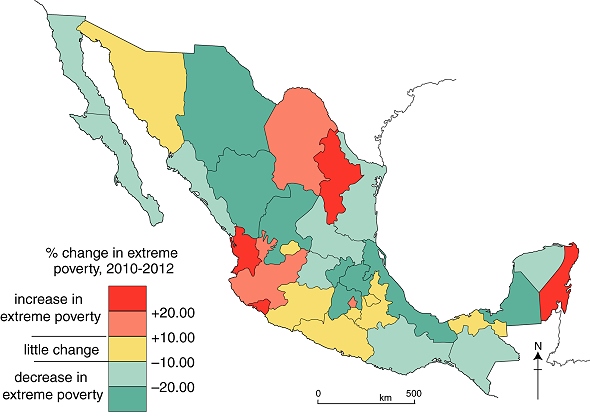
FAO: Poverty indicators persist in México

by the El Reportero’s wire services

The Latin American currencies will face in the future more violatility, specially when the United States changes its monetary policy and increase its interest rates, warned the International Monetary Fund today.
In a press conference about the economic situation in Latin America, Managing Director of the IMF, Christine Lagarde, said that the region will also be affected by a fall in the prices of raw materials and a smaller demand from China.
However, Lagarde ruled out any economic recession in Latin America, and forecasted an increase in its GDP of 0.5 percent, which is reliable for an increase of 1.7 percent next year.
In Latin America, as in other regions, every economy has its own characteristics, she commented, though they are all suppliers of basic goods, raw materials, and clearly they have failed to have the benefits of a decade of high prices that boosted growth, she said.
Lagarde said most Latin American currencies have registered a considerable depreciation against the dollar, in view of the anticipated increase of interests in the United States.
She highlighted, however, the measures implemented by the governments of Brazil, Colombia and Peru to restore confidence and reinforce fiscal positions that are on the right course now.
Honduras- over 10,000 children living in the streets  

 
Over 10,000 children are living on the streets of the main cities of Honduras, a local newspaper reported today.
According to estimates by La Prensa, only in the capital and San Pedro Sula in the number of children living on the street, while 94 percent of them consume some kind of drug.
Statistics from Casa Alianza revealed that most are also victims of sexual abuse.
Churches and non-governmental organizations serve a number of children in distress or social risk, but not enough, said the director of Casa Alianza, José Guadalupe Ruelas.
In his opinion, the Directorate for Children, Youth and Family does a good job, because it rescues and takes the children to institutions where they are taken care, but capacity is overwhelmed.
Since the beginning of the year about nine thousand children without accompanying adults they migrated recently reported the United Nations Fund for Children.
Poverty and violence were incentives for 2013 and 2014 more than 15 thousand minors traveling to the US border, a situation that was seen as a humanitarian crisis in this nation.

Mexico: No sentences after ten months of Iguala crime
Ten months after the crime of Iguala in Guerrero, Mexico, authorities have charged 110 people with being involved in the disappearance of 43 students from a teacher training college, but so far none have been sentenced.
Two of the main perpetrators of the crime, occurred on September 26 and 27, 2014, have not been arrested yet.
From that date on, more than 25 mass graves have been found in the state of Guerrero and more than 1,428 killings reported, as well as 113 kidnappings and more than 30 missing people.
Governmental statistics indicate that the crime rates have not decreased in that state and, quite the contrary, the number of homicides and discovery of corpses in mass graves have increased, mainly in the areas of Acapulco and La Montaña, said the newspaper La Jornada.

spot_img

Jazz Latino: Multi-dimensional artistic expression in the Americas

Compiled by the El Reportero’s staff

The Yerba Buena Gardens Festival, the Museum of the African Diaspora (MOAD), and SFJAZZ presents a six-week lecture series by John Santos. Machito and the Afro Cubans (c.1946)  L-R: Graciela (claves), Carlos Vidal (conga), René Hernandez (piano), Jose Mangual (bongos in front), Ubaldo Nieto (timbales), Bobby Rodriguez (bass), Machito (maracas).
Wednesday evenings 7 p.m. to 9 p.m., Aug. 5 through Sept. 9, 2015, at MOAD 685 Mission St. San Francisco. (415) 358-7200. (Aug 19 only) at the California Historical Society, 678 Mission St. San Francisco. (415) 357-1848.
YBGF/MOAD/SFJAZZ Members: $15/class or $75/full series. Public: $20/class or $100/full series. One Free class when you purchase the series!

It’s the Psychotronix Film Festival!
Weird, Wild & Wacky Short Subjects: Monster Movie Trailers, Drive-in Snack Bar Ads, Old School Films, Retro TV Commercials, Forgotten Cartoons, Scopitone Music Films and Much More! All on 16mm film, the Vinyl of Visuals.
Friday, Aug. 7, 2015 at Art House Gallery & Cultural Center, 2905 Shattuck Ave, Berkeley, CA (510) 472-3170. Doors: 7 p.m. Show: 8 p.m. Donation: $5 – $10. All Ages & Wheelchair Accessible.

Summer Nights Outdoor Concert Series
At the Osher Marin JCC Kanbar Center, ‘Plena Libre Celebrate Puerto Rico,’ on Saturday Aug. 8, 6:15 p.m. doors open, 6:40 dance lesson, 7 p.m. show.
Tickets and more info at: http://www.marinjcc.org/events/2015/08/08/performing-arts/plena-libre-summer-nights-outdoor-concert/55886/
$20 members / $23 public / $28 Day of (members & public), ages 17 and under FREE!
SFJAZZ presents a tribute honoring Puerto Rican icon and photojournalist Frank Espada
An unforgettable concert experience commemorating the life work of activist and master photographer Frank Espada (1930-2014).
Featuring The John Santos Sextet, with extra special guests, wordsmith Rico Pabon, guitarists/vocalists Jose Roberto Hernandez & Manuel Constancio, Afro-Puerto Rican dance master Shefali Shah, vocalist/poet Sandra Garcia Rivera corista Sarita Shah.
Images of Frank Espada’s profound work will be shown throughout this concert.
This will be the largest public showing of his iconic photography to date!
(Some seats have obstructed views of the large screen above the stage – inquire with SFJAZZ)
Sunday, Aug. 9, 2015, 2 p.m. at the gorgeous new SFJAZZ Center, 201 Franklin at Fell St., San Francisco. http://www.sfjazz.org, (866)920-5299.

Unveiling of mural and performance of spoken word piece
67 Sueños, Oakland chapter, will unveil a mural in East Oakland to celebrate and honor past victories of migrant communities. The mural aims to shed light on the struggles, risk, but also the hope that many undocumented communities, and their allies, endured while fighting against draconian anti-immigrant bills and advocating for bills such as AB- 241, the California Bill of Rights. The mural is inspired by interviews conducted by 67 Sueños youth with parents and community activist who migrated to the U.S. with aspirations to improve their conditions. Youth, children of immigrants, painted the mural.
At 23 percent, undocumented immigrants constitute a large majority of the California population, yet their stories are often overlooked. Making up roughly 5.1 percent of the labor force in the nation, undocumented immigrants are vital to the U.S. economy. Despite this, executive actions to provide protection from deportation such as DAPA have come to halt; little aid is reaching to the broader 11.1 M undocumented immigrants in this country. On Sunday, Aug. 9, at 1390 66th Ave, Oakland.

spot_img

Óscar Jaenada awarded as Best Actor for his role in Cantinflas

by the El Reportero’s wire services

The Spanish-Argentinian co-production Wild Tales has won a total of eight Premios Platino of Iberoamerican Cinema during the second annual award show recognizing the best work of the film industry in Iberoamerica.
Damian Szifrón’s Wild Tales, which started as the front-runner with 10 nominations, won the awards for Best Iberoamerican Feature Film, Best Director, Best Performance by an Actress, Best Screenplay, Best Original Score, Best Sound Direction, Best Editing and Best Art Direction.
In the Best Actor category, the award went to Oscar Jaenada for his work on Cantinflas, while the film of Alberto Rodríguez, La isla mínima (Marshland) won for Best Cinematography. Two Brazilian productions dominated the categories for Best Animated Feature Film and Best Documentary, with O Menino e o mundo (The Boy and the World) and O sal da terra (The Salt of the Earth) respectively. As for the Best Iberoamerican Feature Film Debut, the award went to the Spanish-Venezuelan film La distancia más larga.
Critics and audiences have made Wild Tales the highest grossing film in the history of Argentina. Its director, Damian Szifron, emphasized that “it is the end of a long road” – a road that began at the Cannes Film Festival and has led him to earn almost a hundred awards including an Academy Award Nomination and now eight Premios Platino of Iberoamerican Cinema.
The Spanish actor Oscar Jaenada received from a trio of presenters (Kate del Castillo, Miguel Bose and Dario Grandinetti) the award for Best Performance by an Actor for his role as Mario Moreno in the Mexican film Cantinflas. The award for Best Performance by an Actress, which went to Erica Rivas for her performance in Wild Tales.
Italian square named after novel One Hundred Years of Solitude
Italy today perpetuates the memory of Gabriel García Márquez by naming a square in the village of Perdasdefogu One Hundred Years of Solitude, which is the most famous novel by the Colombian writer.
During the ceremony a plaque will be unveiled with the dates of birth and death of Garcia Marquez and the public will be able to read the first pages of the novel that tells the story of the Buendia family in the imaginary town of Macondo.
The initiative is a tribute to the 1982 Nobel Literature Prize winner, also known as one of the greatest exponents of magic realism, a literary movement founded in the mid-twentieth century.
In his prolific creation, Gabo brought to life unforgettable characters: Florentino Ariza and Fermina Daza, protagonists of his famous novel Love in the Time of Cholera.
García Márquez also created unmatched stories that stand out in the world and Latin American literary scene as No One Writes to the Colonel, Chronicle of a Death Foretold and Of Love and Other Demons.

Record number of films in Film Festival Mar del Plata
The 29th edition of the Film Festival Mar del Plata, which will commemorate the 60th anniversary of this event, has registered a record of two 2,112 productions until today, organizers reported.
In total, 318 short and feature films from the USA are registered; 798 from Latin America; 832 from Europe; 126 coming from Asia; 25 from Oceania, and 13 others from Africa. On its website, the organizing committee also states that in the special celebration of this year more than one million 500,000 pesos will be distributed (over $163,000) as prizes.

spot_img

Harvard psychologists have been studying what it takes to raise good kids

Help unlock your child’s best self with a few tried-and-true strategies, here are six tips

by Maz Ali

A lot of parents are tired of being told how technology is screwing up their kids
Moms and dads of the digital age are well aware of the growing competition for their children’s attention, and they’re bombarded at each turn of the page or click of the mouse with both cutting-edge ideas and newfound worries for raising great kids.
But beneath the madness of modernity, the basics of raising a moral child haven’t really changed
Parents want their kids to achieve their goals and find happiness, but Harvard researchers believe that doesn’t have to come at the expense of kindness and empathy. They say a few tried-and-true strategies remain the best ways to mold your kids into the morally upstanding and goals-oriented humans you want them to be. Here are six practical tips:
1) Hang out with your kids
This is, like, the foundation of it all. Spend regular time with your kids, ask them open-ended questions about themselves, about the world and how they see it, and actively listen to their responses. Not only will you learn all sorts of things that make your child unique, you’ll also be demonstrating to them how to show care and concern for another person.
2) If it matters, say it out loud
According to the researchers, “Even though most parents and caretakers say that their children being caring is a top priority, often children aren’t hearing that message.” So be sure to say it with them. And so they know it’s something they need to keep up with, check in with teachers, coaches, and others who work with your kids on how they’re doing with teamwork, collaboration, and being a generally nice person.
3) Show your child how to “work it out”
Walk them through decision-making processes that take into consideration people who could be affected. For example, if your child want  s to quit a sport or other activity, encourage them to identify the source of the problem and consider their commitment to the team. Then help them figure out if quitting does, in fact, fix the problem.
4) Make helpfulness and gratitude routine
The researchers write, “Studies show that people who engage in the habit of expressing gratitude are more likely to be helpful, generous, compassionate, and forgiving — and they’re also more likely to be happy and healthy.” So it’s good for parents to hold the line on chores, asking kids to help their siblings, and giving thanks throughout the day. And when it comes to rewarding “good” behavior, the researchers recommend that parents “only praise uncommon acts of kindness.”
5) Check your child’s destructive emotions
“The ability to care for others is overwhelmed by anger, shame, envy, or other negative feelings,” say the researchers. Helping kids name and process those emotions, then guiding them toward safe conflict resolution, will go a long way toward keeping them focused on being a caring individual. It’s also important to set clear and reasonable boundaries that they’ll understand are out of love and concern for their safety.
6) Show your kids the bigger picture
“Almost all children empathize with and care about a small circle of families and friends,” say the researchers. The trick is getting them to care about people who are socially, culturally, and even geographically outside their circles. You can do this by coaching them to be good listeners, by encouraging them to put themselves in other people’s shoes, and by practicing empathy using teachable moments in news and entertainment.
The study concludes with a short pep talk for all the parents out there:
“Raising a caring, respectful, ethical child is and always has been hard work. But it’s something all of us can do. And no work is more important or ultimately more rewarding.”
Watch the Washington Post’s wrap-up of the study below:
http://www.upworthy.com/harvard-psychologists-have-been-studying-what-it-takes-to-raise-good-kids-here-are-6-tips?g=2&c=ufb2

spot_img

Texas launches gold-backed bank, challenging Federal Reserve

FROM THE EDITOR:

Dear readers, for most of you who don’t know the story about the gold confiscation by the US government during the Great Depression, which gave birth to the current gold defunded dollar, the story below, written by Alex Newman, brings some hope to the return to sound money backed by gold, speculating that real prosperity for the American people could be coming.

by Alex Newman
The New American

The State of Texas is setting up a gold-backed bank that will allow depositors to bypass the controversial Federal Reserve System and its fiat currency in banking and commerce, according to the state representative who authored the recently enacted law. Under the measure, passed overwhelmingly by lawmakers and signed in mid-June by Republican Governor Greg Abbott, Lone Star State officials will establish and operate the Texas Bullion Depository for anyone who would like to deposit and trade in precious metals. The implications are as big as Texas.
While some analysts have said the move may be another sign heralding Texas’ eventual secession from the union, or preparation for financial Armageddon, its advocates say the depository simply makes financial sense. Among other benefits, the institution will provide more options to consumers weary of the increasingly troubled traditional banking and monetary system, which is viewed by the public with growing suspicion. And experts say the effect of making it easier to use sound money in commerce could be far-reaching.
Among other immediate effects, the law creating the first state-level gold-backed bank in the nation, House Bill 483, will involve repatriating about $1 billion of Texas gold from New York. Conflicting news reports and official statements say the state’s precious metals stockpile is being held either by HSBC in New York, or by the powerful New York Federal Reserve Bank, a privately owned outfit cloaked in secrecy with immense power over the U.S. economy. First, though, officials will need to select a home for the Texas depository.
“Today I signed HB 483 to provide a secure facility for the State of Texas, state agencies and Texas citizens to store gold bullion and other precious metals,” said a statement issued by Governor Abbott, a popular conservative governor, after the ceremonial signing.  “With the passage of this bill, the Texas Bullion Depository will become the first state-level facility of its kind in the nation, increasing the security and stability of our gold reserves and keeping taxpayer funds from leaving Texas to pay for fees to store gold in facilities outside our state.” The law protects the assets from seizure by the feds or other forces, too.
There will be many other benefits as well, according to supporters. While other states have in recent years passed legislation declaring gold and silver to be legal tender, analysts say Texas’ new depository could help supercharge the growing movement for an honest and sensible monetary system founded on real money rather than debt-based paper notes conjured into existence by a private banking cartel. Indeed, one of the chief aims of gold-and-silver-as-currency proponents is to restore sound money — and the Texas law could help pave the way.
Tenth Amendment Center chief Michael Boldin, whose organization promotes states’ rights to rein in the feds under the 10th Amendment to the U.S. Constitution, called the law “an important first step towards gold and silver as commonly-used legal tender in the state.” He said the move has the potential to open the market to sound money, even in day-to-day transactions. “By making gold and silver available for regular, daily transactions by the general public, the new law has the potential for wide-reaching effect,” Boldin added.
The Tenth Amendment Center also highlighted the constitutional implications. Noting that Article I, Section 10, of the U.S. Constitution prohibits state governments from making anything other than gold and silver a tender in payment of debts, Boldin said the bill takes Texas a step toward fulfilling that long-ignored constitutional obligation. “Such a tactic would undermine the monopoly the Federal Reserve system by introducing competition into the monetary system,” he said.
Other experts also highlighted those effects. “Over time, as residents of the state use both Federal Reserve notes and silver and gold coins, the fact that the coins hold their value more than Federal Reserve notes do will lead to a ‘reverse Gresham’s Law’ effect, where good money (gold and silver coins) will drive out bad money (Federal Reserve notes),” explained constitutional-tender expert William Greene in a paper for the market-oriented Ludwig von Mises Institute.
The new law can also help protect depositors from other downsides of the present monetary regime — the risks inherent in fractional-reserve banking, for example — while still providing many of the conveniences associated with a bank account. Indeed, the depository will engage in many of the functions associated with traditional banking: The ability to store wealth for safe-keeping, the ability to write checks against deposits to transfer funds, and so on.
But in other respects, the institution will function very differently from a traditional bank. For instance, depository accounts will not pay interest, according to the law, nor will the deposits be loaned out to borrowers under the prevailing fractional-reserve banking regime.
“This is different than your traditional bank — a traditional bank lends money,” said Texas Representative Giovanni Capriglione, who authored and sponsored the legislation. “Especially if you’re in Greece right now, you know that if you go to the bank, and everybody went to the bank to try to get their deposits out, there’s not enough paper money to cover it. That causes a whole bunch of concerns. What this depository does is, it doesn’t allow that — if there are 5,000 bars of gold in there, there will be 5,000 gold bars there, and you’ll be able to access your deposits directly upon demand.”
Depositors will also be able to write checks against their gold deposits to pay others, continued Rep. Capriglione, calling the measure a “big deal.” “You can write checks to individuals who have gold depository accounts, and you’ll also be able to write checks to individuals and corporations who don’t have gold depository accounts,” he explained. “We set up a system of depository agents so you can have any corporation, any group, basically start a depository agent, and they can send and receive through this depository system, outside of the Federal Reserve System.” Public entities will also be able to participate.
It will not be just Texas citizens, governments, agencies, and businesses taking advantage of the new options, either. “We are not talking Fort Knox,” Capriglione told the Star-Telegram newspaper. “But when I first announced this, I got so many emails and phone calls from people literally all over the world who said they want to store their gold … in a Texas depository. People have this image of Texas as big and powerful … so for a lot of people, this is exactly where they would want to go with their gold.”
Some conservative and liberty-minded activists expressed concerns about the law because it creates yet another state agency.

However, writing in the market-oriented Ludwig von Mises Institute, economist Ryan McMaken argued that the benefits outweigh the downsides in this case. “While the Texas depository is a government-owned enterprise, it nevertheless is an improvement since it is a case of decentralization (and arguably nullification) which provides alternatives to the federally controlled monetary and banking systems,” he said. “As Hayek and other Austrians noted for decades, a decentralization of the monetary system is a key first step in moving toward more sound money.”
The depository will be run by an administrator appointed by the Texas Comptroller, whose office will oversee the institution. The chief of the Texas depository will have to be approved by various state executive and legislative officials. Any profits made will be handed to the general revenue fund, potentially benefiting taxpayers beyond the savings associated with repatriating the state’s gold.
A similar bill was introduced in 2013 but did not gain traction. This year, though, lawmakers approved it by a landslide margin, with 140 to 4 in the Texas House and 27 to 4 in the state Senate. Now, energized activists in other states are hoping to see similar measures across the country — with the ultimate goal of eventually restoring sound money and an honest economy free from the clutches of the Federal Reserve.

spot_img

Chamomile tea lowers thyroid cancer risk: study

by Dr.Sofiya

The tiny, daisy-like flowers from the chamomile plant have long been valued for their medicinal properties. At least as far back as Roman times, chamomile was used in teas and extracts to promote relaxation and restful sleep as well as to support the health of the digestive system. Topically, it was used to even skin tones and to bring out highlights in blonde or light-colored hair. It is a popular treatment for the conditions mentioned above even today. However, apparently the healing power of chamomile goes far beyond promoting digestive function and sound sleep. Modern research is also discovering that the bio-active compounds in these tiny, sweet-smelling flowers can also help to reduce the chances of thyroid cancer. While this form of cancer can often be treated successfully with either surgery or radioactive iodine treatment (or both), it is even better to prevent it in the first place! Let’s look at the research.
The new study
The study that has everyone talking is one that was recently published in the European Journal of Public Health. Three groups of volunteers were studied for this research: The first was a group of 113 thyroid cancer patients who were compared to another group of 138 cancer-free patients and 286 patients who have a history of benign thyroid disease. All three groups received detailed questionnaires so that researchers could determine such factors as their daily dietary habits, overall medical history, general lifestyle and beverage consumption (including the consumption of coffee and tea).
The results
What the researchers found was that those who consumed the highest amounts of chamomile tea had the lowest chances of developing thyroid cancer. And the percentage was significant: A person consuming 2-6 cups of chamomile tea on a weekly basis has a whopping 70 percent less chance of thyroid cancer development; if this practice had been going on for 30 years or longer, they were 80 percent less likely to suffer from the onset of this disease.
Reactions of the researchers
Researchers working on this study noted that while many studies have been done to study in the effects of green or black tea consumption and its relationship to disease development, no studies have looked at the same effects for different kinds of herbal teas. They noted that “our study suggests, for the first time, that consumption of chamomile tea is linked to a lower incidence of thyroid cancer as well as other benign thyroid diseases”. They believe that this correlation between chamomile tea consumption and reduced thyroid cancer risk is due to one of the compounds in chamomile called apigenin, which has clinically proven anti-cancer properties.
In short, this research is important because it identifies the consumption of herbal teas to be a healthy behavior akin to that of consuming green tea on a regular basis. It is also the first proof clinicians have of chamomile’s ability to fight off thyroid cancer rather than being used solely for insomnia or digestive complaints. Hopefully, more research like this will be done in the future to determine the healthful effects of other herbal teas as well.

spot_img

Nearly 40 national Latino groups denounce SF anti-sanctuary ordinance

by Michael Oleaga

A coalition of 39 national Latino advocacy groups have called on the House of Representatives not to pass a bill that generalizes Latino immigrants for political gain.
The “Enforce the Law for Sanctuary Cities Act” (H.R. 3009) would amend the Immigration and Nationality Act and make state and local jurisdictions ineligible of federal funding if they refuse to comply on reporting detained immigrants. Rep. Duncan Hunter, R-Calif., introduced the bill as a response to Kathryn Stienle’s death by an undocumented immigrant in San Francisco earlier this month.
Latino advocacy groups and politicians, however, have opposed the legislation and connected the bill to Republican presidential candidate Donald Trump’s rhetoric. In a letter sent to members of Congress, the National Hispanic Leadership Agenda (NHLA) said passage of H.R. 3009 will affect lawmakers’ scorecard in their annual congressional scorecard — conducted by NHLA.
“This enforcement-only piecemeal bill is simply another vehicle for spreading the same lies that Donald Trump has espoused about Latino immigrants,” said NHLA Chair Hector Sanchez, who also serves as the executive director for the Labor Council for Latin American Advancement. “The truth is that immigrants are less likely to be involved in crime than native-born Americans and that H.R. 3009 will not improve public safety. Congress should vote down this offensive bill and then get to work on serious immigration reform.”
In the letter, the NHLA reiterated its recommendation for a “No” vote and any similar pieces of legislation. According to NHLA, such legislation represents a “misguided response” to Steinle’s death, which has led to extensive generalizations about immigrants because of one undocumented immigrant’s actions — who was previously deported on five occasions over drug felonies.
The letter continued, “It is unacceptable when a presidential contender such as Donald Trump makes such generalizations in campaigning and equally unacceptable when members of Congress do so in legislating. No responsible public official should use this tragedy as a pretext for harsh and unproductive policies that only serve to satisfy the anti-immigrant impulses of certain politicians while doing nothing to improve public safety.”
The letter references the American Immigration Council study, which states immigrants are less likely to be criminals than U.S.-born individuals.
While acknowledging Steinle’s death was tragic, the case should not warrant a “wholesale change” in immigration policy and called for comprehensive immigration reform legislation.
The letter comes after the Senate Judiciary Committee held a hearing about immigration enforcement policies, which included testimony from Steinle’s father. According to a prepared statement by Sen. Chuck Grassley, R-Iowa, chairman of the Senate Judiciary Committee, the July 21 hearing focused on the Obama administration’s immigration policies and practices that are “hurting American families.” Grassley claimed the deaths of Americans by immigrants were “a direct result” of the Obama administration’s “failure to deport criminals or its tolerance of sanctuary policies.”
Among the NHLA’s 39 national Latino organizations are the Hispanic National Bar Association, League of United Latin American Citizens, NALEO Educational Fund, National Council of La Raza and the U.S. Hispanic Chamber of Commerce.
The Congressional Hispanic Caucus (CHC) has referred H.R. 3009 as “The Donald Trump Act.” CHC Chairwoman Linda Sanchez, Democratic representative from California, said the bill is another attack on Latinos and the immigrant community.
“This Congress we’ve seen numerous anti-immigrant bills and this legislation is yet another excuse to scapegoat our community,” said Sanchez in a statement. “With this vote, House Republicans are running to embrace Donald Trump’s racist and offensive views. Donald Trump should not be setting the agenda for the United States Congress.
“Any law enforcement professional will tell you that when half of the community is too afraid to report a crime, they can’t do their job,” Sanchez said. “Withholding federal funds from jurisdictions that practice community-oriented trust policies jeopardizes the public safety of families. This bill undermines law enforcement when the real issue here is the need to pass comprehensive immigration reform. The Congressional Hispanic Caucus continues to call for smart immigration legislation that will move our country forward.”
(For the latest updates, follow Latin Post’s Politics Editor Michael Oleaga on Twitter: @EditorMikeO or contact via email: m.oleaga@latinpost.com).

spot_img