Monday, September 7, 2026
Home Blog Page 392

Native student and family disappointed

They met with university president re native genocide

by Vincent Schilling

One week after 19-year-old Native American student Chiitaanibah Johnson of California State University, Sacramento says she was disenrolled from her U.S. History class for disagreeing with her professor over the existence of Native American genocide, Johnson and her family met with Sacramento State President Robert S. Nelsen to discuss the matter. Though Johnson and her family say the meeting was cordial and sincere, they feel disappointed and say they fear neither the school nor the president will be taking any action that will satisfactorily address their concerns.
President Nelsen agreed to meet on Thursday with Johnson as well as her mother, Martina Johnson, father Kurt Johnson and Cindy La Marr (Pit River and Paiute), Executive Director of Capitol Area Indian Resources, Inc. in Sacramento, an organization that advocates for the academic and cultural rights of American Indian students. Nelsen told the family and the University has told ICTMN in an email that the President will also be meeting with Professor Maury Wiseman, the professor involved in the matter, at a later time.
Johnson says she was comforted by the meeting’s informality but fears a viable solution may never happen. “The president was respectful, open and I didn’t expect it to be just him,” she said. “I thought someone would be recording it or there would possibly be a lawyer present, but there wasn’t.
“But when we pressed for a solution,” says Johnson, “the president told me that his hands were basically tied. I thought at least the professor’s class might be monitored or evaluated on some level. But the professor is still teaching and going on with his class.”
Cindy La Marr, who has worked with public schools and universities for many years for the benefit of Indian country, says she was not as impressed by Nelsen’s cordial demeanor. She told ICTMN that some of Nelsen’s proposed solutions were not sufficient. “I asked if the instructor would be required to attend this, and he said, ‘No.’”
La Marr says that when she and the family asked if there was going to be any disciplinary action against the professor, President Nelsen said Professor Wiseman was protected by his faculty’s labor union. La Marr says after the Johnson family’s repeated attempts to ask if the professor would be disciplined were deflected, they decided to leave. “I continually asked, ‘What is your plan?’” Martina Johnson said. “The President just told us, ‘It is out of my hands.’”
In addition to speaking to ICTMN, student Chiitaanibah Johnson also issued a written statement addressing her thoughts on the meeting.
“The President was fair, open and welcoming in hearing my concerns. I appreciated his candor regarding the bureaucratic and regulatory restrictions his office is subject to with regards to the limited actions he is allowed to take with regards to the issues at hand.
However, I am particularly concerned that while CSU-Sacramento officials are working to transfer me into another course, Professor Wiseman, under protection of the faculty teacher’s union and legal team, is still teaching under no observation or supervision while under investigation and that curriculum changes to actually address GENOCIDE are even less likely.
Having met with the CSU-Sacramento President, a fair and reasonable resolution to these issues appears unlikely within the current bureaucratic bounds of the university.
There are three very important points we want to make very clear:
Genocide is and always has been wrong.
Teaching otherwise is wrong.
Instructors demonstrating such lack of academic rigor and acting in a manner both aggressive and intimidating manner of stifling student questioning should be held accountable in a manner both fair and timely.”
Chiitaanibah Johnson’s father Kurt Johnson added to his daughter’s remarks and told ICTMN, “The professor’s statements were a product of a direct lack of academic rigor. Academic freedom does not preclude academic responsibility.”
ICTMN has reached out to Sacramento State regarding the meeting. University spokesperson Elisa Smith replied in an email with the following statement:
President Nelsen had an extensive, fact-gathering meeting with Ms. Johnson and her family as he attempts to achieve a positive resolution in this matter.  He also is meeting with Prof. Wiseman.
As the fact-finding continues, and because this is an ongoing personnel matter, we cannot comment further at this time.
In the meantime, President Nelsen’s message to the campus earlier this week speaks for itself:
We at the University believe in academic freedom, and we also believe in civility and rigorous academic research. Our standards must be high, and we must follow the processes that we have put in place to ensure that the rights of students and faculty are protected.
Johnson says when she first returned to the school after the incident, she felt as if people were looking her way but not overtly staring or being intrusive. Though she says she is disappointed in the outcome thus far, she is encouraged by the outpouring of support from Indian country.
“It is what it is. I had no idea what to expect based on what happened but I told myself not to be not to set on the idea that the professor would be reprimanded,” she says. “I thought they might make him apologize or something else. The president basically said his hands were tied and there was only so much he could do.
“I feel unresolved about the issue.  But my mom says, ‘There are Indian people all over the country that are supporting you because they know the truth and they know you stood up for them.’
“There is a conversation now,” says Johnson. “And people are talking about whether genocide has happened. My father said something that really affected me. He said, ‘Even if nothing else happens, the circulation of this story and the effects on conversations across the country are more than my own grandfather could have done.’ If I had done something like this back then, it could have gotten me killed. But here I am.
“I didn’t realize how good having the blessing of so many Indian people would feel. I’ve only known the natives of the outer rings of my family or in college, but I’ve never felt so connected to Indian country.”
Follow ICTMN’s Vincent Schilling on Twitter – www.twitter.com/VinceSchilling


spot_img

Monsanto loses GMO permit in Mexico – judge sides with the bees

by Arjun Walia

A number of countries around the world have now completely banned GM food and the pesticides that go with them, or have severe restrictions against them. This comes after the world has experienced a massive resistance against Monsanto and other biotech giants that manufacture GMOs and pesticides.
It’s (the resistance) also a result of numerous studies that have emerged showing the environmental and health dangers that are associated with pesticides, as well as health dangers that could be associated with GMOs.
The latest country to make headlines with regards to banning Monsanto products is Mexico, as a group of beekeepers was successful in stopping Monsanto from the planting of soybeans that are genetically modified to resist their Round-up herbicide.
Monsanto loses Mexican permit
Monsanto had received a permit to plant its seeds on over 250,000 hectares of land, which equates to approximately 620,000 acres. That’s a lot of land, and they managed to get the permit despite thousands of citizens, beekeepers, Greenpeace, Mayan farmers, The National Institute of Ecology and other major environmental groups protesting against it.
According to The Guardian:
“A district judge in the state of Yucatán last month overturned a permit issued to Monsanto by Mexico’s agriculture ministry, Sagarpa, and environmental protection agency, Semarnat, in June 2012 that allowed commercial planting of Round-up ready Soybeans.  In withdrawing the permit, the judge was convinced by the scientific evidence presented about the threats posed by GM soy crops to honey production in the Yucatán peninsula, which includes Campeche, Quintana Roo and Yucatán states. Co-existence between honey production and GM soybeans is not possible, the judge ruled.”
Mexico is the fourth largest honey producer and fifth largest honey exporter in the world.
These Pesticides Are Killing Bees and Farmers Are Unable To Export Pollen From GMO Crops
Bee colonies are declining very fast, threatening food security all over the world, and as the guardian reports:
“GM crops could devastate the important European export market for Mexican beekeepers, where the sale of honey containing pollen derived from GM crops has been restricted since a landmark decision in 2001 by the European Court of Justice.”
Here is more on a study that found GM pollen destined for Europe after this ruling, and according to local farmers, threatens the honey industry. http://phys.org/news/2014-02-gmo-soybean-pollen-threatens-mexican.html.
Below is a summary of the problem (apart from massive bee declines):
“David Roubik, senior staff scientist at the Smithsonian Tropical Research Institute, and his colleagues developed the ability to identify pollen grains in honey in Panama and in Mexico during the 1980s and 1990s when they studied the effects of the arrival of Africanized bees on native bees. “Nobody else can do this kind of work in the ‘big field’ environment and be confident that what they are seeing are soybean pollen grains,” said Roubik. They found that six honey samples from nine hives in the Campeche region contained soy pollen in addition to pollen from many wild plant species. The pollen came from crops near the bee colonies in several small apiaries. Due to strict European regulations, rural farmers in the Mexican Yucatan face significant price cuts or outright rejection of their honey when their product contains pollen from GMO crops that are not for human consumption. The regional agricultural authorities, furthermore, seemed unaware that bees visited flowering soybeans to collect nectar and pollen”
A study is published in the US National Library of Medicine and in the journal Food and Chemical Toxicology shows how several recent studies illustrate glyphosate’s potential to be an endocrine disruptor. Endocrine disruptors are chemicals that can interfere with the hormone system in mammals. These disruptors can cause developmental disorders, birth defects and cancer tumors.
A group of scientists put together a comprehensive review of existing data that shows how European regulators have known that Monsanto’s glyphosate causes a number of birth malformations since at least 2002. Regulators misled the public about glyphosate’s safety, and in Germany the Federal Office for Consumer Protection and Food Safety told the European Commission that there was no evidence to suggest that glyphosate causes birth defects.
A new study out of Germany concludes that Glyphosate residue could reach humans and animals through feed and can be excreted in urine. It outlines how presence of glyphosate in urine and its accumulation in animal tissues is alarming even at low concentrations.
It’s also been linked to Alzheimers, Parkinsons Disease and Autism.
A recent study conducted by researchers from RMIT university, published in the journal Environmental

Research found that an organic diet for just one week significantly reduced pesticide (commonly used in conventional food production) exposure in adults.
Thirteen participants were randomly selected to consume a diet consisting of at least 80 percent organic or conventional food for precisely seven days, afterwards crossing over to the alternative diet from which they started.

Urinary levels were used for analysis. The study found that urinary dialkylphosphates (DAPs) measurements were 89 percent lower when they ate an organic diet for seven days compared to a conventional diet for the same amount of time.
“A lot of these agents were initially developed as nerve gases for chemical warfare, so we do know that they have toxic effects on the nervous system at high doses. Conventional food production commonly uses organophosphate pesticides, which are neurotoxins that act on the nervous system of humans by blocking an important enzyme. Recent studies have raised concerns for health effects of these chemicals even at relatively low levels. This study is an important first step in expanding our understanding about the impact of an organic diet” (source) – Dr. Liza Oates. Natural News.

spot_img

Pope stressed importance of “Substainable Development” among others

by the El Reportero’s wire services

Francis said during his address at the UN, that economic and social exclusion is a violation of human rights and urged for the total elimination of nuclear weapons, wars and drugs trafficking, because of their high cost in lives and the suffering caused to mankind.
When addressing to a plenary session of the UN General Assembly, Pope Francis regretted that many people are victims of conflicts.
The Pope also demanded urgent action to tackle the dramatic reality of exclusion and inequality, and stressed the importance of the Agenda for Sustainable Development.
Sustainable Developtment, a product of the Earth Summit (UN Conference on Environment and Development) held in Rio de Janeiro, Brazil, in 1992, contains the key elements for the creation of a new social, economic and population reduction order, which, according to experts, is the globalists’ agenda contained in the Agenda 21 action plan, that ends private property and reduces the population of the world to no more than 500 million people.
It is an action agenda for the UN, other multilateral organizations, and individual governments around the world that can be executed at local, national, and global levels. The “21” in Agenda 21 refers to the 21st Century. It has been affirmed and modified at subsequent UN conferences.

Students-teachers were attacked in Iguala by elite troops
Ayotzinapa students-teachers, disappeared on Sept. 26, 2014, were attacked in that date by an elite groups led by the then sub-director of Iguala Police (Mexico), was released today.
According to witnesses’ statements, the special group, known as ‘Los Belicos’, was led by police deputy director, Francisco Salgadoes and was used in ‘immediate response’ actions.
According to testimony, the students were attacked on the night of September 26, 2014 by masked men who fired heavy weapons.
‘Los Belicos’, also responded to the command of the then Mayor, José Luis Abarca, who used them to monitor access to Iguala. Besides being members of the criminal group ‘Guerreros Unidos’ (United Warriors).
The involvement of ‘Los Belicos’ in the events of Iguala is established from some statements of witnesses affirmed in the preliminary investigation that the Attorney General’s Office (PGR) opened last week in a public version.
‘People who seem to be from the state, as they were uniformed differently, even carrying body armor, with hoods covering their faces, wore tactical team’, was collected in the statements of one of the witnesses.
From these and other statements was established that ‘Los Belicos’ managed to block the tracks way in which the students were travelling, in the 024, 025 and 027 patrols, and attack them later with bullets and took those who are still missing.
Prime Minister of the United Kingdom, David Cameron, admitted today in Jamaica the atrocities committed during slavery in the colonial era, but ruled out making reparations for Britain’s role, despite the Caribbean demand for compensation.
During his speech to the parliament of the island, the president stated it would be wrong to ignore the painful aspects of that period and expressed his pride for his country as it abolished this form of servitude.

spot_img

A poet’s Love – combining song, aereal dance and theater

Compiled by the El Reportero’s staff

Zaccho Dance Theatre (ZDT) will premiere A Poet’s Love, a new work created by Zaccho’s Artistic Director Joanna Haigood and Brooklyn-based singer/actor José Joaquín García.
A Poet’s Love is a new creation based on the Dichterliebe song cycle from classical German composer Robert Schumann. A Poet’s Love takes the form of sixteen discrete vignettes, each one responsive to and deeply immersed in the musical and poetic context of a song in Dichterliebe.
The complete work – combining song, aerial dance and theatre – will be performed at Zaccho Studio in San Francisco and will feature members of ZDT’s performance ensemble as well as José Joaquín García, who will perform the songs accompanied by well-known Bay Area pianist Frederick Harris.
On Friday Oct. 2, 2015. Additional performances will occur Saturday, Oct. 3 at 8 p.m. and Sunday Oct. 4 at 7 p.m.
Tickets are $20 at the door, but seating is limited. To guarantee and pre-order tickets please visit http://www.brownpapertickets.com/event/2182219. Feel free to call us at 415.822.6744 or send an email to christopher@zaccho.org for more information.

La Casa de las Madres kicks off Domestic Violence Awareness Month Standing
An event on behalf of La Casa will take place, and all proceeds from the event will go support La Casa, San Francisco’s oldest and largest anti-domestic violence provider. La Casa helps women, teens, and children of all ages affect change and break cycles of violence.
La Casa de las Madres’ annual premier fundraiser, the redHOT party, will be held on Thursday, Oct. 1, 2015 from 6 – 9 p.m. at 111 Minna Gallery at 111 Minna Street in San Francisco.

The Library welcomes Kindie Rockers for 7th Annual Tricycle Music Fest
October is here and everyone knows it’s time to break out your dancing shoes for some Tricycle Music Fest fun.
Each week in October will feature a different performer, offering their brand of Kindie Rock!
Aaron Nigel Smith will kick off the 7th Annual Tricycle Music Fest full of reggae beats reimagined for the child in you and with you, the party gets started on Friday, Oct. 2 at 3 p.m. at the Portola Branch. The fun will continue on Saturday, Oct. 3 at 4 p.m. in the Main Library’s Children’s Center.
The following week Frances England will bring her kindie rock music to Parkside and Mission Bay Branches. From October sun on Friday, Oct. 9th at 4:30 p.m. at Mission Bay Branch. Then she will perform her toe tapping beats at the Parkside Branch on Saturday, Oct. 10 at 3:30 p.m.
Our third weekend of performances will be performed by none other than the Grammy and Emmy winning team of Lucky Díaz and the Family Jam Band. With their new featured album, Adelante!, they will be sure to get the crowd jumping, dancing and singing along. The Richmond Branch will be hosting them at outdoor family fun day on Friday, Oct. 16 at 3:30 p.m. On Saturday, Oct. 17 at 3 p.m., the band will be performing at Bernal Heights Branch.

spot_img

Hispanics start to perform in U.S. Festival

by the El Reportero’s news services

Stars of the Hispanic music scene such as Enrique Iglesias, Juan Gabriel and Gloria Trevi will be the main attraction of the L Festival – Feria Cultural Latinoamerica, to be held in the OC Fair and Event Center, organizers confirmed today.
These three media figures will be accompanied by others such as Spanish Juan Magan, the Mexican band La Arrolladora Banda El Limon, among more than 25 artists, who will be part of the program taking place next Oct. 24 and 25.
The organizers of the musical event confirmed the L Festival will include over 30 performances with artists from a dozen nations, in a variety of genres, slated to perform on the four main stages simultaneously.
“It will be a unique opportunity for the audience to enjoy the greatest stars of the Latin music”, state the organizers through a report.
At the end, the public will be able to enjoy visual arts exhibitions, playgrounds and typical Latin American culinary service in more than 30 restaurants.

Colombia, guest at Mexico International Book Fair
The 27th International Fair of Books on Anthropology and History (Filah), with Colombia and the state of Chiapas as guests of honor, will open its doors today at the Mexican capital until next Oct. 4.
Over 20 thousand titles of 89 editorial houses and 103 presentations are programmed at Filah, together with six academic forums, round tables, artistic manifestations, 15 workshops for children and youths and the projection of 35 films.

Casa de Las Americas readies colloquium of Latino presence in USA
Casa de Las Americas prepares today the Third Symposium of Latino Presence in the United States that will be held from October 13 to 15, with representatives from six countries.
According to the cultural institution, during those days more than 40 social researchers, critics, writers, and cultural analysts will meet in this capital, coming from Colombia, Puerto Rico, Venezuela, Dominican Republic, Mexico and the host country.
Key subjects such as transnational citizenship, creation and transnational movement and displaced indigenous will be put on the table for consideration in the Manuel Galich Hall of the house by participants in the event.

Juan Luis Guerra nominated for the Latin Grammy
Juan Luis Guerra, the icon of tropical music, receives a recognition of his spectacular career and talent through his latest work Everything Has Its Time album presented in November 2014 this year.
The artist has been nominated for the Latin Grammy 2015 in the category ‘Album of the Year ‘,’ Best Contemporary Tropical Album ‘,’ Record Of The Year ‘(Your Kisses),’ Best Tropical Song (Your Kisses). The Annual Latin GRAMMY Awards, which will take place on Nov. 19 at the MGM Grand Garden Arena in Las Vegas, which will be broadcast live on the Univision Network from 8-11 pm ET / PT (7 pm Central).

spot_img

The Pope appeareth – first visit to the U.S.

by Jon Rappoport

“Religions and, yes, even certain ‘economic systems’ have preached poverty as the way to salvation, or at least a ‘more honest’ life. Poverty is promoted as a kind of test of faith. But the promoters always had cash in the bank. The catch is this: in order to reap the spiritual rewards, a poor person has to remain poor. Otherwise, how can he continue to know true glory? The modern version of this is: a victim is a victim forever. Otherwise, he might eliminate the need for ‘social justice’ and the con artists who peddle it. Don’t spend a few dollars cleaning up the contaminated water systems in Third World countries. Don’t give back good growing land that was stolen. Poverty and starvation are glamorous. They give rise to humanitarian ideologies that front for theft and destruction on a grand scale.” (The Underground, Jon Rappoport)

— He’s here. The Pope. And his covert Jesuit message is: let’s get rid of separate nations, eliminate private profit for the middle class, and return to those glorious days of the Middle Ages; my Church flourishes under those conditions; we know how to deal with wall-to-wall misery; oh, and here’s the collection plate.
He’s part of the international gang that throws around the word “capitalism” as if it’s a mortal sin.
Making distinctions isn’t the Pope’s forte.
He ignores the differences between mega-corporations who align with governments (and his Church) to create a Globalist Order…and the untold numbers of small businesses owned by people who want to work for a living and earn a profit.
For the Pope, it’s all “capitalism.” Everything should be free—which, translated, means: almost everyone should be poor.
Migration of populations? No problem. It’s a good thing. After all, it helps, in the long run, to erase borders and nations and turn back the clock to more troubled times.
That’s the op, and the Pope is on board with it. He and Obama will get along well. Obama is in charge of making sure the inner-city communities he champions will stay poor and have ample targets to blame.
Obama never intended to create jobs in those inner cities and transform them. That was never on his agenda. He never intended to speak about how the jobs and the companies were lost there, as one Globalist trade deal after another sent work and factories overseas. Obama is touting new trade deals.
He and the Pope will give each other a nudge and a wink.
If these two have their way, the “settled science” on man-made warming will trigger global cuts in energy production (except for favored companies), thus creating even more horrific poverty among the Third World countries which are supposed to “benefit from the rational distribution of energy”).
These two men know how to use “humanitarian” utterances to front for their real goals. They know how to play that tune up and down the scale, instilling the proper amount of guilt along the way.
The Pope and the President will be popping champagne corks. It’ll be a party.
Obama: Your Holiness, I’m a rank amateur when it comes to psyops. You folks have been running cons for a couple of thousand years give or take. So any tips you can offer me…
Pope: Don’t kid a kidder, Barack. You’re doing a bang-up job. You started off with that messianic salvation utopia thing, and then you put it on the shelf and went for social justice, which is a biggie, because it diverts attention from the fact that most people just want jobs and enough money to survive—and of course that is never going to happen…
In his first comments to the press after election as Pope, Francis said: “This is what I want, a poor church for the poor.”
1.2 billion members, a separate nation (the Vatican), an estimated $170 billion in annual spending…sure, a poor church.
The “for the poor” part of the Pope’s quote is accurate. As in: a return to greater poverty. In such a world, the feudal lords will fill the collection plate.
There’s just one problem with the Vatican’s Globalist agenda. It doesn’t quite mesh with the mega-corporate view of Globalism. As fewer and fewer people around the world can afford to buy what the corporations are selling, a crack-up will occur. But for the Pope, those are petty details. He’s with the mega-corporations on the surface; but at a deeper level, the Vatican wants what it’s always wanted: chaos, poverty, and top-down control.

spot_img

Article: The only way to deconstruct the corporation-nation is at the state level

FROM THE EDITOR:

Dear readers:
I just ran into this amazing article, that explains how our nation’s government is not a constitutional institution, but rather that it is a for-profit corporation at the service of an elite. And it shows that there is a way to dissolving the corporation. Let’s see what it says and then let’s form our own opinion and learn from this different historical perspective. – Marvin Ramírez

Published by AntiCorruption Society

The Dale, Rodney vs United States lawsuit, filed in 2009, was aimed at the heart of the de facto government. Unfortunately (but not surprisingly) the de facto government (USA INC) has elected to ignore this incredibly important legal action. However, the information and documentation the Class, Weston research team have shared opened the door for another effort to proceed in unison with theirs: the state nullification of the 14th Amendment
“There are 1000 hacking at the branches of evil to one who is striking at the root “
-Henry David Thoreau, Walden

‘The United States government is actually a corporation. [1] State, county and municipal ‘governments’ (and agencies) are also corporations and have become part of the federal-municipal corporate franchise system. This massive corporate structure [2] is founded on commercial/contract/statutory law, which does not recognize the Constitution or the Bill of Rights.
1. How and when did this happen?
2. What does it mean to all of us?
3. What is the ‘endgame’?
4. Do our ‘elected representatives’ in Washington know about this?
5. How do we recover our country and our Constitutional rights?

1. How and when did this happen?
“From its inception, the federal government of the United States of America was created to function as a constitutionally limited federation state. In practical sense, this contracted state is fundamentally an agent for several states of the American union, which had their own Constitutions and their own citizen nationals.”
“Accordingly, the original federal government—i.e., the United States—did not have nationals of its own. Hence, in a strict sense, a federation state is neither a country nor a nation but is simply a contractually created entity functioning as an agent in certain capacities for the benefit of its creator(s). And the 10th Amendment of the Constitution limited the authority of this federation body.” [3]
There seems to be some dispute as to when the conversion from a Constitutional Republic to a Federal Corporation (USA INC) actually occurred. However, after the Civil War the passage of the Reconstruction Act and the 14th Amendment cemented the Federal Corporation into place giving USA INC control over both the ‘Federal’ and ‘state’ governments. [4]
The post Civil War Reconstruction Act took all power away from the states
The 14th Amendment essentially overthrew the Constitution
The 14th Amendment prohibits the public debt from being questioned
The 14th Amendment was never lawfully ratified
The UNITED STATES CORPORATION COMPANY was chartered in Florida in 1925

2.  What does this mean to all of us?
Not long after the passage of the Reconstruction Act and the 14th Amendment, the corrupt Supreme Court gave corporations the same ‘rights’ as live flesh and blood humans in the 1886 Santa Clara vs the Southern Pacific RR decision.
One year after that, the ‘regulatory agency’ era was born with the creation of the Interstate Commerce Commission. But the ‘regulatory agency’ system was never really constructed to protect the public. It was designed to control competition through onerous government regulations, and help the corporate mega industries. [5] Example: the Food and Drug Administration was created to help advance oil Baron Rockefeller’s petro-pharmaceutical industry over the popular natural remedies. [6] Another example of an agency promoting corporate interests over the public’s well being is the Center for Disease Control, which promotes toxic vaccines on behalf of Big Pharma. [7] And possibly the all-time worst example of a government agency working against the welfare of the public is the United States Dept of Agriculture (USDA). Outrageously, the USDA co-owns the patent [with Monsanto] on the “Terminator Gene”, which means that the seeds have been modified to “commit suicide” after one season, and will not germinate if they are planted in a subsequent season. This technology could potentially wipe out food on the planet in one season. [8] In fact all of the government ‘agencies’ today are listed on Dun and Bradstreet as businesses
From this corporation foundation the state, county and municipal governments were eventually all incorporated (they are listed on Dun & Bradstreet) as well. All of this resulted in the construction of the Federal-Municipal Franchise system. We are now truly a ‘Corporation Nation’. [9] Consequently the term ‘public official’ is really a misnomer.
These government/corporations are run as businesses and have their own ‘investment’ funds (CAFR). [10] Collectively these government-corporation investment funds amount to trillions of dollars being invested by their own managers in the Stock Market each year. Their decisions are made solely on rate of return. The good of the people and/or the protection of the environment are not considerations. In fact the investment fund managers invest in corporations that are actually working against local businesses and farms such as: Walmart and Monsanto. [11]
In 1913 the Congress of USA INC turned monetary policy over to an international banking cartel aka the Federal Reserve. [12]
Then in 1933, in response to the bankruptcy of USA INC (caused by the Federal Reserve), President Roosevelt: [13]
commandeered the population’s gold
turned the population into collateral against the corporation’s debt via the Social Security system
Acquired dictatorial powers (Executive Orders) via the War and Emergency Powers Act
TODAY
We now find ourselves victims to a profiteering for-profit government/business system that taxes, fines, and penalizes us by way of their ability to write and enforce statutes, rules and regulations ad nauseum. These rules, regulations, and restrictions are frequently in direct violation of the Bill of Rights and the original/organic Constitution.
Our legal system has been converted to a debtor-creditor maritime system which does not recognize common law or the Constitution. The bankruptcy ‘creditors’ (the international bankster) control our currency and our debt-based economy. [14] [15]

spot_img

Research: Human consciousness survives even after biologial death

by J. D. Heyes

There have been a number of theories – some based on religious principles, some on philosophical ones – about what happens to our “souls” when we die.
Many people of various religious faiths, for example, believe there is a “heaven” or another pleasant afterlife for those who have led good, virtuous and moral lives on Earth.
But scientists have largely rejected such claims, mostly because science relies principally on documentable and replicable proof. Now, when it comes to human consciousness after the body dies, that’s a different thing altogether.
With that in mind, a group of researchers at Southampton University in the United Kingdom recently conducted the largest-ever study about what happens to consciousness after death. The team has concluded that, while it is not known why or how, there nonetheless appears to be some consciousness and awareness for some time after physical death has occurred. That suggests consciousness and the body are intertwined in some fashion, but they may travel down a separate non-physiological path after what humans describe as death.
The research was lead by Dr. Sam Parnia, and the study has been published in the medical journal Resuscitation. The study involved more than 2,000 people who had suffered a cardiac arrest in the UK, United States and Austria.
‘The evidence suggests consciousness is not annihilated’
The largest study of its kind to date, researchers applied rigorous methodology in order to weed out all cases that could have been based on individual impressions that might have been worthy but that nonetheless held no scientific interest.
The results found that 40 percent of persons who survived a cardiac arrest were aware during the time they were clinically dead and before their hearts started beating once more.
“The evidence thus far suggests that in the first few minutes after death, consciousness is not annihilated.
Whether it fades away afterwards, we do not know, but right after death, consciousness is not lost,” Parnia said.
“We know the brain can’t function when the heart has stopped beating,” he continued. “But in this case conscious awareness appears to have continued for up to three minutes into the period when the heart wasn’t beating, even though the brain typically shuts down within 20-30 seconds after the heart has stopped.
“This is significant, since it has often been assumed that experiences in relation to death are likely hallucinations or illusions, occurring either before the heart stops or after the heart has been successfully restarted,” Parnia further noted. “But not an experience corresponding with ‘real’ events when the heart isn’t beating. Furthermore, the detailed recollections of visual awareness in this case were consistent with verified events.”
“Potentially reversible process”
Parnia said that, in all, a total of 2,060 cardiac arrest patients were studied. Out of those patients, 330 survived, and of that number, 140 said they had been partly aware during their time of resuscitation.
“[T]hirty-nine percent… described a perception of awareness, but did not have any explicit memory of events,” he said, suggesting that “more people may have mental activity initially but then lose their memories, either due to the effects of brain injury or sedative drugs on memory recall.”
“One in five said they had felt an unusual sense of peacefulness while nearly one third said time had slowed down or speeded [sic] up,” the researcher continued, as quoted by Bioethics.Georgetown.edu. “Some recalled seeing a bright light; a golden flash or the sun shining. Others  Georgrecounted feelings of fear or drowning or being dragged through deep water. 13 per cent said they had felt separated from their bodies and the same number said their sense[s] had been heightened.”
In the end, Parnia said he believes that, “contrary to perception, death is not a specific moment, but a potentially reversible process that occurs after any severe illness or accident causes the heart, lungs and brain to cease functioning.” Natural News.

spot_img

A resistance dance for the Zapotecas in México

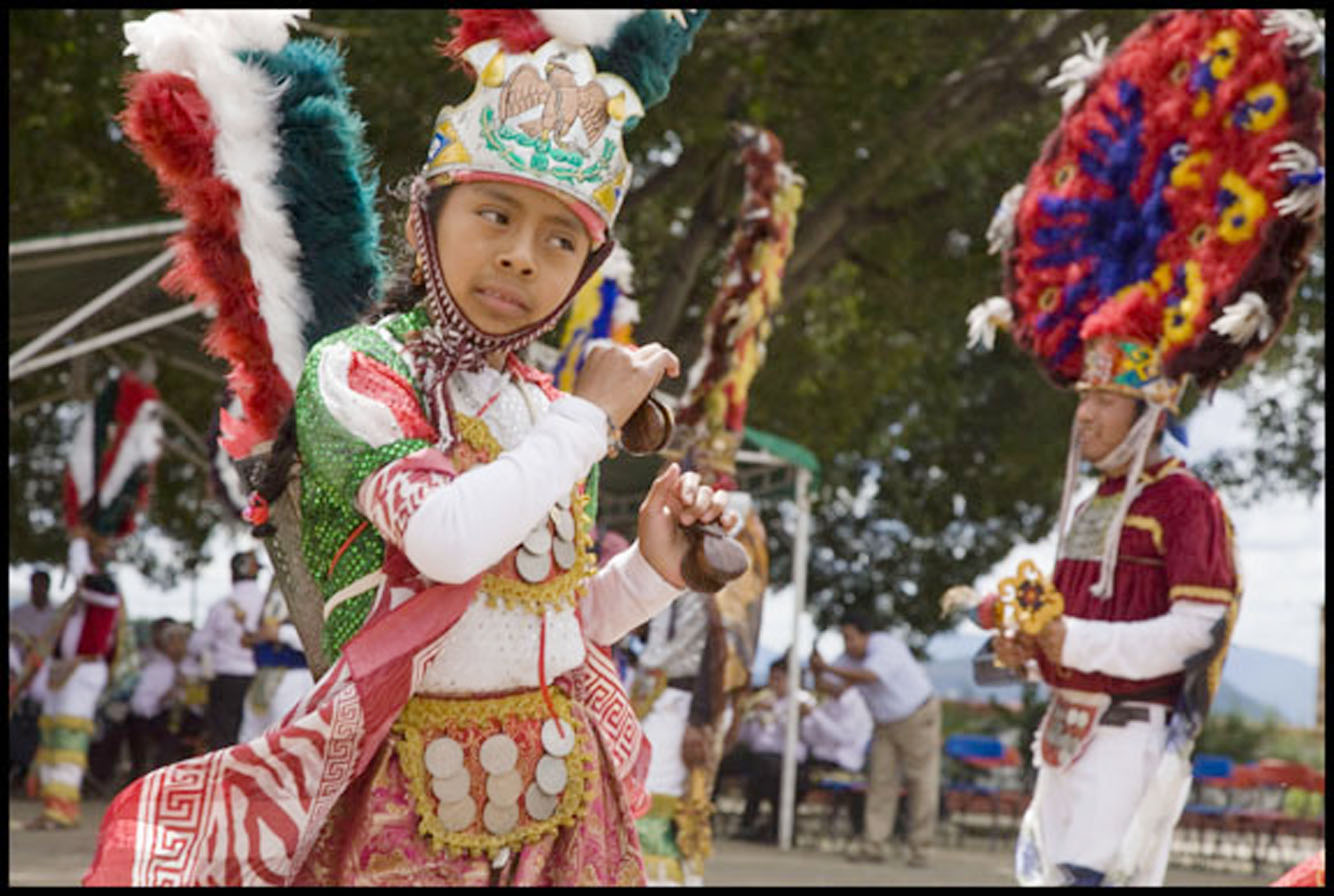
TEOTITLAN DEL VALLE, OAXACA, MEXICO 07OCTOBER12- Dancers perform the “Danza de la Pluma” or Deance of the Feather (called Guyach in Zapotec). The dance commemorates the conquest by the Spanish, although in the dance the indigenous people are not defeated by the children dressed in the uniforms of the Spanish. The name Teotitlán comes from Nahuatl and means “land of the gods”. Its Zapotec name is Xaguixe, which means “at the foot of the mountain”. It still retains its Zapotec culture and language. The dance is performed in the town plaza in front of the Preciosa Sangre de Cristo Church, which was begun in 1581 and completed in 1758. It sits on the ruins of a Zapotec temple, which the Spanish destroyed. In the dance, two young girls dance the part of dual nature of La Malinche, the interpreter for conquistador Hernan Cortez. One, in European dress, represents Doña Marina, while the other, in indigenous dress, represents La Malinche. Copyright David Bacon

by David Bacon

The Spaniards conquered the Zapotecs of the central valleys of Oaxaca, Mexico, almost 500 years ago, in an earth-shattering series of events. It changed everything in the lives of the conquered. So many died that many indigenous peoples came close to disappearing; some estimates hold that the indigenous population of the Americas was reduced by 90 percent in the two centuries following the conquest. The population drop was so great that the Spaniards later had to bring slaves to labor in their plantations on the Costa Chica (Oaxaca’s Pacific coast).
Such change and catastrophe, however, produced one of the world’s most beautiful dances: The Dance of the Feather. Today, it is performed in a number of towns in central Oaxaca, among them the weaving village of Teotitlan del Valle. In one of life’s ironies, the forced migration of the Zapotecs, driven from their homes by poverty and conquest, helped this commemorative dance survive.
The name of the city, Teotitlán, comes from Nahuatl and means “land of the gods”. Its Zapotec name is Xaguixe, which means “at the foot of the mountain”. It still retains its Zapotec culture and language. The dance is performed in the town plaza in front of the Preciosa Sangre de Cristo Church, begun in 1581 and completed in 1758. The church sits on the ruins of a Zapotec temple, which the Spanish destroyed.
The dance recalls the basic history of the conquest. At the time of the Spaniards’ arrival, indigenous people had been living in Oaxaca’s central valleys for 11,000 years. The first site of human habitation is not far from Teotitlan, in the Guilá Naquitz cave near the town of Mitla. The discovery of corncob fragments indicates that the world’s first people to cultivate corn lived there.
People speaking Zapotec in Oaxaca’s central valleys built towns with palaces, temples, ball courts and markets, coexisting and sometimes fighting with each other until 1457. That year the Aztec tlatoani, or ruler, Moctezuma invaded. First he conquered the towns inhabited by Mixtecs, then those of the Zapotecs. The Aztec invasion halted when Hernando Cortes arrived in the Yucatan, traveling up the coast of Tabasco in 1519. Cortes made alliances with the Aztecs’ enemies and marched on Tenochtitlan, their capital, massacring thousands of indigenous people at Cholula on the way.
By then, the first Moctezuma was dead. The second Moctezuma let Cortes and his soldiers into the city. Moctezuma was then taken hostage and later murdered. The city’s inhabitants rose up, forcing Cortes to flee, but they won only temporary respite. Cortes laid siege to Tenochtitlan and finally destroyed it, burying the huge temple pyramid under what is now Mexico City’s main cathedral and central plaza, the Zocalo. Moctezuma’s successor, Cuauhtemoc, was eventually captured and, with his death, the Aztec empire crumbled.
To form alliances against the Aztecs, Cortes needed a translator. First he found a priest who could speak Mayan, then a Nahuatl woman from the Gulf Coast who could translate between Mayan and Nahuatl, the language of the Aztecs and surrounding peoples. Malinalli, or Doña Marina, was one of 20 women given to the Spaniards by the residents of Tabasco. She became Cortes’ lover and advisor, and bore Cortes’ first son, Martin.
Malinalli became known as the Malinche, an object of hatred and veneration ever since. She is blamed for the defeat of the feathered warriors of Tenochtitlan and the end of purely indigenous civilization in Mexico. But she was also the mother of one of the first children borne of this enormous clash. The Oaxacan Jose Vasconcellos, secretary of education in Mexico’s first post-Revolutionary government, called the mix a new race: la raza cosmica or “the cosmic race.” He and his intellectual companions held that Mexico had people of mixed indigenous, African, and European ancestry, and was therefore moving beyond the boundaries of the old world.
While the union of Malinalli and Cortes gave birth to the mestizo, this did not free indigenous people, who were forced into conditions close to slavery. When Cortes died, Martin became Marquis of the Valley of Oaxaca. His lands included 23,000 people living in 11,500 square kilometers of territory. The Spaniards set up the encomienda system, huge land grants that included the indigenous population, forced into slavery to “pay” for room, board, and religious instruction.
Martin, so the legend goes, invented a dance to dramatize the conquest of indigenous people by the Spaniards. Jorge Hernandez Diaz, an anthropologist at the Benito Juarez Autonomous University of Oaxaca, writes that there are three theories of the origin of the dance. In one, Martin celebrated the birth of twins by staging a fight between dancers representing the conquering Spaniards (headed by Martin himself in the role of his father) and the defeated native people. The roles of the dancers in the Dance of the Feather today are still the same: Cortes, his captains and soldiers, Moctezuma and his allies. The personality of Malinalli was split into the roles of two people: Doña Marina and the Malinche.
In Teotitlan del Valle, the dance also highlights another contradiction. Fifty years ago, the town was very poor and much of the traditional weaving craft that had created part of its historical identity was no longer practiced. That poverty, reinforced by economic reforms and trade agreements that undermined Oaxaca’s agricultural economy, forced many of the town’s residents to leave. They became migrants, first within Mexico and then across the border into the United States. As remittances began arriving to support the families left behind, expatriates also provided money to buy materials for weaving. With the influx of tourists anxious to buy rugs in traditional Zapotec designs, weaving workshops were reestablished.
Migrants saved money to buy the materials for the elaborate clothing and headdresses needed for the Dance of the Feather. Some returned home to fulfill the three-year commitment required of those wanting to perform the dance.
“Why do people make the commitment?” he asks. “These commitments have a religious and spiritual importance. [Benito Mendoza Mendoza, who played Moctezuma in 1977, says:] ‘In some cases we do it because the Lord helped us overcome our food situation, when we had no money. Others do it because of their faith. And other people do it because they had a personal problem, or were sick and got better.

Therefore, to give thanks to God that they were able to move forward they made the commitment. There are many reasons why people do it.’”

spot_img

Mayan people’s movement defeats Monsanto law in Guatemala

by Christin Sandberg
IC Magazine

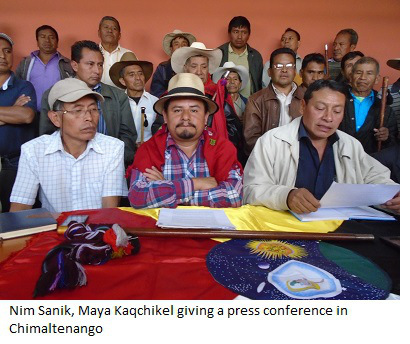
On Sept. 4, after ten days of widespread street protests against the biotech giant Monsanto’s expansion into Guatemalan territory, groups of indigenous people joined by social movements, trade unions and farmer and women’s organizations won a victory when congress finally repealed the legislation that had been approved in June.
The demonstrations were concentrated outside the Congress and Constitutional Court in Guatemala City during more than a week, and coincided with several Mayan communities and organizations defending food sovereignty through court injunctions in order to stop the Congress and the President, Otto Pérez Molina, from letting the new law on protection of plant varieties, known as the “Monsanto Law”, take effect.
On Sept. 2, the Mayan communities of Sololá, a mountainous region 125 kilometers west from the capital, took to the streets and blocked several main roads. At this time a list of how individual congressmen had voted on the approval of the legislation in June was circulating.
When Congress convened on Sept. 4, Mayan people were waiting outside for a response in favor of their movement, demanding a complete cancellation of the law –something very rarely seen in Guatemala. But this time they proved not to have marched in vain. After some battles between the presidential Patriotic Party (PP) and the Renewed Democratic Liberty Party (LIDER), the Congress finally decided not to review the legislation, but cancel it.
Lolita Chávez from the Mayan People’s Council summarized the essence of what has been at stake these last weeks of peaceful protests as follows: “Corn taught us Mayan people about community life and its diversity, because when one cultivates corn one realizes that there is a variety of crops such as herbs and medical plants depending on the corn plant as well. We see that in this coexistence the corn is not selfish, the corn shows us how to resist and how to relate with the surrounding world.”
Controversies surrounded law
The Monsanto Law would have given exclusivity on patented seeds to a handful of transnational companies. Mayan people and social organizations claimed that the new law violated the Constitution and the Mayan people’s right to traditional cultivation of their land in their ancestral territories.
Antonio González from the National Network in Defense of Food Sovereignty and Biodiversity commented in a press conference Aug. 21: “This law is an attack on a traditional Mayan cultivation system which is based on the corn plant but which also includes black beans and herbs; these foods are a substantial part of the staple diet of rural people.”
The new legislation would have opened up the market for genetically modified seeds which would have threatened to displace natural seeds and end their diversity. It would have created an imbalance between transnational companies and local producers in Guatemala where about 70 per cent of the population dedicate their life to small-scale agricultural activities. That is a serious threat in a country where many people live below the poverty line and in extreme poverty and where children suffer from chronic malnutrition and often starve to death.
The law was approved in June without prior discussion, information and participation from the most affected. It was a direct consequence of the free trade agreement with the US, ratified in 2005. However, recently the protests started to grow and peaked a couple of weeks ago with a lot of discussions, statements and demonstrations.
At first the government ignored the protests and appeared to be more interested in engaging in superficial forms of charity like provision of food aid while ignoring the wider and structural factors that cause and perpetuate poverty in Guatemala such as unequal land distribution, deep rooted inequalities, racism, to name but a few.
But soon enough they decided to act. Even though politicians claimed not to act on social demands, it is without doubt a decision taken after enormous pressure from different social groups in society.
Criminalizing the Mayan people – again
There was a great risk that the Monsanto Law would have made criminals of already repressed small farmers who are just trying to make ends meet and doing what they have done for generations – cultivating corn and black beans for their own consumption. The Monsanto Law meant that they would not have been able to grow and harvest anything that originates from natural seeds. Farmers would be breaking the laws if these natural seeds had been mixed with patented seeds from other crops as a result of pollination or wind, unless they had had a license for the patented seed from a transnational corporation like Monsanto.
Another risk expressed by ecologists was the fear that the costs for the patented seeds would have caused an increase in prices and as consequence caused a worsened food crisis for those families who could not afford to buy a license to sow.
Academics, together with the Mayan people, also feared that the law would have intensified already existing fierce social conflicts between local Mayan communities and transnational companies in a country historically and violently torn apart.
Mayan people and Mother Earth
Currently international companies are very interested in gaining control of the abundant and rich natural assets that Guatemala possesses.

spot_img