Sunday, October 18, 2026
spot_img
Home Blog Page 386

City clears out homeless encampment

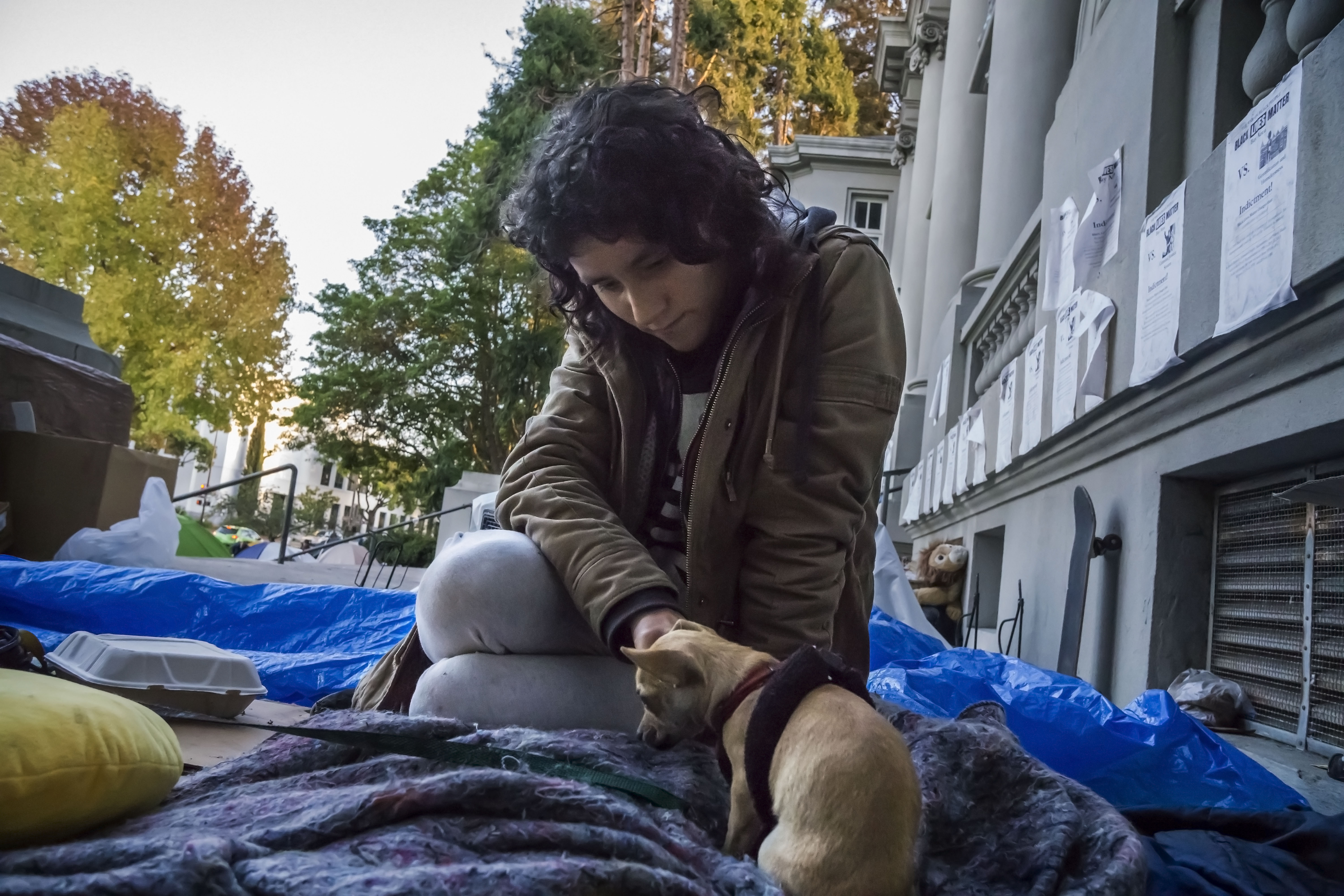
BERKELEY, CA - 24NOVEMBER15 - The camp outside the old Berkeley City Hall, called by the residents an occupation. It is a protest against the Berkeley City Council passing an anti-homeless ordinance. Copyright David Bacon

by David Bacon

NOTE FROM THE EDITOR:

The March 2 print edition of our front page story incorrectly identified the author of its story City Clears Out Homeless Encounter. The correct author of the piece is David Bacon. Bacon’s story was edited by Josh Wolf, who contributed additional reporting to focus the story on recent developments in San Francisco. El Reportero regrets the error.
Michael Lee started living on the streets of San Francisco last May. He had traveled to the city from Las Vegas to seek medical treatment. When he arrived, he searched for cheap, temporary housing in some of San Francisco’s most affordable neighborhoods, but he had seriously underestimated the cost of living in the nation’s most expensive city.
“I was under the impression the rent was $300 a month, and I brought the resources for sixty days,” he said in an interview. “I was going to go back to Las Vegas afterwards and go back to work. But the first place I walked into, they told me it was $300 a week. The next was $400 a week, and then $500. People were laughing at me – $300 a week is actually cheap on Skid Row. So I wound up living on the streets.”
Just before dawn on Tuesday, March 1, San Francisco officials moved forward with a plan to push out the people living in tents along a commercial thoroughfare near Highway 101. The homeless who have been camping along Division Street for months were notified a few days earlier of the plan to oust the encampment.
Some left when they heard the news of the city’s plan, others defied the orders to leave saying they had nowhere to go. While the city made plans to house people in a temporary encampment at Pier 80, its numerous rules combined with the remote location and barbed wire fences proved to be an unacceptable alternative for many of the city’s homeless.
A few of the city’s homeless residents have found stability through the nearby homeless navigation center, a new model for sheltering the homeless that drops the traditional paternalistic rules that leave many clients feeling disempowered. Other homeless residents, like Lee, have left San Francisco for other Bay Area communities.
After learning about a large encampment in Berkeley that homeless activists had set up to protest the US Postal Service’s plan to sell its historic downtown post office building, Lee moved across the bay to join the movement. He quickly became a leader of the Berkeley camp, and advocated for a plan to transform the old post office building into a community resource: “A homeless contact center run by homeless people,” he said.
“Why [were] homeless people the main defenders?” Lee asked rhetorically, referring to the post office. “Without community resources we can’t get a hand up. There’s just no place to go. This is where we live, unfortunately – on the sidewalks. We don’t want to live in a community where private developers, the One Percenters, have everything.
“We’re not going to be homeless forever,” Lee continued. “Eventually, we will recover from homelessness because we’re pretty determined individuals. That’s something that people with houses truly need to understand. We are going to be rejoining the community.
After a federal judge granted the City of Berkeley a temporary restraining order against the US Postal Service’s planned sale of the downtown post office, the USPS announced that it was shelving its plans to sell the building. Several months later, some of the people in the post office camp set up a larger homeless encampment, which became known as “Liberty City” or “Liberty Village.” They set this camp up a block away, on the lawn in front of Old City Hall, to protest a new city council plan to establish stricter rules targeting homeless people. During the holidays, Berkeley cleared out Liberty City, and the homeless people who had been part of it scattered to other spots in the city and to locations throughout the Bay Area. The post office camp, now more than four hundred days old, still remains.
Over the years, Berkeley, like most liberal communities, has been comfortable with the idea of the homeless being victims. But many Berkeley residents and business owners grow uneasy when homeless people organize and use the creative tactics of the labor and civil rights movements.
Last year, Berkeley’s homeless people did just that. They created what they called, “intentional communities,” or “occupations,” like Liberty City and the post office camp, not just as a protest tactic, but also as places where they could gain more control over their lives and implement their own ideas for dealing with homelessness.
Many drew on previous experience in other movements. “ A lot of us are older activists,” Lee explained. “Our ideas come out of the 1960s and even before, from the 1930s. Homeless people have always formed communities, whether we were considered hoboes or homeless people or just bums. Hobo jungles were intentional communities too, based on an unconscious understanding of the need for mutual aid and voluntary cooperation.
“People police themselves,” he added, in an interview while Liberty City was still operating. “I see people out there in the middle of the night with flashlights picking up trash. I see them chase off anti-social elements. If you want to talk about the solution to homelessness, all you have to do is walk down to Berkeley City Hall, and the post office. Is it a perfect solution? No. Housing is the permanent solution to homelessness. But this is a helluva good start.”
Nearly everyone agrees that the answer to homelessness is permanent housing. But the state and federal governments do not provide the funding needed to build permanent housing for homeless people. In fact, over the decades, national policies have eliminated housing for poor people and cost hundreds of thousands of jobs.
Local governments provide homeless shelters and services, but they are unable to meet the needs of the huge number of people living on the streets because of a lack of money. Berkeley alone has 1,200 homeless residents, according to city officials. Further, many homeless people don’t like shelters because they can’t bring their pets, or because most shelters require you to be inside by a certain hour in the evening and to leave during the day.
As a result, some cities, including Portland and Seattle, have approved the creation of tent cities as an alternative form of temporary housing for homeless people. And Berkeley’s experience with Liberty City revealed that a tent city has the potential to work in the East Bay as well.
Meanwhile, the homeless who had been living in San Francisco along Division Street have been pushed into the Potrero Hill Neighborhood, and it’s unclear how long the city will tolerate their presence. Tho 180 or so people who relocated to Pier 80 have a shelter for now, but that site was only scheduled to remain open until the end of the month. City officials are now looking to extend its usage for the coming months, but it is neither a permanent nor complete solution to the ongoing problem.
Mike Zint has been homeless since 2000. For many years, he lived out of his car, moving from town to town. He said that during the Occupy movement several years ago, he was in San Francisco when “police sent me to Occupy, thinking that I must be a drug addict. But they made a big mistake, because I began organizing.”
Zint said that after San Francisco police “crushed” the Occupy encampment, he and other homeless activists staged a series of protests, including one during the America’s Cup yacht race.
Zint said that, over the years, San Francisco has hardened its stance against marginalized people, like the homeless. Politicians “pass laws to get the homeless out of sight of the businesses, so shoppers don’t see them,” he said. “San Francisco has an image as a world class city, but there are no bathrooms. There are no shower facilities. They say there are only a few thousand homeless when there are twice as many. With the shuffle going on they just move them. One day this street looks good because they’ve cleared people out, and then they get rid of them somewhere else.”


spot_img

Kaiser Permanente San Jose Jazz Winter Fest 2016

Compiled by El Reportero’s staff

Renowned for its annual Summer Fest, the iconic Bay Area institution San Jose Jazz kicks off 2016 with dynamic arts programming honoring the jazz tradition and ever-expanding definitions of the genre with singular concerts curated for audiences within the heart of Silicon Valley. presented by Metro continues its steadfast commitment of presenting a diverse array of some of today’s most distinguished artists alongside leading edge emerging musicians with an ambitious lineup of more than 25 concerts
The Jazz Beyond series, co-curated with local production house Universal Grammar, presents buzzy young stars pushing the boundaries of jazz, soul and hip-hop and the Next Gen performances showcase top student jazz ensembles in the region and offer open master classes. Tickets are now on sale ranging in price from $10 – $65. For detailed ticket information as well as updates on the artists and performance schedule, please visit: sanjosejazz.org/winterfest.
San Jose Jazz proudly presents the following artists at Winter Fest 2016: John Scofield Joe Lovano Quartet, Regina Carter, Nicholas Payton Trio, Delfeayo & Ellis Marsalis Quartet, Marquis Hill Blacktet, Incendio, KING, Kneedelus, Kadhja Bonet, Bria Skonberg, Jackie Ryan, Chester ‘CT’ Thompson and the Bay Area’s premier youth jazz ensembles. From February 25 through March 8, 2016.

Noche Bohemia en la Bahía
Golden Promotion Entertainment presents live, Noche Bohemia en la Bahía, from Culiacán, Sinaloa, Mexico, Benny Camacho; from Los Angeles California, Korina López, José Montes de Oca; y como talento local a Sergio García Checo.
On Saturday, Feb. 27, The Mario Juárez Event Center, 1241 High St, Oakland, California. (510) 437-1111, esmeraldac@mariojuarez.com

Two of the most respected musicians from Galicia, Spain in SF
Uxía & Narf unite for the first time to present a joint musical project that features reinterpretations of classics, including poems by Rosalía de Castro and García Lorca, original compositions, and adaptations of traditional alalás, the oldest and best-known form of Galician music.
Building bridges across cultures through music, they create their respective repertoires after more than 20 years of traveling and exchanging experiences with artists from Brazil, Angola, Mozambique, Cape Verde, and Guinea-Bissau. The duo unites harmonious vocals and intimate melodies through the shared pursuit of originality and cultural crossroads.
At the Red Puppy, 2698 Folsom St. @ 23rd St., San Francisco, on March 3 at 7:30 p.m. – 10:00 p.m. Admission: $20-25. Doors at 7 p.m. Show at 7:30 p.m. All ages welcome.

Absolute Beginning Taiko Workshop with Bruce Ghent
Learn the ancient art of Japanese Taiko drumming with Sensei Bruce ‘Mui’ Ghent. The Introductory taiko class will cover basic fundamental skills and history which will prepare students to advance to the next level of classes.
Beginners ages 12-adult, with little or no music experience are welcome. Taiko drumming is a rigorous physical activity. Bring water and wear clothes to exercise. Class is taught with traditional martial arts etiquette and discipline as outlined in the student handbook supplied.
For more information, contact Bruce “Mui” Ghent at bruceghent@gmail.com or visit www.maikazedaiko.com.
March 6-April 10: Sundays, 10:30 a.m.-12 p.m., at the Dance Mission Theater. To register call 415-826-4441 or email dancemissiontheater@yahoo.com.

spot_img

Kaiser Permanente San Jose Jazz Winter Fest 2016

Compiled by El Reportero’s staff

Renowned for its annual Summer Fest, the iconic Bay Area institution San Jose Jazz kicks off 2016 with dynamic arts programming honoring the jazz tradition and ever-expanding definitions of the genre with singular concerts curated for audiences within the heart of Silicon Valley. presented by Metro continues its steadfast commitment of presenting a diverse array of some of today’s most distinguished artists alongside leading edge emerging musicians with an ambitious lineup of more than 25 concerts
The Jazz Beyond series, co-curated with local production house Universal Grammar, presents buzzy young stars pushing the boundaries of jazz, soul and hip-hop and the Next Gen performances showcase top student jazz ensembles in the region and offer open master classes. Tickets are now on sale ranging in price from $10 – $65. For detailed ticket information as well as updates on the artists and performance schedule, please visit: sanjosejazz.org/winterfest.
San Jose Jazz proudly presents the following artists at Winter Fest 2016: John Scofield Joe Lovano Quartet, Regina Carter, Nicholas Payton Trio, Delfeayo & Ellis Marsalis Quartet, Marquis Hill Blacktet, Incendio, KING, Kneedelus, Kadhja Bonet, Bria Skonberg, Jackie Ryan, Chester ‘CT’ Thompson and the Bay Area’s premier youth jazz ensembles. From Feb. 25 through March 8, 2016.

Noche Bohemia en la Bahía
Golden Promotion Entertainment presents live, Noche Bohemia en la Bahía, from Culiacán, Sinaloa, Mexico, Benny Camacho; from Los Angeles California, Korina López, José Montes de Oca; y como talento local a Sergio García Checo.
On Saturday, Feb. 27, The Mario Juárez Event Center, 1241 High St, Oakland, California. (510) 437-1111, esmeraldac@mariojuarez.com

Two of the most respected musicians from Galicia, Spain in SF
Uxía & Narf unite for the first time to present a joint musical project that features reinterpretations of classics, including poems by Rosalía de Castro and García Lorca, original compositions, and adaptations of traditional alalás, the oldest and best-known form of Galician music.
Building bridges across cultures through music, they create their respective repertoires after more than 20 years of traveling and exchanging experiences with artists from Brazil, Angola, Mozambique, Cape Verde, and Guinea-Bissau. The duo unites harmonious vocals and intimate melodies through the shared pursuit of originality and cultural crossroads.
At the Red Puppy, 2698 Folsom St. @ 23rd St., San Francisco, on March 3 at 7:30 p.m. – 10:00 p.m. Admission: $20-25. Doors at 7 p.m. Show at 7:30 p.m. All ages welcome.

Absolute Beginning Taiko Workshop with Bruce Ghent
Learn the ancient art of Japanese Taiko drumming with Sensei Bruce ‘Mui’ Ghent. The Introductory taiko class will cover basic fundamental skills and history which will prepare students to advance to the next level of classes.
Beginners ages 12-adult, with little or no music experience are welcome. Taiko drumming is a rigorous physical activity. Bring water and wear clothes to exercise. Class is taught with traditional martial arts etiquette and discipline as outlined in the student handbook supplied.
For more information, contact Bruce “Mui” Ghent at bruceghent@gmail.com or visit www.maikazedaiko.com.
March 6-April 10: Sundays, 10:30 a.m.-12 p.m., at the Dance Mission Theater. To register call 415-826-4441 or email dancemissiontheater@yahoo.com.

spot_img

Mexico and the U.S. reach agreements for orderly repatriation

by the El Reportero’s wire services

The Foreign Ministry of Mexico called historic the negotiation that led to agreements with the U.S. for ‘’decent, safe and orderly repatriation of Mexican nationals’’ it was known here today.
Both sides finished in El Paso, Texas, the review process and signing of the Local Arrangements of Repatriation at the border to ensure the safety and proper reception of the returned Mexicans.
As a result of historical trading, for the first time the agreements include a commitment to carry out the repatriations at certain times (primarily diurnal) and to limit the repatriations to 12 points (11 of them borderly and Mexico City for the flights of the Repatriation Program to the Interior) where there is infrastructure and assistance programs for people who return.
So it says a statement from the Foreign Ministry releasing the analysis of initiatives to improve care for unaccompanied children and teenagers arrested in their attempt to enter the United States.
Both countries agreed to increase to three the weekly flights of the Mexican Interior Repatriation Program (MIRP).
The National Migration Institute received 205,417 repatriations of Mexican people from the United States and the Ministry of Foreign Affairs, through its consular network, attended 180,908 cases of protection and assistance, the statement adds.

Nobel Peace prizes visit political prisoners in Guatemala
Nobel Peace Prizes Rigoberta Menchú (1992) and Jody Williams (1997) visited five Guatemalan community leaders, who remain in prison after a year for defending their communities’s rights in the country.
During their visit to the Detention Centre in Zone 18 in the capital, the Nobel Women’s Initiative (NWI) learned details of the delays of the process of securing justice in favor of Rigoberto Juárez, Domingo Baltazar, Arturo Pablo, Francisco Juan and Adalberto Villatoro.
Each conscious prisoner offered details about their fights against the installation of hydro projects in the territories of Santa Eulalia and Santa Cruz Barillas, in the western department of Huehuetenango, as well as their experiences in prison.
This visit encourages us to keep fighting, along with the Nobel Women’s Initiative, it helps us make more contributions and provides us with inputs to do our bit for their release, she added.

Pemex’’s debt is unsustainable; its revenues drop  
The debt accumulated today by Petróleos Mexicanos (Pemex, in Spanish) is no longer sustainable, recognized its director, José Antonio González, while the company’’s revenues continue to decline.
González said that despite the debit Pemex has a long-term viability.
It has a large inventory of total reserves, low production cost and the recognized ability and talent of its technicians, said the executive.
However, indicators of the oil company after the first month of the year brought bad news.
The revenues from oil exports dropped by 50 percent a year, due to a fall of 34 percent of oil prices in January.
On that date, Pemex entered just 815 million dollars, compared with the 1,630 million recorded in the same month of 2015.
It was also specified that the volume of oil exports fell 11 percent year to January 2016, totaling 1.12 million barrels per day, compared with the 1.26 reported in the same month of 2015.
By contrast, Pemex increased its imports of natural gas in 47.2 percent per year.
The decision of the government led by President Enrique Peña Nieto to liberalize the imports of gasoline and diesel from next April, represents another blow to this company of the Mexican state.

spot_img

Kaiser Permanente San Jose Jazz Winter Fest 2016

Compiled by El Reportero’s staff

Renowned for its annual Summer Fest, the iconic Bay Area institution San Jose Jazz kicks off 2016 with dynamic arts programming honoring the jazz tradition and ever-expanding definitions of the genre with singular concerts curated for audiences within the heart of Silicon Valley. presented by Metro continues its steadfast commitment of presenting a diverse array of some of today’s most distinguished artists alongside leading edge emerging musicians with an ambitious lineup of more than 25 concerts
The Jazz Beyond series, co-curated with local production house Universal Grammar, presents buzzy young stars pushing the boundaries of jazz, soul and hip-hop and the Next Gen performances showcase top student jazz ensembles in the region and offer open master classes. Tickets are now on sale ranging in price from $10 – $65. For detailed ticket information as well as updates on the artists and performance schedule, please visit: sanjosejazz.org/winterfest.
San Jose Jazz proudly presents the following artists at Winter Fest 2016: John Scofield Joe Lovano Quartet, Regina Carter, Nicholas Payton Trio, Delfeayo & Ellis Marsalis Quartet, Marquis Hill Blacktet, Incendio, KING, Kneedelus, Kadhja Bonet, Bria Skonberg, Jackie Ryan, Chester ‘CT’ Thompson and the Bay Area’s premier youth jazz ensembles. From February 25 through March 8, 2016.

Noche Bohemia en la Bahía
Golden Promotion Entertainment presents live, Noche Bohemia en la Bahía, from Culiacán, Sinaloa, Mexico, Benny Camacho; from Los Angeles California, Korina López, José Montes de Oca; y como talento local a Sergio García Checo.
On Saturday, Feb. 27, The Mario Juárez Event Center, 1241 High St, Oakland, California. (510) 437-1111, esmeraldac@mariojuarez.com

Two of the most respected musicians from Galicia, Spain in SF
Uxía & Narf unite for the first time to present a joint musical project that features reinterpretations of classics, including poems by Rosalía de Castro and García Lorca, original compositions, and adaptations of traditional alalás, the oldest and best-known form of Galician music.
Building bridges across cultures through music, they create their respective repertoires after more than 20 years of traveling and exchanging experiences with artists from Brazil, Angola, Mozambique, Cape Verde, and Guinea-Bissau. The duo unites harmonious vocals and intimate melodies through the shared pursuit of originality and cultural crossroads.
At the Red Puppy, 2698 Folsom St. @ 23rd St., San Francisco, on March 3 at 7:30 p.m. – 10:00 p.m. Admission: $20-25. Doors at 7 p.m. Show at 7:30 p.m. All ages welcome.

Absolute Beginning Taiko Workshop with Bruce Ghent
Learn the ancient art of Japanese Taiko drumming with Sensei Bruce ‘Mui’ Ghent. The Introductory taiko class will cover basic fundamental skills and history which will prepare students to advance to the next level of classes.
Beginners ages 12-adult, with little or no music experience are welcome. Taiko drumming is a rigorous physical activity. Bring water and wear clothes to exercise. Class is taught with traditional martial arts etiquette and discipline as outlined in the student handbook supplied.
For more information, contact Bruce “Mui” Ghent at bruceghent@gmail.com or visit www.maikazedaiko.com.
March 6-April 10: Sundays, 10:30 a.m.-12 p.m., at the Dance Mission Theater. To register call 415-826-4441 or email dancemissiontheater@yahoo.com.

spot_img

Cuban band Gente de Zona to perform in Europe, Asia

by the El Reportero’s news services

The coming international tour of the Cuban band Gente de Zona stresses today by the inclusion of stages in Spain, France, Netherlands, and Israel, according to its director, Alexander Delgado.
Scheduled for April, the tour will promote the new album entitled “Visualizate,” to be released on April 22 by Sony Music.
“The volume has the collaboration of artists such as Pitbull, Marc Anthony, and Juan Magan, but we are recording another CD with Cuban friends, including Leoni Torres,” Delgado said.
Randy Malcom, member of the band, said before leaving for Europe and Asia, that they will perform with Enrique Iglesias in Quito, Ecuador, on April 3, during a show designed to combine Spanish and Latin American rhythms.
After the Eurasian tour in May, the band will tour in Las Vegas to participate in the Billboard Music Awards ceremony, to which they were nominated in four categories in 2016.

U.S. Poet Laureate and retired writing professor will receive the Robert Kirsch Award
Juan Felipe Herrera, United States Poet Laureate and professor of creative writing emeritus at the University of California, Riverside, will receive the 2015 Robert Kirsch Award for lifetime achievement during the 21st Los Angeles Times Festival of Books.
The award will be presented April 9.
“We are delighted to honor Juan Felipe Herrera’s remarkable 45-year career as a writer, teacher and activist,” Kenneth Turan, Times film critic and director of the Times Book Prizes. “His literary contributions include poetry, prose, young adult novels and children’s literature, and his work in all artistic forms highlights a life dedicated to giving voice to those who are not always heard.”
Herrera, who retired in March 2015 as a professor of creative writing at UCR, was named California Poet Laureate in 2012 and U.S. Poet Laureate in 2015. The son of migrant farm workers, Herrera earned a B.A. in social anthropology from UCLA, an M.A. in social anthropology from Stanford University, and an M.F.A. in poetry from the University of Iowa Writers’ Workshop. He joined the UCR faculty in 2005 and was the Tomás Rivera Chair in Creative Writing until he was named the state’s poet laureate.

Panama holds early music festival
Songs of the 17th and 18th centuries will be performed today by groups from Spain, Portugal, Cuba, Panama and Colombia, as part of the 2nd Early Music Festival.
The meeting, to be held until Sunday, Feb. 28, aims to show the identity and diversity of the European musical richness, whose rhythms came to America in late 15th century.
Tunes and mergers, especially from the Baroque period, will encourage each of the performances, as part of the program of activities of the event.
The opening concert will be held at the Monumental Historic Complex of Panama Viejo -declared in 2003 a World Heritage site-, where the Academy of Spain Piaccere will present a repertoire that includes the music the Spanish metropolis and its American colonies exchanged in the 17th century.
According to Arlene Lachman, president of the Arte Panama Foundation, the guest artists will perform music with historical criteria, with scores of the 17th and 18th century, and instruments of the time, such as harpsichord, theorbo, viola da gamba, lute, violin and recorders, among others.
“This event will put Panama on the international circuit of the major festivals in the region. It will also promote its position as a Latin American capital that promotes culture, arts, historic heritage and cultural tourism,” the president of the Organizing Committee added.

spot_img

Entrevista de Erika Vidrio en Noche Bohemia

spot_img

Mission Fire press conference

spot_img

Mardi Gras San Francisco 2016 con Luz Cabrera

spot_img

House Democrats call on house Republicans to begin negotiations on Puerto Rico

by Rep. Raúl M. Grijalba

Washington, D.C. – The House Natural Resources Committee is holding its third hearing on Puerto Rico’s financial and economic crisis tomorrow. A representative from the U.S. Treasury Department will testify and present the Obama Administration’s assessment of the Commonwealth’s debt crisis. Democrats are calling for the Committee to begin bipartisan negotiations and draft a legislation that outlines a responsible solution to Puerto Rico’s crisis by March 31, the deadline set by House Speaker Paul Ryan.
On Oct. 21, 2015, the Obama Administration unveiled a detailed legislative outline to help Puerto Rico address its serious fiscal challenges. While the Administration has worked extensively with Puerto Rican officials to find solutions to the Commonwealth’s fiscal crisis, Congress has authority to provide Puerto Rico with the tools required to lay the foundation for the Commonwealth’s recovery, and Congress should act.
Last summer Puerto Rico’s governor, Alejandro García Padilla, declared that the commonwealth’s $72 billion in debt “is not payable.” This past week, the Puerto Rican government announced that “it had substantial doubt about its ability to operate in the long term” after the Government Development Bank signaled that it is likely to miss its next bond payment.
“As we enter tomorrow’s hearing on Puerto Rico, I want my colleagues to remember that we are dealing with people’s lives here – parents, children, teachers, nurses, law enforcement officers – all U.S. citizens,” said House Natural Resources Committee Ranking Member Raúl M. Grijalva (D-AZ). “The 3.5 million Puerto Ricans living on the island have endured more than a decade of austerity and deserve economic relief. Following tomorrow’s hearing we should immediately start discussions on drafting bipartisan legislation that can be reported to the floor without further delay. The clock is ticking; March 31 will be here before we know it.”
“Our fellow Americans in Puerto Rico continue to face a contracting economy and an unsustainable debt burden,” said House Minority Leader Nancy Pelosi. “Only Congress can empower Puerto Rico with the meaningful tools to restructure its public debt and restore the economic stability necessary to create jobs and a brighter economic future. I urge my Republican colleagues to act expeditiously in enacting a comprehensive and bipartisan solution that brings urgent relief to the people of Puerto Rico.”
“I join in calling on House Republicans to begin bipartisan negotiations on legislation to address the debt crisis in Puerto Rico,” stated Democratic Whip Steny H. Hoyer. “Puerto Rico is an integral part of the United States of America, and like other jurisdictions who have found themselves in deep fiscal trouble, we ought to allow the island to restructure its debt. House Democrats will continue to push for commonsense legislation to confront the financial crisis in Puerto Rico, and I am hopeful both parties can reach agreement on a path forward before Speaker Ryan’s March 31 deadline.”
“Congress has a responsibility to every American citizen to make sure we don’t get in the way of their prosperity,” said House Democratic Caucus Chairman Xavier Becerra (D-CA). “The American citizens of Puerto Rico have been waiting for months for Congress to act. American citizens can’t afford a do-nothing Congress.”
“What’s happening in Puerto Rico is not only a financial crisis, but a humanitarian one,” said Rep. Nydia M. Velázquez (D-NY). “It is critical the Committee move forward swiftly with meaningful, broad based legislation that allows the Commonwealth to restructure its debt, without imposing further hardship on the people of Puerto Rico who have already endured major cuts to public services. Congress has a moral obligation to act.”
“Puerto Rico can’t solve its economic problems alone and only Congress can take the necessary action at the federal level,” said Congressman José E. Serrano (D-NY). “The island is on the verge of a humanitarian crisis and more than 3.5 million American citizens are suffering the consequences of Congress’ inaction. I trust tomorrow’s hearing will allow us to reach some consensus and make significant progress in addressing this crisis. The Speaker’s deadline is approaching- and it is time to act.”
“The people of Puerto Rico want and deserve respect from the Congress and want to know that their opinions, their aspirations, and their lives will be taken seriously by Congress and by Washington,” said Rep. Luis V. Gutiérrez (D-IL).
“Puerto Rico is facing a financial and humanitarian crisis, and Congress has both a duty and moral responsibility to act,” said Rep. Joe Crowley (D-NY), Vice Chair of the Democratic Caucus. “The people of Puerto Rico are a part of our American family, and they deserve immediate action by their Congress. I join my colleagues in urging House Republicans to make this issue a priority.”

spot_img