Monday, October 19, 2026
spot_img
Home Blog Page 328

In ongoing drug war, US-trained Mexican troops go unpunished for human rights violations

When pursuing their various “wars” on drugs and “wars” on terror, the U.S. and the governments it supports in these “wars” are apt to overlook human rights abuses committed by the militaries and police forces upon which they rely. A new report details how this has played out in the Mexican military

by Whitney Webb

MEXICO CITY – A study published Tuesday by the advocacy group Washington Office on Latin America (WOLA) has revealed the woeful inadequacy of the Mexican government in pursuing cases of human rights violations committed by soldiers against civilians — in spite of recent reforms that allow such cases to be heard by civilian, rather than military, courts. According to its website, WOLA is “a leading research and advocacy organization advancing human rights in the Americas.”

WOLA’s report, titled “Overlooking Justice: Human Rights Violations Committed by Mexican Soldiers Against Civilians are Met with Impunity,” examined data made available by Mexico’s Attorney General’s Office (Procuraduría General de la República, PGR). The data showed clearly that the vast majority of investigations, even those in which abundant evidence exists to show proof of wrongdoing, fail to result in punishments for those accused of abuses of human rights, such as extrajudicial killings, torture, kidnappings and the use of excessive force. In all, only 16 of the 505 criminal investigations PGR launched between 2012 and 2016 ended with a conviction.

Furthermore, of those 505 cases, only two involved commanding officers — with the vast majority examining the conduct of rank-and-file soldiers, many of whom claim to have been following the orders of their superiors. WOLA cited this trend as a strong indication that Mexico’s military leadership operates with relative impunity.

The WOLA study also found that the PGR put minimal effort into amassing the evidence needed to successfully prosecute cases, suggesting that many were set up to fail. In addition, it found numerous examples of the Mexican military intervening in cases by limiting civilian access to testimony or by altering crime scenes — actions which further derailed investigations into potential abuses.

Ximena Suárez, WOLA’s Associate for Mexico and lead author of the report, stated in a press release:

Civilian oversight of the military is essential to any democracy, yet the PGR has failed to hold the military accountable for human rights violations. This is particularly important given the government’s reliance on soldiers to patrol streets and take the leading role in the fight against organized crime.”

In response to the report, the Mexican government defended its rights record.

A government statement, cited by the Associated Press, said that the PGR is working toward “structural and institutional changes to put an end to impunity and pursue human-rights violations” through the creation of special investigative units and that the Mexican military would undergo increased human-rights training.

As Suárez noted, Mexico in recent years — since former Mexican president Felipe Calderón authorized an “all-out war” on drug cartels in 2006 — has become particularly reliant on its military for its controversial crackdown on drug gangs as well as for general policing activity. This “war” — claiming over 23,000 lives last year alone — has continued under the current president, Enrique Peña Nieto, despite drawing criticism that it has militarized the streets of Mexico and actually worsened the situation. Current legislation being considered by the Mexican Congress would further expand the Mexican military’s role in matters of public security, while further weakening the civilian justice system.

The Mexican military, despite its high body-count since the drug war began and its tendency to commit human rights violations against civilians, continues to enjoy strong support from the United States.

Since 2008, the U.S. Department of Defense has given over $521 million in assistance to the Mexican military via its Combating Terrorism Fellowship Program and Section 1004 Counter-Drug Assistance Program. In addition, over the course of the drug war, the U.S. military has overseen and paid for the training of large parts of the Mexican military — a program that has increased in recent years, jumping from $3 million in 2009 to $15 million in 2013. Between 2010 and 2015, the U.S. military taught 7,678 elite courses to nearly 9,000 members of the Mexican military, at an estimated cost of $60 million. These courses have covered a wide range of topics, including sniper training, explosives, and psychological operations (psyops).

The U.S. government has also funded the other side of the conflict, having allowed the sale of more than $1.25 million worth of guns to the Mexican Sinaloa cartel in a failed sting operation known as “Fast and Furious.”

In addition, to support from the U.S. government, the U.S. corporate media has also been supportive of the Mexican military, even when it has been caught committing extrajudicial killings and human rights abuses. A 2016 article from The New York Times stated that some consider extrajudicial killings committed by the military a “form of pragmatism,” as the armed forces “cannot rely on the shaky legal system” to properly prosecute those suspected of drug trafficking.

CBS News last year stated that “Mexico’s armed forces have increasingly been pulled into the conflict because police forces are often corrupt or unreliable. That has had its own toll on the troops, who are frequently ambushed and accused of illegally executing detained cartel suspects in some cases.” CBS failed to note that the same police forces that are “corrupt or unreliable” have also been trained, in many cases, by the U.S. government.

The substantial support the Mexican military received from the U.S. is second only, within Latin America, to that received by Colombia. Like the Mexican military, the Colombian military – trained and funded to a large degree by the United States via “Plan Colombia” — has also been exposed as serially violating human rights of Colombian civilians and sharing corrupt connections to drug traffickers, even taking part in the drug trade themselves.

Indeed, the United Nations Drug Control Program (UNDCP) has described the Colombian military as being among “the biggest heroin and cocaine trading institutions” in the world. Colombian military officials have also assisted in training the Mexican military in recent years.

Ultimately, the U.S.’ aid and support for the Mexican military is likely to continue – regardless of whether the military’s human rights abuses continue to go unpunished or not. For much of the past century, the U.S. has repeatedly provided aid to militaries and paramilitary groups throughout Latin America that have partaken in grave human rights abuses as well as genocide.

Yet, despite the abuses, U.S. aid to Latin America has only grown, particularly since the advent of the U.S.’ War on Drugs in Latin America. As MintPress News has previously noted, however, the consequence of this war – as opposed to decreasing drug trafficking – has instead concentrated it in the hands of a wealthy oligarchy that supports the U.S.’ ambitions for dominance of the region.


spot_img

Mexican immigrant acquitted of murder of Kate Steinle

by the El Reportero’s wire services

A Mexican immigrant was acquitted of murder and manslaughter charges in San Francisco on Thursday, Nov. 30, in the politically charged shooting and death of a woman, the San Francisco Chronicle reported.

The case against José Inés García Zarate, who immigrated illegally to the United States, became a rallying cry for President Donald Trump during his campaign for the White House, as he pushed to halt illegal immigration and penalize so-called sanctuary cities, including San Francisco.

Zarate, who had been deported to Mexico five times since first entering the U.S. as a juvenile, said the July 1, 2015, shooting of Kate Steinle on a pier in San Francisco, was an accident.

The San Francisco jury, while acquitting him of murder and manslaughter charges, found him guilty of the lesser charge of being a felon in possession of a firearm, a San Francisco Chronicle reporter covering the case said on Twitter.

Honduras under tension due to presidential elections results

Honduras dawned in tension on Nov. 30 after the presidential candidate for the Opposition Alliance against the Dictatorship party, Salvador Nasralla, has denounced to the public that the Supreme Electoral Tribunal (TSE) manipulated the data.

Nasrallah said he would ignore the results of the general elections offered by the TSE, noting that the electoral entity is deceitful, corrupt and serves the president and candidate for reelection, Juan Orlando Hernández.

‘I was the target of a trap and I do not fall into traps,’ said the opposition candidate when referring to the signing of a pact with the Organization of American States (OAS) in which he committed, like Orlando Hernández, to accept the results.

Nasrallah said that hours after the signing of that agreement polling data were altered during several cuts on the TSE computer system.

‘We do not recognize the results because on Wednesday the server fell down and then files were downloaded that we can not allow and you can verify it, these are minutes that are not signed by the representatives at the polling stations,’ he said.

Although the opposition candidate will have to demonstrate his allegations of fraud, the delayed publication of the results by the TSE have done nothing but generate doubts and suspicions inside and outside the country.

Mexico Ranks Fifth in the World in Human Trafficking

Mexico ranks today fifth in the world for the crime of human trafficking, acknowledged Renato Sales Heredia, National Security Commissioner.
The official accepted that it is a problem for the country and a form of modern slavery that it is necessary to prevent and confront in collaboration with other nations.

He commented that human trafficking is a crime that deeply hurts, that hurts dignity, by turning people into objects, because they are offered as merchandise.

‘It transgresses not only the dignity of the most vulnerable: of minors, of women, of migrants; but also those of their families, their parents, brothers, children, and affects us all, society and the community,’ he said.

During the inauguration of the first Hemispheric Summit on Human Trafficking, he commented that it is necessary to have policies that combat crime in the country, as well as a culture change among Mexicans.

The Diagnosis of Trafficking in Persons was made by the National Human Rights Commission (CNDH) in 2014 and updated in 2016.

According to the information gathered from local prosecutors, 87.9 percent of trafficking victims are Mexicans and 93.4 percent are women.

spot_img

Selling out the US to the megabanks – Part 2 and last

NOTA DEL EDITOR

Comparto este interesante artículo sobre banca, sobre cómo nuestra nación se está vendiendo a los grandes bancos. Escrito por Ellen Brown, expone lo que la mayoría de nosotros nunca pensó, por qué esos pequeños bancos que solían brindarnos servicios más personalizados, están desapareciendo, y las consecuencias de nuestras vidas y libertades.

Vender a los megabancos de Estados Unidos: la regulación está matando a los bancos de la comunidad, los bancos públicos pueden revivirlos

Restoring community banking: the model of North Dakota  

by Ellen Brown
Global Research

Dodd-Frank institutionalizes “too big to fail”

How can the community banks be preserved and nurtured? For some ideas, we can look to a state where they are still thriving – North Dakota. In an article titled “How One State Escaped Wall Street’s Rule and Created a Banking System That’s 83 percent Locally Owned,” Stacy Mitchell writes that North Dakota’s banking sector bears little resemblance to that of the rest of the country:

With 89 small and mid-sized community banks and 38 credit unions, North Dakota has six times as many locally owned financial institutions per person as the rest of the nation. And these local banks and credit unions control a resounding 83 percent of deposits in the state — more than twice the 30 percent market share that small and mid-sized financial institutions have nationally.

Their secret is the century-old Bank of North Dakota (BND), the nation’s only state-owned depository bank, which partners with and supports the state’s local banks. In an April 2015 article titled “Is Dodd-Frank Killing Community Banks? The More Important Question is How to Save Them”, Matt Stannard writes:

Public banks offer unique benefits to community banks, including collateralization of deposits, protection from poaching of customers by big banks, the creation of more successful deals, and …regulatory compliance. The Bank of North Dakota, the nation’s only public bank, directly supports community banks and enables them to meet regulatory requirements such as asset to loan ratios and deposit to loan ratios…. [I]t keeps community banks solvent in other ways, lessening the impact of regulatory compliance on banks’ bottom lines.

We know from FDIC data in 2009 that North Dakota had almost 16 banks per 100,000 people, the most in the country. A more important figure, however, is community banks’ loan averages per capita, which was $12,000 in North Dakota, compared to only $3,000 nationally…. During the last decade, banks in North Dakota with less than $1 billion in assets have averaged a stunning 434 percent more small business lending than the national average.

The BND has been very profitable for the state and its citizens – more profitable, according to the Wall Street Journal, than JPMorgan Chase and Goldman Sachs. The BND does not compete with local banks but partners with them, helping with capitalization and liquidity and allowing them to take on larger loans that would otherwise go to larger out-of-state banks.

In order to help rural lenders with regulatory compliance, in 2011 the BND was directed by the state legislature to get into the rural home mortgage origination business. Rural banks that saw only three to five mortgages a year could not shoulder the regulatory burden, leading to business lost to out-of-state banks.
After a successful pilot program, SB 2064, establishing the Mortgage Origination Program, was signed by North Dakota’s governor on April 3, 2013. It states that the BND may establish a residential mortgage loan program under which the Bank may originate residential mortgages if private sector mortgage loan services are not reasonably available. Under this program a local financial institution or credit union may assist the Bank in taking a loan application, gathering required documents, ordering required legal documents, and maintaining contact with the borrower. At a hearing on the bill, Rick Clayburgh, President of the North Dakota Bankers Association, testified in its support:

Over the past years because of the regulatory burdens our banks face by the passage of Dodd Frank, and now the creation of the Consumer Financial Protection Bureau, it has become very prohibitive for a number of our banks to provide residential mortgage services anymore. We two years ago worked both with the Independent Community Bankers Association, and our Association and the Bank of North Dakota to come up with the idea in this program to help the bank provide services into the parts of the state that really residential mortgaging has seized up. We have a number of our banks that have terminated doing mortgage loans in their communities. They have stopped the process because they cannot afford to be written up by their regulator.

Under the Mortgage Origination Program, local banks get paid what is essentially a finder’s fee for sending rural mortgage loans to the BND. If the BND touches the money first, the onus is on it to deal with the regulators, something it can afford to do by capitalizing on economies of scale. The local bank thus avoids having to deal with regulatory compliance while keeping its customer.

The BND is the only model of a publicly-owned depository bank in the US; but in Germany, the publicly-owned Sparkassen banks operate a network of over 15,600 branches and are the financial backbone supporting Germany’s strong local business sector. In the matter of regulatory compliance, they too capitalize on economies of scale, by providing a compliance department that pools resources to deal with the onerous regulations imposed on banks by the EU.

The BND and the Sparkassen are proven models for maintaining the viability of local credit and banking services. It is time other states followed North Dakota’s lead, not only to protect their local communities and local banks, but to bolster their revenues, escape the noose of Washington and Wall Street, and provide a bail-in-proof depository for their public funds.

Ellen Brown is an attorney, founder of the Public Banking Institute, a Senior Fellow of the Democracy Collaborative, and author of twelve books including Web of Debt and The Public Bank Solution. A thirteenth book titled The Coming Revolution in Banking is due out this winter. She also co-hosts a radio program on PRN.FM called “It’s Our Money.” Her 300+ blog articles are posted at EllenBrown.com.

This article was originally published by Web of Debt Blog.
– The original source of this article is Global Research.

spot_img

“Adapt” to stress with these five adaptogenic herbs

by Janine Acero

People, especially women, have resorted to various kinds of products and services to reduce stress. Stress, (and anxiety in extension) after all, can lead to a plethora of diseases such as asthma, depression, gastrointestinal problems, obesity, diabetes, and heart disease. The newest solution to fighting off that perpetual exhaustion and boosting your energy levels is in the form of herbal plants called adaptogens that you can add to your favorite drinks, or eat like snacks.

A Russian pharmacologist studied the herbs that Chinese and Indian Ayurvedic doctors had been using to alleviate stress and enhance energy for countless of years. These herbs were labelled as “adaptogens,” and there are now around 20 plants that are considered to be part of these stress-busting plants. Today, these adaptogens are popular additives to food and drinks and are key ingredients in supplements that help reduce stress, boost energy levels, and even increase libido.

Here are the top five adaptogens to try:

1. Rhodiola – This evergreen perennial loves the cold; you can find it in the mountainous regions of Europe and Asia and at high altitudes in the Arctic. Rhodiola gives you more energy by helping your cells use oxygen more efficiently; therefore it can cure headaches, fatigue, anemia, infections, anxiety, stress-induced depression and even impotence. It can also improve resistance to altitude sickness and increase overall physical performance.

According to GP and nutritionist Dr. Sarah Brewer: “Rhodiola is one of the most effective adaptogens for relieving stress and anxiety, and is also energizing. I take it myself to prevent burnout during busy times. I like the fact that this herbal medicine is regulated by the Medicines and Healthcare Products Regulatory Agency (MHRA) to ensure pharmaceutical quality.”

2. Ashwagandha (Withania somnifera)  – This is a plant that belongs to the Solanaceae family (nightshades), also known as Indian ginseng. It is a staple in Ayurvedic medicine, and is used for combating stress, fatigue, and lack of energy. It is also known to boost concentration.

Nutritional therapist Henrietta Norton has this to say about ashwagandha: “Research has shown it can reduce levels of the stress hormone cortisol by an average of 27.9 percent, and causes a lowering of depression and anxiety scores of more than 70 per cent over eight weeks. It would be difficult to find any other nutrient to have that dramatic an effect.”

3. Jujube (Ziziphus jujuba) – Sometimes called jujuba, this small, deciduous shrub has thorny branches that usually grow between five and 12 meters. Thought to be native to Asia, this has been used in different cuisines or eaten as a snack. The fruits of the Jujube (also called Chinese red dates) can be candied, pickled, smoked or made into tea or wine.

“Jujube are energizing, taste great and are a good source of antioxidant polyphenols and soluble fibre. Clinical trials suggest jujube may improve cholesterol levels, sleep and reduce constipation. As a snack, they’re better than a bag of crisps, but you would have to eat them every day for a sustained benefit,” said Dr. Brewer.

4. Tulsi (Ocimum tenuiflorum) – This aromatic perennial plant is widely used in Thai cuisine and its dried leaves can be used as insect repellent. It goes by several names such as thulasi, Thai holy basil or simply holy basil. It is dubbed the “elixir of life” and is sacred to Hindus. Purple tulsi enhances mental clarity and relieves stress-related irritable bowel syndrome (IBS). According to Dr. Brewer, it is “used to improve glucose control, lower blood pressure and relieve anxiety.”

5. Maca (Lepidium meyenii) – The roots of this herbaceous biennial can be cooked as vegetable similar to radishes and turnips, or it can be dried to make maca flour. It improves semen quality and remedies symptoms of menopause.

Rhian Stephenson who is a celebrity fitness trainer, nutritionist and naturopathic doctor said: “There’s a real buzz around adaptogens, but they’re not hippy dippy ingredients. They are quite heavily researched, with studies showing how and why they work to reduce stress hormones in your body.”

Besides the ones listed, there are also lesser-known herbs that fight off stress and anxiety.

spot_img

The Art of the Border: Searching for Kikito

A French artist’s colossal installation on Mexico’s side of the border may make the invisible visible, but other subjects carry a sharper critical edge and pose deeper questions

by David Bacon
First person

(This article originally ran at Capital & Main, an award-winning publication that reports from California on economic, political, and social issues.)

For almost an hour, Laura, Moises, and I drove through the dusty neighborhoods of Tecate, looking for Kikito. Tecate is a small border city in the dry hills of Baja California. It’s famous for a huge brewery, although today most workers find jobs in local maquiladoras.

When we asked for directions, a couple of people had heard of Kikito, but couldn’t tell us where he was. Most didn’t know who we were talking about.

We figured that if we kept driving along the border fence, we’d find him. In these neighborhoods, the second stories of large comfortable homes, mostly built in the 1940s and 1950s, rise above adobe walls enclosing their courtyards. But unlike downtown, with its colorful bustle, there was no street life on the hot streets here, hardly anyone on the sidewalk.

Finally, we passed the one man who could surely tell us how to find Kikito—the cable guy. He even volunteered to lead us in his van part of the way. Using his directions, we bumped along a dirt road next to the border fence, up and down a couple of hills where the city fades into scrubland. Then we found Kikito.

He was much larger than I’d imagined.

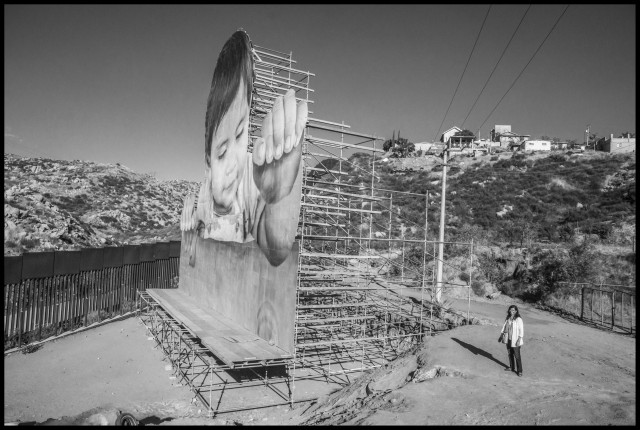
Kikito is an enormous photograph of a 1-year-old child, pasted onto plywood sheets. The assemblage is mounted on a huge, complex metal scaffold, 65 feet high, much like what painters erect to embrace the buildings they work on. Kikito’s scaffolding, however, doesn’t embrace anything. Instead, it pushes the enormous photograph toward, and above, the border wall’s severe vertical iron bars.

The structure is so big that to bring the photo into position, part of the hillside had to be excavated, and a hole dug deep into the ravine at the bottom.  A few walled houses in the distance line the rim of the hill above.

I felt like Dorothy going behind the curtain, when she suddenly confronts the Wizard as he manically pulls levers to present his fierce, disembodied face to the audience out in front.  Like the Wizard’s, you can only see Kikito’s visage the right way from the other side of the curtain – in this case, the metal fence separating Tecate from the U.S.  

Viewed from the U.S. side, Kikito becomes an enormous black and white toddler, his chubby hands appearing to grip the top of the border-wall as he seems to look over it, into the mysterious United States.  He has a slight smile.

If we’d been on the U.S. side, driving east from San Diego, we could have followed the directions Kikito’s creator, the French artist JR, posted on his website.  There you can even see JR’s photograph of two U.S. Border Patrol agents staring at the baby.  Apparently they often help visitors find the right spot.

We now have 20,000 Border Patrol agents, whose parked vans dot the desert all along the border wall from California to Texas, as they wait to grab someone trying to cross. Helping visitors find Kikito must provide a welcome break in the tedium of watching and waiting, and sweating in vans on shadeless hills, where the temperature climbs to 105 degrees and above.

It’s obvious that Kikito’s audience is located in the United States. “The piece is best viewed from the U.S. side of the border,” JR’s website explains. In fact, the optical effect can only be seen from that side—Mexicans standing in Tecate, where it’s actually located, can’t see it the right way. JR says Kikito is looking “playfully,” but then admits, “Kikito and his family cannot cross the border to see the artwork from the ideal vantage point.”

I took a photo of Laura on a nearby hummock, just to give an idea of the structure’s immense scale. She seems diminutive next to it. In her classes at the Colegio de la Frontera Norte (COLEF) in Tijuana, and in her books and research about the migration of Mexico’s indigenous people to Baja California and eventually to the United States, Laura Velasco is hardly dispassionate. She advocates for migrants, and has no love for the wall and its unsubtle messages of “Keep Out!” and “Stay in Mexico!”

That’s one reason she liked Kikito. “He shows us to be human beings,” she said, looking up at his half smile. “That’s a good message for people in the U.S. And he does it without shouting, just by being who he is.” If people in Mexico can’t see him properly, she thinks, they’re not the ones who need to get the message anyway.

spot_img

How to stop Google and Facebook from becoming even more powerful

by Barry Lynn and Matt Stoller

On Tuesday, Senator John Kennedy of Louisiana told the general counsels of Facebook and Google: “Your power sometimes scares me.” The problem, Kennedy said, is that the corporations know too much about us, and too little about themselves.

Kennedy illustrated his fears with two rhetorical questions. “If the CEO came to you … and said I want to know everything we can find out about Senator Graham … You could do that, couldn’t you?” On the other hand, Kennedy said: “You don’t have the ability to know who every one of [your] advertisers is, do you?”

This seeming paradox points to a fundamental problem that Facebook and Google cannot solve on their own; these institutions are designed to gather vast amounts of information about every American, but they are not built to manage that information in the interest of those individuals or the public as a whole, such as by preventing Russian hackers from targeting propaganda at specific voters.

It will take time to figure out how to ensure Google, Facebook and the other giant platform monopolists truly serve the political and commercial interests of the American people. The good news is that there’s a simple way to at least slow the rate at which the problem is getting worse. Don’t allow these dominant platforms to buy other companies.

If it’s clear that Facebook and Google can’t manage what they already control, why let those corporations own more? America’s antitrust enforcers can impose such a rule almost immediately.

For one thing, there is no doubt these corporations qualify for antitrust regulation. Facebook, for instance, has 77 percent of mobile social networking traffic in the United States, with just over half of all American adults using Facebook every day.

Nearly all new online advertising spending goes to just Facebook and Google, and those two companies refer over half of all traffic to news websites. In all, Facebook has some 2 billion users around the world.

For another, the Department of Justice and the Federal Trade Commission have all the authority they need under existing law. Indeed, the FTC itself partially created the “fake news” problem by failing to use its existing authority to block previous acquisitions by these platforms such as Facebook’s purchases of WhatsApp and Instagram.

Had those companies been allowed to grow and compete with Facebook, we would today see less power and control concentrated in that one corporation. The history of the platform monopolies themselves provides ample evidence of the power that comes from buying other people’s technologies.

One of the myths of the tech platforms is that they are innovative actors who invent new ways of doing things. They really aren’t. They are conglomerates.

Google’s Larry Page and Sergey Brin, in a project financed by a National Science Foundation grant, created a way to rank web pages that allowed them to build a very good search engine. They then used cash earned or raised off this early success to buy most of the rest of Google’s key products, including YouTube, Android, Deep Mind, Waze and Doubleclick. At a certain point a few years ago, Google was buying roughly one company a week.

Another lesson of history is that temporary restrictions on how these corporations can use their newly acquired technologies don’t solve the fundamental problem. Seven years ago, Google paid $700m for a company called ITA that provides software for the travel industry. The Department of Justice approved the deal on the condition that Google keep access to the software open to other businesses for at least five years. This year, Google closed that access. As Ted Benson, a former Googler, put it: “That’s an entire ecosystem of airfare startups executed with the stroke of a pen.”

These corporations already enjoy vast advantages over any potential rivals. In the case of Facebook, those advantages verge on being blatantly unfair. In 2013, Facebook bought a mobile data analytics company called “Onavo”. As a recent article in the Wall Street Journal made clear, Onavo allows Facebook to observe the online behavior of internet users, providing Facebook executives with an “unusually detailed look at what users collectively do on their phones.”

Facebook, in essence, gets to see which products are doing well and what features within those products users especially appreciate. It can then use this information to target fast-growing rivals with potentially fatal copycat techniques, and attempt to buy out these competitors.

A few weeks ago, Facebook bought a three-month old social networking company called TBH, which was growing quickly among teenagers. It’s not clear why Facebook bought the company. But it is clear this acquisition will only further entrench Facebook’s monopoly position in social media and expand its power over all competitors.

For this reason, we at the Open Market Institute recently called on the FTC to put a hold on all future mergers and acquisitions by Facebook – and potentially Google and Amazon. Such a ban on mergers would leave many big problems answered. It would not fix the Facebook and Google’s duopoly over online advertising, nor would it prevent foreign actors from using the company’s network to manipulate American voters.

But such a ban would help provide the American people with the time we need to figure out how to ensure these immensely powerful monopolies no longer threaten our most fundamental civic, artistic, economic and political freedoms.

(Barry Lynn is the Executive Director of the Open Markets Institute. Matt Stoller is a fellow at the Open Markets Institute).

spot_img

JFK: FBI concerned of growing Latino political power

by Russell Contreras
AP wire services

A memo included in recently released John F. Kennedy documents shows that the FBI was concerned about the growing political power of Latinos, historians say.
Among the thousands of documents released last week was a memo from an FBI informant who kept watch on a Dallas chapter of the G.I. Forum — a moderate group of Mexican American veterans who spoke out against discrimination.

According to the 1963 document, the informant closely followed a chapter meeting where members expressed concern about the revival of a similar organization, the League of United Latin American Citizens.

The G.I. Forum members feared a public fight with LULAC over membership might make both groups powerless, and members discussed ways to keep tabs on LULAC leadership.

The informant reported that G.I. Forum members didn’t want to dabble in politics and felt “racial discrimination is lessening to the point where they receive no complaints from victims,” the memo said.

President Donald Trump has ordered the release of all records related to the Kennedy assassination, and they are expected to be made public on a rolling basis during the coming weeks. He also directed agencies to take another look at redactions and withhold information only in the rarest of circumstances. It’s unclear why this memo was among the classified government documents released last month by the National Archives.

Historians say the memo gave a glimpse into the FBI’s concern about the growing political power of Latinos in Texas, New Mexico, California and Illinois and may also show the FBI was working to create tensions among the Latino civil rights groups.

“We know that the FBI was monitoring LULAC in the 1940s and 1950s. But this appears to show they were more worried about all of the groups’ growing influence,” said Emilio Zamora, a University of Texas history professor. “Even though these groups were moderate, the FBI was worried because they were Mexican. In their eyes, they could become radicalized at any time.”

Jose Angel Gutierrez, a political science professor at the University of Texas at Arlington, said the memo was evidence that the federal government actively sought to divide Latino civil rights groups to thwart efforts to fight discrimination.

Some historians also believe the FBI feared the G.I. Forum might protest Kennedy’s motorcade in Dallas over civil rights.

The G.I. Forum became a force after its founder, Hector P. Garcia, drew national attention for protesting a Texas funeral director’s decision to not hold a service in the chapel for a Mexican-American soldier killed in World War II.

The documents show the agency was monitoring the civil rights groups just weeks before Kennedy visited with one of the Hispanic organizations
Kennedy spoke at a LULAC gala in Houston the night before his Nov. 22, 1963, assassination. Historians believe that was the first time a sitting president acknowledged the Latino vote.

Hispanics voted overwhelmingly for Kennedy in 1960. Robert Kennedy, the president’s brother, would attribute the election victory in part to the support among Mexican Americans and Puerto Ricans.

(Associated Press writer Russell Contreras is a member of the AP’s race and ethnicity team. Follow him on Twitter at http://twitter.com/russcontrerashttp://twitter.com/russcontreras)

spot_img

Puerto Rican Shorts, A Benefit For Puerto Rico Sunday at The Roxie Theater in SF

In collaboration with Puerto Rico’s Rincón International Film Festival, the largest film festival in Puerto Rico, RoxCine and Cine+Mas SF present Puerto Rican short films November 19th at 4:30PM. All proceeds will go to support hurricane relief efforts in Puerto Rico, via donation to Alianza Somos Una Voz / We Are One Voice.

The lineup includes the following short films.

Volcados – 8 min. (Animation)
Director: Paola Melendez Roca
“A Puerto Rican animation about a Chupacabra’s relentless attempts at making a friend.

Teorias de la Cigüeña – 13 min. (Drama)
Director: Javier Enrique Perez
“When an eight year old boy asks his mom, ‘Where do babies come from?’, he is forced to embark on an adventure to reverse a spell he placed himself.”

No hay Sistema – 7 min. (Comedy)
Director: Susana Matos
“In Puerto Rico, waiting in line to change your name can become chaotic if the clerk’s shift is about to end.”

Luna Vieja – 11 min. (Drama – TIFF)
Director: Raisa Bonnet
Director Raisa Bonnet’s naturalistic short, sketches an almost wordless tale of the relationship between a young girl and her grandmother.

Miedo a las Aturas – 4 min. (Comedy)
Director: H.J. Leonard
Tommy is a young adult who after dreaming for a whole week with a harassing, sinister and, cute being, he visits a psychologist seeking for answers to his dreams. For his surprise, the remedy is worst than the cure.

Así de grandes son las ideas – 5 min. (Animation)
Director: José Enrique Rivera
An old man of the future, equipped with the benefits of evolution, somehow survives the extinction of all living beings.

La Carta – 7 min. (Drama)
Director: Angel Soto
“An unusually common love story about a boy’s search for inspiration to write a love letter.”

Por Feo – 7 min. (Comedy)
Director: Susana Matos
Winner of the 48 Hour Film Project – San Juan. The ugliest brother in the family at last finds someone to confront for his perceived ugliness.

Chula – 17 min. (Action Adventure)
Director: Victoria E. Soberal
“There’s a wedding in the coastal farm town of Camuy, Puerto Rico! On the way, Fredo, the best man, becomes distracted with what could be devastating consequences. The race is on for Fredo to fix his problem and attend the wedding before it starts.”

Cine+Mas SF showcases film from the Americas at Bay Area theaters year-round with a spotlight film festival every September. For tickets to this benefit, go to Roxie.com.

spot_img

Exhibition of Mechanical Sculptures returns to the Exploratorium

Compiled by the El Reportero’s staff

This year’s show features nearly 30 automata, 3 artists in residence, and workshops teaching visitors to build their own automata

On November 16, the Exploratorium’s returning winter exhibition, Curious Contraptions, will open to the public. The collection of automata features the work of eleven artists from around the world and gives visitors a chance to interact firsthand with charming and often hilarious mechanical objects brought to life by intricate arrangements of handmade cams, cranks, and other simple mechanisms.

“I’m so excited about this year’s show,” says Nicole Minor, who curates the seasonal Curious Contraptions exhibition.

The Exploratorium is open Tuesday through Sunday, 10 a.m. to 5 p.m. Every Thursday, the museum reopens from 6 p.m. to 10 p.m. for adults only. For more about how to get here, visit exploratorium.edu/directions. For tickets and pricing information, visit exploratorium.edu/tickets.

Annual fundraising event honoring excellence in the art of film

SFFILM has announced the date and venue for SFFILM Awards Night (formerly the Film Society Awards Night), its annual fund-raising celebration that pays tribute to filmmaking achievement. The historic 60th anniversary edition of this glamorous event and awards presentation will take place on Tuesday night December 5 at the San Francisco Palace of Fine Arts, 39 Mesa Street, Suite 110, The Presidio, San Francisco.

JUNTOS Collective joins the Global #GivingTuesday Movement

JUNTOS Collective will participate in it’s second annual  #GivingTuesday, hosting Voices: An Evening of Untold Stories. This event, open to the general public, will honor JUNTOS supporters, and invite new faces to hear stories and share dances from past program participants. The event will include drinks and small bites, performance shorts, guest speakers and unique raffle prizes. 

JUNTOS Collective, a non-profit organization enabling free contemporary dance workshops and performances in underserved communities of Guatemala, Mexico and Nicaragua, joined #GivingTuesday last year, inspired by the generosity, collaboration and philanthropy that the movement encouraged. The organization was able to successfully raise the funds to sponsor 3 trips abroad during this global day of giving. 

One of the many stories supported by this fundraiser, involves the journey of Megan Stricker, a JUNTOS Alumni who had the opportunity to live and teach dance in Santa Maria Tlahuitoltepec, Oaxaca this past summer. Megan taught dance to a community of Mixe people for four weeks, one of Mexico’s oldest indigenous cultures.
On Dec. 2 at The Golden Stateroom. Tickets to Voices: An Evening of Untold Stories can be purchased in advance at http://bit.ly/JUNTOSvoices.

spot_img

Haiti included for the first time in the Oscars

by the El Reportero’s news service

The incipient Haitian film industry began to emerge, after the announcement today of the first entry of this Caribbean nation to the Oscars, with the film ‘’Ayiti Mon Amour’’, by director Guetty Felin.

The production exposes the portrait of a post-earthquake nation that cries its more than 220,000 dead, but rises from the rubble. It is nominated in the category of best foreign film.

Felin, is a filmmaker born in Haiti, and raised between the Caribbean nation and New York, traveled to Port-au-Prince on an emergency plane 10 days after the disaster of 2010, and tried to remember in the film each of the scenes encountered when disembarking, ‘Images that will stay with me throughout the practice of my film career,’ the author stated.

Seven years later, ‘Ayiti Mon Amour’ marks not only the emergence of a new distinctive voice in Haitian cinema, but also a milestone in the country’s cultural recovery, as the first narrative film filmed locally and directed by a woman.

Taking advantage of her previous work, Felin infuses the realities of today’s Haiti, the shortage of power and water, the threats of climate change, with a lyricism that plays its mystical side.

First Artists Confirm Attendance at Latin Grammy Gala

Singers Luis Fonsi, Juanes, Mon Laferte, Maluma, and Resident confirmed their attendance at the 18th annual Latin Grammy Awards, which will take place on November 16 in Las Vegas, USA.

J Balvin, Bad Bunny, Flor de Toloache, Natalia Lafourcade, and Sofía Reyes are also among the first artists to perform at the event to be celebrated at the MGM Grand Garden Arena.

During the ceremony is also expected the performance of Spanish Alejandro Sanz, Steve Aoki, Alessia Cara, Logic and French Montana, announced Latin Recording Academy in a statement.

This year the nominations are headed by Puerto Rican René Pérez Joglar, Resident of Calle 13, with nine, followed by Mexican Maluma with 7, and Colombian Shakira with six mentions.

Others who opt for the golden gramophone in the 48 categories of the contest are the Spanish Joaquín Sabina and David Bisbal; Mexicans Lila Downs and Alejandro Fernández; Colombian Juanes and Venezuelan Franco de Vita.

spot_img