
Monday, March 9, 2026
Home Blog Page 28

Richard Talavera: A pillar of Chicano art and culture in the Bay Area

The Mexican Bus
Richard Talavera

by Marvin Ramírez

Richard Talavera, a cherished actor, playwright, and cultural advocate, passed away on July 28 at the age of 73. He died peacefully at a local hospital, surrounded by his sisters and niece, after a brief four-month battle with cancer. “When he was diagnosed, he said, ‘I had a damn good life,’” recalled his sister Jackie Talavera.

Born on Jan. 17, 1952, in Los Angeles, Talavera spent most of his life in the San Francisco Bay Area, as did the rest of his family. A longtime resident of Yountville’s Veterans Home in Napa Valley, Talavera left a lasting legacy through his artistic vision and dedication to preserving Mexican cultural traditions.

His death was first shared on social media by close friends and fellow artists, who immediately reflected on the impact he made both personally and professionally.

Talavera’s unique contributions centered around his collaboration with fellow artist and entrepreneur Toni Hafter, who is Jewish. Together, they were co-creators and partners in The Mexican Bus project, a visionary endeavor that brought Mexican public transit art and culture to life in the Bay Area.

The project originated with Hafter’s transformation of a faded church bus into El Volado, a vibrant mobile art space celebrating Mexican heritage. Talavera joined this effort by bringing his Chicano playwright perspective to Lola, another bus launched in 2001 as part of The Mexican Bus fleet in Richmond, California. His artistic influence helped infuse the buses with cultural depth, blending visual arts with storytelling and performance.

The Mexican Bus project became more than just transportation. It was a living, moving celebration of Latino identity and history, offering salsa rides, community gatherings, and a platform for local artists to share their work. Talavera and Hafter’s vision was to preserve the rich tradition of Mexican public transit art—a colorful and distinctive cultural expression seen throughout Mexican cities—and to foster Latino cultural pride in their community.
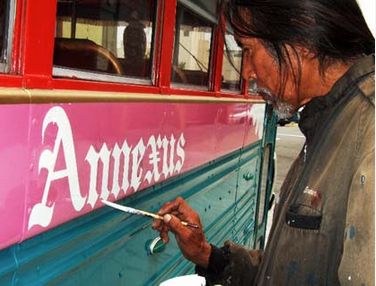
Richard Talavera

After The Mexican Bus experience ended, Talavera semiretired but continued teaching improvisational theater and writing poetry, staying connected to the creative world that had defined much of his life.

Talavera’s involvement in theater was extensive and deeply impactful. In 2016, he was featured in the Central Works’ season-closing production Into the Beautiful North. Additionally, he participated in Moving Art House, a dynamic project that utilized the bus as a platform for innovative programming in southeast San Francisco.

Throughout his career, Talavera produced numerous plays including The Trail of Los Siete, Chac, Macairo Meets La Muerte, Poeta Pan (co-authored), Popol Vuh, and more recently Before The Dream, a celebration of author Richard Wright and Black expatriates in Europe. His original play concepts include Rampage, The Last Taboo, Land, and the open-air Truly Needed Travlin’ Show.

Talavera was a proud member of Teatro Latino and Teatro de La Esperanza, touring extensively as an actor across the United States, with performances in Mexico and Chile. In the summer of 2016, he was engaged in finishing his play The Entertaining Journey through Central Works’ Playwright Workshop, reflecting his lifelong commitment to evolving as an artist.

Beyond his theatrical work, Talavera was the owner of The Mexican Bus, integrating his passion for art, community, and cultural preservation into this unique business venture.

Friends and colleagues remember Richard Talavera as a passionate, warm-hearted individual who championed both art and social justice. His involvement in theater and community arts initiatives reflected a lifelong commitment to celebrating and empowering Latino voices.

The Veterans Home of California-Yountville, where Talavera spent his final years, is the nation’s most comprehensive veterans’ facility, providing care and community to former military members. Talavera’s residence there reflects his service and dedication beyond the arts, adding another layer to his complex and inspiring life story.

Talavera is survived by four brothers and sisters—Raymundo (Ofelia), Margie, Jackie (Richard), and Emma (Rudy) Sister-in-Law Patricia,—along with three nephews (Rudolph, Evaristo, Franklin) and two nieces (Jessica and Christina (Tiana, Alejandro, Santiago), all from the Bay Area. He was predeceased by his father Frank, mother Esther, and brother Frank Jr.

Talavera’s passing has inspired an outpouring of love and remembrance from those who knew him. His artistic legacy, particularly through The Mexican Bus, continues to influence the Bay Area’s cultural scene. The project remains a testament to the power of community-driven art and the importance of preserving cultural heritage.

As the Bay Area remembers Richard Talavera, his story is a reminder of how art connects people, honors roots, and builds bridges across generations. His collaboration with Toñia Hafter and their shared vision for The Mexican Bus will live on as a vibrant symbol of Mexican-American culture and pride.

For many, Talavera was more than an artist; he was a cultural ambassador and a beloved community member whose creative spirit and dedication left an indelible mark on the region.

— With collaborations.

spot_img

Cultura Fest Returns to Honor Salvadoran Culture

by Magdy Zara

With the theme “Central American Roots and World Music,” the Bay Area Cultural Festival takes place this month. It’s a family-friendly event celebrating Central American heritage, music, and culture, featuring live music, dance, art, food, and culture.

Emerging talent will have the opportunity to be seen and heard by an exceptional panel of world-class judges, empowering the Latino community through music.

Cultura Fest fills that void, uniting people through music, art, and food. It highlights Salvadoran and Latin American musicians, chefs, and artists, honoring their shared journey of resilience and creativity.

There are two talent categories, both based on world music and Central American roots music. These categories include new interpretations of classic versions, with a special emphasis on roots music, folklore, and the fusion of international and Central American music across all genres.

For the complete contest rules and entry process, visit

https://s.disco.ac/uwqqcqaucjie

The festival will take place on August 23, 2025, from 11 a.m. to 5 p.m., at 400 Grand Ave, South San Francisco. However, the deadline to submit entries and participate is this Friday, August 15.

WAWDF 2025 Weekend

As part of the 2025 World Arts West Dance Festival, the World Arts West 2025 Dance Festival (WAWDF) will be held, featuring dance, music, and art workshops for all levels.

This festival will have the central theme “Dance as Health and Healing,” exploring what constitutes a healthy community.

Its goal is to showcase dance and art forms rooted in cultural traditions, including the sacred, the social, and the contemporary. The festival will include movement workshops, artistic dialogues, and new activities such as Hawaiian lei making, kalimba music, and Afro-Cuban healing rituals.

It will be held on August 16 and 17, starting at 2 p.m., at 2560 Ninth Street #119 in Berkeley. Tickets are $15 in advance and $20 at the door.


A Little Rock Outdoors in Madera

ApCal Rock’n Ranch is one of the largest and most comfortable spaces to enjoy music, inviting you to enjoy the best of classic rock, 90s pop, Latin, and dance music.

Enjoy a multi-genre musical experience with your friends, featuring multi-platinum recording artists all on one stage for a night of pure musical delight.

Some of the talents on show include: Quad City DJ Malo, Cultjam, Dayna Donna, Mosca Española, Scott Patrick, The Wet Bandidos, and more.

Doors open at 4 p.m. Remember, this is at the ApCal Rock’N Ranch, located in Madera on Highway 32 No. 7409.

spot_img

Eddie Palmieri: A Titan of Latin Jazz leaves an eternal legacy

by the El Reportero‘s staff

The music world is mourning the loss of Eddie Palmieri, the revolutionary pianist, composer, and bandleader whose fearless innovation redefined Latin music and forever changed the course of jazz and salsa. Palmieri, who passed away this week at the age of 88, leaves behind a towering legacy that spans more than six decades, nine Grammy Awards, and an immeasurable impact on the sound and soul of the Americas.

Palmieri died on August 6, 2025, at his home in New Jersey after an extended illness, according to a statement confirmed by his daughter, Gabriela. While public reports have not specified who was present during his final moments, it is clear that his passing marks the end of an era in Latin music.

Born in Spanish Harlem, New York City, on December 15, 1936, to Puerto Rican parents, Palmieri grew up immersed in a musical landscape that was bursting with Afro-Caribbean rhythms, jazz, and the emerging voices of Latino musicians shaping new identities through sound. He studied classical piano as a child but was soon drawn to the vibrant energy of Latin dance music and jazz. By his teens, he was playing in local bands, absorbing everything from Cuban son and mambo to bebop and blues.

In 1961, Palmieri formed his first major group, La Perfecta, with a bold vision: to replace traditional trumpets with trombones, creating a more aggressive and gritty sound that would become one of his trademarks. The effect was revolutionary. Fusing the driving rhythms of Afro-Caribbean percussion with the improvisational complexity of jazz, Palmieri crafted an explosive sound that captivated dancers and musicians alike. La Perfecta set the stage for a new era of salsa and Latin jazz, blending tradition with innovation.

Palmieri’s music was always more than entertainment—it was an act of cultural affirmation, a celebration of Afro-Latin identity, and at times a form of protest. In songs like “Justicia” and “Puerto Rico,” he called attention to issues of social injustice and colonialism, channeling his art into a deeper expression of community and resistance. His compositions were layered, complex, and deeply rooted in the rhythms of the African diaspora, while also borrowing from classical fugues, jazz harmonies, and modern improvisation.

In 1975, Palmieri became the first Latin artist to win a Grammy Award for Best Latin Recording, for his groundbreaking album The Sun of Latin Music. That milestone marked the beginning of a long list of accolades, including multiple Grammy wins, a National Endowment for the Arts Jazz Master Award, and honors from cultural institutions across the United States and Latin America. Yet Palmieri never slowed down. Well into his 80s, he continued to perform, record, and mentor young musicians, his energy on stage undiminished and his passion as fierce as ever.

Palmieri’s influence extended far beyond the Latin music scene. Jazz legends like Herbie Hancock and McCoy Tyner admired his harmonic daring, while salsa giants such as Willie Colón and Rubén Blades credited him with expanding the possibilities of the genre. To many fans, he was not just a musician but a philosopher of rhythm, a master who spoke through polyrhythms and piano lines with equal eloquence.

For the Latino community in the United States, Palmieri was a cultural pillar. His music was the soundtrack of family gatherings, street festivals, political rallies, and late-night dance floors. He gave a voice to generations of immigrants, Afro-Caribbeans, and urban youth who found in his work a sense of belonging and pride. In cities like San Francisco, New York, and Miami, his passing is being mourned with concerts, tributes, and spontaneous gatherings of musicians and fans celebrating his legacy.

Palmieri is survived by five children and four grandchildren, who carry forward his personal and musical legacy. While the Maestro has left the stage, his rhythms still pulse through turntables, dance clubs, and concert halls around the world. His legacy is not just in the notes he played but in the doors he opened for those who followed.

He was, and will always be, El Maestro.

– With reports by various sources.

spot_img

The human cost of immigration enforcement: A nation at a moral crossroads

Marvin Ramírez, editor

by Marvin Ramírez

In the midst of the intensifying immigration crackdown, one reality is impossible to ignore: millions of undocumented families in the United States are living in fear, and their children are caught in the crossfire. Many of these children were brought here at a young age or were born on American soil. They attend school, receive medical care, and live as any other child might—until the threat of their parents’ arrest and deportation shatters their sense of safety.

Recent deportations have sent a wave of fear through immigrant communities. Parents are increasingly afraid to drop their children at daycare or pick them up from school, worried that immigration agents might be waiting. The thought is heartbreaking: how many children will end up in limbo, left without their parents, or forced to abandon school altogether out of fear?

For working-class immigrant families, child care centers are lifelines. They allow parents—many of them single mothers—to hold jobs, pay taxes, and contribute to the economy. These are not people hiding in the shadows, but members of our communities who mow lawns, build houses, clean offices, and care for our elderly. They are working honestly, often in jobs others refuse to take, and they are paying into the very system that now seeks to uproot them.

Critics argue that the law is the law, and that entering without documentation must have consequences. It is true that border policy must be enforced and improved. But we cannot lose sight of the human dimension. The current approach risks punishing children for decisions they did not make, and it ignores the desperation—political instability, economic collapse, violence—that drives many to flee their countries in the first place.

Some states, like Florida, are considering bipartisan proposals to allow certain undocumented immigrants to work legally without granting full amnesty. Such ideas could provide stability while avoiding the political backlash associated with blanket legalization. But time is running out for many families.

History shows that immigration policy can be both firm and compassionate. As a nation, we must decide whether our legacy will be one of breaking families apart or finding solutions that uphold both the law and our moral responsibility. Children should not be collateral damage in the enforcement of immigration policy. The soul of the country is watching.

spot_img

The US will open its largest migrant detention center on a Texas military base

via El Reportero‘s wire services

The United States government will open the largest migrant detention center in the country in the coming weeks—with space for approximately 1,000 people—on a military base in Texas.

The center, which will bolster President Donald Trump’s campaign of mass detentions and deportations, will be located at Fort Bliss, just outside the border city of El Paso. It will consist of tarpaulin buildings and will begin operating on August 17, according to the digital website Border Report on Friday, August 8.

Authorities plan to expand the facility to detain up to 5,000 people, a Department of Homeland Security (DHS) official told EFE.

Indigenous victims of plastic pollution made their voices heard at the un

Indigenous peoples who declare themselves victims of plastic pollution demanded this Friday, August 8, that their positions be taken into account during the negotiations toward a global treaty to curb this environmental crisis, which are being held until August 14 at the UN European headquarters in Geneva.

“Our medicines, food systems, water, even our culture and language are threatened by toxic chemicals and microplastics,” said Cheyenne Rendon, representative of the Society of Native Nations USA, at a press conference attended by several Indigenous leaders seeking to make their voices heard in the current deliberations.

For Rendon, any treaty that may emerge from the current negotiations, which began in 2022, must take into account the land and resource rights recognized in the United Nations Declaration on the Rights of Indigenous Peoples.


spot_img

Nine Ways to Exercise Your Memory After 40

by El Reportero news services

After the age of 40, many people begin to notice that recalling names, dates, or even where they left their keys is not as automatic as before. However, specialists insist that the brain—like muscles—can remain strong and agile with the right training.

“Memory is not a fixed resource that inevitably declines over time; it can be cultivated with simple, consistent habits,” explains Dr. Jessica Zwerling, director of the Montefiore Center of Excellence for Alzheimer’s Disease. According to the specialist, certain mental exercises work like “muscle builders” for the brain, boosting information retention and mental agility.

Based on recent studies and neurologists’ advice, here are nine recommended activities to keep the mind in shape.

  1. Read aloud

A 2017 study in the journal Memory found that people who read aloud retain information better than those who read silently. Speaking the words and hearing them engages different brain areas, reinforcing long-term memory.

  1. Practice spaced repetition

This technique involves reviewing information several times, with intervals in between. It activates the hippocampus—a key brain region for forming new memories—and is considered one of the most effective learning strategies.

  1. Use mnemonic devices

Acronyms, rhymes, and vivid mental images help encode complex data. For example, in first aid, the word RICE (Rest, Ice, Compression, Elevation) is used to remember the steps to treat an injury.

  1. Build a memory palace

Also known as the method of loci, it involves associating information with familiar places. Mentally placing data in specific spots within a well-known space can greatly enhance recall.

  1. Manage perceived stress

Not only does real stress affect the brain—perceived stress does too. Practices like meditation, yoga, and physical activity can reduce this risk and improve cognitive performance.

  1. Do stretching exercises

The EXERT clinical trial, funded by the U.S. National Institute on Aging, found that regular stretching could slow cognitive decline in people with mild memory issues, with results similar to aerobic exercise.

  1. Dance with others

Social dances like tango or waltz not only improve coordination but also stimulate executive brain functions. A New England Journal of Medicine study found that dancing three to four times per week lowered dementia risk in older adults.

  1. Solve crosswords or play mahjong

Logic and strategy games help maintain mental sharpness. Recent studies show that even digital crossword puzzles slow cognitive decline more than other games. Mahjong, popular in Asia, offers similar benefits.

  1. Learn something new and challenging

A new language, a musical instrument, or chess can be powerful allies for brain health. The key is that the activity should be challenging and have increasing levels of difficulty to keep you engaged.

Dr. Joe Verghese, an expert in brain aging, advises choosing activities you genuinely enjoy: “When you like something, you do it regularly—and that consistency is key to keeping the brain active.”

In short, aging does not have to mean inevitable memory loss. With the right habits, it is possible to strengthen memory and maintain mental agility for years to come. The essential thing is to incorporate these practices into daily life and stick to them.


spot_img

‘There won’t be an invasion’: Sheinbaum de-escalates after Trump orders US military to target cartels

Sheinbaum pushed back against reports that Trump's order authorized the U.S. military to target criminal organizations abroad. (Cuartoscuro, Shutterstock)

by Mexico News Daily

President Claudia Sheinbaum on Friday told reporters that an executive order signed by U.S. President Donald Trump directing the Pentagon to target foreign drug cartels does not pose a risk of invasion to Mexico.

Citing anonymous sources, a New York Times report published on Friday said that Trump has “secretly signed a directive to the Pentagon to begin using military force against certain Latin American drug cartels that his administration has deemed terrorist organizations.”
During her daily press conference, Sheinbaum said the directive does not imply that the U.S. military will cross the border into Mexico. She also told reporters that her administration had been advised of the details of the executive order.

“We were informed that this executive order was coming and that it had nothing to do with the participation of any military personnel or any institution in our territory,” she said, adding that the directive referred exclusively to actions within U.S. territory.

When asked about the Times’ reporting that the directive authorized military use abroad, on land and sea, Sheinbaum dismissed that claim, too.

“No,” she said, “absolutely not. The United States is not going to send its military into Mexico. We cooperate, we collaborate, but there will be no invasion. That’s ruled out … because, in addition to what we’ve stated in all our conversations, it’s not allowed, nor is it part of any agreement.

“Each time they’ve raised the issue, we’ve said no. We can collaborate in other ways, but if [entry of the U.S. military is the suggestion], then no.”
When pressed to explain if the reporting was inaccurate, Sheinbaum demurred, suggesting she had not seen the directive.

“Well, we’ll have to see how the executive order is [written],” she said, “but there’s no risk that they’ll invade our territory.”

The Times reported the U.S. Defense Department declined to comment on the directive. When AFP contacted the Pentagon with regard to the executive order, its questions were referred to the White House.
Still, the Times said Trump’s directive provides an official basis for U.S. military operations at sea or on foreign soil against the cartels.

Mexican cartels in the crosshairs
In February, the Trump administration designated six Mexican drug trafficking groups as terrorist organizations. When the U.S. government announced this classification, Sheinbaum warned that her administration would never tolerate a U.S. invasion.
In a Thursday television interview, U.S. Secretary of State Marco Rubio said the U.S. government could use the designations to “target” cartels, without further specifying what range of actions could be used to do so.

“It allows us to now target what they’re operating and to use other elements of American power, intelligence agencies, the Department of Defense … to target these groups if we have an opportunity to do it,” Rubio said. “We have to start treating them as armed terrorist organizations, not simply drug dealing organizations.”

The Trump administration has already deployed thousands of active-duty combat troops to the U.S. border with Mexico in order to staunch the northward flow of drugs, particularly fentanyl, as well as limit the flow of immigrants.

The U.S. also has sent two warships to patrol the coasts of Mexico — one in the Pacific Ocean, the other in the Gulf of Mexico — a use of naval force without precedent in U.S. border security operations.

The U.S. has also been using drones and spy planes to surveil Mexican drug cartels, an action that Sheinbaum said was “part of a coordinated operation between the U.S. and Mexican governments.”

At the same time, the news agency Reuters reported on Friday that the U.S. Federal Bureau of Investigation (FBI) is looking to add drug cartel suspects to its terror watch list.
In an exclusive report filed after reviewing law enforcement documents, Reuters reported that the FBI has asked local police to submit the names of people they believe are linked to the eight criminal groups designated as terrorist organizations in February. It also asked for information about family members and associates of the groups’ members.
These names would be added to the U.S. government’s terrorist watch list which contained roughly 1.1 million names as of a year ago.

Civil rights groups have complained that designating suspected cartel and gang members, as well as their relatives, as terrorists will drastically expand the number of people on the watch list, which can subject people to surveillance on airplanes, travel restrictions and secondary screenings at airports and other ports of entry into the United States.
With reports from The New York Times, El Universal, Reforma, Reuters and CBS News

spot_img

Child care crisis in San Mateo: Families caught between income limits and high costs

by the El Reportero team

In San Mateo County, hundreds of families face a painful paradox: they earn too much to qualify for financial assistance for child care, but not enough to cover its real cost. This situation, which impacts both parents and providers, will be the main focus of a series of public meetings starting this Thursday.

Blanca Ventura knows this dilemma all too well. A Sequoia High School graduate with a university degree and a stable career, the single mother found herself shut out of subsidized programs and unable to afford private rates. “It was like, ‘I might as well stay home and take care of my child.’ And obviously, I couldn’t do that because I have a mortgage to pay,” she said.

According to official figures, the county meets only 73% percent of the demand for licensed child care, leaving nearly 9,000 children without access to this essential service. The problem doesn’t just affect families—providers face rising costs, difficulty hiring qualified staff, and in some cases, the threat of closure.

Economic pressures are also driving some residents to consider moving to areas with a lower cost of living, which authorities warn could threaten the region’s long-term economic stability.

To seek solutions, County Supervisors Jackie Speier and Lisa Gauthier have organized community meetings open to parents, caregivers, and providers. The first will take place on Thursday, August 14, at 6 p.m. at the South San Francisco Library/Parks and Recreation Center (901 Civic Campus Way). There will be a supervised space for children 2.5 years and older who are toilet-trained, subject to availability. Families bringing children must RSVP and provide the child’s age.

“We want to hear directly from the community,” the organizers have said, emphasizing that the sessions will be active listening forums where every voice will count toward building proposals.

Ventura resolved her own situation thanks to a chance encounter at the library, where she connected with an affordable local provider. “I was finally able to pay without feeling like I had to lie about my income,” she recalled. Her three-year-old son now attends a program close to home.

The second meeting is scheduled for Wednesday, August 27, at EPACENTER in East Palo Alto. County leaders hope that, as happened with Ventura, the conversations sparked in these forums will help build networks and find solutions for those still searching for quality, affordable child care.


spot_img

Eddie Palmieri: A Titan of Latin Jazz leaves an eternal legacy

Eddie Palmieri Latin Jazz Network

by the El Reportero‘s staff

The music world is mourning the loss of Eddie Palmieri, the revolutionary pianist, composer, and bandleader whose fearless innovation redefined Latin music and forever changed the course of jazz and salsa. Palmieri, who passed away this week at the age of 88, leaves behind a towering legacy that spans more than six decades, nine Grammy Awards, and an immeasurable impact on the sound and soul of the Americas.

Palmieri died on August 6, 2025, at his home in New Jersey after an extended illness, according to a statement confirmed by his daughter, Gabriela. While public reports have not specified who was present during his final moments, it is clear that his passing marks the end of an era in Latin music.

Born in Spanish Harlem, New York City, on December 15, 1936, to Puerto Rican parents, Palmieri grew up immersed in a musical landscape that was bursting with Afro-Caribbean rhythms, jazz, and the emerging voices of Latino musicians shaping new identities through sound. He studied classical piano as a child but was soon drawn to the vibrant energy of Latin dance music and jazz. By his teens, he was playing in local bands, absorbing everything from Cuban son and mambo to bebop and blues.

In 1961, Palmieri formed his first major group, La Perfecta, with a bold vision: to replace traditional trumpets with trombones, creating a more aggressive and gritty sound that would become one of his trademarks. The effect was revolutionary. Fusing the driving rhythms of Afro-Caribbean percussion with the improvisational complexity of jazz, Palmieri crafted an explosive sound that captivated dancers and musicians alike. La Perfecta set the stage for a new era of salsa and Latin jazz, blending tradition with innovation.

Palmieri’s music was always more than entertainment—it was an act of cultural affirmation, a celebration of Afro-Latin identity, and at times a form of protest. In songs like “Justicia” and “Puerto Rico,” he called attention to issues of social injustice and colonialism, channeling his art into a deeper expression of community and resistance. His compositions were layered, complex, and deeply rooted in the rhythms of the African diaspora, while also borrowing from classical fugues, jazz harmonies, and modern improvisation.

In 1975, Palmieri became the first Latin artist to win a Grammy Award for Best Latin Recording, for his groundbreaking album The Sun of Latin Music. That milestone marked the beginning of a long list of accolades, including multiple Grammy wins, a National Endowment for the Arts Jazz Master Award, and honors from cultural institutions across the United States and Latin America. Yet Palmieri never slowed down. Well into his 80s, he continued to perform, record, and mentor young musicians, his energy on stage undiminished and his passion as fierce as ever.

Palmieri’s influence extended far beyond the Latin music scene. Jazz legends like Herbie Hancock and McCoy Tyner admired his harmonic daring, while salsa giants such as Willie Colón and Rubén Blades credited him with expanding the possibilities of the genre. To many fans, he was not just a musician but a philosopher of rhythm, a master who spoke through polyrhythms and piano lines with equal eloquence.

For the Latino community in the United States, Palmieri was a cultural pillar. His music was the soundtrack of family gatherings, street festivals, political rallies, and late-night dance floors. He gave a voice to generations of immigrants, Afro-Caribbeans, and urban youth who found in his work a sense of belonging and pride. In cities like San Francisco, New York, and Miami, his passing is being mourned with concerts, tributes, and spontaneous gatherings of musicians and fans celebrating his legacy.

Palmieri is survived by five children and four grandchildren, who carry forward his personal and musical legacy. While the Maestro has left the stage, his rhythms still pulse through turntables, dance clubs, and concert halls around the world. His legacy is not just in the notes he played but in the doors he opened for those who followed.

He was, and will always be, El Maestro.

– With reports by various sources.

spot_img

PG&E Supports Local Restaurants: 188 Restaurants Will Receive $5,000 in Resiliency Grants Funded by the PG&E Corporation Foundation

Grants Help Restaurants and Commercial Caterers in Our Cities Achieve Long-Term Success

Oakland, California — This year, a record number of restaurants and commercial caterers in Northern and Central California will receive grants from the California Restaurant Foundation (CRF) and the PG&E Corporation Foundation (PG&E Foundation). Grant money can be used for equipment upgrades, staff training, and more. The grants reflect the commitment to strengthening local restaurants so they can achieve long-term business success and continue to contribute to local economies and community development.

The PG&E Foundation’s $1.1 million charitable contribution this year will fund $5,000 grants for 188 local restaurants. Recipients are located in 29 counties across the Pacific Gas and Electric Company (PG&E) service area. The contribution also provides operating support to CRF, which administers the grant program. Funding comes from PG&E shareholders, not customers.

This increased number of grant recipients this year exceeds last year’s 154. This means that CRF’s Restaurants Care Resiliency Fund will assist more restaurants. Grant funds can help pay for equipment and technology upgrades, unexpected hardships, training, and employee retention bonuses. The goal is to help restaurant owners invest in their businesses and staff.

The grants were available to California-based restaurant owners with fewer than five locations and revenues under $3 million.

“This grant is a huge blessing. I opened my restaurant with no savings or formal training; I relied only on my passion for feeding people and a lot of support from my family. Today, we are a full-service restaurant with a loyal team and community. With rising costs, it’s harder than ever to invest in the equipment and upgrades we need to grow. This assistance will help us become more efficient and expand our menu with homemade desserts. That gives us the boost we need to stay strong and continue doing what we’re passionate about,” said Dawn Borst, owner of Bayside Café in Morro Bay.

Since 2021, PG&E and the PG&E Foundation have contributed $4.3 million in funding to the CRF’s Restaurants Care Resiliency Fund, offering grants of $3,000 to $5,000. (Watch our “From Kitchen to Community” videos featuring previous grant recipients in the PG&E service area.)

With this year’s funding, PG&E has helped provide grants to a total of 863 restaurants and caterers in Northern and Central California.

“These restaurants, which are often family-run businesses, are the lifeblood of our communities. They are gathering places where friends and families gather to celebrate birthdays and graduations and create cherished memories. Partnering with the California Restaurant Foundation helps these restaurants thrive and strengthens our local economies and communities,” said Carla Peterman, executive vice president of Corporate Affairs for PG&E Corporation and chair of the PG&E Corporation Foundation board of directors.

CRF created the Resiliency Fund to support restaurants recovering from the economic impacts of the COVID-19 pandemic. The pandemic caused many restaurants to close their doors temporarily or permanently. PG&E and the PG&E Corporation Foundation have supported the program since its inception. The company has maintained its support as restaurants continue to weather economic fluctuations.

“We are incredibly grateful to PG&E for five years of unwavering support for the Resilience Fund,” said Alycia Harshfield, president of the California Restaurant Foundation. “This assistance is critical because when local restaurants thrive, so do the people and neighborhoods around them. Partnering with PG&E helps independent restaurant owners recover from hardships, strengthen their operations, and continue to create jobs and gathering spaces in the communities they serve.”

We Help Restaurants and Small and Medium-Sized Businesses

PG&E remains committed to offering its small and medium-sized business customers ways to save energy and money, especially during tough economic times. Here are some of the ways PG&E is helping its customers:

Bill Financing. PG&E offers 0% interest loans to replace old, worn-out equipment with more energy-efficient models. Watch this video to learn how energy savings are reinvested in your business to help improve your bottom line.

Foodservice Equipment Rebates. PG&E offers several rebate programs to help you save money and improve productivity when you upgrade your foodservice equipment.

Foodservice Technology Center. Access key training programs, design consultants, and test kitchen plans to improve your operations and energy efficiency.

Budget Billing. If you’re a small business owner, you can have a predictable bill each month by enrolling in the Budget Billing program. The program averages your monthly bill to determine your monthly payment, rather than having unpredictable summer bills.

Energy Efficiency Programs. PG&E hires third-party companies to provide a customized solution for different business sectors.

Find Your Best Rate Plan. Customers can use this online tool to perform a rate analysis to see if they are on the best rate plan for their operations. Last year, we were able to save customers $5.4 million.

Economic Development Rate. This offers eligible business customers the opportunity to reduce costs through one of three reduced electric rate options. PG&E developed this rate to help businesses grow or maintain jobs in California. The standard 12% rate is available throughout our service territory.


For more information about PG&E’s support for small and medium-sized business customers, visit pge.com/smbsupport.

spot_img