Wednesday, October 14, 2026
spot_img
Home Blog Page 240

Threats reported after returning to classes at City College

by Araceli Martínez


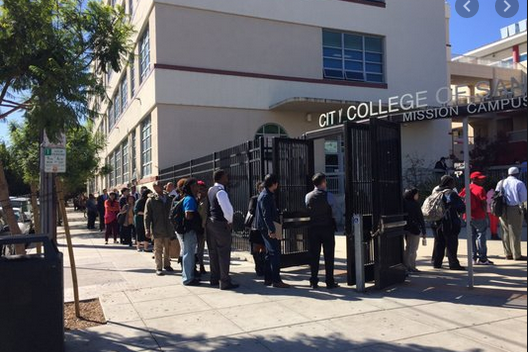
San Francisco City College students and teachers denounced the threats and challenges they face with returning to school remotely for the fall 2020 semester due to the pandemic.

During a press conference, they questioned why if City College of San Francisco is key to getting back to work in a post-pandemic economy, the administration and Board of Trustees is making decisions to reduce and destroy it.

“Why in this age of the Black Lives Matter movement are they weakening the Department of Black Studies? Why in times of a global pandemic are 60 percent of teachers of English as a Second Language fired, leaving immigrant students without the resources to integrate into the economy?” they questioned.

But that was not all. They also demanded to know why in this time of the affordable housing crisis they ignored protecting the interests of the college on land that City College has used since 1946.

Malaika Finkelstein, president of the AFT 2121 union, asked the administration not to use the pandemic as an excuse to cut classes for the already suffering young people.

And she said that the rumors that the rectors and heads of departments have ordered to cut classes with less than 10 students, have been confirmed. Nor is there a tuition plan, she lamented, that takes into account the global pandemic and the economic crisis that students and the community face.

“Students and school employees are struggling to find health and child care, financial security, and how to deal with the crisis. We must be there for them. Leave classes open and give them time to sign up,” the union leader said in a letter to City College councilors and Chancellor Rajen Vurdien.

“We have to keep classes open, and fulfill our mission in times of crisis. Our community needs us more than ever. We are critical to the recovery of San Francisco,” she said.

More than a dozen librarians who recently received notices of layoffs or cuts in their hours during the fall semester urged City College administration and counselors to reconsider their decision.

The reasons for the fall layoffs are that libraries are closed and librarians do not serve students in person.

“This confirms to us that much of our valuable work is not seen. Since the school closed in March, the adjunct librarians have answered questions via our chat service 24 hours a day, 7 days a week, we classify online workshops with individual comments, we offer research workshops via Zoom and we give individual follow-up to students,” they said when listing the series of activities they have carried out while working from home.

Kelvin Ming Young, head of the Aging Department (OLAD), lamented that the College’s administration canceled more than 90 percent of their original schedule and left them with only five classes for the semester.

“Senior programs at San Francisco City College are among the first of their kind in the nation. They are essential services for the health and physical and mental well-being of the adults of our community through a variety of courses such as art, music, theater, literature, yoga, Tai Chi, mind and body health”.

He added that without this robust and comprehensive program, many of his adult students will face isolation, loneliness, anxiety, depression, and physical injury.

“Now more than ever as COVID-19 continues to cause harm, we must maintain our program and classes to serve the adult residents of San Francisco.”

In an open letter addressed to the City College Board by 60 English as a Second Language (ESL) assistant teachers who were suddenly laid off this spring, they said they understand that tough decisions are needed given the nature of the current crisis.

However, they stated that COVID-19 should not serve as a scapegoat for the continued mismatch of the school’s goals with the administrative actions that are taken behind closed doors.

“Our students are the hardest hit, while they lose their classes, teachers lose jobs and students we love,” they indicated.

And they called for a change for greater transparency and communication of the present administration even towards the Board of Directors.

“We demand a change of direction from our city, our students and ourselves.”

On the other hand, they also protested against the vote of the San Francisco Board of Supervisors that approved the development of a housing project on the site where the Balboa Dam was planned 100 years ago next to San Francisco City College.

The Balboa Dam was designed to fill with water to a depth of 25 feet. But it was never used, and it was left as an empty space that is currently used as a parking lot by San Francisco City College without being its property.

But the place belongs to the City of San Francisco; the president of the Board of Supervisors, Norman Yee wants houses to be built there, and he already has a project to build 1,100 new houses, 50 percent would be for essential workers supposedly to affordable prices.

It is also planned to dedicate 150 units for City College staff and faculty.

San Francisco Mayor London Breed said around the project that San Francisco is in the midst of a housing shortage and they need to build more houses across the city.

“The Balboa Dam project will create more than 1,000 new homes for families, workers, and teachers, while also providing the necessary childcare facilities and open spaces,” he said in a statement.

However, dozens of community members and organizations such as CCSF4All, Our City SF, Richmond District Rising, and Defend City College Alliance among many others said that this project will cause significant damage to City College and the surrounding neighborhoods as it will make access impossible for many and very difficult for others; it will create problems with public transportation, traffic congestion and safety.

“This valuable public land should not be privatized. It should be kept in public hands and used for a project that is 100 percent accessible that meets the growing need for affordable housing, not market rates, and at the same time that it protects the City College”.

However, dozens of community members and organizations such as CCSF4All, Our City SF, Richmond District Rising, and Defend City College Alliance among many others, said that this project will cause significant damage to City College and surrounding neighborhoods by doing the access impossible for many and very difficult for others; it will create problems with public transportation, traffic congestion and safety.

“This valuable public land should not be privatized. It should be kept in public hands and used for a project that is 100 percent accessible; that meets the growing need for affordable housing, not market rates; and at the same time that it protects the City College.


spot_img

Oaxaca Congress approves law prohibiting sale of junk food to minors

Supplying such products is also prohibited, but parents are exempt

by Mexico News Daily

The Congress of Oaxaca passed a law on Wednesday that bans the sale of junk food and sugary drinks to minors.

Thirty-one lawmakers voted in favor of the so-called ley antichatarra, or anti-junk food law, while just one voted against it.

Oaxaca becomes the first state in the country to prohibit the sale of items such as chips, candy, soda and other sugary drinks to children under 18.

The enactment of the law comes as health authorities blame Mexico’s high coronavirus death toll on the high prevalence of diet-related diseases such as diabetes and obesity. Deputy Health Ministry Hugo López-Gatell last month described soft drinks as “bottled poison.”

Magaly López Domínguez, a Morena party deputy who presented the legislation, said obesity has reached “epidemic proportions” in Mexico and that Oaxaca has the highest rates of childhood obesity among the country’s 32 states.

“About 28 of every 100 boys and girls aged between 5 and 11 suffer from obesity or are overweight, according to Oaxaca health services,” she said.

A study by the National Institute of Public Health (INSP) and Tufts University found that the high rates of consumption of soft drinks and other drinks with a high sugar content contributes to the death of more than 40,000 people a year.

“We could prevent a large number of deaths by reducing the consumption of sugary drinks,” said Tonatiuh Barrientos, an assistant director at INSP and one of the authors of the report.

The researchers involved in the study proposed increasing the IEPS excise tax on sugary drinks by up to 40 percent.

Oaxaca’s new law, which was backed by the United Nations Children’s Fund and scores of other international organizations, also prohibits the supply of such products to minors.

However, parents are exempt from the restriction, meaning that they will still be able to give high-calorie treats to their children.

The Oaxaca Health Ministry will have to determine exactly which products children will be prohibited from buying. Those that exceed recommended limits for sugar, saturated fat, trans fat and salt are set to be off limits.

Before legislators voted on the law, a group of grocery store owners and business group members protested outside the Congress building and said they would take legal action if it passed.

López, the law’s sponsor, said the ban “in no way seeks to punish business owners” and any suggestion that it does was a lie.

She said it was regrettable that the business sector has tried to make people believe that prohibiting the sale of unhealthy foods to children would cause an “economic catastrophe” for Oaxaca.

López pointed out that shops will still be able to sell junk food and soft drinks to adults, likening the ban to that on the sale of cigarettes and alcohol to minors.

“We have to put a stop to the privileges of the few to prioritize children’s health. There is no place for economic interests above health,” she said.

Source: La Silla Rota (sp), El Universal (sp), Milenio (sp) 

Catholic cardinal accuses AMLO of leading Mexico into communism

But president says defending the poor is gospel, not communist

Mexico is not turning communist, it’s following the gospel, according to President López Obrador.

Mexican Cardinal Juan Sandoval Íñiguez declared this week that the president is leading Mexico into communism, to which the president responded by asking the religious leader to recall the words of Pope Francis: “Defending the poor is not being a communist. It is the center of the gospel.”

According to an essay written by the 87-year-old Sandoval and published on the archdiocese of Guadalajara’s website, the “atheist” Mexican government has begun to take its people down a slippery slope to communism.

The essay, called The Communism that is Coming to Mexico, identified several indications to back up its argument — taking control of the nation’s assets and the economy, assuming a dictatorial role, and promoting gender ideology over the family, among others — as examples of the country’s descent.

In response, López Obrador argued that accusations such as those by the cardinal are due to the changes that his administration has made and is making in favor of a more just society.

“I understand that some have their interests affected, but we could not continue as we were, the government could not continue to be kidnapped in the service of a minority and turn its back on the people,” he said in response. “You cannot put new wine in old bottles.”

Cardinal Sandoval, who once described abortion as a crime committed with the same barbarity as a narco execution, presided over a 2015 exorcism intended to banish violence from Mexico.

Source: ADN Político (sp), Excélsior (sp)

Advocates: Many CA Families Face Ruin; Senate Urged to Act

SACRAMENTO, Calif. — California families of color are bearing the brunt of the pandemic while also working many of the jobs essential to the economy, so advocates are urging the U.S. Senate to make sure their basic needs are met.

The House passed the $3 trillion HEROES Act in May, but the Senate has yet to act on the legislation. Gabriella Barbosa, policy director at The Children’s Partnership, said without help, many families face irreparable harm to their health and well-being.

“So we really want Congress to include supports around food, housing, access to health care and income supports in the next iteration of federal legislation around the pandemic,” Barbosa said.

Advocates want legislators to approve $1,200 a month in cash relief to families, including immigrants and mixed-status families. They’re also calling for $100 billion in emergency rental assistance and a 14 percent increase in the amount the feds pay states in Medicaid matching funds.

Deborah Weinstein is executive director of the nonprofit Coalition on Human Needs. She said Congress needs to take bold action before federal unemployment benefits and the eviction moratorium run out.

“We have not experienced anything like this for 100 years. We’ve got a stubborn disease that is keeping our economy from functioning the way it should,” Weinstein said. “We cannot let our families suffer in this way. The consequences to children are so grave.”

Weinstein also is calling for $1 trillion in aid to state and local governments in order to stave off huge cuts in Medi-Cal, education and social services. Senate Republicans are in favor of a relief bill that would provide direct stimulus payments to Americans and relief for businesses. (by Suzanne Potter).

spot_img

Are today’s leftists truly Marxists?

by Walter E. Williams

Most people who call themselves Marxists know very little of Karl Marx’s life and have never read his three-volume “Das Kapital.” Volume I was published in 1867, the only volume published before Marx’s death in 1883. Volumes II and III were later edited and published in his name by his friend and collaborator Friedrich Engels. Most people who call themselves Marxist have only read his 1848 pamphlet “The Communist Manifesto,” which was written with Engels.

Marx is a hero to many labor union leaders and civil rights organizations, including leftist groups like Black Lives Matter, antifa and some Democratic Party leaders. It is easy to be a Marxist if you know little of his life. Marx’s predictions about capitalism and the “withering away of the state” turned out to be grossly wrong. What most people do not know is that Marx was a racist and an anti-Semite.

When the U.S. annexed California after the Mexican-American War, Marx wrote: “Without violence nothing is ever accomplished in history.” Then he asked, “Is it a misfortune that magnificent California was seized from the lazy Mexicans who did not know what to do with it?” Friedrich Engels added: “In America we have witnessed the conquest of Mexico and have rejoiced at it. It is to the interest of its own development that Mexico will be placed under the tutelage of the United States.” Many of Marx’s racist ideas were reported in “Karl Marx, Racist” a book written by Nathaniel Weyl, a former member of the U.S. Communist Party.

In a July 1862 letter to Engels, in reference to his socialist political competitor, Ferdinand Lassalle, Marx wrote: “It is now completely clear to me that he, as is proved by his cranial formation and his hair, descends from the Negroes from Egypt, assuming that his mother or grandmother had not interbred with a nigger. Now this union of Judaism and Germanism with a basic Negro substance must produce a peculiar product. The obtrusiveness of the fellow is also nigger-like.”

In 1887, Paul Lafargue, who was Marx’s son-in-law, was a candidate for a council seat in a Paris district that contained a zoo. Engels claimed that Paul had “one eighth or one twelfth nigger blood.” In an April 1887 letter to Paul’s wife, Engels wrote, “Being in his quality as a nigger, a degree nearer to the rest of the animal kingdom than the rest of us, he is undoubtedly the most appropriate representative of that district.”

Marx’s anti-Semitic views were no secret. In 1844, he published an essay titled “On the Jewish Question.” He wrote that the worldly religion of Jews was “huckstering” and that the Jew’s god was “money.” Marx’s view of Jews was that they could only become an emancipated ethnicity or culture when they no longer exist. Just one step short of calling for genocide, Marx said, “The classes and the races, too weak to master the new conditions of life, must give way.”

Marx’s philosophical successors shared ugly thoughts on blacks and other minorities. Che Guevara, a hero of the left, was a horrific racist. He wrote in his 1952 memoir, “The Motorcycle Diaries”: “The Negro is indolent and lazy and spends his money on frivolities, whereas the European is forward-looking, organized and intelligent.”

British socialist Beatrice Webb griped in The New Statesmen about declining birthrates among so-called higher races, which would lead to “a new social order” that would be created “by one or other of the colored races, the Negro, the Kaffir or the Chinese.” The Soviets espoused the same “Jewish world conspiracy” as the Nazis. Joseph Stalin embarked upon a campaign that led to the deaths of Jewish intellectuals for their apparent lack of patriotism. By the way, the Soviet public was not told that Karl Marx was Jewish. Academics who preach Marxism to their classes fail to tell their students that his ideology has led to the slaughter of tens of millions of people. What’s worse, they fail to even feign concern over this fact.

White liberals are useful idiots. BLM, antifa and other progressive groups use the plight of poor blacks to organize left-leaning, middle-class, college-educated, guilt-ridden suburbanite whites. These people who topple statues and destroy public and private property care about minorities as much as their racist predecessors. Their goal is the acquisition and concentration of power and Americans have fallen hook, line and sinker for their phony virtue signaling.

(Walter E. Williams is a professor of economics at George Mason University.

spot_img

With Joshua Redman, Ambrose Akinmusire, Danilo Pérez, John Patitucci, and Brian Blade

Compiled by the El Reportero‘s staff

Legendary saxophonist and composer Wayne Shorter had been scheduled to perform with his quartet over four nights in Miner Auditorium in January of 2019, but an illness that precluded travel prevented Wayne from appearing that week. Masterminded by piano legend and Wayne’s best friend Herbie Hancock as a tribute and benefit for Wayne’s medical expenses, an all-star roster of jazz greats assembled over those four nights to perform classic material written by the 11-time GRAMMY winner, 1998 NEA Jazz Master, and Kennedy Center Honoree, anchored by Wayne’s longtime quartet including pianist Danilo Pérez, bassist John Patitucci, and drummer Brian Blade.

This final night of the Wayne Shorter Celebration features two generations of exploratory musicians, saxophonist Joshua Redman and trumpeter Ambrose Akinmusire, each a Bay Area native and alumnus of the remarkable Berkeley High School jazz program.

Wayne Shorter Benefit Boasts Streams From Herbie Hancock, Kamasi Washington (Rolling Stone)

Celebrating Wayne Shorter (San Francisco Classical Voice) Recorded Jan 6, 2019

For this special broadcast, 100% of Tip Jar proceeds will go directly to Wayne Shorter for his ongoing medical needs.

Online Concert Series, every Friday, Aug. 28 at 5 p.m. Pacific Time

Get Access to ‘Fridays at Five’

Become a Digital Member

Starting at just $5 a month ($60 annually), you can sign up for or gift a digital membership and tune in with friends each Friday at 5 PM (PT) for the latest concert. Proceeds will help the SFJAZZ team prepare to reopen the SFJAZZ Center and bring you the same breadth of live concert and educational programming you’re used to. The music will outlive the virus.

https://www.sfjazz.org/membership/digital-memberships/

Palo Alto Reads: One Book, One Community Initiative
To support our ongoing Race & Equity conversations, the Palo Alto City Library is launching its first “Palo Alto Reads” virtual event. The Color of Law: A Forgotten History of How Our Government Segregated America by Richard Rothstein tells the history of the segregation of American communities along racial lines.

The Color of Law explores today’s ongoing inequities in housing, education, income, and health. Starting Monday, August 17, free copies of The Color of Law will be available at Mitchell Park and Rinconada Libraries during Sidewalk Service hours (while supplies last) and then join us for a  virtual conversation with “Color of Law” author Richard Rothstein on Thursday, August 27 at 7:00 p.m. This author event is sponsored and hosted by The Bill Lane Center for the American West of Stanford University. In addition, the Palo Alto Library is offering a series of companion events focused on race and equity for all ages.

Council Approves Summer Streets Extension
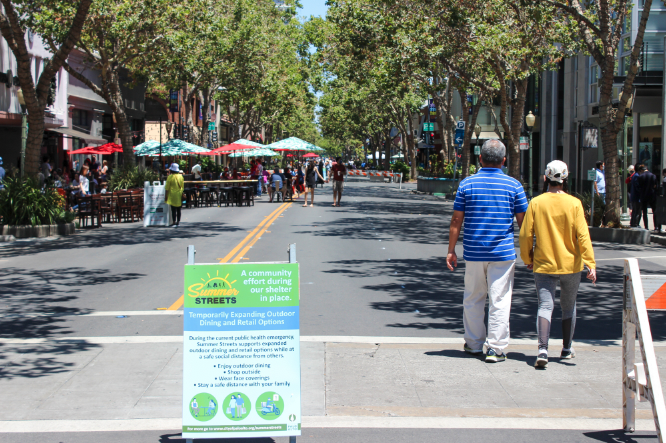
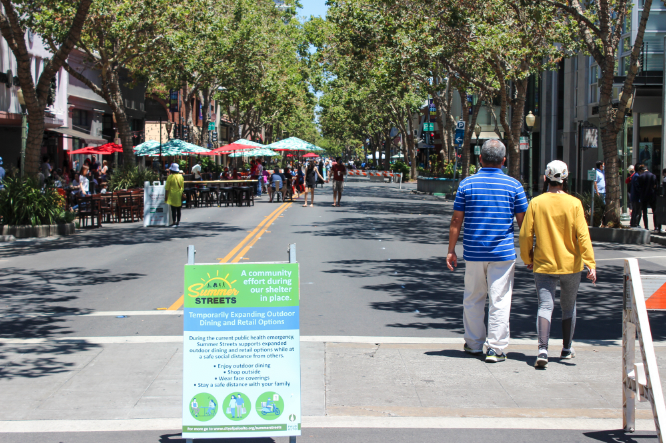
At their August 10 meeting, City Council approved the extension of the Summer Streets program to December 31, 2020, and pushed the expiration of the temporary parklet program to September 7, 2021, continuing the temporary program seeking to support local businesses by offering safe outdoor dining and retail experiences for the community to enjoy. Also, City Council approved additional uses of outdoor spaces such as gyms and personal services. Businesses will need to fill out an application and comply with all County and State guidelines. Summer Streets is just one effort of several underway to help local businesses during this difficult time. Learn more at cityofpaloalto.org/SummerStreets. With this new extension, the Summer Streets program will have to go through a “renaming.” Have any ideas? Send them our way by replying to this email.

There are many ways to enjoy summer, tell your story, and support our local seniors! Today’s resources include a great community program from our library, a national storytelling project, and outdoor and at-home fun!

Supporting our Seniors: Our Library’s Book to Action program continues this month! Here are some resources for reaching out to local seniors who may be suffering from isolation and ways to connect with them. The Library’s Letters of Love program is going on through August 24. For more information on this program, visit here and click the Service Project Guide link. You can drop off your letters at the Rinconada and or Mitchell Park Libraries during Sidewalk Service hours Monday through Friday.

spot_img

Business resource center in Palo Alto

Summer Streets continues with partial closure of Ramona St, starting August 7


compiled by the El Reportero staff


The Summer Streets program is designed to be a nimble and flexible initiative to evolve with the public health emergency and support both our community and local businesses.

Our Business Assistance Center has up to date information for businesses that continue to operate and for those businesses that are closed and experiencing hardship during the shelter in place order. If you are a restaurant or retail business that would like to provide outdoor dining or shopping experiences, please learn more on our Summer Streets for Business page.

Thought Leaders: Stanford’s eCorner Entrepreneurial Thought Leaders series features Kevin Weil, VP of Product at Novi Wednesday, Aug. 5 at 4:30 p.m. Join virtually as they bring founders, investors, and industry influencers to center stage and invite them to share what it takes to become a disruptor.

Grants for Artists and Cultural Practitioners: The California Relief Fund for Artists and Cultural Practitioners is distributing $920,000 from the CAC’s general fund in the form of $1,000 grants to help artists and cultural practitioners (including fine and performing artists, teaching artists, culture bearers, and maker-based sole or collective creative entrepreneurs) who comprise the various and diverse cultural communities of the state of California. The application cycle closes Tuesday, Aug. 18 at 3 p.m.

Coffee & Community: Join the Renaissance Women’s Business Center for “Coffee & Community,” a space for entrepreneurs to share stories of resiliency, strength, and support during these challenging times. Be prepared for an interactive morning with fellow entrepreneurs and the Renaissance team. Bring a cup of coffee or tea, and join the group on Wednesday, Aug. 12, 2020, from 9:30 a.m. to 11 a.m.


Best of the fest season finale – Michael Franti, Los Lobos, and more

Headline One-Hour Special Broadcast On KPIX-TV


SAN FRANCISCO, CA (July 29, 2020)—Stern Grove Festival celebrates the conclusion of their 83rd season with a one-hour special featuring exclusive, newly-recorded performances from Michael Franti, Los Lobos, Ben Gibbard, Bebel Gilberto, Fantastic Negrito featuring Tarriona “Tank” Ball, ALO and Con Brio. The Best of the Fest finale, hosted by TV and radio personality and season emcee Liam Mayclem,

The Festival created Best of the Fest in response to the COVID-19 pandemic and the moratorium on large gatherings. The nine-week series of video playlists, featuring performances and historic footage from its archives, began on Sunday, June 14, and has garnered a significant audience on KPIX-TV and its sister station KBCW 44/Cable 12.

It will be televised on KPIX-TV/CBS on Sunday, Aug. 16 at 4 p.m., and simultaneously on the Festival’s Facebook page, where Mayclem will host a Watch Party.


Some SF libraries expected to start servicing its clients

The City Librarian, Michael Lambert, is planning the first reopening of the Main Library and the Excelsior Branch to curbside service a local news source reported.

Named SFPL To Go, the program will allow pick up and return of pre-ordered books and materials. The exact dates of reopening will be announced soon and we will let you know the details at once. Please continue to check our home page at FriendsSFPL.org.


Save the Dates: D1, D7, & D11 Board of Supervisors Candidate Forums

Save the dates for our upcoming D1, D7, & D11 San Francisco Board of Supervisors Candidate Forums. In our LWVSF hosted online forums, candidates for Board of Supervisors will answer questions submitted in advance about issues important to San Francisco voters:

– District 1: Thursday, September 17, 7-8:30 p.m.

– District 7: Wednesday, September 23, 7-8:30 p.m.

– District 11: Wednesday, September 30, 7-8:30 p.m.

– Registration is required; Zoom details will be emailed prior to the forum. Please register and share with your friends, family, colleagues, and online communities by forwarding this email or sharing the event on Facebook! Register here: https://lwvsf.org/candidate-information.


spot_img

Cuban regime wants to take rapper Maykel Osorbo custody of his daughter

by the El Reportero‘s news services


The threat to opponents of depriving them of parental authority over their children has been a common practice of the political police for many years, but it has rarely been carried out, says a report by ADN Cuba.

An Interior Ministry official threatened rapper Maykel Osorbo and his partner Rosmelis Hernández to strip them of the custody of their 4-year-old daughter, Jade de la Caridad.

Hernández was summoned to the Old Havana police station, located at the intersection of Cuba and Chacón streets, to alert her to the education she is providing her little girl.

“I was not allowed to enter the interview, even though I was the girl’s father. However, I could see that there were many State Security agents inside the police unit, ”the rapper told Radio Televisión Martí.

“Rosmelis was received by a Major [of the Department] of Minors of Old Havana who told her about the upbringing that we are giving to our daughter. They told her that the girl is starting school in the next academic year (…), that we are not teaching her the real concepts of the Revolution and that this was going to create a disorder in her behavior.

“And that is why, at any time, they could take away the custody of the girl, who will analyze whether the state is raising her or her grandmother is raising, which they will determine,” said the rapper.

A day earlier, the same unit had been summoned to the same unit by Felicia Hernández, Rosmelis’s mother, to order her to expel Osorbo from her home, because, according to what they alleged, he is “an anti-social element.”


Film by Cuban Edesio Alejandro wins new award

Jul 29 – The film Mambo Man, by Cuban musician Edesio Alejandro and British-Iranian film-maker Mo Fini, received today a new award after being chosen as the Best Feature Film of the season at Best Global Shorts festival.

With this prize this film increased to 15 the awards won, including Best Director and Best Fiction Film at the Festigious International Film Festival; Best Feature Film at the Florence Film Awards; and Best Foreign Film at the Moody Crab Film in India.

‘And today we reached 15 awards, […], I am very happy, congratulations to all my Mambo Man team, these awards belong to us all, […], all of you are indispensable, thanks to all,’ Edesio Alejandro wrote on Facebook

This independent film, shot in locations of the eastern region of Cuba, was produced by Tumi Music, a British company that has recorded Cuban traditional musicians for years.

The film is starred by renowned Cuban actor Héctor Noas, with the special feature of musicians Cándido Fabré, María Ochoa, Arturo Jorge, David Álvarez, and Julio Montoro.


Selena tribute during Premios Juventud 2020

Premios Juventud 2020 is officially 10 days away and today (Aug. 3), Billboard exclusively reveals more exciting news.

As part of the forthcoming 17th annual awards show, Univision announced that a special segment, honoring 25 years of Selena Quintanilla’s music and legacy, will air during the star-studded event.

Her brother and producer of her biggest hits, A.B. Quintanilla III, as well as Karol G, Natti Natasha, Danna Paola, Ally Brooke and Greeicy, will participate in the motivating special.

“For me being part of this special was a real honor. She is a woman that after all these years, and everything that has happened, is a legend. I never hard the chance to meet her while she was here but she is an icon, an icon that lasts a lifetime,” Greeicy tells Billboard.

“How amazing is it that she has inspired so many with her music. It was very challenging for me to create the energy and portray her flavors of cumbia. It was a beautifully difficult challenge and it was very special because I learned from her music and I’m going to keep enjoying it with respect and I hope to honor her. To have the privilege to prepare this special with her brother, who knew her, lived with her, and spent her life with her, is very special. It was a hard challenge for me because I felt like I was speaking directly to her. The special is going to be really great, it was beautiful to be able to create it with him, he was wonderful to work with,” she adds.

spot_img

Is racism responsible for today’s Black problems?

by Walter E. Williams


I doubt whether any American would defend the police treatment of George Floyd that led to his death. But many Americans are supporting some of the responses to Floyd’s death — rioting, looting, wanton property destruction, assaults on police and other kinds of mayhem by both whites and blacks.

The pretense is that police conduct stands as the root of black problems. According to the NAACP, from 1882-1968, there were 3,446 black people lynched at the hands of whites. Today, being murdered by whites or policemen should be the least of black worries. In recent times, there is an average of 9,252 black-on-black murders every year. Over the past 35 years, that translates into nearly 324,000 blacks murdered at the hands of other blacks. Only a tiny percentage of blacks are killed by police.

For example, in Chicago this year, there were 414 homicides, with a total of 2,078 people shot. So far in 2020, three people have been killed by police and four were shot. Manhattan Institute scholar Heather Mac Donald reports that “a police officer is 18 1/2 times more likely to be killed by a black male than an unarmed black male is to be killed by a police officer.” Crime is a major problem for many black communities, but how much of it can be attributed to causes such as institutional racism, systemic racism and white privilege?

The most devastating problem is the very weak black family structure. Less than a third of black children live in two-parent households and illegitimacy stands at 75 percent. The “legacy of slavery” is often blamed. Such an explanation turns out to be sheer nonsense when one examines black history. Even during slavery, where marriage was forbidden, most black children lived in biological two-parent families.

Professor Herbert G. Gutman’s research in “The Black Family in Slavery and Freedom 1750-1925” found that in three-fourths of 19th-century slave families, all the children had the same mother and father. In New York City, in 1925, 85 percent of black households were two-parent. In fact, “Five in six children under the age of six lived with both parents.” During slavery and as late as 1920, a black teenage girl raising a child without a man present was a rarity.

An 1880 study of family structure in Philadelphia shows that three-quarters of all black families were nuclear families. There were only slight differences in family structure between racial groups. The percentages of nuclear families were: black (75.2 percent), Irish (82.2 percent), German (84.5 percent) and native white Americans (73.1 percent). Only one-quarter of black families were female-headed. Female-headed families among Irish, German and native white Americans averaged 11 percent. According to the 1938 Encyclopaedia of the Social Sciences, only 11 percent of black children and 3 percent of white children were born to unwed mothers.

As Thomas Sowell reported: “Going back a hundred years, when blacks were just one generation out of slavery, we find that census data of that era showed that a slightly higher percentage of black adults had married than white adults. This fact remained true in every census from 1890 to 1940.”

The absence of a father in the home predisposes children, especially boys, to academic failure, criminal behavior and economic hardship, not to mention an intergenerational repeating of handicaps. If today’s weak family structure is a legacy of slavery, then the people who make such a claim must tell us how it has managed to skip nearly five generations to have an effect.

There are problems such as grossly poor education, economic stagnation and poverty that impact the black community heavily.

I would like someone to explain how tearing down statues of Christopher Columbus, Thomas Jefferson and Confederate generals help the black cause. Destruction of symbols of American history might help relieve the frustrations of all those white college students and their professors frustrated by the 2016 election of President Donald Trump. Problems that black people face give white leftists cover for their anti-American agenda.

Walter E. Williams is a professor of economics at George Mason University. To find out more about Walter E. Williams and read features by other Creators Syndicate writers and cartoonists, visit the Creators Syndicate webpage at www.creators.com.

spot_img

Rejoice! The Agora is growing!

EDITOR’S NOTE

Dear readers:

Did you know that if you don’t follow the state’s orders to obey everything they say – during this so-called epidemic, regardless of whether it goes against your own freedoms guaranteed by the Constitution and God, you are working against the state economy? So you are a criminal in thought, as described by investigative journalist James Corbett, in the following article, which I hope you fully enjoy and learn something new from it. – Marvin Ramírez


by James Corbett

August 1, 2020


Have you entered a store without the mandated mask affixed to your face?

Visited a friend in violation of a lockdown order?

Frequented a New York bar that didn’t offer “substantive” food to go with your beer?

Congratulations! You’re a thought criminal!

And here’s the best part: There are more thought criminals being born every day!

What am I talking about? The counter-economy, that’s what!

As you’ll no doubt remember from my previous writing on the subject, counter-economics is not what the Pentagon does to cook its books each year. No, it’s both an idea and a practice that was pioneered by Samuel Edward Konkin III, everyone’s second favourite Canadian emigre anarchist.

In An Agorist Primer, Konkin explains that “All (non-coercive) human action committed in defiance of the State constitutes the Counter-Economy.” That’s a deceptively simple definition, so let’s tease out some of the nuance here:

  • “Non-coercive” is important because murder, theft, assault, fraud, extortion and other forms of coercion are not part of the counter-economy, but, as Konkin notes, are simply “other forms of statism.”
  • “Human action” is important because, as Konkin was at pains to stress, counter-economics is not a dry, dusty theory to be discussed in a philosophy classroom, but an idea that can only be realized in practice.
  • And “in defiance of the State” is important because the purpose of counter-economics is to undermine, and, eventually, shrink the state out of existence.

So, you walk into a store without a mask in defiance of your city’s ordinances? Congratulations! You’re a practicing counter-economist.

You pay a barber under the table to cut your hair despite lockdown orders to the contrary? Congratulations! You’re a practicing counter-economist.

You’re a business owner who fails to implement the government-mandated physical distancing and disinfection standards in your workplace? Congratulations! You’re a practicing counter-economist.

Now, this idea could be extended to the point of inanity. Yes, you could technically be a counter-economist if you drive 51 km/h in a 50 km/h zone, but such action is less likely to be an attempt to undermine the authority of the state and more likely to be an attempt to get to a dental appointment on time.

A key part of counter-economics is that this “human action committed in defiance of the state” is consciously directed action. Its purpose is to defy the state, or to carve out a space for people to interact and transact with each other in ways that defy the state’s edicts. This space—the truly free market, unfettered by concern for the state and its mandates—is the agora. Derived from the Greek word for the marketplace, the agora is the space where counter-economic activity flourishes. (But you already knew that, right?)

As Konkin puts it: “The goal is living in the agora and the path is expanding Counter-Economics.”

It should now be apparent how applicable these ideas are to our current situation.

Take the recent demonstration in Berlin. Depending on which source you rely on, there were thousands or hundreds of thousands of Germans that just took to the streets of Berlin to protest the stifling coronavirus restrictions in their country. But this wasn’t just a protest, it was human action in defiance of the state. Note well: These Germans didn’t protest these restrictions by writing scholarly papers on the situation or starting an online petition. They physically took to the streets in defiance of the very orders they were opposing. That is counter-economics in action.

Or take the recent action by Defending Utah, a liberty-minded organization based in Utah. To protest local face mask ordinances they began a regular Thursday event whereby interested members would be texted the location of a particular grocery store and a particular time. At the appointed time, members of the group would all enter the store without masks. They can’t be stopped on their way in because there are simply too many of them, and they can’t be ignored by the establishment mouthpiece media, who have to resort to smearing them instead. That is counter-economics in action.

There are plenty of other examples. Like the Texas salon owner who cut hair in defiance of lockdown orders and who chose jail time rather than make a court-ordered statement that she was wrong and selfish. Or the New Jersey businessmen who were thrown in jail for refusing to shut down their gym despite statewide shutdown orders.

You see? This whole COVID-1984 phenomenon is giving plenty of otherwise ordinary, obedient tax cattle the chance to become counter-economists. It is growing the agora.

But it needs to be restated: All of these counter-economic activities that are happening as a natural response to the lockdowns and restrictions mean nothing if they are not consciously directed counter-economic activity. If people are not aware of the importance of their decisions, if they don’t understand why we must expand the agora and broaden popular support for unsanctioned activities, then they will be easily led back into the system at the first convenient on-ramp.

If the state slackens the rules here or creates some leeway there, then people will—as usual—take the path of least resistance.

“Sure, we could form trading communities outside of the purview of the state. We could begin building up alternative currencies, supporting local businesses, disconnecting ourselves from the Big Brother enslavement grid . . . but that seems like a lot of work. And what if we get caught? What if we face resistance? What if we get a bad social credit score! No, much safer to just sign up for our new Digital Dollar account with the Fed and receive our monthly UBI payment. Of course, it means we’ll have to roll up our sleeve for the coronavirus vaccine and keep our COVI-PASS app up to date, but what’s the harm in that? At least we’ll be taken care of!”

It’s impossible to argue that the counter-economic path is going to be an easy one, because it’s not. But for those who care about human freedom, it’s the only path. And, as the technology of control available to the state increases in sophistication—from brain chips to 5G to gene editing—the agorist path becomes even more important. It is not exaggeration to say that there will be no humanity as we’ve known it by the end of this century if the would-be societal controllers get their way.

The choice of whether or not we grow the agora is quickly becoming an existential one.

In the end that choice is ours to make, but we better make it quickly. Are we counter-economists committed to growing the agora and ending the state? Or are we merely tax cattle to be slaughtered when the state deems us to be sufficiently fattened?

spot_img

Need more potassium? Here are 9 potassium-rich foods to add to your diet

by Virgilio Marin


Potassium is important for many bodily functions. The essential mineral, for instance, plays a vital role in muscle contraction. Multiple studies have also found that consuming more potassium can lower a person’s risk of stroke.

But if the body has low levels of potassium, it can lead to hypokalemia, a condition marked by muscle cramps, weakness and irregular heartbeat.

Nine excellent dietary sources of potassium

The U.S. Department of Agriculture recommends eating 4.7 grams of potassium a day for adults. Knowing which foods are great sources of potassium is a must to get your fill for the day. It’s a well-known fact that bananas are rich in potassium, but here are some other potassium-rich foods to spark up your palate.

1. Potatoes

A medium-sized potato contains about 941 mg of potassium, which is twice as much than a medium-sized banana’s 422 mg. In fact, sweet, red and white potatoes are all excellent sources of potassium.

Baking is the best way to prepare potatoes but leave the skin on, as it contains much of their potassium content. Wash the vegetables properly before cooking.

French fries, despite being made with potatoes, aren’t a healthy source of the mineral. They are fried, so they have added fat from the oil. Furthermore, they are typically peppered with salt, which can offset the benefits of potassium.

2. Leafy greens

Swiss chard, amaranth leaves and cooked spinach are particularly packed with potassium. A cup of each provides more than 800 to 900 mg of the mineral. Furthermore, leafy greens have additional benefits on the brain. A study found that a serving a day of leafy greens may slow age-related cognitive decline. (Related: Ten reasons why leafy greens are the power players on any plate.)

3. Prune juice

Prune juice is packed with with 707 mg of potassium. And because it is also rich in fiber, prunes, or dried plums, can also be used to relieve constipation.

4. Tomato puree, juice and paste

Tomatoes can also offer potassium in addition to lycopene. Tomato puree, juice and paste are more concentrated than the fresh fruit, and are used in several recipes. Tomato paste, in particular, contains 669 mg of potassium per 1/4 cup.

5. Dried apricots and raisins

These two dried fruits are not only delicious but also high in potassium. Dried apricots have more than 1,000 mg of potassium per half a cup, and raisins have 618 mg for the same serving. These two fruits abound in the market, but the healthiest ones are those with no added sugar, coatings or other ingredients.

6. Beans

Many beans offer potassium, but three of the best sources are adzuki beans, kidney beans and soybeans. They also contain a good amount of fiber, making them beneficial for gut health.

7. Lentils

Lentils are a small, round legume with a lot of fiber and protein. And a cup of cooked lentils also has 731 mg of potassium.

Lentils can be bought fresh or in a can. While canned lentils can still offer the mineral, consider rinsing them properly to get rid of the sodium. (Related: Heart-healthy lentil salad: Easy to make and nutrient-dense.)

8. Fruit juices

Fruits are known for being nutrient-dense, meaning they pack in a host of vitamins, minerals and powerful compounds. The following fruit juices, in particular, are high in potassium:

Passionfruit juice: 687 mg

Pomegranate juice: 533 mg

Fresh orange juice: 496 mg

Fresh tangerine juice: 440 mg

9. Milk and yogurt

Dairy products are best known as a calcium-rich food. But they also offer other nutrients such as potassium. In fact, studies suggest that milk is the number one source of potassium among American adults. That’s because a cup of milk has about 366 mg of the mineral. Meanwhile, a cup of plain non-fat yogurt has as much as 579 mg.

Tea and coffee also offer potassium but in lower amounts. Adding creamers or milk, however, can boost their potassium content.

As the list demonstrates, bananas are not the only sources of potassium. A lot of foods also provide the nutrient, aside from the many more vitamins and minerals they each have to offer. Consider increasing your palate diversity. Not only will variety make for a scrumptious meal, but it also gives a wide array of health benefits.

Get to know more healthy foods and the nutrients they offer at Nutrients.news.

Sources include:

LiveScience.com

MedicalNewsToday.com

EverydayHealth.com

Health.gov

spot_img

COVID-19: How to return to school in the midst of the pandemic?

Experts assure that the most vulnerable students must be cared for before implementing formulas that increase the digital divide. School districts are being forced to reopen without any guidance from the federal government


by Jenny Manrique


In East Orosi, a community of about 200 families in the Central Valley of California, children have been thinking for 10 years that water comes naturally from a bottle. There they depend on the distribution of the precious bottled liquid for bathing, cooking and other cleaning uses. They do not know what drinking water coming out from a tap is (even if they pay for the service), much less what is broadband internet access.

These brutal inequities are the main challenge when thinking of a safe and equal model to return to school this semester, in the midst of the COVID-19 pandemic. According to Eddie Valero, supervisor of District 4 of the Tulare County Board of Supervisors in California, which covers East Orosi, it is impossible to think about distance learning with equity if you don’t start by looking at what communities, mostly Latino and traditionally neglected, they need.

“We must model our classes with the most struggling students as a priority in these poor and underserved neighborhoods. And from there, look up to those who have the most access,” said Valero, who spoke at a press conference organized via zoom by Ethnic Media Services.

The supervisor said that in the communities he serves there are no community centers where children can go to study, and that many already had learning deficiencies before the pandemic. In these places, access to smartphones, computers, or private tutors is a mere illusion. According to the National Center for Education Statistics (NCES), there are 11 million children in the country who do not have access to laptops or the internet at home.

“We must continue to pressure our legislators at both the state and federal levels on ways to rectify our mistakes … We need to reimagine what the schools of the future will be like.”

Valero was optimistic with two bills currently in the Senate and Assembly in California that could have a massive impact on equitable access to technology, one of the main pillars of distance education.

One is Assemblywoman Cecilia Aguiar-Curry’s AB-570, which would authorize schools to ask the Department of Education for the necessary computing devices and Internet connectivity suitable for home learning, prioritizing the poorest neighborhoods.

The other is Senator Lena González’s SB1130, which seeks that the Public Services Commission approve funds for infrastructure projects that allow all households considered to be “high poverty” no later than December 2024 to have access to band internet. Wide at speeds of a minimum of 25 megabytes per second.

The Cutler-Orosi School District – also in the Valero jurisdiction – began by distributing Chromebooks and Ipads to all students in grades kindergarten through 12. And it is the intention of the Supervisor to involve county libraries and the Department of Parks and Recreation “In the search for solutions to use our libraries and parks more effectively in times of social distancing.”

Districts forced to improvise

The problems of the so-called digital divide were compounded by the pandemic. Most schools were not prepared to give teachers real guidance on how to use technology or effective forms of instruction for children to study from home. That’s not counting homeless children, those with learning disabilities or those who live in crowded homes where there is no space to study or concentrate.

Although in those situations, parents would like children to return to their traditional educational space, “we are asking districts to reopen (schools) without any guidance or security for staff,” said Pedro Noguera, dean of the Rossier School of Education at the University of Southern California (USC).

“Teacher unions have announced that they will go on strike if forced to work in unsafe conditions … in the absence of federal and state leadership, districts are improvising on their own how to return to school,” said Noguera, who He recalled that in countries like Israel, the early opening of schools has caused the outbreak of the virus.

“We have to put pressure on technology giants like Facebook and Amazon, which have accumulated huge profits during the pandemic … they have a moral responsibility to assist technologically disadvantaged families,” added Noguera.

Three models of back to school have been discussed in the United States: online teaching in its entirety; a hybrid model that allows a percentage of the school population to be brought to the classroom at a safe distance of 6 feet some days of the week, while the rest remain at home; and the return to school without any additional protocol, that is to say as it was done in the past.

“At the beginning of this process (March-April) there were many states in the south of the country, such as Flori-da Georgia, Alabama, Arizona, Texas, that wanted to do things normally without social distance or masks,” said Dan Domenech, executive director of the Association of Superintendents of Schools, (AASA in English).

“But infection rates have dramatically changed their stance … We have strongly pushed for guidelines from the CDC (Centers for Disease Control and Prevention), but the (Donald Trump) administration believes these principles are contrary to its main objective which is to open the economy”, added Domenech.

AASA has calculated how much it would cost the country to partially reopen schools with sanitation protocols in school spaces, special protection equipment (PPE) for teachers and staff, and bus routes that allow minimizing the number of children in the vehicles. He concluded that this cost is $490 per student, which is why he is asking Congress to approve a budget of $ 200 billion.

“The solution is for the federal government to put the money in, but since it’s going into recession in the summer now, it’s impossible to know when those funds will be available,” said Domenech.

(This article was cut due to lack of space).

spot_img