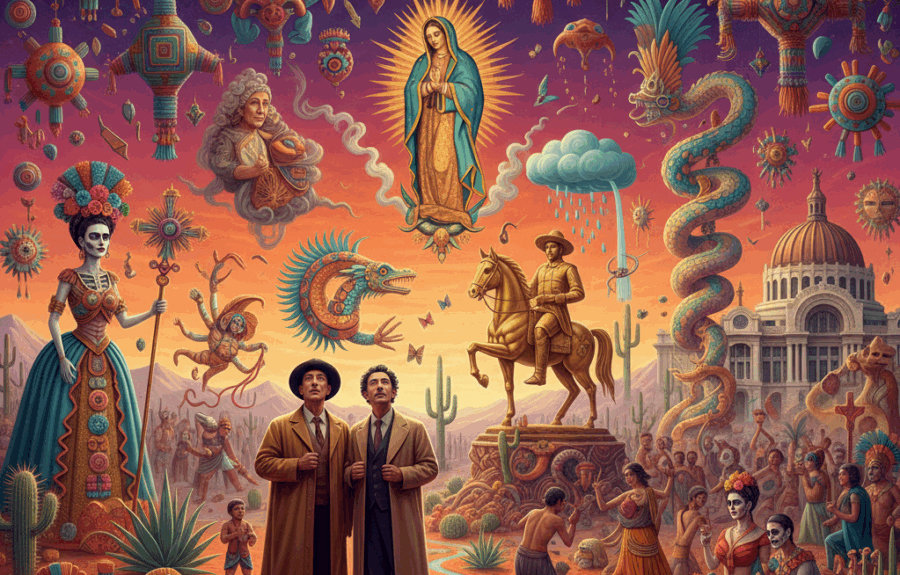
Is Mexico the most surreal country? We find out what Breton and Salvador Dalí meant with their statements about our culture.
by Mexico Desconocido
Nowadays, it’s common to hear, especially when commenting on something bizarre politically or socially, that Mexico is a surreal country. It’s even common to hear people quote Salvador Dalí, one of the greatest exponents of surrealism, who said: “I will never return to Mexico; I can’t stand being in a country more surreal than my paintings.” This is more of a rumored quote than a documented one, which also had a precedent: André Breton’s declaration of Mexico as “the most surreal country in the world.”
Salvador Dalí was one of the most important artists associated with surrealism, a European cultural movement that emerged after the First World War. Born in Figueres, Spain, in 1904, he is mainly remembered for his pictorial legacy. However, he also did creative work in sculpture, set design, and literature.
For his part, André Breton is considered the father of surrealism and visited Mexico on April 18, 1938. During his four-month stay, he traveled through Nuevo León, Michoacán, Jalisco, and Mexico City. According to the INBAL (National Institute of Fine Arts), “it was in the country’s capital where, in the company of Diego Rivera, he visited the National Autonomous University of Mexico and attended various exhibitions. As a guest of Rivera and Frida Kahlo, he met Leon Trotsky at the Blue House.”
What is surrealism?
The word surrealism was coined by Guillaume Apollinaire in 1917, but it was not used with its current connotations until 1924, when André Breton defined it in the Surrealist Manifesto, which reads as follows:
“Surrealism: «noun, masculine. Pure psychic automatism, by which one intends to express, verbally, in writing, or in any other way, the real functioning of thought. It is a dictation of thought, without the regulating intervention of reason, free from all aesthetic or moral concerns.”
Philosophy: «Surrealism is based on the belief in a superior reality of certain forms of association previously disregarded, and in the free exercise of thought. It tends to definitively destroy all other psychic mechanisms, and to replace them with the resolution of the main problems of life.»
The surreal is not limited by morality or aesthetic canons; it is as free as dreams
That is, surrealism aims for a lack of mediation between the ideas of the creative genius and the final work, thus suggesting complete freedom without appealing to social norms to translate what is dreamt into art or literature. Therefore, surrealism takes on dreamlike qualities, because just as images appear freely when one dreams, without this implying any choice on the part of the dreamer, so the surrealist artist aspires to translate their psychic material into works. Regarding these images, Breton mentions:
Surrealist images, like those produced by opium, are not voluntarily evoked by man, but “present themselves to him in a spontaneous and despotic way. He cannot dismiss them because the will no longer has power or governs the mental faculties.”
Why is Mexico the most surrealist country?
Due to the above, we can conclude that Mexico is considered a surrealist country because of the freedom and spontaneity of its cultural and social expressions; some of them dissimilar and eclectic, in the same way that it is possible to mix diverse unrelated elements in a dream. The above does not mean that our country is bizarre, but rather that its richness is diverse and does not conform to moral or aesthetic patterns; it simply is, a product of its historical processes. In short, Mexico is a dream.
On the other hand, we can also refer to the statements of Ricardo Echávarri, director of the Center for Surrealist Studies in Mexico City:
“We were fortunate that very important authors arrived in our country, such as André Breton and Antonin Artaud, and then some of them stayed to live permanently, such as Leonora Carrington, Remedios Varo, and Kati Horna. This gave Mexico a particular character, as it served as a refuge for many surrealist writers and painters who migrated due to the events of the Second World War. Thus, through these twists of fate, it became the quintessential surrealist country.”