by México Desconocido
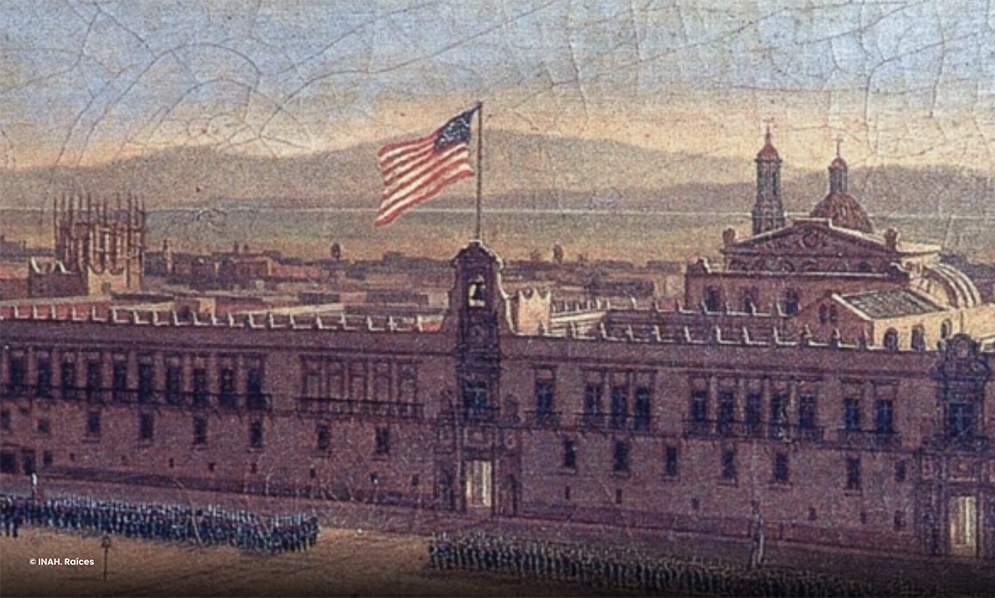
The U.S. invasion of Mexico and the war fought from 1846 to 1848 remains an episode of tragic memory. In addition to the subsequent loss of half the national territory, the disasters caused by the conflagration in defense of the Republic were extensive. After the Battle of Chapultepec Castle on September 13, 1847, the American army took Mexico City. The next day, when the U.S. flag was raised at the National Palace, a massive popular revolt broke out, seeking to resist the arrogant invaders.
The night of September 13–14: terror and uncertainty
After the fall of Chapultepec Castle on September 13, 1847, and with the imminent entry of American troops into Mexico City, Antonio López de Santa Anna decided to evacuate the capital. He and what remained of his forces abandoned the city, heading toward Querétaro.
The situation in the city was one of sheer panic. During the night of September 13–14, the streets of the capital were plunged into total darkness. The sound of gunfire and cannon shots from isolated skirmishes still echoed. The city council authorities met in Tacubaya with General Winfield Scott, leader of the U.S. troops. Their purpose was to guarantee the safety of the population and to lodge a strong protest, making clear that although Mexico City was being captured, it never willingly intended to submit to the invaders.
The American entry: the U.S. flag at the National Palace and the beginning of the popular revolt
By 7 a.m. on September 14, 1847, the 10,000-strong U.S. army was gradually entering the streets of Mexico City. This sight shocked the inhabitants of the capital of the Republic. To make matters worse, stragglers and deserters from the Mexican army still roamed the city. Added to this, the day before, Santa Anna had ordered the release of all prisoners from the city’s jails to foment disorder. The indignation of the citizens grew by the hour. Shouts and insults from the people soon erupted.
Once in the city’s main square—the Zócalo—the American troops, led by General Scott, received control of the capital from the president of the City Council, Mr. Zaldívar. Lieutenant Lovell was charged with raising the U.S. flag at the National Palace. However, at that moment, a shot was heard, apparently from the San Juan de Letrán area, wounding an American officer. This was taken as a signal for combat by the Mexicans, and soon stones and bottles began to rain down on the Americans from the rooftops.
Very soon, armed with knives, sabers, machetes, sticks, or rifles, citizens, beggars, and Mexican soldiers alike engaged the U.S. forces. As Guillermo Prieto recalled in his chronicle of this episode in Memorias de mis tiempos (1886):
“It is estimated that fifteen thousand men, unarmed, disorganized, and frantic, threw themselves against the invaders, who truly behaved as if they were taking possession of a savage encampment.”
The last resistance against the invaders
At every corner, street, and rooftop of what is now the Historic Center, bloody and terrible fighting broke out. The American troops who had occupied the Zócalo smashed open doors of houses to fight their occupants. Those who strayed too far from their columns were stabbed in the alleys by furious Mexicans. With support from General Gabriel Valencia, a contingent of the National Guard and civilians entrenched themselves in the National Palace, from where they sallied out to fight the invaders.
Meanwhile, Mexican neighbors and soldiers battled the Americans from Alameda Central to Salto del Agua. At the Garita de la Viga, a clash erupted where a Mexican cavalry unit swept through an American cavalry battalion. In what is now Barranca del Muerto, civilians and soldiers ambushed the invaders, leaving a large number of them dead. The revolt grew so intense that General Winfield Scott himself was struck in the head by a stone or flowerpot hurled from a balcony. According to legend, years later the American general admitted:
“I regret having invaded the great country of Mexico, for they fought us to the death.”
The surrender and consequences of the uprising against the raising of the U.S. flag at the National Palace
The street battles in Mexico City raged throughout September 14 and 15, 1847. Despite appeals for peace from the city council authorities, little could be done to stop the fury of citizens and soldiers against the invaders. The fighting reached such extremes that in the very Zócalo, the Americans had to use heavy artillery against the rebellious populace. Peace was only restored on the night of September 15, when the interim president of the Mexican Republic, Manuel de la Peña y Peña, surrendered what remained of the national forces.
The dead numbered in the hundreds. Countless corpses littered the streets of Mexico City. It is estimated that the Americans lost about one thousand men quelling the rebellion. Scott dealt harshly with the prisoners taken in those days: they were executed or flogged in the Plaza Mayor, at the Alameda, and at the Ciudadela.
Why did the last Mexican resistance against the Americans not succeed?
The uprising of citizens, beggars, and soldiers against the Americans might well have triumphed. Although figures are imprecise, the population of Mexico City was vastly larger than the number of invading troops. However, the rebellion failed because of the rejection it suffered from the bureaucracy and the wealthy classes. These groups were horrified at the idea of arming the populace to defend national sovereignty. The possibility that the revolt could become a social revolution was so real that they preferred not to risk their status quo—even if it meant losing half the country. As Guillermo Prieto recalled in Notes for the History of the War Between Mexico and the United States (1848):
“Multitudes of victims on that day shed their blood in the streets and squares of the city. Painful it is to say that this generous effort of the lower classes was, in general, harshly censured by the privileged class of fortune, who looked with indifference on the humiliation of the homeland, so long as they could preserve their interests and their comfort.”