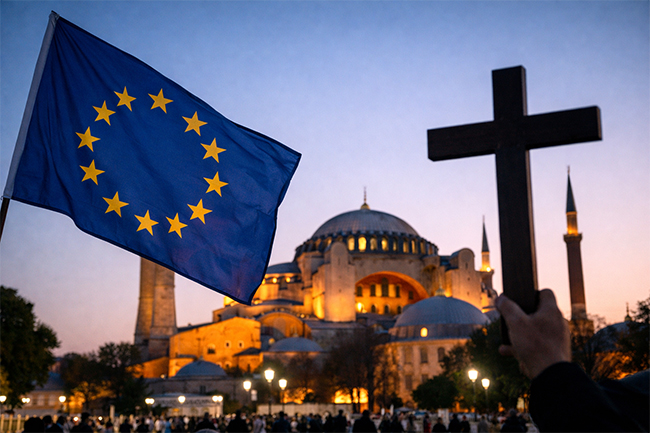
by the El Reportero staff
There are political decisions that, even when presented as acts of “national security,” end up revealing something deeper: power’s fear of difference. The recent resolution adopted by the European Parliament condemning Turkey for expelling Christian missionaries under opaque national security pretexts is not merely a diplomatic statement; it is a wake-up call about the direction taken by a country that sits at the crossroads of East and West, is a NATO member, and claims—at least rhetorically—to aspire to European human rights standards.
That 502 Members of the European Parliament from across the political spectrum voted in favor of the resolution speaks volumes. This is not an ideological maneuver or a religious crusade from Brussels. It is, rather, an acknowledgment that expelling people because of their faith—without public evidence, without due process, and without clear avenues for appeal—is incompatible with the basic principles of religious freedom and the rule of law that Turkey claims to uphold in its Constitution and in the international treaties it has signed.
The remarks by Dutch MEP Bert-Jan Ruissen capture the paradox at the heart of the issue: preaching a message of peace and reconciliation can turn someone into a “national security threat.” Taken to its logical extreme, that reasoning empties the very concept of security of meaning. When anything that makes those in power uncomfortable is labeled a risk, the line between legitimate state protection and the repression of fundamental freedoms becomes dangerously blurred.
The figures documented by ADF International are telling: at least 160 foreign Christian workers and their families have been expelled from Turkey or denied re-entry in recent years. These are not isolated incidents or bureaucratic mistakes. Many of those affected had lived in Turkey for decades, built families, and contributed to local communities. Suddenly, they found the door slammed shut without a concrete explanation. There are no public charges, no transparent proceedings, no real opportunity to defend oneself—only a bureaucratic stamp: “national security risk.”
This pattern cannot be understood outside the political climate that followed the failed coup attempt of 2016. Since then, the Turkish government has dramatically expanded the use of anti-terror and internal security laws. Under that umbrella, critics say, authorities have pursued opposition figures, journalists, academics, and civil society organizations. In such an environment, religious minorities—already vulnerable in a predominantly Muslim society—are exposed to arbitrary decisions that rarely face serious domestic scrutiny.
What is troubling is not that a state seeks to protect its security. Every country has that right and responsibility. What is alarming is when “security” becomes a catch-all label to silence inconvenient voices or expel those who do not fit the dominant narrative. Today it is Christian missionaries; tomorrow it could be activists, human rights defenders, or any group perceived as “other” or “suspicious.”
Ankara’s response—dismissing the resolution as “baseless” and insisting that no foreign institution has the right to interfere in its judicial processes—is predictable, but insufficient. National sovereignty is not a blank check to ignore international commitments. Turkey is a member of the Council of Europe and subject to the jurisdiction of the European Court of Human Rights. The fact that at least 20 related cases are currently before that court suggests this is not a misunderstanding, but a practice that violates rights enshrined in conventions Turkey itself has accepted.
It is true that the European Parliament’s resolution is not legally binding. It does not force Turkey to change course overnight. But resolutions help shape the political climate. They draw lines in the sand. They pave the way for diplomatic pressure, conditionality in cooperation agreements, and broader debates about the relationship between the European Union and Turkey. In a world increasingly cynical about the language of human rights, such gestures still matter.
Beyond the Turkish case, this episode raises an uncomfortable question for all of us: how fragile are our freedoms when the word “security” enters the conversation? The temptation to trade rights for order is not unique to any one country. We have seen it in consolidated democracies and authoritarian regimes alike. That is why defending religious freedom—whether or not we believe in the message others preach—is really about defending something broader: the right to exist without being criminalized for what one believes.
When preaching becomes a “threat,” the problem is not the preacher. The problem is a power that no longer tolerates diversity. And that is always the first symptom of something deeper: a state afraid of its own fragility.
– With reports by Andreas Wailzer from LifeSite.