by Marvin Ramírez
In recent years, the United States has witnessed the rise of a phenomenon many now call “tipflation” — the inflation of tipping expectations. What was once a voluntary gesture of appreciation has increasingly turned into a social obligation, even in situations where little or no service is provided.
Tipping was never meant to function as a hidden tax. Historically, it emerged as a way to reward good service, particularly in industries where workers relied on tips to supplement low wages, such as restaurants, hotels, and transportation. At its core, tipping has always been voluntary — a reflection of satisfaction, not a requirement.
But something has changed.
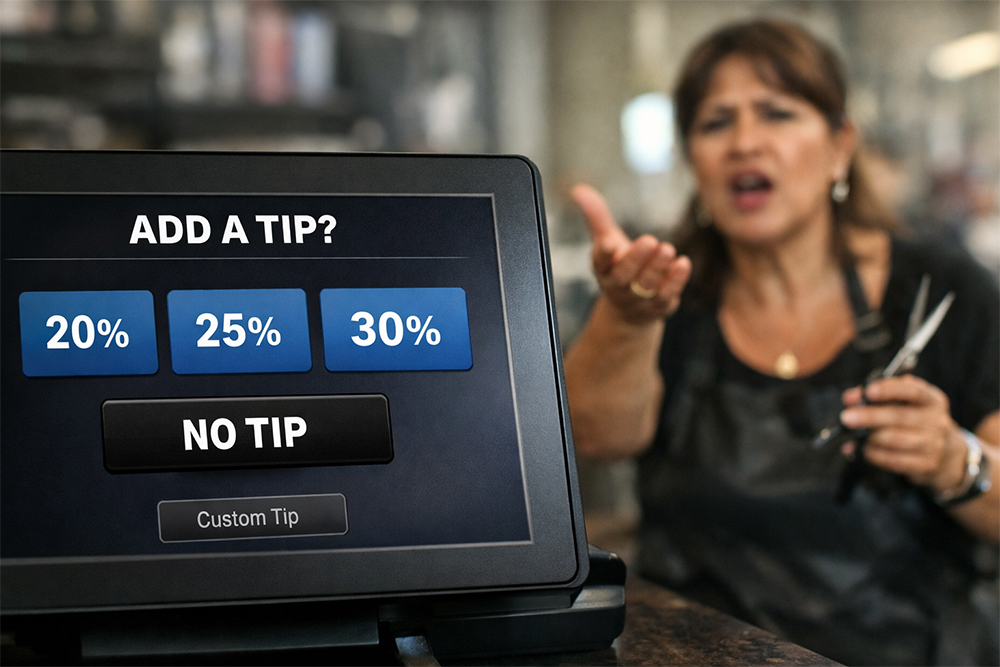
Today, customers are prompted to tip in places where tipping once made little sense: self-service counters, takeout orders, even automated transactions. Digital payment screens often suggest preset tip percentages and require a response before the transaction can be completed. While technically optional, the experience can feel anything but. The subtle pressure of being watched while selecting “no tip” has turned what should be a personal choice into an uncomfortable public decision.
This shift has blurred the line between appreciation and expectation.
I have experienced this shift firsthand over more than two decades with my longtime hairdresser, Tere. For over 20 years, I have sat in her chair, a relationship built on trust, routine, and conversation. I still remember when I stopped going to her briefly many years ago. She reached out and asked me to return. At the time, a haircut cost $10. I agreed — but only after she assured me, clearly and directly, that the price would never increase. “It will always be $10,” she said.
Over the years, however, that promise slowly faded. The price went from $10 to $15, then to $20, and now to $25. That is her right as a business owner. Prices change, and the market evolves. But what has also changed is something else — the expectation that a tip should accompany that fixed price, as if the agreed amount were no longer sufficient.
This is where the problem lies.
When a business sets a price, that price should represent the full value of the service. The customer pays it, and the service is delivered. That is a fair exchange. Tipping, in this context, should remain optional — not assumed, and certainly not demanded or suggested publicly.
The distinction is important. There is a fundamental difference between tipping workers who depend on gratuities to make a living and tipping business owners who set their own prices, control their income, and operate from a position of financial stability. When tipping becomes expected in both cases, the original purpose of the practice is lost.
Even more concerning is when that expectation turns into subtle pressure or public commentary. No customer should feel singled out or judged for choosing not to tip after paying the full price requested. A price is not a suggestion; it is an agreement.
If that price no longer reflects the true cost of doing business, it should be adjusted transparently — not supplemented through implied obligation.
The expansion of tipping into nearly every corner of daily life raises a simple question: where does it end?
Are we expected to tip at every transaction, regardless of the level of service? At what point does appreciation lose its meaning and become a requirement?
Public sentiment suggests that many Americans are already questioning this shift. Surveys show growing frustration and confusion around tipping norms, with a significant number of people believing the practice has gone too far. Some have begun to scale back or refuse tipping altogether in response.
This reaction is understandable.
When a voluntary act becomes expected, it ceases to be voluntary. When gratitude is pressured, it stops being gratitude.
It is time to return to common sense.
Tipping should remain what it was always meant to be: a personal choice, freely given in recognition of truly good service — not a social obligation imposed by default.
And above all, one principle must remain clear:
paying the stated price should never be a source of embarrassment.