by the El Reportero’s staff
In recent decades, the language of crime and justice has undergone profound changes, shaped in large part by social movements and their influence on governments, legal systems, and the press. One of the most striking examples is the rise of the term femicidio or feminicide, a word now present in headlines, courtrooms, and political speeches across Latin America and beyond. This concept has become a rallying point for women’s rights advocates, but it has also generated controversy, particularly when one asks whether such terminology should apply equally when the victims are men.
Strictly speaking, the word femicidio refers to the killing of a woman precisely because she is a woman, within a social context marked by misogyny, discrimination, or systemic violence. It is not a synonym for homicide; rather, it is a recognition of gendered violence, rooted in centuries of cultural and structural inequality. When legislators in countries such as Mexico, Argentina, and Guatemala included “feminicide” in their penal codes, they intended to highlight that these murders were not random but tied to deep societal patterns of male dominance.
The press quickly adopted the term. Today, when a woman is murdered under suspicious or brutal circumstances, newspapers and television anchors often describe it as a femicide even before investigators determine motive. Activists argue this is necessary to pressure authorities who historically ignored or minimized violence against women. For them, naming is an act of justice. By calling it femicide, society acknowledges that women are not merely victims of crime in general but of crimes rooted in patriarchy.
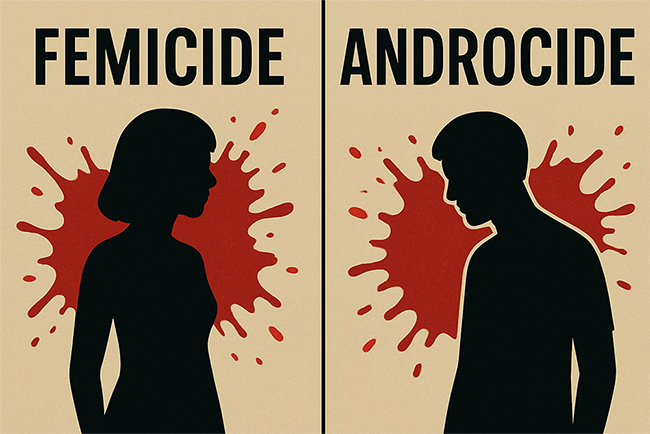
Yet this widespread adoption of femicidio has sparked an inevitable question: what happens when the victim is a man killed because of his gender? Is there an equivalent term? The language exists—academics sometimes speak of androcide (from the Greek andros, meaning man) or masculinicidio. But these words rarely appear in news reports or legislation. Governments have not recognized them in criminal codes. The absence has created a sense of imbalance for critics who argue that equality should apply in both directions.
The debate is not merely semantic. It touches the core of how societies conceptualize violence, gender, and power. Proponents of the term femicide argue that there is a historical asymmetry: women have been subjected to systematic violence for centuries, often unpunished, while men as a group have not suffered the same structural vulnerability. From this perspective, introducing the concept of “masculinicidio” would dilute the urgent need to address violence against women specifically.
On the other side, skeptics contend that violence should be addressed with gender-neutral terminology. Murder is murder, they say, and to create a special category for one gender but not the other risks politicizing justice. For them, the media’s embrace of femicide often feels like advocacy disguised as reporting. They point to cases where headlines proclaim a femicide before the facts are established, reinforcing a narrative rather than respecting journalistic neutrality.
This tension reflects the broader influence of feminist movements in shaping contemporary politics and media discourse. Over the last three decades, women’s rights organizations have become powerful voices in the public sphere, pushing governments to adopt laws, create special prosecutors’ offices, and track statistics on gender violence. The international press, attuned to these shifts, has followed suit, ensuring that femicide remains part of the daily vocabulary. In this sense, the word represents a triumph of activism: it has forced states and societies to confront a reality that was once invisible.
At the same time, critics warn of unintended consequences. They argue that framing violence primarily through a gendered lens risks obscuring other drivers, such as poverty, organized crime, or mental health crises. Moreover, the exclusive focus on women as victims can feed a perception—fair or not—that men’s suffering is less visible or less worthy of unique recognition. When men are killed in acts motivated by misandry, revenge, or gender hatred, the lack of a recognized equivalent term creates an asymmetry that some see as unjust.
The controversy, then, is not about denying the reality of femicide but about whether justice and journalism should employ symmetrical language. If the goal is equality, should not a gender-based killing of a man also carry a name, whether androcide or otherwise? Or does symmetry miss the point, ignoring the historical weight that makes femicide distinct?
What complicates the matter further is that language shapes perception. Once a term is entrenched in legal codes and public discourse, it guides how people interpret events. When the press labels a murder as femicide, it sends a clear message that misogyny is a factor to be considered. The absence of an equivalent for men signals that such considerations are, at least officially, unnecessary in reverse. Whether one views that as progress or imbalance depends largely on one’s political and philosophical stance.
For policymakers and journalists, the challenge lies in balancing recognition of structural gender violence with the commitment to fairness and precision. Governments must ensure that laws do not become tools of ideological favoritism, while the press must resist the temptation to adopt activist language prematurely. At the same time, ignoring the specific realities of violence against women would be a step backward after decades of advocacy and sacrifice.
Ultimately, the debate over femicide and its possible counterparts is a mirror of our societies’ struggles with gender, equality, and justice. It forces us to ask difficult questions: Do we achieve fairness by creating special categories, or by treating all victims under one standard? Is the media advancing awareness, or blurring the line between reporting and activism? And perhaps most importantly, what kind of language will help us confront violence without deepening division?
What is certain is that words matter. The rise of femicidio demonstrates the power of naming to transform public consciousness. Whether or not we eventually recognize terms like androcide, the discussion itself reveals the complex interplay between movements, media, and the state in shaping the narrative of violence in the twenty-first century.