by Marvin Ramírez
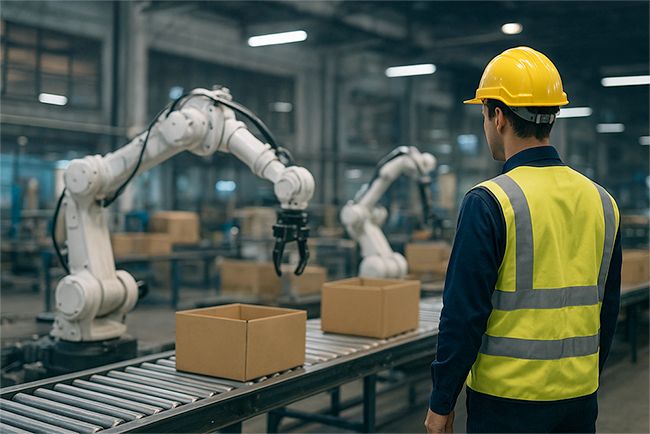
The mass replacements have begun. Amazon recently announced it will eliminate 30,000 management jobs. UPS, according to The Wall Street Journal, is cutting 48,000 positions. Target, General Motors, and other corporate giants are following the same trend — replacing humans with artificial intelligence and automation at a pace few could have imagined just a few years ago.
The public has been told this is “progress,” the natural evolution of technology. But beneath that glossy promise lies a much darker truth — one that raises fundamental questions about the survival of human work, identity, and freedom. The age of AI is not simply a story of innovation; it is also a story of displacement, dependency, and the concentration of power in the hands of a small technocratic elite.
At first, artificial intelligence seemed like a tool to make life easier — digital assistants, chatbots, self-driving cars, and algorithms that could recommend what to watch or buy. But now it is something far more pervasive. Every job sector, from logistics to journalism, healthcare, and education, is being quietly restructured around machines that never sleep, never demand a raise, and never unionize.
In the name of “efficiency,” companies are dismantling entire layers of human management. AI systems now schedule workers, evaluate their performance, and even decide who gets fired. White-collar workers who once believed they were safe from automation are discovering that AI can do their jobs faster and cheaper.
Meanwhile, millions of people who lost their jobs during and after the pandemic are now talking to AI chatbots — like ChatGPT — not only for work support but for emotional comfort. They are seeking advice, consolation, and even friendship from algorithms that simulate empathy but have no soul. Psychologists are warning about what some are calling “AI psychosis,” a condition in which users become trapped in obsessive digital relationships with machines, losing their sense of reality and human connection.
We are entering a dangerous psychological and social experiment, one never approved by the public. The same corporations that are replacing human workers are also offering digital “companionship” to the unemployed and lonely — creating a feedback loop of dependence that benefits the very forces responsible for their suffering.
Bit by bit, we are being enclosed in a digital bubble. Many people, especially the younger generation, believe this is normal — that learning to coexist with AI is simply “the future.” But few understand the economic and political dimensions behind this transformation. The so-called “Fourth Industrial Revolution,” promoted by institutions like the World Economic Forum, envisions a world where every human action is tracked, analyzed, and managed through digital systems — a form of technocratic governance that could erase the last remnants of personal freedom.
And it’s not just the office jobs that are disappearing. Automation is advancing rapidly in agriculture, transportation, and retail. Robots can already plant seeds, harvest crops, pack goods, and deliver them to your door. Self-driving taxis are being tested in major cities. In a few years, we may see planes flown almost entirely by AI. What happens then to the millions of drivers, pilots, cashiers, and factory workers whose livelihoods vanish overnight?
Some policymakers claim that “universal basic income” will solve the problem — that governments will simply pay citizens a small monthly stipend once the jobs are gone. But this idea, while seductive, carries its own risks. If your survival depends on a digital payment controlled by the state, your freedom to dissent evaporates. What happens if your political opinions, or even your social behavior, are deemed “inappropriate”? A digital system can cut off your access to money instantly.
The disappearance of physical cash, already being pushed in some countries, could mark the final stage of this transition. A cashless world means every transaction is traceable, every purchase monitored, every citizen categorized by algorithms. It would be the end of anonymity — and with it, the end of true liberty.
Behind all this technological upheaval, there is an uncomfortable question few dare to ask: Who benefits from replacing humanity with machines? The rhetoric of “innovation” hides an economic reality — automation increases profits for shareholders and consolidates control among global corporations while leaving millions of people disposable. Some thinkers warn that what is emerging is not a future of abundance but one of managed scarcity, where a small elite controls the means of production — and, by extension, the rest of society.
So, what can be done to save ourselves from this accelerating transformation?
First, we must resist blind acceptance of AI as inevitable. Technology should serve humanity, not the other way around. Governments must enforce laws that protect human labor, demand transparency from corporations using AI, and ensure that technology complements — rather than replaces — human intelligence.
Second, society must revive the value of human connection and creativity. Education should focus less on teaching people to adapt to machines and more on nurturing what machines can never replicate — empathy, ethics, and the imagination that drives real progress.
Finally, we need to reassert the principle of human sovereignty in the digital age. That means preserving physical money, protecting privacy, and ensuring that no government or corporation can control individuals through data or algorithms.
The dark side of AI is not only about job loss — it is about the redefinition of what it means to be human. The choice before us is stark: either we become passive spectators in a machine-run world, or we reclaim our right to shape the future on our own terms. The time to decide is now, before the last human switch is turned off.